


Blog Categories
- African Incidents
- Atlantis Incidents
- Australian Incidents
- Belgian Incidents
- Bermuda Triangle Incidents
- Brazilian Incidents
- Canadian Incidents
- Chinese Incidents
- European Incidents
- France Incidents
- Ghosts
- Giants
- Italy Incidents
- Japanese Incidents
- Middle East Incidents
- Portugal Incidents
- Project Serpo
- Puerto Rico Incidents
- Russian Incidents
- Sasquatch
- Scandinavia Incidents
- Spanish Incidents
- UFOs
- United Kingdom Incidents
- United States Incidents
1492: Christopher Columbus and the “Glowing Object”
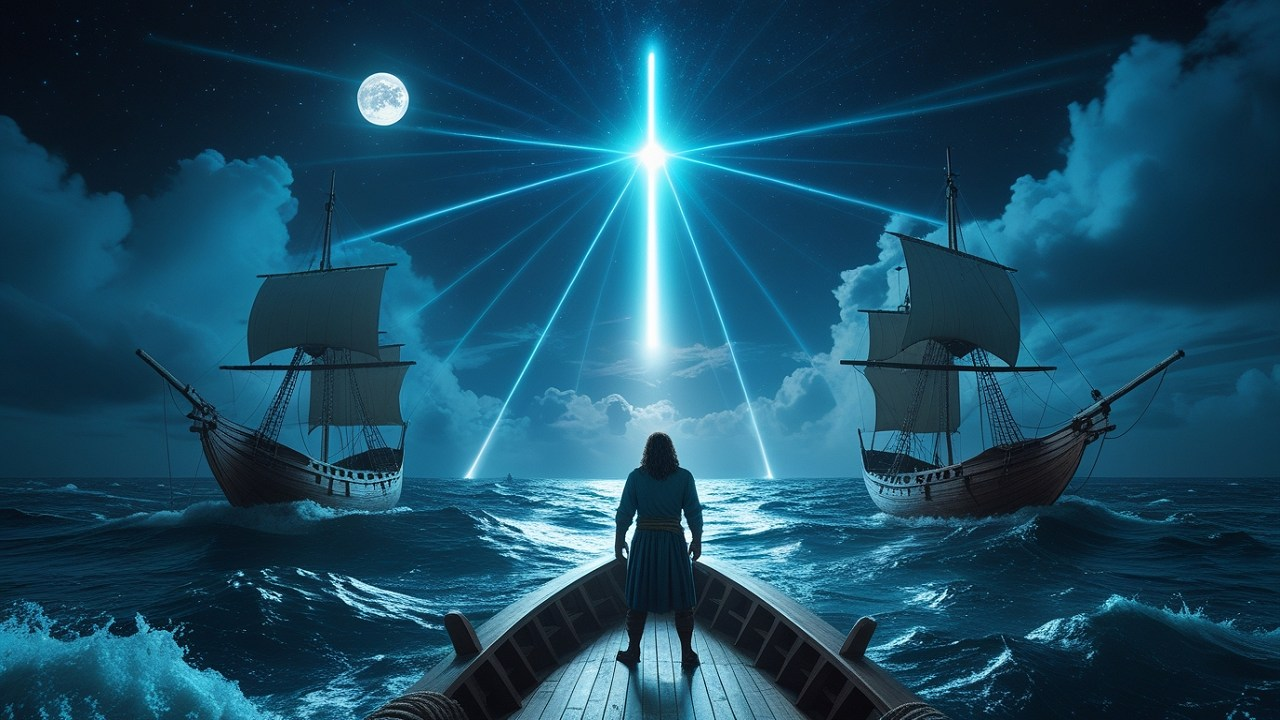
The 1492 sighting recorded by Christopher Columbus stands as one of the most intriguing early cases of a luminous object emerging from the sea and taking to the sky—what would today be classified as an Unidentified Submerged Object, or USO. Because of the reputation of the observers and the context of the event—occurring during one of the most consequential voyages in human history—the account has held unusual weight among historians, ufologists, and naval researchers alike.
Though never framed as a supernatural or extraterrestrial encounter by Columbus himself, the description is precise, unexpected, and singular in a log otherwise focused on navigation, weather, and the morale of a weary crew. Over time, the event has taken on a monumental symbolic significance, not merely as an early anomalous sighting, but as an encounter at the threshold of continents and civilizations—a moment in which an unexplained light rose from the depths of the ocean just before the European world collided with the Americas.
The original note appears in the logbook entry of October 11, 1492, the night before land was sighted. In it, Columbus describes seeing “a light glimmering at a great distance,” which “seemed to rise from the sea” and move upward before disappearing. He observed the light again, and at least one crew member, generally believed to be Rodrigo de Triana, also witnessed it.
The account is brief yet unmistakable in its clarity: the light rose from the water, behaved with intentional movement, and disappeared at altitude. This sequence is crucial, because it rules out many of the common alternative explanations proposed over the years—lighthouses (none existed in the region), coastal fires (unlikely in mid-ocean darkness, and they would not rise into the air), and meteor activity (which would appear from the sky, not the sea).
To understand the impact of this event on the people involved, it is necessary to consider the stress and uncertainty the crew had been enduring. After more than two months at sea, morale had deteriorated significantly. Rumors of mutiny circulated. Sailors feared they had sailed past the point at which a return to Europe would be possible. Every unusual sight became a potential omen, and every unexpected detail carried emotional weight. In that climate of anxiety and exhaustion, a sudden burst of light rising from the sea—something no one aboard had ever seen or heard described—would have carried an immediate and visceral impact. That the crew reacted strongly enough for Columbus to note it in the log at all suggests it disrupted the night’s expectations in a profound way.
Yet the event is also striking because of its context: it happened just hours before the first sighting of land. Columbus referenced the light just prior to making note of the shoreline’s appearance, almost as if the two events formed a connected sequence in his mind. Indeed, some observers throughout history have interpreted the glowing object as a kind of sign, though interpretations differ widely.
Some religious commentators in the centuries after the voyage saw it as a divine signal that landfall was near. Later writers with interest in anomalous aerial phenomena saw it as a technological object operating with intent, perhaps surveying the ocean or moving between water and sky. Modern ufologists have often focused on this interpretation, noting that many contemporary USO reports describe objects transitioning smoothly from sea to air with luminosity and controlled motion. What matters most is that Columbus did not embellish or speculate; he only recorded what he saw in the measured tone of a navigator. He described an anomalous light whose movement did not conform to any common natural or maritime phenomenon of the era. This combination of credibility, observational precision, and proximity to one of the most historically significant voyages in human history has made the 1492 sighting a focal point for research into the deep history of anomalous aerial and aquatic phenomena.
The effect of the sighting on the crew, though not documented in personal diaries, can be inferred from the circumstances. After weeks of despair and unease, the sudden appearance of a mysterious light rising from the sea may have been interpreted by the sailors as a sign that land or something transformative was near. And indeed, only hours later, cries of “Tierra!” confirmed the long-awaited moment. In the psychological landscape of fifteenth-century mariners—deeply superstitious, deeply religious, and profoundly attuned to omens—the sequence of a luminous apparition followed by the discovery of new land would have reinforced a sense of destiny.
Beyond the immediate effects on the voyage, the account had a long intellectual afterlife. The logs of Columbus circulated widely in the decades after the journeys, and the unusual detail of the rising light was never removed or revised out of embarrassment or skepticism. It became part of the canon of early maritime anomalies.
Over the centuries, the story occasionally resurfaced in discussions of mysterious oceanic lights—particularly among mariners who experienced unexplained glowing phenomena near coasts or in deep water. In that sense, the Columbus sighting became a subconscious anchor point in the evolving understanding of strange luminous events at sea. In the twentieth century, when study of UFOs expanded and the term USO gained traction, researchers revisited earlier historical accounts. Columbus’s observation was frequently cited as one of the earliest well documented examples of an object emerging from the water and ascending into the sky—precisely the behavior described in dozens of naval reports from the Second World War onward.
These parallels elevated the 1492 account beyond historical curiosity; it became evidence that such phenomena had been occurring long before powered flight, satellite activity, or modern naval technology. And because the report appears in a navigator’s log rather than folklore, its credibility remained strong even among skeptics.
Throughout the modern era, the sighting has fueled speculation about two major themes: the possibility that anomalous craft operate in or originate from the ocean, and the possibility that such phenomena observe or interact with moments of human historical significance. The ocean hypothesis gained strength from modern sonar anomalies, unexplained underwater sounds, and a long list of modern USO sightings reported by naval personnel. Columbus’s account fits this pattern almost perfectly: an object rising from the water, luminous, moving with purpose, and leaving no trace.
The second theme—the notion that anomalous craft show interest in pivotal moments—remains far more speculative, yet it captures the imagination of many. Why would a luminous object appear on the very night before European contact with the New World? Was it coincidence? Was it observation? Or was it something else entirely? While strict evidence does not exist to answer these questions definitively, the timing remains part of the case’s enduring intrigue.
Notable individuals associated with the case are limited, as the documentation is sparse, but they include Columbus himself, whose reliability as an early observer has been widely recognized. Rodrigo de Triana, the sailor often credited as the first to spot land, is commonly believed to be the other witness to the light. Later historians, such as Bartolomé de las Casas, preserved the log entries in their summaries of the voyages, ensuring the sighting would endure in written records. Las Casas did not treat the account as metaphor or embellishment; he included it as a genuine navigational note, further solidifying its authenticity.
The broader cultural impact of the 1492 sighting is not as widely known as its historical impact, yet it has played a subtle but enduring role in the way early explorers’ accounts are interpreted. It has broadened the timeline of anomalous sea–sky phenomena, showing that such sightings did not begin in the modern era. It has contributed to the recognition that USO events have been witnessed across centuries and continents. It has also shaped discussions about the relationship between human exploration and unexplained aerial or aquatic phenomena, especially during moments of profound historical transition.
Today, the case remains a touchstone in the study of ancient and medieval anomalous sightings. It is frequently referenced in discussions of pre modern USOs and is often used to demonstrate that credible observers have recorded the same kinds of phenomena across vastly different eras. And because the event occurred on the eve of the encounter between Europe and the Americas—a moment still taught and debated around the world—the sighting carries symbolic resonance far beyond its brief description in a ship’s log.
In the end, the 1492 encounter endures because it is simple, clear, and impossible to explain with certainty. A respected navigator saw a luminous object rise from the ocean and ascend into the sky. He recorded it without exaggeration. It happened at a moment of enormous historical consequence. And over five centuries later, it still defies easy categorization. Whether interpreted as an early USO encounter, a technological observation by an unknown intelligence, or a natural phenomenon not yet understood, the sighting remains one of the most compelling early examples of mysterious activity at the boundary between sea and air.
Its power lies not only in what Columbus saw, but in how it hints that the world’s oceans may hold more secrets than the land Columbus would soon claim.
The 1492 sighting recorded by Christopher Columbus stands as one of the most intriguing early cases of a luminous object emerging from the sea and taking to the sky—what would today be classified as an Unidentified Submerged Object, or USO. Because of the reputation of the observers and the context of the event—occurring during one of the most consequential voyages in human history—the account has held unusual weight among historians, ufologists, and naval researchers alike.
Though never framed as a supernatural or extraterrestrial encounter by Columbus himself, the description is precise, unexpected, and singular in a log otherwise focused on navigation, weather, and the morale of a weary crew. Over time, the event has taken on a monumental symbolic significance, not merely as an early anomalous sighting, but as an encounter at the threshold of continents and civilizations—a moment in which an unexplained light rose from the depths of the ocean just before the European world collided with the Americas.
The original note appears in the logbook entry of October 11, 1492, the night before land was sighted. In it, Columbus describes seeing “a light glimmering at a great distance,” which “seemed to rise from the sea” and move upward before disappearing. He observed the light again, and at least one crew member, generally believed to be Rodrigo de Triana, also witnessed it.
The account is brief yet unmistakable in its clarity: the light rose from the water, behaved with intentional movement, and disappeared at altitude. This sequence is crucial, because it rules out many of the common alternative explanations proposed over the years—lighthouses (none existed in the region), coastal fires (unlikely in mid-ocean darkness, and they would not rise into the air), and meteor activity (which would appear from the sky, not the sea).
To understand the impact of this event on the people involved, it is necessary to consider the stress and uncertainty the crew had been enduring. After more than two months at sea, morale had deteriorated significantly. Rumors of mutiny circulated. Sailors feared they had sailed past the point at which a return to Europe would be possible. Every unusual sight became a potential omen, and every unexpected detail carried emotional weight. In that climate of anxiety and exhaustion, a sudden burst of light rising from the sea—something no one aboard had ever seen or heard described—would have carried an immediate and visceral impact. That the crew reacted strongly enough for Columbus to note it in the log at all suggests it disrupted the night’s expectations in a profound way.
Yet the event is also striking because of its context: it happened just hours before the first sighting of land. Columbus referenced the light just prior to making note of the shoreline’s appearance, almost as if the two events formed a connected sequence in his mind. Indeed, some observers throughout history have interpreted the glowing object as a kind of sign, though interpretations differ widely.
Some religious commentators in the centuries after the voyage saw it as a divine signal that landfall was near. Later writers with interest in anomalous aerial phenomena saw it as a technological object operating with intent, perhaps surveying the ocean or moving between water and sky. Modern ufologists have often focused on this interpretation, noting that many contemporary USO reports describe objects transitioning smoothly from sea to air with luminosity and controlled motion. What matters most is that Columbus did not embellish or speculate; he only recorded what he saw in the measured tone of a navigator. He described an anomalous light whose movement did not conform to any common natural or maritime phenomenon of the era. This combination of credibility, observational precision, and proximity to one of the most historically significant voyages in human history has made the 1492 sighting a focal point for research into the deep history of anomalous aerial and aquatic phenomena.
The effect of the sighting on the crew, though not documented in personal diaries, can be inferred from the circumstances. After weeks of despair and unease, the sudden appearance of a mysterious light rising from the sea may have been interpreted by the sailors as a sign that land or something transformative was near. And indeed, only hours later, cries of “Tierra!” confirmed the long-awaited moment. In the psychological landscape of fifteenth-century mariners—deeply superstitious, deeply religious, and profoundly attuned to omens—the sequence of a luminous apparition followed by the discovery of new land would have reinforced a sense of destiny.
Beyond the immediate effects on the voyage, the account had a long intellectual afterlife. The logs of Columbus circulated widely in the decades after the journeys, and the unusual detail of the rising light was never removed or revised out of embarrassment or skepticism. It became part of the canon of early maritime anomalies.
Over the centuries, the story occasionally resurfaced in discussions of mysterious oceanic lights—particularly among mariners who experienced unexplained glowing phenomena near coasts or in deep water. In that sense, the Columbus sighting became a subconscious anchor point in the evolving understanding of strange luminous events at sea. In the twentieth century, when study of UFOs expanded and the term USO gained traction, researchers revisited earlier historical accounts. Columbus’s observation was frequently cited as one of the earliest well documented examples of an object emerging from the water and ascending into the sky—precisely the behavior described in dozens of naval reports from the Second World War onward.
These parallels elevated the 1492 account beyond historical curiosity; it became evidence that such phenomena had been occurring long before powered flight, satellite activity, or modern naval technology. And because the report appears in a navigator’s log rather than folklore, its credibility remained strong even among skeptics.
Throughout the modern era, the sighting has fueled speculation about two major themes: the possibility that anomalous craft operate in or originate from the ocean, and the possibility that such phenomena observe or interact with moments of human historical significance. The ocean hypothesis gained strength from modern sonar anomalies, unexplained underwater sounds, and a long list of modern USO sightings reported by naval personnel. Columbus’s account fits this pattern almost perfectly: an object rising from the water, luminous, moving with purpose, and leaving no trace.
The second theme—the notion that anomalous craft show interest in pivotal moments—remains far more speculative, yet it captures the imagination of many. Why would a luminous object appear on the very night before European contact with the New World? Was it coincidence? Was it observation? Or was it something else entirely? While strict evidence does not exist to answer these questions definitively, the timing remains part of the case’s enduring intrigue.
Notable individuals associated with the case are limited, as the documentation is sparse, but they include Columbus himself, whose reliability as an early observer has been widely recognized. Rodrigo de Triana, the sailor often credited as the first to spot land, is commonly believed to be the other witness to the light. Later historians, such as Bartolomé de las Casas, preserved the log entries in their summaries of the voyages, ensuring the sighting would endure in written records. Las Casas did not treat the account as metaphor or embellishment; he included it as a genuine navigational note, further solidifying its authenticity.
The broader cultural impact of the 1492 sighting is not as widely known as its historical impact, yet it has played a subtle but enduring role in the way early explorers’ accounts are interpreted. It has broadened the timeline of anomalous sea–sky phenomena, showing that such sightings did not begin in the modern era. It has contributed to the recognition that USO events have been witnessed across centuries and continents. It has also shaped discussions about the relationship between human exploration and unexplained aerial or aquatic phenomena, especially during moments of profound historical transition.
Today, the case remains a touchstone in the study of ancient and medieval anomalous sightings. It is frequently referenced in discussions of pre modern USOs and is often used to demonstrate that credible observers have recorded the same kinds of phenomena across vastly different eras. And because the event occurred on the eve of the encounter between Europe and the Americas—a moment still taught and debated around the world—the sighting carries symbolic resonance far beyond its brief description in a ship’s log.
In the end, the 1492 encounter endures because it is simple, clear, and impossible to explain with certainty. A respected navigator saw a luminous object rise from the ocean and ascend into the sky. He recorded it without exaggeration. It happened at a moment of enormous historical consequence. And over five centuries later, it still defies easy categorization. Whether interpreted as an early USO encounter, a technological observation by an unknown intelligence, or a natural phenomenon not yet understood, the sighting remains one of the most compelling early examples of mysterious activity at the boundary between sea and air.
Its power lies not only in what Columbus saw, but in how it hints that the world’s oceans may hold more secrets than the land Columbus would soon claim.