


Blog Categories
- African Incidents
- Atlantis Incidents
- Australian Incidents
- Belgian Incidents
- Bermuda Triangle Incidents
- Brazilian Incidents
- Canadian Incidents
- Chinese Incidents
- European Incidents
- France Incidents
- Ghosts
- Giants
- Italy Incidents
- Japanese Incidents
- Middle East Incidents
- Portugal Incidents
- Project Serpo
- Puerto Rico Incidents
- Russian Incidents
- Sasquatch
- Scandinavia Incidents
- Spanish Incidents
- UFOs
- United Kingdom Incidents
- United States Incidents
June 1878: Charles F. Ritchel’s Dirigible
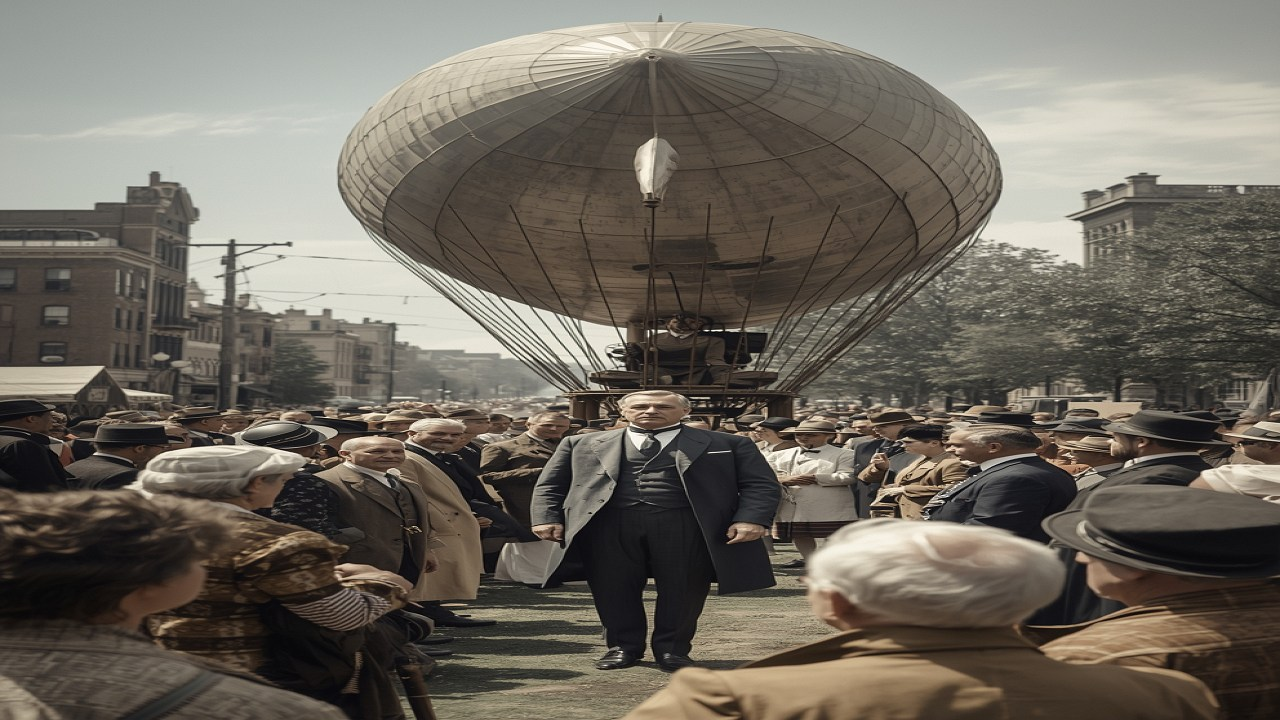
In the summer of 1878, the skies over Hartford, Connecticut, hosted a sight so extraordinary that it imprinted itself deeply on the public imagination. On June 12 of that year, Charles F. Ritchel, an inventor and mechanical visionary from Bridgeport, conducted one of the earliest successful flights of a steerable, lighter-than-air craft in the United States.
His demonstration was not only a technical marvel for its time, but also a symbolic milestone in the evolution of humanity’s relationship with flight. Although not a UFO event in the modern sense, Ritchel’s experiment played an important cultural role. It primed the public mind to expect extraordinary objects in the sky, making later “mystery airship” and unidentified aerial phenomena reports easier for witnesses to accept as plausible.
Ritchel’s invention was a small, hand-cranked dirigible — a single-person airship designed to be both steerable and controllable in flight. Unlike balloons, which drifted with the wind, his creation allowed its pilot to maneuver in the air with precision.
The dirigible consisted of a cylindrical gas bag made of varnished fabric filled with hydrogen, and below it hung a small metal frame containing pedals, a crank, and rudimentary steering controls. The entire contraption was compact enough that one person could lift and operate it. By cranking the propeller, the pilot could generate forward thrust, while movable rudders provided control over direction.
This was no small accomplishment in 1878. The Wright brothers would not make their first powered airplane flight until 1903 — a full quarter century later. In that context, Ritchel’s machine represented one of the first steps toward powered, directed flight.
The demonstration in Hartford was not only an engineering experiment but also a public spectacle. Newspaper accounts from the period describe crowds gathering to watch the strange, cigar-shaped airship glide above the city’s fairgrounds. For many, it was the first time they had seen a human being rise into the sky under their own control, rather than being carried helplessly by the wind in a balloon.
Harper’s Weekly, one of the most respected publications of the time, published an illustration and account of Ritchel’s airship in July 1878. The article described the inventor’s test flights and included a detailed image showing the small, hand-cranked craft in motion. These illustrations circulated widely, giving Ritchel’s creation national visibility.
For the public, this was an electrifying glimpse into what seemed like a future of personal flight. It also helped establish the idea — new at the time — that a person could build a machine capable of navigating the sky through mechanical means.
The impact of Ritchel’s demonstration went beyond Hartford’s borders. In the years that followed, newspapers across America published stories about “flying machines” and inventors attempting similar feats. While many of these later reports were exaggerated or fictionalized, they reflected a growing fascination with the possibilities of human flight.
By the 1890s, this cultural anticipation had ripened into the “mystery airship” wave of 1896–97, when witnesses across the United States — including in the Midwest and the East Coast — reported seeing cigar shaped craft with bright lights and mechanical sounds passing overhead.
Historians have since suggested that these sightings were shaped, in part, by public memory of earlier demonstrations like Ritchel’s. People already knew that inventors were experimenting with powered flight; thus, when they saw something unusual in the sky, it seemed reasonable to assume it might be one of those machines.
Ritchel’s 1878 dirigible thus occupies a crucial position in the timeline between the era of hot air balloons and the first airplanes. His achievement represented a bridge between fantasy and practicality — between the whimsical dream of floating through the air and the scientific challenge of building a controllable flying vehicle.
Although his craft was powered entirely by human effort and limited in range, its success proved that steerable flight was possible. That lesson would inspire other inventors in the coming decades, including pioneers like Alberto Santos-Dumont, who developed motorized dirigibles in France around the turn of the century.
Culturally, the Hartford demonstration also signified a turning point in how Americans perceived the sky. Before Ritchel’s time, celestial phenomena — from comets to meteors to unusual lights — were often interpreted through religious or superstitious frameworks. The heavens were seen as the domain of the divine.
But as inventors like Ritchel began to intrude upon that domain with machines of human creation, the boundary between the natural and the technological blurred. The sky became a potential arena for innovation — and, for some, for mystery. In the decades that followed, reports of unidentified aerial objects increasingly mixed scientific curiosity with speculative imagination.
For the people of Hartford in 1878, the experience of seeing Ritchel’s dirigible must have been astonishing. Accounts from local observers describe excitement, disbelief, and even fear. Some were inspired by the vision of human flight, while others wondered whether such machines might one day be used for military or surveillance purposes — an early echo of modern debates about technology and privacy.
Children reportedly followed Ritchel’s airship on the ground, cheering as it floated overhead. The demonstration made him a local celebrity for a brief time, and he continued to refine his inventions in the years afterward.
Yet, Ritchel’s life also reflects the challenges faced by early inventors. Despite his brilliance, he lacked the financial backing to mass-produce or commercialize his airship. Patent records show that he worked on several other inventions, including mechanical toys and devices, but he never achieved lasting fame or fortune.
His dirigible became a historical curiosity — a footnote in the broader story of aviation. Still, for those who witnessed it, the memory of that summer day in Hartford remained powerful. It was a glimpse of the impossible made real.
Today, Ritchel’s demonstration continues to matter for several reasons. From a technological standpoint, it marks one of the earliest proofs of controlled flight in America. From a cultural standpoint, it helps explain how late-19th-century observers came to view the sky as a space filled with potential human inventions. This shift in perception is key to understanding the social backdrop of later UFO sightings.
When the “mystery airships” appeared in the 1890s — described as cigar shaped craft with lights and wings — they were not seen as supernatural objects but as likely human inventions. The idea that a person could build and fly such a machine had already been demonstrated in Hartford two decades earlier.
The legacy of Charles F. Ritchel endures in the historical record and in the collective imagination of aviation and UFO researchers alike. While his dirigible was a genuine technological breakthrough, it also stands as an early example of how flight experiments can influence public perception of the skies.
It is no coincidence that many early UFO reports describe airships remarkably similar in shape and size to Ritchel’s creation. Whether consciously or not, witnesses may have drawn upon the mental imagery first sparked by his invention.
In that sense, Ritchel’s 1878 flight did more than lift a man into the air — it elevated an entire culture’s expectations of what was possible.
The spectacle over Hartford became part of America’s evolving mythology of the skies, blending invention with imagination, fact with wonder. For UFO historians, it serves as a reminder that not all “unidentified” phenomena are born from mystery; some arise from the very human drive to explore, to create, and to reach beyond what seems possible. Charles F. Ritchel, with his humble hand-cranked airship, may not have met beings from the stars — but he helped set the stage for a nation ready to look upward and wonder what else might be there.
In the summer of 1878, the skies over Hartford, Connecticut, hosted a sight so extraordinary that it imprinted itself deeply on the public imagination. On June 12 of that year, Charles F. Ritchel, an inventor and mechanical visionary from Bridgeport, conducted one of the earliest successful flights of a steerable, lighter-than-air craft in the United States.
His demonstration was not only a technical marvel for its time, but also a symbolic milestone in the evolution of humanity’s relationship with flight. Although not a UFO event in the modern sense, Ritchel’s experiment played an important cultural role. It primed the public mind to expect extraordinary objects in the sky, making later “mystery airship” and unidentified aerial phenomena reports easier for witnesses to accept as plausible.
Ritchel’s invention was a small, hand-cranked dirigible — a single-person airship designed to be both steerable and controllable in flight. Unlike balloons, which drifted with the wind, his creation allowed its pilot to maneuver in the air with precision.
The dirigible consisted of a cylindrical gas bag made of varnished fabric filled with hydrogen, and below it hung a small metal frame containing pedals, a crank, and rudimentary steering controls. The entire contraption was compact enough that one person could lift and operate it. By cranking the propeller, the pilot could generate forward thrust, while movable rudders provided control over direction.
This was no small accomplishment in 1878. The Wright brothers would not make their first powered airplane flight until 1903 — a full quarter century later. In that context, Ritchel’s machine represented one of the first steps toward powered, directed flight.
The demonstration in Hartford was not only an engineering experiment but also a public spectacle. Newspaper accounts from the period describe crowds gathering to watch the strange, cigar-shaped airship glide above the city’s fairgrounds. For many, it was the first time they had seen a human being rise into the sky under their own control, rather than being carried helplessly by the wind in a balloon.
Harper’s Weekly, one of the most respected publications of the time, published an illustration and account of Ritchel’s airship in July 1878. The article described the inventor’s test flights and included a detailed image showing the small, hand-cranked craft in motion. These illustrations circulated widely, giving Ritchel’s creation national visibility.
For the public, this was an electrifying glimpse into what seemed like a future of personal flight. It also helped establish the idea — new at the time — that a person could build a machine capable of navigating the sky through mechanical means.
The impact of Ritchel’s demonstration went beyond Hartford’s borders. In the years that followed, newspapers across America published stories about “flying machines” and inventors attempting similar feats. While many of these later reports were exaggerated or fictionalized, they reflected a growing fascination with the possibilities of human flight.
By the 1890s, this cultural anticipation had ripened into the “mystery airship” wave of 1896–97, when witnesses across the United States — including in the Midwest and the East Coast — reported seeing cigar shaped craft with bright lights and mechanical sounds passing overhead.
Historians have since suggested that these sightings were shaped, in part, by public memory of earlier demonstrations like Ritchel’s. People already knew that inventors were experimenting with powered flight; thus, when they saw something unusual in the sky, it seemed reasonable to assume it might be one of those machines.
Ritchel’s 1878 dirigible thus occupies a crucial position in the timeline between the era of hot air balloons and the first airplanes. His achievement represented a bridge between fantasy and practicality — between the whimsical dream of floating through the air and the scientific challenge of building a controllable flying vehicle.
Although his craft was powered entirely by human effort and limited in range, its success proved that steerable flight was possible. That lesson would inspire other inventors in the coming decades, including pioneers like Alberto Santos-Dumont, who developed motorized dirigibles in France around the turn of the century.
Culturally, the Hartford demonstration also signified a turning point in how Americans perceived the sky. Before Ritchel’s time, celestial phenomena — from comets to meteors to unusual lights — were often interpreted through religious or superstitious frameworks. The heavens were seen as the domain of the divine.
But as inventors like Ritchel began to intrude upon that domain with machines of human creation, the boundary between the natural and the technological blurred. The sky became a potential arena for innovation — and, for some, for mystery. In the decades that followed, reports of unidentified aerial objects increasingly mixed scientific curiosity with speculative imagination.
For the people of Hartford in 1878, the experience of seeing Ritchel’s dirigible must have been astonishing. Accounts from local observers describe excitement, disbelief, and even fear. Some were inspired by the vision of human flight, while others wondered whether such machines might one day be used for military or surveillance purposes — an early echo of modern debates about technology and privacy.
Children reportedly followed Ritchel’s airship on the ground, cheering as it floated overhead. The demonstration made him a local celebrity for a brief time, and he continued to refine his inventions in the years afterward.
Yet, Ritchel’s life also reflects the challenges faced by early inventors. Despite his brilliance, he lacked the financial backing to mass-produce or commercialize his airship. Patent records show that he worked on several other inventions, including mechanical toys and devices, but he never achieved lasting fame or fortune.
His dirigible became a historical curiosity — a footnote in the broader story of aviation. Still, for those who witnessed it, the memory of that summer day in Hartford remained powerful. It was a glimpse of the impossible made real.
Today, Ritchel’s demonstration continues to matter for several reasons. From a technological standpoint, it marks one of the earliest proofs of controlled flight in America. From a cultural standpoint, it helps explain how late-19th-century observers came to view the sky as a space filled with potential human inventions. This shift in perception is key to understanding the social backdrop of later UFO sightings.
When the “mystery airships” appeared in the 1890s — described as cigar shaped craft with lights and wings — they were not seen as supernatural objects but as likely human inventions. The idea that a person could build and fly such a machine had already been demonstrated in Hartford two decades earlier.
The legacy of Charles F. Ritchel endures in the historical record and in the collective imagination of aviation and UFO researchers alike. While his dirigible was a genuine technological breakthrough, it also stands as an early example of how flight experiments can influence public perception of the skies.
It is no coincidence that many early UFO reports describe airships remarkably similar in shape and size to Ritchel’s creation. Whether consciously or not, witnesses may have drawn upon the mental imagery first sparked by his invention.
In that sense, Ritchel’s 1878 flight did more than lift a man into the air — it elevated an entire culture’s expectations of what was possible.
The spectacle over Hartford became part of America’s evolving mythology of the skies, blending invention with imagination, fact with wonder. For UFO historians, it serves as a reminder that not all “unidentified” phenomena are born from mystery; some arise from the very human drive to explore, to create, and to reach beyond what seems possible. Charles F. Ritchel, with his humble hand-cranked airship, may not have met beings from the stars — but he helped set the stage for a nation ready to look upward and wonder what else might be there.