


Blog Categories
- African Incidents
- Atlantis Incidents
- Australian Incidents
- Belgian Incidents
- Bermuda Triangle Incidents
- Brazilian Incidents
- Canadian Incidents
- Chinese Incidents
- European Incidents
- France Incidents
- Ghosts
- Giants
- Italy Incidents
- Japanese Incidents
- Middle East Incidents
- Portugal Incidents
- Project Serpo
- Puerto Rico Incidents
- Russian Incidents
- Sasquatch
- Scandinavia Incidents
- Spanish Incidents
- UFOs
- United Kingdom Incidents
- United States Incidents
1693: Savannah Burning Shield in the Sky
In the year 1693, long before the United States even existed, in a remote colonial outpost on the edge of the untamed Georgia wilderness, multiple witnesses looked up at the night sky and saw something that should not have been there.
They saw a bright, glowing object shaped like a shield — fiery yet metallic — drifting slowly and deliberately across the heavens. This was not a fleeting meteor or a hazy comet. It moved with purpose, silent and majestic, for a duration long enough for people to gather, point it out to one another, and discuss what they were seeing.
This is the story of the Burning Shield of Savannah — one of the earliest well-documented anomalous sky events in colonial North America, and a powerful reminder that UFOs and UAP did not begin in 1947.
Welcome to the channel. Today we’re going deep into one of the most fascinating pre-modern UFO cases in American history.
Let’s travel back to 1693.
Savannah had not yet been formally founded by James Oglethorpe — that would happen 40 years later in 1733. At this time, the region was a wild frontier. Scattered English traders, missionaries, and hardy settlers had pushed south from the Carolinas, carving out fragile footholds along the Savannah River. The landscape was a mix of dense pine barrens, cypress swamps, and rich tidal marshes. Indigenous peoples like the Yamacraw and Guale still held strong influence, and their oral traditions spoke of powerful spirits and omens in the sky.
It was into this world of uncertainty, danger, and superstition that the Burning Shield appeared.
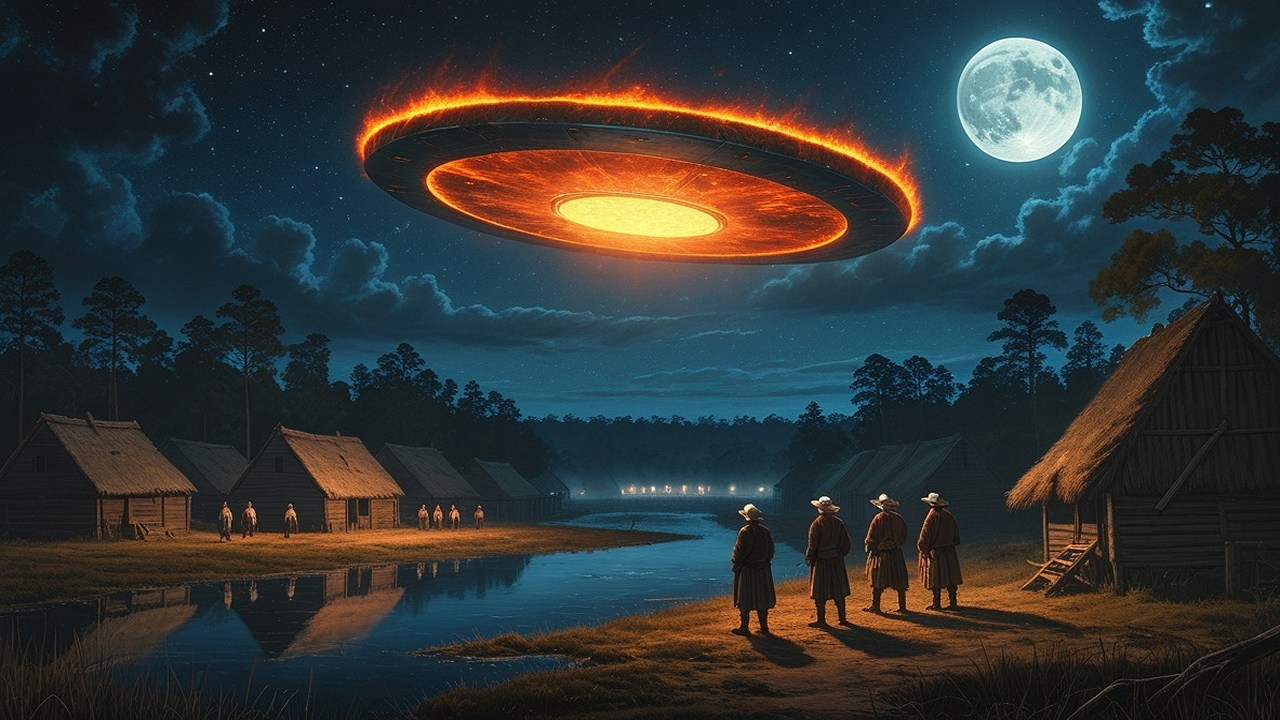
According to fragmentary letters, journals, and later colonial chronicles, multiple witnesses saw a bright, glowing object distinctly shaped like a shield moving slowly across the night sky. Contemporary descriptions called it fiery yet metallic in appearance — a contradiction that must have been deeply unsettling to 17th-century minds. The object emitted a steady, radiant light. Its edges appeared burnished, almost like hammered iron or bronze catching fire, while the center pulsed with an inner glow that cast an eerie illumination over the treetops and riverbanks below.
Unlike a meteor that blazes across the sky in seconds, this Burning Shield moved with deliberate, unhurried grace. It traversed a significant arc of the sky, remaining visible long enough for independent observers separated by miles to track its path and confirm the same details.
The object maintained a consistent altitude and velocity. Some accounts noted a subtle rotation or wobble, as though it were a crafted artifact rather than a natural phenomenon. There was no sound — no thunder, no crackling, no roar. Just silent, majestic passage.
In an era when nearly every unusual celestial event was interpreted through a religious or superstitious lens, this sighting carried enormous weight. Settlers whispered of divine portents — perhaps a warning about Spanish forces to the south, unrest among Native tribes, or moral failings within their own fragile community. Missionaries may have seen it as a pillar of fire, while others feared it heralded invasion or apocalypse.
The event occurred on a clear night, likely during the warmer months when the stars shone with unusual clarity over the marshes. Imagine the scene: a handful of timber huts and thatched roofs clustered near the river, lanterns flickering, the sounds of night birds and alligators in the distance. Then someone spots it. The cry goes out. People step outside, tilt their heads back, and watch in collective awe and terror as this glowing shield drifts overhead, casting faint shadows on the ground.
What makes the 1693 Savannah case so historically valuable is its specificity. While many colonial records describe vague “battles in the sky” or “armies of the air,” this event was clearly anchored to a distinct shield-shaped object with metallic and fiery qualities, moving in a controlled manner. The documentation, though fragmentary due to the limitations of record-keeping at the time, comes from multiple independent sources, lending it credibility as more than mere folklore.
Skeptics have proposed various natural explanations over the centuries — everything from rare atmospheric phenomena and ball lightning to misidentified comets or even optical illusions. However, the consistent “shield” morphology, the metallic-fiery appearance, the slow and steady motion, and the prolonged visibility challenge these explanations. No known 17th-century technology or natural event perfectly matches the descriptions.
This sighting does not stand alone. It belongs to a longer pattern of pre-telescopic aerial anomalies recorded across Europe and the early American colonies. Similar accounts of structured objects, aerial battles, and unusual lights appear in chronicles from the 1500s through the 1700s. What makes the Savannah case special is its early date in North American colonial history and its clear documentation of a structured, shield-like craft.
Today, modern ufologists and anomalists recognize striking parallels between the 1693 Burning Shield and contemporary UAP reports: defined geometric shape, self-illumination with metallic qualities, non-ballistic trajectories, silent operation, and duration long enough for detailed observation. The event fits the profile of a classic structured craft sighting — centuries before the invention of airplanes or drones.
In the cultural context of colonial Georgia, such an event would have been profoundly meaningful. Life on the frontier was precarious. Disease, starvation, conflict, and the constant threat of Spanish raids created an atmosphere where signs in the sky were taken seriously. The Burning Shield was recorded not as idle superstition but as a real event worthy of letters back to England and entries in colonial records.
Some modern interpreters suggest these historical anomalies reflect a long-standing pattern of visitation or interaction — advanced technology or interdimensional phenomena manifesting in forms that made sense to the observers of the time. A metallic burning shield would naturally evoke medieval heraldry and biblical imagery to European settlers.
The 1693 Savannah sighting stands as powerful evidence that humanity’s encounter with the unknown did not begin with Kenneth Arnold in 1947 or the Roswell incident. It has been happening for centuries, recorded by people who had no modern framework for what they were seeing. They simply documented what they witnessed because it was too extraordinary to ignore.
As we continue our modern search for answers with radar, infrared cameras, and official UAP investigations, cases like the Burning Shield of Savannah remind us how deep the mystery truly runs. The night sky has never been entirely silent. Something has been moving through it — observed, recorded, and remembered — for hundreds of years.
The citizens of early Savannah looked up in 1693 and saw something that challenged their understanding of the world. Today, with vastly better tools, we continue to see similar reports. The more things change, the more the skies seem to hold onto their secrets.
The Burning Shield did not crash. It did not communicate directly. It simply passed overhead, leaving wonder, fear, and speculation in its wake. Centuries later, its light still illuminates one of humanity’s oldest and most persistent questions: Are we alone?
In the year 1693, long before the United States even existed, in a remote colonial outpost on the edge of the untamed Georgia wilderness, multiple witnesses looked up at the night sky and saw something that should not have been there.
They saw a bright, glowing object shaped like a shield — fiery yet metallic — drifting slowly and deliberately across the heavens. This was not a fleeting meteor or a hazy comet. It moved with purpose, silent and majestic, for a duration long enough for people to gather, point it out to one another, and discuss what they were seeing.
This is the story of the Burning Shield of Savannah — one of the earliest well-documented anomalous sky events in colonial North America, and a powerful reminder that UFOs and UAP did not begin in 1947.
Welcome to the channel. Today we’re going deep into one of the most fascinating pre-modern UFO cases in American history.
Let’s travel back to 1693.
Savannah had not yet been formally founded by James Oglethorpe — that would happen 40 years later in 1733. At this time, the region was a wild frontier. Scattered English traders, missionaries, and hardy settlers had pushed south from the Carolinas, carving out fragile footholds along the Savannah River. The landscape was a mix of dense pine barrens, cypress swamps, and rich tidal marshes. Indigenous peoples like the Yamacraw and Guale still held strong influence, and their oral traditions spoke of powerful spirits and omens in the sky.
It was into this world of uncertainty, danger, and superstition that the Burning Shield appeared.
According to fragmentary letters, journals, and later colonial chronicles, multiple witnesses saw a bright, glowing object distinctly shaped like a shield moving slowly across the night sky. Contemporary descriptions called it fiery yet metallic in appearance — a contradiction that must have been deeply unsettling to 17th-century minds. The object emitted a steady, radiant light. Its edges appeared burnished, almost like hammered iron or bronze catching fire, while the center pulsed with an inner glow that cast an eerie illumination over the treetops and riverbanks below.
Unlike a meteor that blazes across the sky in seconds, this Burning Shield moved with deliberate, unhurried grace. It traversed a significant arc of the sky, remaining visible long enough for independent observers separated by miles to track its path and confirm the same details.
The object maintained a consistent altitude and velocity. Some accounts noted a subtle rotation or wobble, as though it were a crafted artifact rather than a natural phenomenon. There was no sound — no thunder, no crackling, no roar. Just silent, majestic passage.
In an era when nearly every unusual celestial event was interpreted through a religious or superstitious lens, this sighting carried enormous weight. Settlers whispered of divine portents — perhaps a warning about Spanish forces to the south, unrest among Native tribes, or moral failings within their own fragile community. Missionaries may have seen it as a pillar of fire, while others feared it heralded invasion or apocalypse.
The event occurred on a clear night, likely during the warmer months when the stars shone with unusual clarity over the marshes. Imagine the scene: a handful of timber huts and thatched roofs clustered near the river, lanterns flickering, the sounds of night birds and alligators in the distance. Then someone spots it. The cry goes out. People step outside, tilt their heads back, and watch in collective awe and terror as this glowing shield drifts overhead, casting faint shadows on the ground.
What makes the 1693 Savannah case so historically valuable is its specificity. While many colonial records describe vague “battles in the sky” or “armies of the air,” this event was clearly anchored to a distinct shield-shaped object with metallic and fiery qualities, moving in a controlled manner. The documentation, though fragmentary due to the limitations of record-keeping at the time, comes from multiple independent sources, lending it credibility as more than mere folklore.
Skeptics have proposed various natural explanations over the centuries — everything from rare atmospheric phenomena and ball lightning to misidentified comets or even optical illusions. However, the consistent “shield” morphology, the metallic-fiery appearance, the slow and steady motion, and the prolonged visibility challenge these explanations. No known 17th-century technology or natural event perfectly matches the descriptions.
This sighting does not stand alone. It belongs to a longer pattern of pre-telescopic aerial anomalies recorded across Europe and the early American colonies. Similar accounts of structured objects, aerial battles, and unusual lights appear in chronicles from the 1500s through the 1700s. What makes the Savannah case special is its early date in North American colonial history and its clear documentation of a structured, shield-like craft.
Today, modern ufologists and anomalists recognize striking parallels between the 1693 Burning Shield and contemporary UAP reports: defined geometric shape, self-illumination with metallic qualities, non-ballistic trajectories, silent operation, and duration long enough for detailed observation. The event fits the profile of a classic structured craft sighting — centuries before the invention of airplanes or drones.
In the cultural context of colonial Georgia, such an event would have been profoundly meaningful. Life on the frontier was precarious. Disease, starvation, conflict, and the constant threat of Spanish raids created an atmosphere where signs in the sky were taken seriously. The Burning Shield was recorded not as idle superstition but as a real event worthy of letters back to England and entries in colonial records.
Some modern interpreters suggest these historical anomalies reflect a long-standing pattern of visitation or interaction — advanced technology or interdimensional phenomena manifesting in forms that made sense to the observers of the time. A metallic burning shield would naturally evoke medieval heraldry and biblical imagery to European settlers.
The 1693 Savannah sighting stands as powerful evidence that humanity’s encounter with the unknown did not begin with Kenneth Arnold in 1947 or the Roswell incident. It has been happening for centuries, recorded by people who had no modern framework for what they were seeing. They simply documented what they witnessed because it was too extraordinary to ignore.
As we continue our modern search for answers with radar, infrared cameras, and official UAP investigations, cases like the Burning Shield of Savannah remind us how deep the mystery truly runs. The night sky has never been entirely silent. Something has been moving through it — observed, recorded, and remembered — for hundreds of years.
The citizens of early Savannah looked up in 1693 and saw something that challenged their understanding of the world. Today, with vastly better tools, we continue to see similar reports. The more things change, the more the skies seem to hold onto their secrets.
The Burning Shield did not crash. It did not communicate directly. It simply passed overhead, leaving wonder, fear, and speculation in its wake. Centuries later, its light still illuminates one of humanity’s oldest and most persistent questions: Are we alone?