

Blog Categories
- African Incidents
- Atlantis Incidents
- Australian Incidents
- Belgian Incidents
- Bermuda Triangle Incidents
- Brazilian Incidents
- Canadian Incidents
- Chinese Incidents
- European Incidents
- France Incidents
- Ghosts
- Giants
- Italy Incidents
- Japanese Incidents
- Middle East Incidents
- Portugal Incidents
- Project Serpo
- Puerto Rico Incidents
- Russian Incidents
- Sasquatch
- Scandinavia Incidents
- Spanish Incidents
- UFOs
- United Kingdom Incidents
- United States Incidents
1697: Germany Astronomer Observation
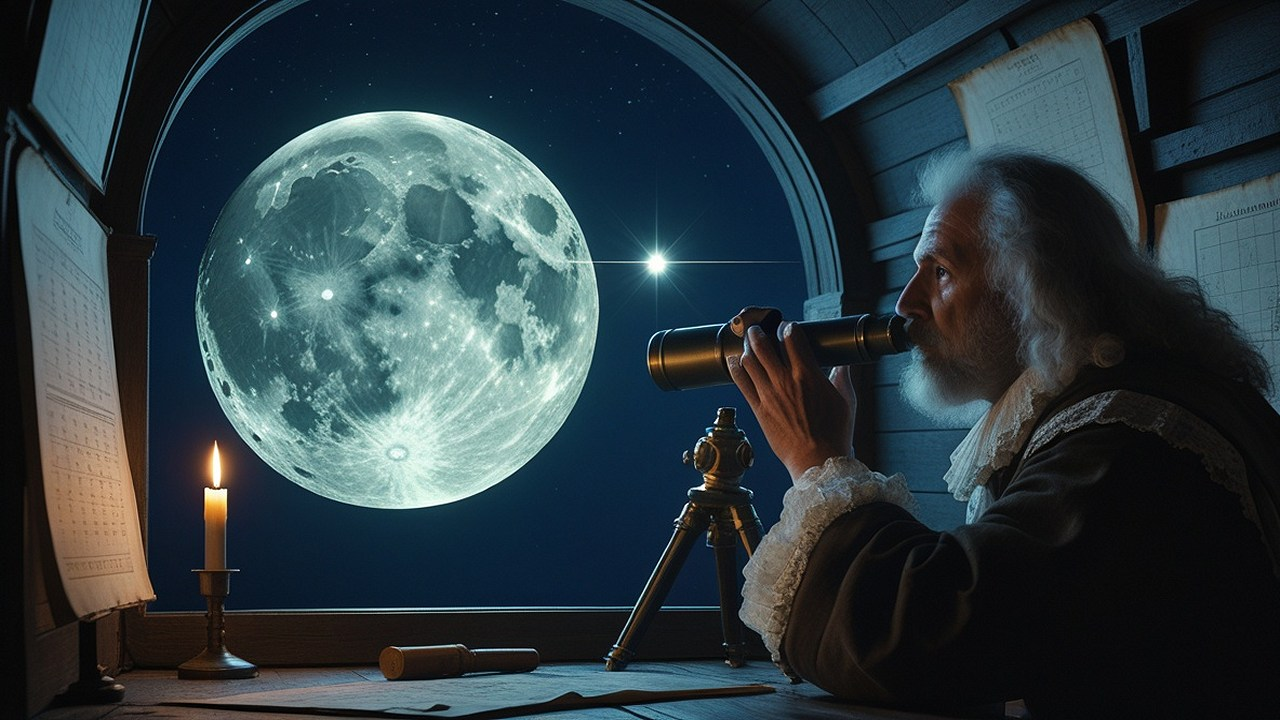
In November 1697, one of the most respected astronomers of his time looked through his telescope and saw something that should not have been there. Gottfried Kirch, court astronomer to the Elector of Brandenburg, recorded a bright, star-like object moving in a straight line across the lunar disk. The sighting lasted several minutes. The object was not a meteor. It was not a known planet or star. It was not anything that belonged in the sky according to the astronomy of 1697.
This is the story of the 1697 Kirch lunar transit — one of the earliest documented telescopic anomalies involving an object crossing the face of the Moon. Recorded by a meticulous, highly credible observer, this account stands as powerful evidence that anomalous aerial phenomena have been documented for centuries, long before the modern UFO era.
Welcome to the channel. Today we’re going back to the 17th century to examine one of the oldest credible telescopic sightings in history. Everything in this video is drawn directly from historical records and Gottfried Kirch’s own documentation. No speculation. Just the facts as they were recorded at the time.
Let’s set the scene.
The 17th century was a revolutionary period in astronomy. The invention of the telescope in the early 1600s changed everything. Before then, lunar anomalies were recorded by the naked eye: bright flashes, moving lights, dark shapes crossing the disk. These were dramatic but imprecise. The telescope brought magnification, clarity, and repeatability. It turned the Moon from a distant symbol into an observable world. And almost immediately, observers began seeing things that should not have been there.
Gottfried Kirch was no amateur stargazer. Born in 1639, he was one of the most respected astronomers of his era. He served as court astronomer to the Elector of Brandenburg, discovered several comets, and kept detailed journals that were later used by astronomers including Edmond Halley. His observations were meticulous, sober, and highly regarded. When Kirch looked through his telescope on November 4, 1697, and saw a bright point of light moving in a straight line across the lunar disk, he recorded it with the same precision he applied to his comet discoveries.
The object traversed the visible face of the Moon from one limb to the other. It moved at a steady, non-flickering pace. The sighting lasted several minutes — long enough for Kirch to note its consistent velocity and deliberate path. He ruled out atmospheric phenomena and optical illusions, concluding it was something physical passing between Earth and the Moon — or possibly moving across its surface.
This case stands out for several key reasons. First, the observer: Kirch was trained, experienced, and not prone to exaggeration. His journals were considered reliable by his contemporaries. Second, the instrument: early telescopes, while limited, were sufficient to distinguish a point source from a star or planet. Third, the duration and path: several minutes of straight-line motion across the disk rules out most natural explanations. Meteors burn up in seconds. Birds or insects would not appear as star-like points against the bright lunar background. Atmospheric refraction does not produce linear transits of this nature.
Kirch’s observation belongs to a small but growing class of 17th- and early 18th-century telescopic lunar transit anomalies. Similar reports appear in the records of other respected astronomers. In 1665, Giovanni Cassini recorded a bright object moving across the Moon’s disk during a lunar eclipse — too slow for a meteor, too fast for a planet. In 1671, Robert Hooke noted a small bright spot moving across the Moon’s disk in a straight line. In 1715, Edmond Halley observed a similar transit during a lunar eclipse.
These accounts share common traits: brief but deliberate motion, star-like appearance, linear or gently curved paths, and absence of tail or fragmentation. None matched known celestial mechanics of the time. Astronomers of the era were meticulous. They timed transits, measured angular speed, and compared positions to star charts. When something did not fit, they recorded it as anomalous rather than dismissing it outright.
Skeptical explanations have been offered over the centuries: high-altitude birds or insects catching moonlight, atmospheric mirages, optical artifacts from early lenses, or even early secret aircraft. Yet these alternatives strain credibility more than the observations themselves. Birds and insects do not appear as consistent star-like points against the bright lunar surface for several minutes. Early telescopes had limitations, but trained observers like Kirch, Cassini, Hooke, and Halley knew their instruments’ flaws and still considered these transits real.
The 1697 Kirch sighting is one of the earliest telescopic lunar transit anomalies with a named, credible observer and surviving documentation. It marks the transition from naked-eye chronicles to systematic astronomical observation. The Moon was no longer just a poetic object or divine sign — it was a world under scrutiny. And almost as soon as humans gained the tools to study it closely, something was seen moving across its face in ways that did not belong.
These early telescopic cases are not proof of extraterrestrial craft. They are proof of continuity. The Moon has produced unexplained moving lights and objects for at least 500 years — long before rockets, satellites, or drones could explain them away. What began as naked-eye wonders in the 1500s became telescopic mysteries in the 1600s and 1700s. By the 20th century, cameras, radar, and orbiters would add new layers to the same persistent question: what is moving on or near the Moon, and why has it never stopped?
The answer has never been found in any official catalog. But the sightings never stopped either.
Kirch’s account, preserved in his journals, stands as a foundational piece of evidence in the long history of lunar anomalies. It demonstrates that credible, trained observers using the best technology of their time recorded phenomena that defied conventional explanation. The straight-line motion, steady light, and duration of the transit challenge natural explanations. The fact that similar transits were reported by other respected astronomers of the era strengthens the pattern.
In the broader study of unidentified aerial and lunar phenomena, the 1697 sighting provides historical depth. It shows that reports of objects moving across or near the Moon predate modern space programs by centuries. This continuity is difficult to dismiss. It suggests that whatever is causing these transits has been active for a very long time.
For those interested in USO and UAP research, the Kirch case also hints at the possibility of transmedium capabilities. While the object was observed crossing the lunar disk, the broader historical context of lunar anomalies includes objects that appear to interact with both space and Earth’s atmosphere or surface. The 1697 sighting fits into this larger pattern of intelligently moving luminous objects that have been documented near the Moon for hundreds of years.
The cultural and scientific impact of these early telescopic sightings was profound. They challenged the perfection of celestial bodies assumed by many philosophers and astronomers. They forced observers to confront the possibility that the Moon and the space around it were not as empty or static as previously believed. Kirch and his contemporaries laid the groundwork for later lunar studies while simultaneously documenting anomalies that remain unexplained to this day.
Today, the 1697 Kirch lunar transit remains one of the most compelling early telescopic anomalies on record. It is frequently cited by researchers exploring the history of lunar and near-lunar phenomena. The sighting’s credibility, documentation, and alignment with later reports make it a cornerstone case for those studying the long timeline of unidentified objects in our skies and near our nearest celestial neighbor.
The bright point of light that crossed the Moon’s disk in 1697 may have eventually disappeared beyond the limb, but its place in the history of anomalous phenomena is secure. Gottfried Kirch’s meticulous record ensures that one of the earliest telescopic mysteries continues to challenge our understanding of what moves in the space between Earth and the Moon.
As we continue to explore the Moon with modern orbiters and telescopes, it is worth remembering that astronomers have been seeing unusual activity there for centuries. The 1697 sighting reminds us that the mystery is old, well-documented, and still waiting for answers.
The Moon has never been silent. And according to observers like Gottfried Kirch, something has been moving across its face for a very long time.
In November 1697, one of the most respected astronomers of his time looked through his telescope and saw something that should not have been there. Gottfried Kirch, court astronomer to the Elector of Brandenburg, recorded a bright, star-like object moving in a straight line across the lunar disk. The sighting lasted several minutes. The object was not a meteor. It was not a known planet or star. It was not anything that belonged in the sky according to the astronomy of 1697.
This is the story of the 1697 Kirch lunar transit — one of the earliest documented telescopic anomalies involving an object crossing the face of the Moon. Recorded by a meticulous, highly credible observer, this account stands as powerful evidence that anomalous aerial phenomena have been documented for centuries, long before the modern UFO era.
Welcome to the channel. Today we’re going back to the 17th century to examine one of the oldest credible telescopic sightings in history. Everything in this video is drawn directly from historical records and Gottfried Kirch’s own documentation. No speculation. Just the facts as they were recorded at the time.
Let’s set the scene.
The 17th century was a revolutionary period in astronomy. The invention of the telescope in the early 1600s changed everything. Before then, lunar anomalies were recorded by the naked eye: bright flashes, moving lights, dark shapes crossing the disk. These were dramatic but imprecise. The telescope brought magnification, clarity, and repeatability. It turned the Moon from a distant symbol into an observable world. And almost immediately, observers began seeing things that should not have been there.
Gottfried Kirch was no amateur stargazer. Born in 1639, he was one of the most respected astronomers of his era. He served as court astronomer to the Elector of Brandenburg, discovered several comets, and kept detailed journals that were later used by astronomers including Edmond Halley. His observations were meticulous, sober, and highly regarded. When Kirch looked through his telescope on November 4, 1697, and saw a bright point of light moving in a straight line across the lunar disk, he recorded it with the same precision he applied to his comet discoveries.
The object traversed the visible face of the Moon from one limb to the other. It moved at a steady, non-flickering pace. The sighting lasted several minutes — long enough for Kirch to note its consistent velocity and deliberate path. He ruled out atmospheric phenomena and optical illusions, concluding it was something physical passing between Earth and the Moon — or possibly moving across its surface.
This case stands out for several key reasons. First, the observer: Kirch was trained, experienced, and not prone to exaggeration. His journals were considered reliable by his contemporaries. Second, the instrument: early telescopes, while limited, were sufficient to distinguish a point source from a star or planet. Third, the duration and path: several minutes of straight-line motion across the disk rules out most natural explanations. Meteors burn up in seconds. Birds or insects would not appear as star-like points against the bright lunar background. Atmospheric refraction does not produce linear transits of this nature.
Kirch’s observation belongs to a small but growing class of 17th- and early 18th-century telescopic lunar transit anomalies. Similar reports appear in the records of other respected astronomers. In 1665, Giovanni Cassini recorded a bright object moving across the Moon’s disk during a lunar eclipse — too slow for a meteor, too fast for a planet. In 1671, Robert Hooke noted a small bright spot moving across the Moon’s disk in a straight line. In 1715, Edmond Halley observed a similar transit during a lunar eclipse.
These accounts share common traits: brief but deliberate motion, star-like appearance, linear or gently curved paths, and absence of tail or fragmentation. None matched known celestial mechanics of the time. Astronomers of the era were meticulous. They timed transits, measured angular speed, and compared positions to star charts. When something did not fit, they recorded it as anomalous rather than dismissing it outright.
Skeptical explanations have been offered over the centuries: high-altitude birds or insects catching moonlight, atmospheric mirages, optical artifacts from early lenses, or even early secret aircraft. Yet these alternatives strain credibility more than the observations themselves. Birds and insects do not appear as consistent star-like points against the bright lunar surface for several minutes. Early telescopes had limitations, but trained observers like Kirch, Cassini, Hooke, and Halley knew their instruments’ flaws and still considered these transits real.
The 1697 Kirch sighting is one of the earliest telescopic lunar transit anomalies with a named, credible observer and surviving documentation. It marks the transition from naked-eye chronicles to systematic astronomical observation. The Moon was no longer just a poetic object or divine sign — it was a world under scrutiny. And almost as soon as humans gained the tools to study it closely, something was seen moving across its face in ways that did not belong.
These early telescopic cases are not proof of extraterrestrial craft. They are proof of continuity. The Moon has produced unexplained moving lights and objects for at least 500 years — long before rockets, satellites, or drones could explain them away. What began as naked-eye wonders in the 1500s became telescopic mysteries in the 1600s and 1700s. By the 20th century, cameras, radar, and orbiters would add new layers to the same persistent question: what is moving on or near the Moon, and why has it never stopped?
The answer has never been found in any official catalog. But the sightings never stopped either.
Kirch’s account, preserved in his journals, stands as a foundational piece of evidence in the long history of lunar anomalies. It demonstrates that credible, trained observers using the best technology of their time recorded phenomena that defied conventional explanation. The straight-line motion, steady light, and duration of the transit challenge natural explanations. The fact that similar transits were reported by other respected astronomers of the era strengthens the pattern.
In the broader study of unidentified aerial and lunar phenomena, the 1697 sighting provides historical depth. It shows that reports of objects moving across or near the Moon predate modern space programs by centuries. This continuity is difficult to dismiss. It suggests that whatever is causing these transits has been active for a very long time.
For those interested in USO and UAP research, the Kirch case also hints at the possibility of transmedium capabilities. While the object was observed crossing the lunar disk, the broader historical context of lunar anomalies includes objects that appear to interact with both space and Earth’s atmosphere or surface. The 1697 sighting fits into this larger pattern of intelligently moving luminous objects that have been documented near the Moon for hundreds of years.
The cultural and scientific impact of these early telescopic sightings was profound. They challenged the perfection of celestial bodies assumed by many philosophers and astronomers. They forced observers to confront the possibility that the Moon and the space around it were not as empty or static as previously believed. Kirch and his contemporaries laid the groundwork for later lunar studies while simultaneously documenting anomalies that remain unexplained to this day.
Today, the 1697 Kirch lunar transit remains one of the most compelling early telescopic anomalies on record. It is frequently cited by researchers exploring the history of lunar and near-lunar phenomena. The sighting’s credibility, documentation, and alignment with later reports make it a cornerstone case for those studying the long timeline of unidentified objects in our skies and near our nearest celestial neighbor.
The bright point of light that crossed the Moon’s disk in 1697 may have eventually disappeared beyond the limb, but its place in the history of anomalous phenomena is secure. Gottfried Kirch’s meticulous record ensures that one of the earliest telescopic mysteries continues to challenge our understanding of what moves in the space between Earth and the Moon.
As we continue to explore the Moon with modern orbiters and telescopes, it is worth remembering that astronomers have been seeing unusual activity there for centuries. The 1697 sighting reminds us that the mystery is old, well-documented, and still waiting for answers.
The Moon has never been silent. And according to observers like Gottfried Kirch, something has been moving across its face for a very long time.