


Blog Categories
- African Incidents
- Atlantis Incidents
- Australian Incidents
- Belgian Incidents
- Bermuda Triangle Incidents
- Brazilian Incidents
- Canadian Incidents
- Chinese Incidents
- European Incidents
- France Incidents
- Ghosts
- Giants
- Italy Incidents
- Japanese Incidents
- Middle East Incidents
- Portugal Incidents
- Project Serpo
- Puerto Rico Incidents
- Russian Incidents
- Sasquatch
- Scandinavia Incidents
- Spanish Incidents
- UFOs
- United Kingdom Incidents
- United States Incidents
1790s: Augusta Flying Globe Reports
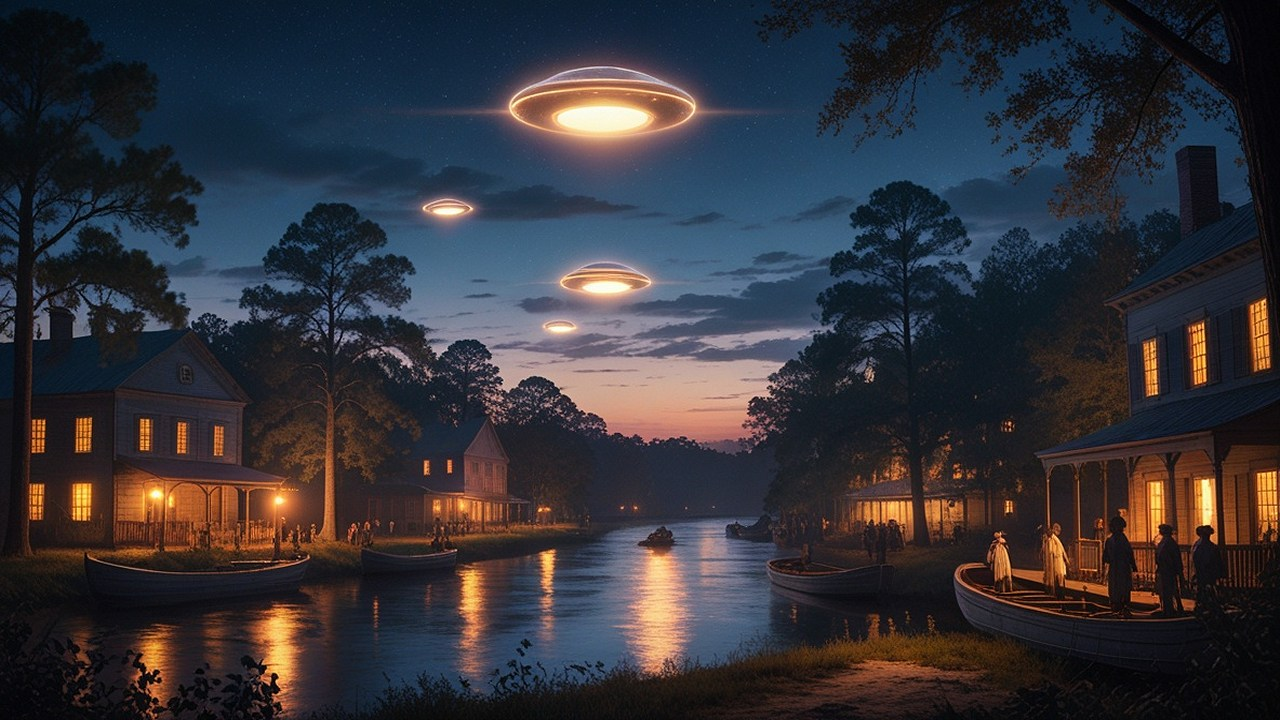
In the final decade of the 18th century, as the young United States consolidated its independence and Georgia transitioned from a frontier colony into a growing state, residents near Augusta—the bustling inland hub on the Savannah River—reported a series of puzzling aerial phenomena. These accounts describe floating luminous spheres, bright orbs that appeared at dusk and during the night, hovering above the treetops of the surrounding pine forests and riverbanks. Unlike fleeting meteors or the predictable paths of planets, these glowing globes exhibited behaviors that seemed intentional or mechanical: they would hang motionless for extended periods, only to suddenly accelerate with remarkable speed before vanishing abruptly. Some reports indicated the same or similar objects reappearing over multiple consecutive nights, fueling speculation and quiet alarm among farmers, merchants, and river traders who gathered in the evenings.
This is the story of the 1790s Augusta flying globes — luminous orbs reported in the young American republic that show striking similarities to modern UFO orb sightings. Welcome to the channel. Today we examine these early American accounts in full detail, staying faithful to the historical record.
Augusta in the 1790s was no isolated backwater. Established in 1735 as a trading post and named after Princess Augusta of Saxe-Gotha, it had grown into a vital commercial center. The city served as Georgia’s temporary capital after the Revolutionary War and functioned as a gateway for trade with the backcountry and interactions with Creek and Cherokee nations. Warehouses lined the river, cotton and tobacco moved downstream toward Savannah, and new settlers arrived regularly seeking land in the expanding republic. Life followed the rhythms of agriculture, river commerce, and seasonal hunts. Evenings often brought families and neighbors outdoors to escape the heat of modest wooden homes or to share news under the vast Southern sky. It was in these ordinary moments — perhaps while tending livestock, walking home from a tavern, or simply gazing upward during a clear twilight — that the luminous orbs made their presence known.
Witnesses consistently described the objects as spherical or globe-like, emitting a steady, self-contained brightness that ranged from soft white or yellowish to an intense, almost lantern-like glow. They hovered silently at altitudes estimated anywhere from just above the tallest pines to several hundred feet, casting faint illumination on the foliage below without producing heat, smoke, or sound. No crackling energy, no whooshing wind, no visible exhaust or flames accompanied them. Then, without warning, the orbs would accelerate — sometimes darting horizontally at speeds far exceeding any bird or balloon, other times shooting upward or vanishing instantaneously as if winking out of existence. This sudden change from perfect stillness to rapid motion defied the era’s understanding of natural aerial phenomena. Ball lightning, for instance, was rare, usually tied to thunderstorms, and behaved erratically rather than hovering patiently. Swamp gas or will-o’-the-wisps flickered low to the ground and lacked the brilliant, defined spherical form. Lanterns carried by humans or attached to boats could not float independently above treetops or accelerate so dramatically.
The recurring nature of the sightings added to their impact. In some cases, the flying globes appeared on successive evenings, sometimes in the same general area along the river or over the rolling hills west of town. This repetition allowed multiple independent observers — planters from nearby plantations, soldiers at the small military outpost, and townsfolk — to compare notes and confirm details. Conversations in Augusta’s growing squares or along Broad Street likely mixed practical concern with superstition. Was this a new atmospheric curiosity? A divine sign amid the political uncertainties of the post-Revolutionary period, when tensions with Native tribes, Spanish Florida, and even internal debates over federal power simmered? Or something more ominous, perhaps reconnaissance by foreign agents using experimental devices? In an age still influenced by biblical interpretations and folk traditions, luminous spheres in the sky could evoke images of heavenly portents, angelic messengers, or even the “fiery chariots” of scripture. Yet the controlled hovering and sudden accelerations suggested a level of precision and technology far beyond anything available in the 1790s. Hot-air balloons were experimental curiosities in Europe and had not yet become commonplace in rural Georgia; even the most advanced ones could not hover silently for long or vanish on command.
These 1790s Augusta reports stand out for their striking resemblance to modern orb UFO sightings, which remain among the most frequently documented unidentified aerial phenomena today. Contemporary orb accounts often describe small-to-medium spherical lights that exhibit the exact same characteristics: prolonged hovering with no apparent support, intelligent or purposeful movement, sudden high-speed acceleration or direction changes, and silent disappearance. Modern witnesses frequently capture them on video or still cameras as glowing balls of light that defy wind patterns and conventional aircraft behavior.
In ufology, orbs are sometimes categorized as “nocturnal lights” or probes — possibly remote sensing devices, energy manifestations, or even non-physical entities. The consistency across centuries suggests a persistent phenomenon rather than isolated misidentifications. While skeptics in the 1790s (and today) might propose swamp gas, ball lightning, distant lanterns, or even early misperceived stars or planets under unusual atmospheric conditions, the collective details — multiple nights, treetop altitudes, abrupt accelerations — resist easy dismissal.
Georgia’s broader historical context enriches these accounts. The state’s rivers and dense woodlands created ideal conditions for clear night skies unpolluted by modern lights, making unusual aerial objects more noticeable. Indigenous oral traditions in the region sometimes spoke of sky spirits or “star people,” and European settlers blended these with their own superstitions. The 1790s also marked a period of rapid change: the invention of the cotton gin in 1793 would soon transform Southern agriculture, while political events like the Whiskey Rebellion and Jay Treaty reflected national growing pains. Against this backdrop, the flying globes offered a momentary distraction or source of wonder.
No formal scientific investigation existed at the time; newspapers were few and focused on politics or commerce, so most records survived through private letters, diaries, and later oral histories passed down in Augusta families. These fragments paint a picture of genuine perplexity rather than sensationalism.
The similarity to today’s orb reports invites deeper reflection on the continuity of anomalous phenomena. In an era of smartphones and radar, orbs are still reported worldwide — over military installations, rural areas, and urban neighborhoods — often exhibiting the same hover-and-dart behavior. Some researchers propose they represent a form of plasma or electromagnetic energy; others suggest intelligent control or even interdimensional origins. Whatever the explanation, the 1790s Augusta globes predate powered flight, dirigibles, and drones by more than a century, ruling out conventional technology. Their appearance over a strategically located river town adds intrigue: Augusta’s position made it a natural waypoint for trade and potential military interest, raising questions about why such phenomena might manifest in specific geographic corridors.
Ultimately, these luminous spheres enrich Georgia’s overlooked legacy of sky anomalies, linking the earlier Savannah sightings of 1693 and 1735 with later waves. They remind us that long before the term “UFO” entered the lexicon in the 1940s, ordinary people in America’s expanding republic looked up and saw lights that challenged their worldview. In the quiet dusk of 1790s Augusta, as the Savannah River murmured below and fireflies danced among the trees, bright orbs hovered and darted — silent witnesses to a mystery that persists into our own time. Whether natural rarity, technological artifact, or something stranger, the flying globes left an indelible impression: the night sky above the young nation held secrets that neither reason nor faith could fully unravel.
In the final decade of the 18th century, as the young United States consolidated its independence and Georgia transitioned from a frontier colony into a growing state, residents near Augusta—the bustling inland hub on the Savannah River—reported a series of puzzling aerial phenomena. These accounts describe floating luminous spheres, bright orbs that appeared at dusk and during the night, hovering above the treetops of the surrounding pine forests and riverbanks. Unlike fleeting meteors or the predictable paths of planets, these glowing globes exhibited behaviors that seemed intentional or mechanical: they would hang motionless for extended periods, only to suddenly accelerate with remarkable speed before vanishing abruptly. Some reports indicated the same or similar objects reappearing over multiple consecutive nights, fueling speculation and quiet alarm among farmers, merchants, and river traders who gathered in the evenings.
This is the story of the 1790s Augusta flying globes — luminous orbs reported in the young American republic that show striking similarities to modern UFO orb sightings. Welcome to the channel. Today we examine these early American accounts in full detail, staying faithful to the historical record.
Augusta in the 1790s was no isolated backwater. Established in 1735 as a trading post and named after Princess Augusta of Saxe-Gotha, it had grown into a vital commercial center. The city served as Georgia’s temporary capital after the Revolutionary War and functioned as a gateway for trade with the backcountry and interactions with Creek and Cherokee nations. Warehouses lined the river, cotton and tobacco moved downstream toward Savannah, and new settlers arrived regularly seeking land in the expanding republic. Life followed the rhythms of agriculture, river commerce, and seasonal hunts. Evenings often brought families and neighbors outdoors to escape the heat of modest wooden homes or to share news under the vast Southern sky. It was in these ordinary moments — perhaps while tending livestock, walking home from a tavern, or simply gazing upward during a clear twilight — that the luminous orbs made their presence known.
Witnesses consistently described the objects as spherical or globe-like, emitting a steady, self-contained brightness that ranged from soft white or yellowish to an intense, almost lantern-like glow. They hovered silently at altitudes estimated anywhere from just above the tallest pines to several hundred feet, casting faint illumination on the foliage below without producing heat, smoke, or sound. No crackling energy, no whooshing wind, no visible exhaust or flames accompanied them. Then, without warning, the orbs would accelerate — sometimes darting horizontally at speeds far exceeding any bird or balloon, other times shooting upward or vanishing instantaneously as if winking out of existence. This sudden change from perfect stillness to rapid motion defied the era’s understanding of natural aerial phenomena. Ball lightning, for instance, was rare, usually tied to thunderstorms, and behaved erratically rather than hovering patiently. Swamp gas or will-o’-the-wisps flickered low to the ground and lacked the brilliant, defined spherical form. Lanterns carried by humans or attached to boats could not float independently above treetops or accelerate so dramatically.
The recurring nature of the sightings added to their impact. In some cases, the flying globes appeared on successive evenings, sometimes in the same general area along the river or over the rolling hills west of town. This repetition allowed multiple independent observers — planters from nearby plantations, soldiers at the small military outpost, and townsfolk — to compare notes and confirm details. Conversations in Augusta’s growing squares or along Broad Street likely mixed practical concern with superstition. Was this a new atmospheric curiosity? A divine sign amid the political uncertainties of the post-Revolutionary period, when tensions with Native tribes, Spanish Florida, and even internal debates over federal power simmered? Or something more ominous, perhaps reconnaissance by foreign agents using experimental devices? In an age still influenced by biblical interpretations and folk traditions, luminous spheres in the sky could evoke images of heavenly portents, angelic messengers, or even the “fiery chariots” of scripture. Yet the controlled hovering and sudden accelerations suggested a level of precision and technology far beyond anything available in the 1790s. Hot-air balloons were experimental curiosities in Europe and had not yet become commonplace in rural Georgia; even the most advanced ones could not hover silently for long or vanish on command.
These 1790s Augusta reports stand out for their striking resemblance to modern orb UFO sightings, which remain among the most frequently documented unidentified aerial phenomena today. Contemporary orb accounts often describe small-to-medium spherical lights that exhibit the exact same characteristics: prolonged hovering with no apparent support, intelligent or purposeful movement, sudden high-speed acceleration or direction changes, and silent disappearance. Modern witnesses frequently capture them on video or still cameras as glowing balls of light that defy wind patterns and conventional aircraft behavior.
In ufology, orbs are sometimes categorized as “nocturnal lights” or probes — possibly remote sensing devices, energy manifestations, or even non-physical entities. The consistency across centuries suggests a persistent phenomenon rather than isolated misidentifications. While skeptics in the 1790s (and today) might propose swamp gas, ball lightning, distant lanterns, or even early misperceived stars or planets under unusual atmospheric conditions, the collective details — multiple nights, treetop altitudes, abrupt accelerations — resist easy dismissal.
Georgia’s broader historical context enriches these accounts. The state’s rivers and dense woodlands created ideal conditions for clear night skies unpolluted by modern lights, making unusual aerial objects more noticeable. Indigenous oral traditions in the region sometimes spoke of sky spirits or “star people,” and European settlers blended these with their own superstitions. The 1790s also marked a period of rapid change: the invention of the cotton gin in 1793 would soon transform Southern agriculture, while political events like the Whiskey Rebellion and Jay Treaty reflected national growing pains. Against this backdrop, the flying globes offered a momentary distraction or source of wonder.
No formal scientific investigation existed at the time; newspapers were few and focused on politics or commerce, so most records survived through private letters, diaries, and later oral histories passed down in Augusta families. These fragments paint a picture of genuine perplexity rather than sensationalism.
The similarity to today’s orb reports invites deeper reflection on the continuity of anomalous phenomena. In an era of smartphones and radar, orbs are still reported worldwide — over military installations, rural areas, and urban neighborhoods — often exhibiting the same hover-and-dart behavior. Some researchers propose they represent a form of plasma or electromagnetic energy; others suggest intelligent control or even interdimensional origins. Whatever the explanation, the 1790s Augusta globes predate powered flight, dirigibles, and drones by more than a century, ruling out conventional technology. Their appearance over a strategically located river town adds intrigue: Augusta’s position made it a natural waypoint for trade and potential military interest, raising questions about why such phenomena might manifest in specific geographic corridors.
Ultimately, these luminous spheres enrich Georgia’s overlooked legacy of sky anomalies, linking the earlier Savannah sightings of 1693 and 1735 with later waves. They remind us that long before the term “UFO” entered the lexicon in the 1940s, ordinary people in America’s expanding republic looked up and saw lights that challenged their worldview. In the quiet dusk of 1790s Augusta, as the Savannah River murmured below and fireflies danced among the trees, bright orbs hovered and darted — silent witnesses to a mystery that persists into our own time. Whether natural rarity, technological artifact, or something stranger, the flying globes left an indelible impression: the night sky above the young nation held secrets that neither reason nor faith could fully unravel.