


Blog Categories
- African Incidents
- Atlantis Incidents
- Australian Incidents
- Belgian Incidents
- Bermuda Triangle Incidents
- Brazilian Incidents
- Canadian Incidents
- Chinese Incidents
- European Incidents
- France Incidents
- Ghosts
- Giants
- Italy Incidents
- Japanese Incidents
- Middle East Incidents
- Portugal Incidents
- Project Serpo
- Puerto Rico Incidents
- Russian Incidents
- Sasquatch
- Scandinavia Incidents
- Spanish Incidents
- UFOs
- United Kingdom Incidents
- United States Incidents
1796: The Caribbean Sea Burning Ship
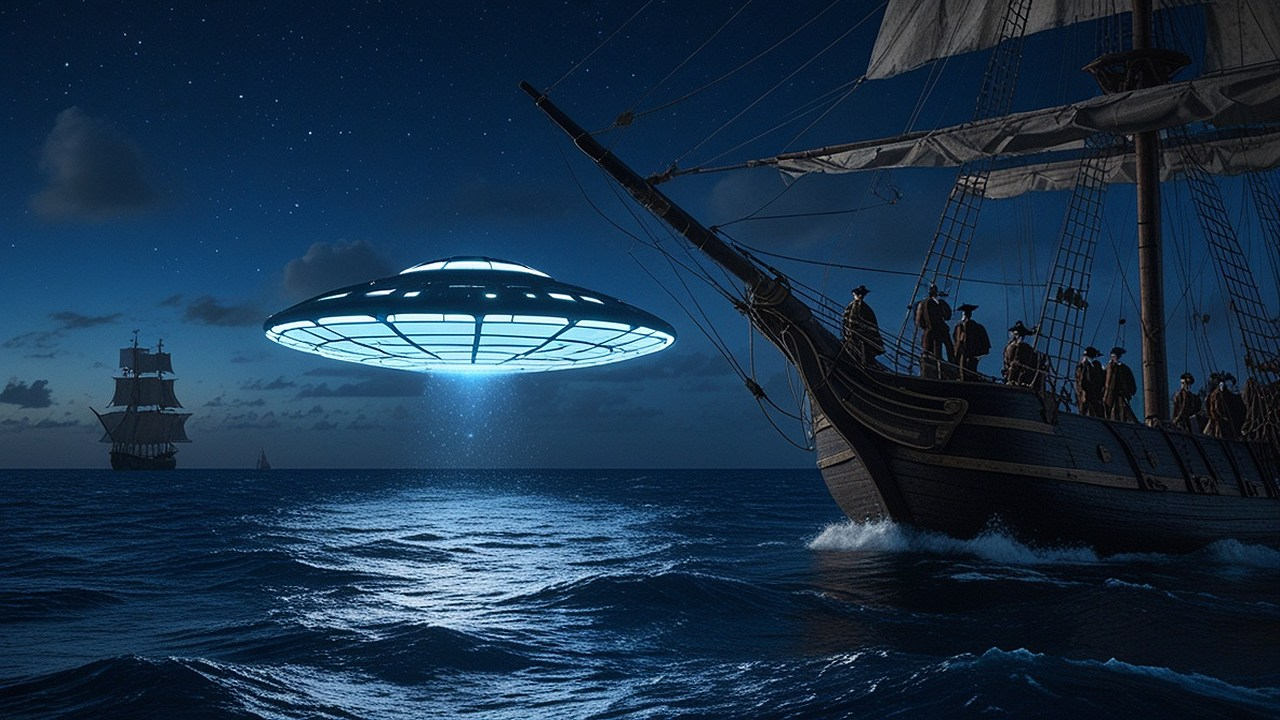
Imagine you are on a British merchant ship in 1796. No radio. No aircraft. No electric lights on the horizon. Just wood, canvas, stars, and the Caribbean after nightfall.
Then something rises out of the water on the starboard side.
It glows blue white. It has edges. It looks like a hull. The sailors will later call it a burning ship without flame.
It makes no sound. It sheds no sparks. The water around it stays dark except where the object touches the surface. It hovers. Then it goes straight up and is gone in seconds.
That is the 1796 Caribbean Sea event as it comes down to us. Not a campfire story invented last week. A report that begins in the world of ship logs, island ports, and the Age of Sail.
Stay with this one. The details are simple. The pattern is not.
THE WORLD OF 1796
Historians usually frame 1796 as a year of maritime expansion, colonial rivalry, and the height of the Age of Sail. The ocean was still a frontier. In many ways it was as unknown to those crews as deep space is to us.
Sailors guided themselves with their senses, their instincts, and centuries of nautical tradition. Storms, reefs, and foreign shores were the expected hazards. Strange lights were written into logs often enough that a glow on the water was not automatically a crisis.
What sets this case apart is not that a light was seen. It is how the light behaved.
The unnamed British merchant vessel was on a routine crossing, moving goods between island ports on a well established route. British merchant shipping was at its height. This was not an explorer lost at the edge of the map. This was working traffic in familiar water.
Then, shortly after nightfall, a bright object appeared to starboard.
WHAT THEY SAW
The first thing that pulled their attention was not only brightness. It was the way the light came up out of the ocean itself.
This was not described as a reflection of stars on the swell. It was not written as ordinary marine bioluminescence. The illumination had structure. Witnesses described edges, a hull like shape, and an outline consistent enough that it suggested design rather than a smear of light.
They called it a ship of light.
It glowed blue white, brighter than moonlit foam. The water around it stayed dark except where the object met the surface. That contrast is important. A burning wreck throws light onto the sea. A flare lights a patch of water. Here the glow belonged to the object.
The most striking detail recorded in the ship’s log was silence.
Storms make sound. Waves make sound. Wooden vessels make sound. This thing came out of the ocean without disturbing it in any natural manner the crew recognized. As it rose it shed no sparks, no smoke, and no flame.
That is why later retellings settled on a phrase that still carries the case: a burning ship without flame.
TWO WAYS OF SEEING THE SAME THING
The crew did not share one interpretation. That split is part of the historical value of the report.
Eighteenth century sailors were often deeply superstitious. Many believed in omens, sea spirits, and divine portents. For some of the men, a luminous object rising from the deep was proof that something supernatural had come to warn them or curse them.
Others tried to stay practical. At least one officer reached for physical language. One account speaks of a metallic gleam, a surface that not only glowed but reflected starlight in a way that did not match biological life or a simple atmospheric trick.
So you have two registers in the same event. Traditional seafaring fear on one side. Early rational observation on the other. The object did not care which language the witnesses used. It was still there.
HOVER, THEN STRAIGHT UP
Once fully above the water, the object hovered briefly.
The log indicates it remained partially translucent in some areas. That suggested the glow may have come from within rather than only from the skin of the thing. The sailors could not measure it with instruments. Comparisons to common ships of the era put it somewhere between twenty and forty feet in length.
Then the pause ended.
The object accelerated straight upward at a speed that stunned every witness. No sound. No trail. No visible propulsion. It vanished into the night sky in a matter of seconds.
In 1796 that kind of vertical climb had no civilian or naval counterpart. Sails do not do that. Balloons of the period do not punch off the sea like that. Even if you bring modern aircraft into the conversation, instantaneous lift of that kind is still the part that stops people.
This is why the case is treated as an early sea to air transition, the signature now associated with unidentified submerged objects and with craft that do not stay in one medium.
Rise from water. Structured light. Silence. Hover. Vertical departure. Controlled motion rather than a random flash.
That sequence is the spine of the report.
WHAT IT DID TO THE CREW
The effect on the men was immediate and it lasted.
Some believed they had seen an apparition that foretold misfortune. Maritime life was already dangerous. Anything that looked supernatural could break nerve. A few sailors reportedly refused night watch duties for weeks afterward.
Officers had a different job. They had to keep the ship running. They tried to calm the crew by calling the event an unusual natural occurrence. They could not name the occurrence. That failure did not reduce the mystery. It fed it.
Fear and discipline sat on the same deck.
FROM LOG TO TAVERN TO FOLKLORE
As the story moved through Caribbean ports and into Atlantic trade routes, it took on a second life.
Sailors repeated it. Some embellished it. That is how oral maritime culture works. The core held: an object rose from the sea, glowed in silence, and flew upward.
Over time the account sat beside ghost ships, spectral lights, and sea monsters in the folklore of the trade. The difference is the origin point. This one is tied to a British ship log. That is why researchers treat it as a historical report rather than only a yarn told for rum.
Officers who kept logs had little reason to invent a spectacle that could stain a reputation. Ink and parchment were not spent lightly. The anonymity of the crew does not erase that professional habit. The men who wrote it down are not famous. Their usefulness is the record itself.
WHY MODERN RESEARCHERS KEEP THIS CASE
There was no public concept of spacecraft in 1796. Visitors from other worlds lived mostly in philosophical speculation, not in a sailor’s working vocabulary. Yet the description tracks with later unidentified aerial and submerged reports.
When twentieth century researchers began mining pre modern accounts, this incident resurfaced as one of the earliest documented examples of a sea to air transition. That retroactive placement matters. It argues that the phenomenon is not a product of radar, jet aircraft, or Cold War nerves alone.
Modern lists of strengthening details are taken from the same report you have already heard.
The object rose from beneath the water.
It emitted light without a trail or vapor.
It moved in silence.
Its acceleration sat beyond eighteenth century technology.
The outline read as structured, not as a shapeless glow.
Those are the same traits that keep showing up in later USO and UFO files.
The long term effect of the case is therefore double.
First, it changes how some historians read early maritime lights. Not every strange vessel at sea has to be dumped into myth by default. Some entries look like fragments of a longer unidentified record.
Second, it sits in the foundation of modern USO research. Persistence across centuries is data. Consistency of behavior is data. A log from 1796 cannot tell you propulsion physics. It can tell you that the pattern did not begin in 1947.
FOLKLORE AND DOCUMENTATION ARE NOT THE SAME THING
Many early maritime wonders die from lack of writing. A tale lives in a port and then dissolves. This one has a documented starting point in disciplined British recordkeeping.
That does not make the object identified. It makes the testimony harder to dismiss as a modern hoax or a television script. No one in 1796 was chasing a YouTube algorithm. No one was fitting the story to a Pentagon hearing. They were trying to name a light that came out of the sea and left the sky.
The case bridges anecdotal folklore and written testimony. That bridge is why it keeps getting cited.
THE PATTERN ACROSS CENTURIES
Look at the repeating pieces.
A glowing structured object.
A crossing between sea and sky.
Silent movement.
Sudden acceleration.
Those pieces appear in different cultures, different oceans, and different centuries. The 1796 Caribbean report is one coordinate on that line. It does not close the mystery. It lengthens the timeline.
The sailors had no airplanes, no submarines as we know them, no electrical grid, and no mass media to copy a standard UFO story. They still described something that modern witnesses keep describing.
A pro UFO reading does not require you to pound the table and declare a species or a home world. It requires you to let the same behaviors sit next to each other across time and admit that coincidence is doing a lot of work if every century is inventing the same object from scratch.
The sea is still a frontier. Most of it is unmapped in any practical sense. The Caribbean of 1796 was a working ocean and still produced a moment when the known world touched something that would not name itself.
CLOSING
The burning ship without flame is not famous because a celebrity saw it. It is remembered because the description is clean and because it matches a class of reports that never really went away.
A British merchant crew on a routine run.
A structured blue white light rising starboard after dark.
No flame. No sound. A brief hover. A climb that emptied the sky in seconds.
They called it a ship of light because that was the closest word they had. We would file it with unidentified submerged objects that do not stay submerged.
If you study this subject honestly, you do not get to start the clock in the 1940s and ignore the water. The ocean was first. The logs were first. The fear on that deck was first.
The sailors who watched that glow come out of the Caribbean did not have our vocabulary. They recognized wonder when it was sitting on the surface of their sea.
If you want more historical cases that look like modern USOs, stay with the channel. Read the comments if you have seen lights on the water that did not behave like ships. And remember this date when someone tells you the phenomenon is only a postwar story.
A burning ship. No flame. Then the sky.
Imagine you are on a British merchant ship in 1796. No radio. No aircraft. No electric lights on the horizon. Just wood, canvas, stars, and the Caribbean after nightfall.
Then something rises out of the water on the starboard side.
It glows blue white. It has edges. It looks like a hull. The sailors will later call it a burning ship without flame.
It makes no sound. It sheds no sparks. The water around it stays dark except where the object touches the surface. It hovers. Then it goes straight up and is gone in seconds.
That is the 1796 Caribbean Sea event as it comes down to us. Not a campfire story invented last week. A report that begins in the world of ship logs, island ports, and the Age of Sail.
Stay with this one. The details are simple. The pattern is not.
THE WORLD OF 1796
Historians usually frame 1796 as a year of maritime expansion, colonial rivalry, and the height of the Age of Sail. The ocean was still a frontier. In many ways it was as unknown to those crews as deep space is to us.
Sailors guided themselves with their senses, their instincts, and centuries of nautical tradition. Storms, reefs, and foreign shores were the expected hazards. Strange lights were written into logs often enough that a glow on the water was not automatically a crisis.
What sets this case apart is not that a light was seen. It is how the light behaved.
The unnamed British merchant vessel was on a routine crossing, moving goods between island ports on a well established route. British merchant shipping was at its height. This was not an explorer lost at the edge of the map. This was working traffic in familiar water.
Then, shortly after nightfall, a bright object appeared to starboard.
WHAT THEY SAW
The first thing that pulled their attention was not only brightness. It was the way the light came up out of the ocean itself.
This was not described as a reflection of stars on the swell. It was not written as ordinary marine bioluminescence. The illumination had structure. Witnesses described edges, a hull like shape, and an outline consistent enough that it suggested design rather than a smear of light.
They called it a ship of light.
It glowed blue white, brighter than moonlit foam. The water around it stayed dark except where the object met the surface. That contrast is important. A burning wreck throws light onto the sea. A flare lights a patch of water. Here the glow belonged to the object.
The most striking detail recorded in the ship’s log was silence.
Storms make sound. Waves make sound. Wooden vessels make sound. This thing came out of the ocean without disturbing it in any natural manner the crew recognized. As it rose it shed no sparks, no smoke, and no flame.
That is why later retellings settled on a phrase that still carries the case: a burning ship without flame.
TWO WAYS OF SEEING THE SAME THING
The crew did not share one interpretation. That split is part of the historical value of the report.
Eighteenth century sailors were often deeply superstitious. Many believed in omens, sea spirits, and divine portents. For some of the men, a luminous object rising from the deep was proof that something supernatural had come to warn them or curse them.
Others tried to stay practical. At least one officer reached for physical language. One account speaks of a metallic gleam, a surface that not only glowed but reflected starlight in a way that did not match biological life or a simple atmospheric trick.
So you have two registers in the same event. Traditional seafaring fear on one side. Early rational observation on the other. The object did not care which language the witnesses used. It was still there.
HOVER, THEN STRAIGHT UP
Once fully above the water, the object hovered briefly.
The log indicates it remained partially translucent in some areas. That suggested the glow may have come from within rather than only from the skin of the thing. The sailors could not measure it with instruments. Comparisons to common ships of the era put it somewhere between twenty and forty feet in length.
Then the pause ended.
The object accelerated straight upward at a speed that stunned every witness. No sound. No trail. No visible propulsion. It vanished into the night sky in a matter of seconds.
In 1796 that kind of vertical climb had no civilian or naval counterpart. Sails do not do that. Balloons of the period do not punch off the sea like that. Even if you bring modern aircraft into the conversation, instantaneous lift of that kind is still the part that stops people.
This is why the case is treated as an early sea to air transition, the signature now associated with unidentified submerged objects and with craft that do not stay in one medium.
Rise from water. Structured light. Silence. Hover. Vertical departure. Controlled motion rather than a random flash.
That sequence is the spine of the report.
WHAT IT DID TO THE CREW
The effect on the men was immediate and it lasted.
Some believed they had seen an apparition that foretold misfortune. Maritime life was already dangerous. Anything that looked supernatural could break nerve. A few sailors reportedly refused night watch duties for weeks afterward.
Officers had a different job. They had to keep the ship running. They tried to calm the crew by calling the event an unusual natural occurrence. They could not name the occurrence. That failure did not reduce the mystery. It fed it.
Fear and discipline sat on the same deck.
FROM LOG TO TAVERN TO FOLKLORE
As the story moved through Caribbean ports and into Atlantic trade routes, it took on a second life.
Sailors repeated it. Some embellished it. That is how oral maritime culture works. The core held: an object rose from the sea, glowed in silence, and flew upward.
Over time the account sat beside ghost ships, spectral lights, and sea monsters in the folklore of the trade. The difference is the origin point. This one is tied to a British ship log. That is why researchers treat it as a historical report rather than only a yarn told for rum.
Officers who kept logs had little reason to invent a spectacle that could stain a reputation. Ink and parchment were not spent lightly. The anonymity of the crew does not erase that professional habit. The men who wrote it down are not famous. Their usefulness is the record itself.
WHY MODERN RESEARCHERS KEEP THIS CASE
There was no public concept of spacecraft in 1796. Visitors from other worlds lived mostly in philosophical speculation, not in a sailor’s working vocabulary. Yet the description tracks with later unidentified aerial and submerged reports.
When twentieth century researchers began mining pre modern accounts, this incident resurfaced as one of the earliest documented examples of a sea to air transition. That retroactive placement matters. It argues that the phenomenon is not a product of radar, jet aircraft, or Cold War nerves alone.
Modern lists of strengthening details are taken from the same report you have already heard.
The object rose from beneath the water.
It emitted light without a trail or vapor.
It moved in silence.
Its acceleration sat beyond eighteenth century technology.
The outline read as structured, not as a shapeless glow.
Those are the same traits that keep showing up in later USO and UFO files.
The long term effect of the case is therefore double.
First, it changes how some historians read early maritime lights. Not every strange vessel at sea has to be dumped into myth by default. Some entries look like fragments of a longer unidentified record.
Second, it sits in the foundation of modern USO research. Persistence across centuries is data. Consistency of behavior is data. A log from 1796 cannot tell you propulsion physics. It can tell you that the pattern did not begin in 1947.
FOLKLORE AND DOCUMENTATION ARE NOT THE SAME THING
Many early maritime wonders die from lack of writing. A tale lives in a port and then dissolves. This one has a documented starting point in disciplined British recordkeeping.
That does not make the object identified. It makes the testimony harder to dismiss as a modern hoax or a television script. No one in 1796 was chasing a YouTube algorithm. No one was fitting the story to a Pentagon hearing. They were trying to name a light that came out of the sea and left the sky.
The case bridges anecdotal folklore and written testimony. That bridge is why it keeps getting cited.
THE PATTERN ACROSS CENTURIES
Look at the repeating pieces.
A glowing structured object.
A crossing between sea and sky.
Silent movement.
Sudden acceleration.
Those pieces appear in different cultures, different oceans, and different centuries. The 1796 Caribbean report is one coordinate on that line. It does not close the mystery. It lengthens the timeline.
The sailors had no airplanes, no submarines as we know them, no electrical grid, and no mass media to copy a standard UFO story. They still described something that modern witnesses keep describing.
A pro UFO reading does not require you to pound the table and declare a species or a home world. It requires you to let the same behaviors sit next to each other across time and admit that coincidence is doing a lot of work if every century is inventing the same object from scratch.
The sea is still a frontier. Most of it is unmapped in any practical sense. The Caribbean of 1796 was a working ocean and still produced a moment when the known world touched something that would not name itself.
CLOSING
The burning ship without flame is not famous because a celebrity saw it. It is remembered because the description is clean and because it matches a class of reports that never really went away.
A British merchant crew on a routine run.
A structured blue white light rising starboard after dark.
No flame. No sound. A brief hover. A climb that emptied the sky in seconds.
They called it a ship of light because that was the closest word they had. We would file it with unidentified submerged objects that do not stay submerged.
If you study this subject honestly, you do not get to start the clock in the 1940s and ignore the water. The ocean was first. The logs were first. The fear on that deck was first.
The sailors who watched that glow come out of the Caribbean did not have our vocabulary. They recognized wonder when it was sitting on the surface of their sea.
If you want more historical cases that look like modern USOs, stay with the channel. Read the comments if you have seen lights on the water that did not behave like ships. And remember this date when someone tells you the phenomenon is only a postwar story.
A burning ship. No flame. Then the sky.