


Blog Categories
- African Incidents
- Atlantis Incidents
- Australian Incidents
- Belgian Incidents
- Bermuda Triangle Incidents
- Brazilian Incidents
- Canadian Incidents
- Chinese Incidents
- European Incidents
- France Incidents
- Ghosts
- Giants
- Italy Incidents
- Japanese Incidents
- Middle East Incidents
- Portugal Incidents
- Project Serpo
- Puerto Rico Incidents
- Russian Incidents
- Sasquatch
- Scandinavia Incidents
- Spanish Incidents
- UFOs
- United Kingdom Incidents
- United States Incidents
1800s: General Strange Lights Over Hawaiian Waters
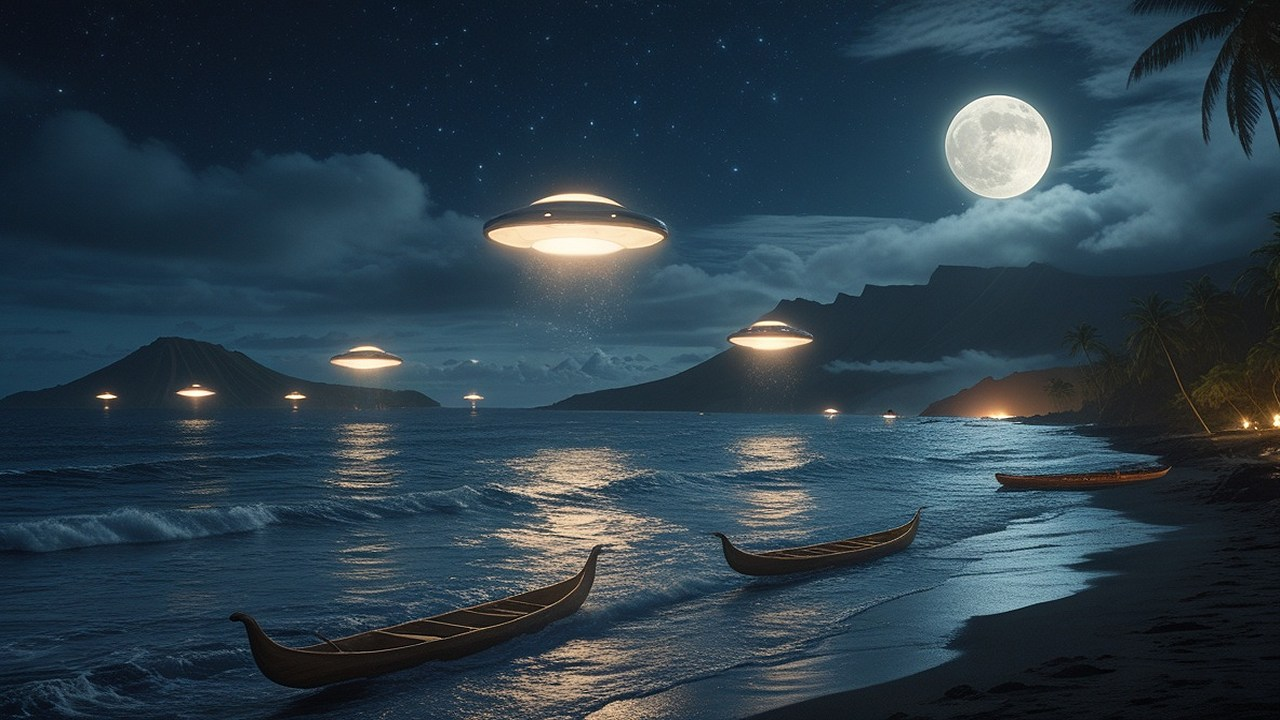
In the early-to-mid 1800s, long before the modern concept of UFOs existed, Hawaiian fishermen, sailors, and coastal residents began recording accounts of mysterious lights appearing over the ocean and islands. These phenomena were often described as glowing orbs or unusually bright lights that hovered, moved erratically, or appeared to rise directly from the water. Such reports represent the earliest documented layer of anomalous aerial activity in the Hawaiian Islands and predate the formal UFO era by well over a century. In the absence of contemporary scientific terminology, these lights were frequently interpreted through traditional Hawaiian spiritual and cultural lenses, sometimes viewed as manifestations of spirits, omens, or supernatural forces connected to the ocean and ancestral realms. These early sightings form a foundational chapter in Hawaii’s long history of unexplained aerial phenomena.
This is the story of the strange lights over Hawaiian waters in the 1800s — glowing orbs witnessed by practical observers who lived closest to the sea and sky. Welcome to the channel. Today we examine these early accounts in full detail, staying faithful to the historical and cultural record.
The Hawaiian Islands in the early-to-mid 19th century existed in a period of profound transition. The Kingdom of Hawaii was navigating increasing contact with the outside world, including Western explorers, missionaries, and traders. Traditional Hawaiian society, with its rich oral traditions, spiritual beliefs, and deep connection to the ‘aina (land) and moana (ocean), provided the primary framework through which unusual events were understood. Fishermen and sailors, who spent long hours on the water under vast night skies, were among the most frequent observers. Their livelihoods depended on keen awareness of natural signs — currents, winds, stars, and marine life — making them particularly attuned to anything that deviated from expected patterns. Coastal residents and those living near sheltered bays similarly maintained constant vigilance over the horizon. In this environment, a glowing orb hovering silently or rising from the sea would have been impossible to ignore.
The phenomena themselves shared several recurring characteristics across multiple independent accounts. Witnesses frequently described bright, self-luminous orbs or diffuse glowing lights that appeared over the ocean. These lights were reported to hover motionless for extended periods, sometimes defying prevailing winds or currents. Others moved in erratic or purposeful patterns — darting, changing direction suddenly, or traveling at speeds inconsistent with known vessels of the era. A particularly striking detail in many reports was the apparent ability of these lights to rise directly from the surface of the water, as though emerging from the depths rather than descending from the sky. This water-origin aspect distinguished them from typical celestial or meteorological events and contributed to their mysterious reputation.
Because these sightings occurred well before the invention of electric lighting, aircraft, or modern navigation aids, the lights stood out dramatically against the dark Pacific night. Hawaiian waters, especially around the main islands, offered vast, unobstructed views. On clear nights, with minimal light pollution, even modest luminous phenomena would have been highly visible to those on canoes, small sailing vessels, or along the shoreline. The consistency of descriptions across different observers — fishermen working at night, inter-island sailors, and coastal families — suggests a genuine anomalous presence rather than isolated imagination. These were practical people whose survival depended on accurate environmental perception. Their collective testimony carries significant cultural weight.
In traditional Hawaiian worldview, such phenomena were often understood through spiritual and ancestral lenses. Hawaiian cosmology is deeply intertwined with the natural world, where lights in the sky or sea could represent akua (gods or deities), aumakua (ancestral guardian spirits), or significant omens. A glowing orb rising from the ocean might be interpreted as a manifestation of Kanaloa, the god associated with the sea, or as a sign from departed ancestors. Some accounts likely entered oral traditions as stories of supernatural visitations or warnings. This cultural interpretation did not diminish the reality of the observations; rather, it provided a framework for understanding experiences that fell outside ordinary categories. The lights were not dismissed as mere curiosities but treated as meaningful events worthy of remembrance and retelling.
The early-to-mid 1800s represent a unique transitional period in Hawaiian history. As Western influence grew — with the arrival of missionaries, increased maritime trade, and eventual political changes — traditional spiritual explanations began to coexist with emerging scientific perspectives. Some later accounts from this era show a blending of worldviews, where Hawaiian observers might describe the lights in both spiritual and more observational terms. Sailors with exposure to Western ships sometimes compared the phenomena to unusual lanterns or signals, yet noted behaviors (prolonged hovering, erratic movement, silent operation) that did not match known technology. This tension between traditional knowledge and new influences makes these reports especially valuable for understanding how anomalous events were processed in a rapidly changing society.
Geographically, the Hawaiian Islands’ position in the central Pacific made them natural observation points for maritime phenomena. The vast expanse of surrounding ocean, combined with the islands’ volcanic origins and unique atmospheric conditions, created an environment where unusual lights could be seen from great distances. Inter-island channels and coastal waters were busy with traditional voyaging canoes and, increasingly, Western vessels. This maritime activity increased the number of potential witnesses and helped spread accounts between islands. The lights’ apparent connection to the ocean — rising from the water or moving across it — reinforced their significance in a culture where the sea held profound spiritual and practical importance.
The significance of these early reports lies in their role as the foundational layer of Hawaii’s anomalous aerial history. They establish that unexplained luminous phenomena were being observed in Hawaiian skies and waters long before the modern UFO era began in 1947. This pre-1900 activity challenges the notion that UFO phenomena are solely a product of the post-World War II technological age. Instead, it suggests a longer, continuous pattern of interaction between humans and unknown aerial or transmedium objects in the Pacific region. For researchers studying global UAP patterns, these Hawaiian accounts provide valuable historical context, showing that similar phenomena were reported in isolated island cultures well before widespread aviation or media connectivity.
The cultural legacy of these early sightings persists in Hawaiian oral traditions and local folklore. Stories of mysterious lights over the ocean have been passed down through generations of fishing families and coastal communities. While many specific details have faded with time, the general motif of anomalous lights connected to the sea remains part of Hawaii’s rich narrative heritage. Modern Hawaiian cultural practitioners sometimes reinterpret these historical accounts through contemporary lenses, seeing them as possible evidence of ancestral knowledge or continued spiritual presence. This cultural continuity demonstrates how anomalous experiences become woven into a people’s collective memory.
In the broader context of Pacific anomalous phenomena, the early Hawaiian reports align with similar accounts from other island nations and maritime cultures. Lights rising from the sea, hovering orbs, and erratic luminous objects appear in traditions across Polynesia and beyond. This suggests the possibility of a regional pattern rather than isolated incidents. The Hawaiian cases, with their emphasis on ocean-origin and spiritual interpretation, offer a unique cultural perspective that enriches global UAP studies. They remind us that the interpretation of such phenomena is deeply influenced by the observer’s worldview, geography, and historical moment.
Today, as scientific interest in unidentified aerial phenomena grows, these early-to-mid 1800s Hawaiian reports take on renewed importance. They provide historical depth to modern discussions about transmedium objects and unidentified lights over ocean areas. With advanced sensor technology and increased maritime traffic, contemporary researchers can look back at these accounts with fresh appreciation for their consistency and cultural significance. While the lack of photographic evidence or instrumental data from the period limits definitive analysis, the multiplicity of independent witnesses across decades creates a compelling cumulative case for genuine anomalous activity.
The mysterious lights observed by Hawaiian fishermen, sailors, and coastal residents in the early-to-mid 1800s represent more than historical curiosities. They embody the earliest documented layer of anomalous aerial phenomena in the Hawaiian Islands — a foundation upon which later centuries of sightings would build. Interpreted through traditional spiritual lenses yet rooted in direct observation, these accounts reveal a complex interplay between human experience, cultural belief, and the unexplained. For the people of Hawaii, they were not merely lights in the sky but meaningful events connected to the living ocean and ancestral realms.
As we continue to explore the full scope of unidentified aerial phenomena in the 21st century, these early Hawaiian reports serve as an important reminder: the mystery has deep roots. Long before radar, aircraft, or formal investigations, practical observers on the Pacific’s most isolated islands were documenting lights that hovered, moved with purpose, and rose from the sea. Their experiences, preserved through oral tradition and cultural memory, form an essential chapter in Hawaii’s aerial history and contribute to our broader understanding of humanity’s long relationship with the unknown in the skies above.
The glowing orbs and bright lights that appeared over Hawaiian waters in the early-to-mid 1800s may never receive definitive scientific classification. Yet their place in the islands’ history remains secure. They stand as testimony to the enduring enigma of luminous phenomena over the Pacific and the importance of preserving accounts from those who lived closest to the ocean and sky — the fishermen, sailors, and coastal residents whose observations helped shape Hawaii’s rich legacy of anomalous aerial activity.
In the early-to-mid 1800s, long before the modern concept of UFOs existed, Hawaiian fishermen, sailors, and coastal residents began recording accounts of mysterious lights appearing over the ocean and islands. These phenomena were often described as glowing orbs or unusually bright lights that hovered, moved erratically, or appeared to rise directly from the water. Such reports represent the earliest documented layer of anomalous aerial activity in the Hawaiian Islands and predate the formal UFO era by well over a century. In the absence of contemporary scientific terminology, these lights were frequently interpreted through traditional Hawaiian spiritual and cultural lenses, sometimes viewed as manifestations of spirits, omens, or supernatural forces connected to the ocean and ancestral realms. These early sightings form a foundational chapter in Hawaii’s long history of unexplained aerial phenomena.
This is the story of the strange lights over Hawaiian waters in the 1800s — glowing orbs witnessed by practical observers who lived closest to the sea and sky. Welcome to the channel. Today we examine these early accounts in full detail, staying faithful to the historical and cultural record.
The Hawaiian Islands in the early-to-mid 19th century existed in a period of profound transition. The Kingdom of Hawaii was navigating increasing contact with the outside world, including Western explorers, missionaries, and traders. Traditional Hawaiian society, with its rich oral traditions, spiritual beliefs, and deep connection to the ‘aina (land) and moana (ocean), provided the primary framework through which unusual events were understood. Fishermen and sailors, who spent long hours on the water under vast night skies, were among the most frequent observers. Their livelihoods depended on keen awareness of natural signs — currents, winds, stars, and marine life — making them particularly attuned to anything that deviated from expected patterns. Coastal residents and those living near sheltered bays similarly maintained constant vigilance over the horizon. In this environment, a glowing orb hovering silently or rising from the sea would have been impossible to ignore.
The phenomena themselves shared several recurring characteristics across multiple independent accounts. Witnesses frequently described bright, self-luminous orbs or diffuse glowing lights that appeared over the ocean. These lights were reported to hover motionless for extended periods, sometimes defying prevailing winds or currents. Others moved in erratic or purposeful patterns — darting, changing direction suddenly, or traveling at speeds inconsistent with known vessels of the era. A particularly striking detail in many reports was the apparent ability of these lights to rise directly from the surface of the water, as though emerging from the depths rather than descending from the sky. This water-origin aspect distinguished them from typical celestial or meteorological events and contributed to their mysterious reputation.
Because these sightings occurred well before the invention of electric lighting, aircraft, or modern navigation aids, the lights stood out dramatically against the dark Pacific night. Hawaiian waters, especially around the main islands, offered vast, unobstructed views. On clear nights, with minimal light pollution, even modest luminous phenomena would have been highly visible to those on canoes, small sailing vessels, or along the shoreline. The consistency of descriptions across different observers — fishermen working at night, inter-island sailors, and coastal families — suggests a genuine anomalous presence rather than isolated imagination. These were practical people whose survival depended on accurate environmental perception. Their collective testimony carries significant cultural weight.
In traditional Hawaiian worldview, such phenomena were often understood through spiritual and ancestral lenses. Hawaiian cosmology is deeply intertwined with the natural world, where lights in the sky or sea could represent akua (gods or deities), aumakua (ancestral guardian spirits), or significant omens. A glowing orb rising from the ocean might be interpreted as a manifestation of Kanaloa, the god associated with the sea, or as a sign from departed ancestors. Some accounts likely entered oral traditions as stories of supernatural visitations or warnings. This cultural interpretation did not diminish the reality of the observations; rather, it provided a framework for understanding experiences that fell outside ordinary categories. The lights were not dismissed as mere curiosities but treated as meaningful events worthy of remembrance and retelling.
The early-to-mid 1800s represent a unique transitional period in Hawaiian history. As Western influence grew — with the arrival of missionaries, increased maritime trade, and eventual political changes — traditional spiritual explanations began to coexist with emerging scientific perspectives. Some later accounts from this era show a blending of worldviews, where Hawaiian observers might describe the lights in both spiritual and more observational terms. Sailors with exposure to Western ships sometimes compared the phenomena to unusual lanterns or signals, yet noted behaviors (prolonged hovering, erratic movement, silent operation) that did not match known technology. This tension between traditional knowledge and new influences makes these reports especially valuable for understanding how anomalous events were processed in a rapidly changing society.
Geographically, the Hawaiian Islands’ position in the central Pacific made them natural observation points for maritime phenomena. The vast expanse of surrounding ocean, combined with the islands’ volcanic origins and unique atmospheric conditions, created an environment where unusual lights could be seen from great distances. Inter-island channels and coastal waters were busy with traditional voyaging canoes and, increasingly, Western vessels. This maritime activity increased the number of potential witnesses and helped spread accounts between islands. The lights’ apparent connection to the ocean — rising from the water or moving across it — reinforced their significance in a culture where the sea held profound spiritual and practical importance.
The significance of these early reports lies in their role as the foundational layer of Hawaii’s anomalous aerial history. They establish that unexplained luminous phenomena were being observed in Hawaiian skies and waters long before the modern UFO era began in 1947. This pre-1900 activity challenges the notion that UFO phenomena are solely a product of the post-World War II technological age. Instead, it suggests a longer, continuous pattern of interaction between humans and unknown aerial or transmedium objects in the Pacific region. For researchers studying global UAP patterns, these Hawaiian accounts provide valuable historical context, showing that similar phenomena were reported in isolated island cultures well before widespread aviation or media connectivity.
The cultural legacy of these early sightings persists in Hawaiian oral traditions and local folklore. Stories of mysterious lights over the ocean have been passed down through generations of fishing families and coastal communities. While many specific details have faded with time, the general motif of anomalous lights connected to the sea remains part of Hawaii’s rich narrative heritage. Modern Hawaiian cultural practitioners sometimes reinterpret these historical accounts through contemporary lenses, seeing them as possible evidence of ancestral knowledge or continued spiritual presence. This cultural continuity demonstrates how anomalous experiences become woven into a people’s collective memory.
In the broader context of Pacific anomalous phenomena, the early Hawaiian reports align with similar accounts from other island nations and maritime cultures. Lights rising from the sea, hovering orbs, and erratic luminous objects appear in traditions across Polynesia and beyond. This suggests the possibility of a regional pattern rather than isolated incidents. The Hawaiian cases, with their emphasis on ocean-origin and spiritual interpretation, offer a unique cultural perspective that enriches global UAP studies. They remind us that the interpretation of such phenomena is deeply influenced by the observer’s worldview, geography, and historical moment.
Today, as scientific interest in unidentified aerial phenomena grows, these early-to-mid 1800s Hawaiian reports take on renewed importance. They provide historical depth to modern discussions about transmedium objects and unidentified lights over ocean areas. With advanced sensor technology and increased maritime traffic, contemporary researchers can look back at these accounts with fresh appreciation for their consistency and cultural significance. While the lack of photographic evidence or instrumental data from the period limits definitive analysis, the multiplicity of independent witnesses across decades creates a compelling cumulative case for genuine anomalous activity.
The mysterious lights observed by Hawaiian fishermen, sailors, and coastal residents in the early-to-mid 1800s represent more than historical curiosities. They embody the earliest documented layer of anomalous aerial phenomena in the Hawaiian Islands — a foundation upon which later centuries of sightings would build. Interpreted through traditional spiritual lenses yet rooted in direct observation, these accounts reveal a complex interplay between human experience, cultural belief, and the unexplained. For the people of Hawaii, they were not merely lights in the sky but meaningful events connected to the living ocean and ancestral realms.
As we continue to explore the full scope of unidentified aerial phenomena in the 21st century, these early Hawaiian reports serve as an important reminder: the mystery has deep roots. Long before radar, aircraft, or formal investigations, practical observers on the Pacific’s most isolated islands were documenting lights that hovered, moved with purpose, and rose from the sea. Their experiences, preserved through oral tradition and cultural memory, form an essential chapter in Hawaii’s aerial history and contribute to our broader understanding of humanity’s long relationship with the unknown in the skies above.
The glowing orbs and bright lights that appeared over Hawaiian waters in the early-to-mid 1800s may never receive definitive scientific classification. Yet their place in the islands’ history remains secure. They stand as testimony to the enduring enigma of luminous phenomena over the Pacific and the importance of preserving accounts from those who lived closest to the ocean and sky — the fishermen, sailors, and coastal residents whose observations helped shape Hawaii’s rich legacy of anomalous aerial activity.