


Blog Categories
- African Incidents
- Atlantis Incidents
- Australian Incidents
- Belgian Incidents
- Bermuda Triangle Incidents
- Brazilian Incidents
- Canadian Incidents
- Chinese Incidents
- European Incidents
- France Incidents
- Ghosts
- Giants
- Italy Incidents
- Japanese Incidents
- Middle East Incidents
- Portugal Incidents
- Project Serpo
- Puerto Rico Incidents
- Russian Incidents
- Sasquatch
- Scandinavia Incidents
- Spanish Incidents
- UFOs
- United Kingdom Incidents
- United States Incidents
1819: Milledgeville Aerial Light Phenomenon
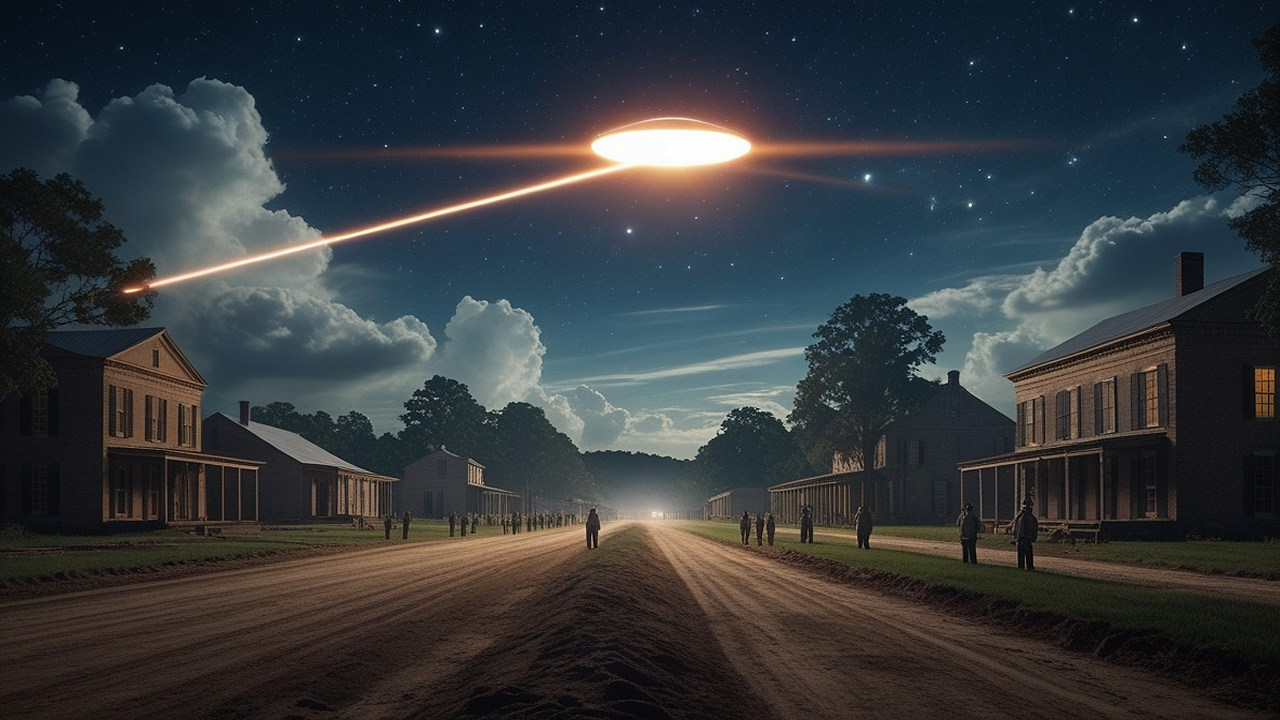
What if I told you that more than two hundred years ago, in the brand-new capital of Georgia, multiple witnesses watched a bright light carve sharp zig-zag paths across the night sky—changing direction abruptly, flaring in brightness, then dimming, all without a single sound?
This was no meteor. No comet. No planet. And in 1819, there were no aircraft, no balloons capable of controlled flight, and no technology that could produce such motion.
Welcome to one of Georgia’s earliest and most compelling historical UAP cases: the 1819 Milledgeville Aerial Light Phenomenon.
In the winter or early months of 1819, residents in and around Milledgeville—then the young state’s capital—witnessed something that still resists easy explanation today.
Milledgeville had been founded in 1803 and designated the capital in 1807. It sat along the Oconee River in Baldwin County, carefully laid out with wide streets, public squares, and grand governmental buildings still under construction. Legislators debated laws. Planters shipped cotton downstream. Settlers streamed in seeking fertile land. The town represented Georgia’s ambitious push into the frontier.
Yet on one or more evenings that year, the orderly rhythms of this budding capital were interrupted by a bright object traversing the sky in ways that defied every natural explanation available at the time.
Witnesses described the object as luminous and distinct. It moved erratically across the heavens with a pronounced zig-zag motion. This was no smooth arc like a comet or the steady drift of a planet. Instead, the light changed direction sharply and repeatedly, creating an angular, almost hesitant or purposeful path that observers found deeply unsettling.
Compounding the strangeness, the object changed brightness mid-flight—flaring intensely at times before dimming to a softer glow, only to brighten again without any apparent external cause such as atmospheric entry or reflection.
These details were not the product of a single excited imagination. The phenomenon was observed by multiple people over a wide area, suggesting it occurred at sufficient altitude to be visible from different vantage points across the town and surrounding countryside. Farmers on outlying plantations, townsfolk in the central squares, and possibly travelers along the river roads all reported consistent elements. In an era when communication relied on word of mouth and handwritten notes, this allowed for genuine cross-verification.
Let’s talk about why the zig-zag trajectory is so important.
Stars and planets appear fixed or move with predictable, gradual motion due to Earth’s rotation. Comets follow sweeping, curved orbits visible over many nights, often with hazy tails. Meteors streak linearly and burn out quickly. Even rare events like ball lightning or auroral displays tend toward erratic flickering but rarely sustain sharp angular changes over a prolonged visible passage.
The 1819 object, by contrast, behaved as if under intelligent control or responding to unseen forces—darting left then right, ascending or descending in abrupt segments.
The accompanying brightness fluctuations added another layer of anomaly. Natural lights do not typically pulse or vary in intensity so dramatically while executing complex maneuvers. And crucially—no sound accompanied the display. No thunder. No hiss. No sonic report. This further rules out explosive atmospheric events or any early experimental rockets, which simply did not exist in rural Georgia at the time.
The year 1819 itself provides important background. It was a time of transition and tension for Georgia and the young United States. The Panic of 1819 triggered the first major U.S. economic depression, with falling cotton prices hitting Southern planters hard. In Milledgeville, the state legislature grappled with issues of banking, land distribution, and relations with the Creek Indians whose territories bordered the expanding settlements.
Religious revivals and folk beliefs still held sway alongside emerging Enlightenment rationalism. In such an environment, a bright, zig-zagging light in the sky could easily be interpreted through multiple lenses. Some witnesses might have seen it as a divine omen—perhaps a warning amid economic hardship or a sign of providence for the young capital. Others, more superstitious, may have whispered of portents linked to Indian unrest or moral failings.
A few practical minds likely attempted naturalistic explanations: a particularly vivid meteor with unusual persistence, swamp gas illuminated under rare conditions, or even a distant lantern carried aloft by wind. But no balloon technology existed locally that could support sustained, high-altitude flight with directional changes.
Yet the collective testimony challenges these dismissals. Multiple independent observers across a broad geographic span reduce the likelihood of mass hallucination or localized illusion.
The erratic motion and variable brightness align closely with characteristics that modern researchers identify as hallmarks of unidentified aerial phenomena. In contemporary reports, objects exhibiting non-ballistic, angular trajectories—often described as “impossible” by aerodynamic standards—frequently resist prosaic categorization even under radar or infrared scrutiny.
The 1819 Milledgeville sighting forms part of a longer continuum in Georgia’s anomalous history. It bridges the earlier luminous events near Savannah in 1693 and 1735 and the glowing orbs reported around Augusta in the 1790s. These recurring patterns in the same broad region suggest something more persistent than isolated misperceptions.
Documentation from the period is inevitably fragmentary. Milledgeville newspapers like The Reflector, active in the late 1810s, focused primarily on political news, land sales, and commercial notices, with limited space for “curiosities.” Surviving accounts likely persisted through private letters, diaries kept by prominent citizens, or oral traditions handed down in local families.
In a small capital town where everyone knew one another, such a shared wonder would have been discussed in taverns, churches, and legislative hallways, embedding itself in regional lore even if never formally investigated by scientists of the day. No telescopes or systematic observatories existed locally. Astronomy remained the domain of educated amateurs who still sometimes blended observation with astrology.
The event’s significance lies in its demonstration of erratic movement as an enduring diagnostic trait. Across centuries and cultures, reports of objects executing sharp turns, instantaneous stops, or zig-zag paths have consistently puzzled witnesses and investigators alike. These behaviors violate expectations of inertia and gravity for both natural objects and known human technology.
In 1819, with no aircraft, drones, or even widespread hot-air balloons, such motion was literally impossible by contemporary means.
Today, similar reports often prompt official inquiries precisely because they suggest propulsion systems or control mechanisms beyond conventional physics as publicly understood.
As Milledgeville matured—hosting governors, witnessing the growth of the cotton kingdom, and later serving as a Confederate capital during the Civil War—the 1819 aerial light faded into memory. Yet it contributed to the area’s subtle reputation for the unexplained.
Modern visitors to the preserved historic district, with its grand old homes and layered legends, walk streets where ancestors once stared skyward in bewilderment.
The sighting invites broader questions that still matter: Were these historical anomalies early glimpses of the same phenomena now studied by government UAP task forces? Do they reflect rare but natural plasma or electromagnetic events that science has yet to fully classify? Or do they hint at something more intentional—visitation, surveillance, or phenomena that each era interprets through its own cultural filters?
Whatever the ultimate explanation, the 1819 Milledgeville Aerial Light Phenomenon enriches our understanding of how ordinary Americans in the early republic encountered the unknown. In an age of nation-building and westward expansion, the night sky above the Oconee River delivered a reminder that not every mystery yielded to reason or faith alone.
The bright, zig-zagging object that changed brightness and defied smooth celestial paths left witnesses with a sense of awe and unease that echoes across time. It stands as a quiet but powerful chapter in Georgia’s hidden chronicle of sky events—evidence that even in the dawning light of the 19th century, the heavens could still surprise, confound, and inspire.
If you’ve ever looked up and felt that the sky was looking back… this case is for you.
What do you think the 1819 witnesses saw over Milledgeville? Drop your thoughts in the comments. And if you want more deep historical UAP cases from Georgia and beyond, hit subscribe and turn on notifications. The mystery continues.
What if I told you that more than two hundred years ago, in the brand-new capital of Georgia, multiple witnesses watched a bright light carve sharp zig-zag paths across the night sky—changing direction abruptly, flaring in brightness, then dimming, all without a single sound?
This was no meteor. No comet. No planet. And in 1819, there were no aircraft, no balloons capable of controlled flight, and no technology that could produce such motion.
Welcome to one of Georgia’s earliest and most compelling historical UAP cases: the 1819 Milledgeville Aerial Light Phenomenon.
In the winter or early months of 1819, residents in and around Milledgeville—then the young state’s capital—witnessed something that still resists easy explanation today.
Milledgeville had been founded in 1803 and designated the capital in 1807. It sat along the Oconee River in Baldwin County, carefully laid out with wide streets, public squares, and grand governmental buildings still under construction. Legislators debated laws. Planters shipped cotton downstream. Settlers streamed in seeking fertile land. The town represented Georgia’s ambitious push into the frontier.
Yet on one or more evenings that year, the orderly rhythms of this budding capital were interrupted by a bright object traversing the sky in ways that defied every natural explanation available at the time.
Witnesses described the object as luminous and distinct. It moved erratically across the heavens with a pronounced zig-zag motion. This was no smooth arc like a comet or the steady drift of a planet. Instead, the light changed direction sharply and repeatedly, creating an angular, almost hesitant or purposeful path that observers found deeply unsettling.
Compounding the strangeness, the object changed brightness mid-flight—flaring intensely at times before dimming to a softer glow, only to brighten again without any apparent external cause such as atmospheric entry or reflection.
These details were not the product of a single excited imagination. The phenomenon was observed by multiple people over a wide area, suggesting it occurred at sufficient altitude to be visible from different vantage points across the town and surrounding countryside. Farmers on outlying plantations, townsfolk in the central squares, and possibly travelers along the river roads all reported consistent elements. In an era when communication relied on word of mouth and handwritten notes, this allowed for genuine cross-verification.
Let’s talk about why the zig-zag trajectory is so important.
Stars and planets appear fixed or move with predictable, gradual motion due to Earth’s rotation. Comets follow sweeping, curved orbits visible over many nights, often with hazy tails. Meteors streak linearly and burn out quickly. Even rare events like ball lightning or auroral displays tend toward erratic flickering but rarely sustain sharp angular changes over a prolonged visible passage.
The 1819 object, by contrast, behaved as if under intelligent control or responding to unseen forces—darting left then right, ascending or descending in abrupt segments.
The accompanying brightness fluctuations added another layer of anomaly. Natural lights do not typically pulse or vary in intensity so dramatically while executing complex maneuvers. And crucially—no sound accompanied the display. No thunder. No hiss. No sonic report. This further rules out explosive atmospheric events or any early experimental rockets, which simply did not exist in rural Georgia at the time.
The year 1819 itself provides important background. It was a time of transition and tension for Georgia and the young United States. The Panic of 1819 triggered the first major U.S. economic depression, with falling cotton prices hitting Southern planters hard. In Milledgeville, the state legislature grappled with issues of banking, land distribution, and relations with the Creek Indians whose territories bordered the expanding settlements.
Religious revivals and folk beliefs still held sway alongside emerging Enlightenment rationalism. In such an environment, a bright, zig-zagging light in the sky could easily be interpreted through multiple lenses. Some witnesses might have seen it as a divine omen—perhaps a warning amid economic hardship or a sign of providence for the young capital. Others, more superstitious, may have whispered of portents linked to Indian unrest or moral failings.
A few practical minds likely attempted naturalistic explanations: a particularly vivid meteor with unusual persistence, swamp gas illuminated under rare conditions, or even a distant lantern carried aloft by wind. But no balloon technology existed locally that could support sustained, high-altitude flight with directional changes.
Yet the collective testimony challenges these dismissals. Multiple independent observers across a broad geographic span reduce the likelihood of mass hallucination or localized illusion.
The erratic motion and variable brightness align closely with characteristics that modern researchers identify as hallmarks of unidentified aerial phenomena. In contemporary reports, objects exhibiting non-ballistic, angular trajectories—often described as “impossible” by aerodynamic standards—frequently resist prosaic categorization even under radar or infrared scrutiny.
The 1819 Milledgeville sighting forms part of a longer continuum in Georgia’s anomalous history. It bridges the earlier luminous events near Savannah in 1693 and 1735 and the glowing orbs reported around Augusta in the 1790s. These recurring patterns in the same broad region suggest something more persistent than isolated misperceptions.
Documentation from the period is inevitably fragmentary. Milledgeville newspapers like The Reflector, active in the late 1810s, focused primarily on political news, land sales, and commercial notices, with limited space for “curiosities.” Surviving accounts likely persisted through private letters, diaries kept by prominent citizens, or oral traditions handed down in local families.
In a small capital town where everyone knew one another, such a shared wonder would have been discussed in taverns, churches, and legislative hallways, embedding itself in regional lore even if never formally investigated by scientists of the day. No telescopes or systematic observatories existed locally. Astronomy remained the domain of educated amateurs who still sometimes blended observation with astrology.
The event’s significance lies in its demonstration of erratic movement as an enduring diagnostic trait. Across centuries and cultures, reports of objects executing sharp turns, instantaneous stops, or zig-zag paths have consistently puzzled witnesses and investigators alike. These behaviors violate expectations of inertia and gravity for both natural objects and known human technology.
In 1819, with no aircraft, drones, or even widespread hot-air balloons, such motion was literally impossible by contemporary means.
Today, similar reports often prompt official inquiries precisely because they suggest propulsion systems or control mechanisms beyond conventional physics as publicly understood.
As Milledgeville matured—hosting governors, witnessing the growth of the cotton kingdom, and later serving as a Confederate capital during the Civil War—the 1819 aerial light faded into memory. Yet it contributed to the area’s subtle reputation for the unexplained.
Modern visitors to the preserved historic district, with its grand old homes and layered legends, walk streets where ancestors once stared skyward in bewilderment.
The sighting invites broader questions that still matter: Were these historical anomalies early glimpses of the same phenomena now studied by government UAP task forces? Do they reflect rare but natural plasma or electromagnetic events that science has yet to fully classify? Or do they hint at something more intentional—visitation, surveillance, or phenomena that each era interprets through its own cultural filters?
Whatever the ultimate explanation, the 1819 Milledgeville Aerial Light Phenomenon enriches our understanding of how ordinary Americans in the early republic encountered the unknown. In an age of nation-building and westward expansion, the night sky above the Oconee River delivered a reminder that not every mystery yielded to reason or faith alone.
The bright, zig-zagging object that changed brightness and defied smooth celestial paths left witnesses with a sense of awe and unease that echoes across time. It stands as a quiet but powerful chapter in Georgia’s hidden chronicle of sky events—evidence that even in the dawning light of the 19th century, the heavens could still surprise, confound, and inspire.
If you’ve ever looked up and felt that the sky was looking back… this case is for you.
What do you think the 1819 witnesses saw over Milledgeville? Drop your thoughts in the comments. And if you want more deep historical UAP cases from Georgia and beyond, hit subscribe and turn on notifications. The mystery continues.