


Blog Categories
- African Incidents
- Atlantis Incidents
- Australian Incidents
- Belgian Incidents
- Bermuda Triangle Incidents
- Brazilian Incidents
- Canadian Incidents
- Chinese Incidents
- European Incidents
- France Incidents
- Ghosts
- Giants
- Italy Incidents
- Japanese Incidents
- Middle East Incidents
- Portugal Incidents
- Project Serpo
- Puerto Rico Incidents
- Russian Incidents
- Sasquatch
- Scandinavia Incidents
- Spanish Incidents
- UFOs
- United Kingdom Incidents
- United States Incidents
1840s: Macon Silent Airship Accounts
Macon, Georgia. The 1840s.
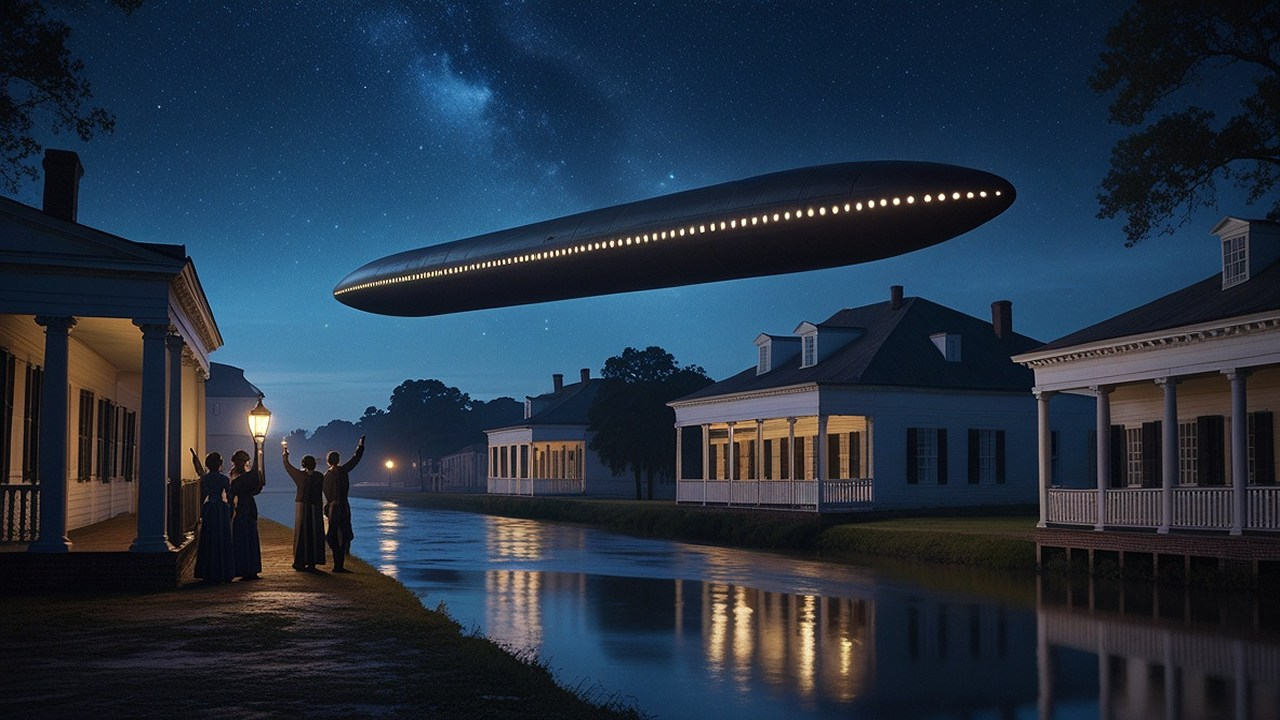
The Ocmulgee River is still. Cotton money is moving. Greek Revival porches are full after supper. Someone on a veranda points up.
A long shape is crossing the stars.
Not a spark. Not a cloud. An elongated body — cylindrical, cigar-like, dirigible-like. It is moving slowly. It is moving as if it means to. And it makes no sound.
No roaring engine. No flapping canvas. No hiss of gas.
Some of the people watching say faint lights run along it. Portholes. Running lamps. A low glow down the hull. The lights hold or flicker as the thing slides from one horizon toward the other.
This is not 1897. This is not California’s phantom airship summer. This is central Georgia, decades earlier, in a city that had only been incorporated in 1823.
1840s. The Macon Silent Airship Accounts.
If you have been told that mystery airships begin with newspaper hysteria in 1896 and 1897, Macon is the correction.
Residents of the growing city and the countryside around it reported something highly unusual in the night sky. Macon sat on the Ocmulgee in the middle of the state. It was a cotton market, a railroad point, a gateway into the plantation economy. Churches and academies were going up. The city already had one of the South’s earliest opera houses. Antebellum life had a rhythm: river trade, harvest, social calls, warehouse labor.
Into that rhythm came multiple witnesses describing a long, cigar-shaped object that moved slowly and silently overhead.
The accounts do not read like a vague light in the woods. They describe structure. Elongated. Cylindrical. A form that looks built, not blown. It glided at a leisurely pace, often low enough that people on the ground could study it. Later experimental balloons and airships would be associated with noise and canvas. This thing was not.
The silence is the detail that should stop a casual dismissal. No audible propulsion. No hissing gas. No mechanical whir.
Some reports add the lights — faint, along the length, steady or flickering as it passed.
These details did not arrive as a national wire story. They survive as scattered eyewitness testimony in private letters, local diaries, and occasional newspaper mentions of “curious aerial phenomena.” They were not as loud as the later national flap. What they have instead is consistency across different parts of Macon and nearby Bibb County. In an era that did not reward sky stories with fame, that consistency is the case.
The decade is the argument.
In the 1840s, practical powered airship technology did not exist.
Early ballooning — Montgolfier in the 1780s, later gas balloons in Europe and America — meant short, wind-dependent flights. Inflation and venting were not quiet. Those craft were creatures of daylight or of hanging lanterns. They could not hold a slow, controlled path over a populated city without becoming slaves to the wind.
No inventor in the United States or anywhere else had demonstrated a steerable, silent, cigar-shaped aerial vessel that behaved the way the Macon witnesses described.
Henri Giffard’s steam-powered airship does not fly until 1852. Even that machine is crude, short-range, and nothing like silent graceful passage over rooftops. The first successful dirigibles are still in the future. The Wright brothers are not born yet into this story. Zeppelin is not the explanation.
So the 1840s Macon sightings predate the 1890s airship wave. They also predate any publicly known aviation that could honestly stand in for a long, quiet, lit hull moving with purpose.
That is not a vibe. That is a calendar.
Picture the evening the chapter asks you to picture.
The sun is down over the Ocmulgee. The sky is indigo and stars. Families on verandas. Talk of cotton prices. Couples walking. Laborers leaving the warehouses.
Someone points.
A dark elongated shape comes against the stars — longer than any balloon people in Macon would have known, with clean, deliberate contours. It drifts slowly from horizon to horizon. The motion is steady. It does not look slapped around by wind.
Faint lights mark the underside or the sides. Soft illumination on the river, on the roofs. The night’s ordinary sounds stay ordinary: crickets, a distant train, conversation breaking into wonder. Witnesses watch for several minutes. Then the object fades with distance or leaves their view.
Controlled silent flight, in 1840s Georgia, leaves you two boxes. Secret human technology far ahead of the public record. Or something outside the inventory of the decade.
The culture of the 1840s South did not have the word UFO. It had Providence, folklore, and skepticism.
Religious observers could call it a sign — a heavenly vessel, a warning, while sectional tension over slavery and states’ rights was already in the air. Superstitious readers could reach for phantom ships and ghostly apparitions. Skeptics reached for nature and for human tricks: an oddly shaped cloud lit by distant lightning, birds flashing moonlight, an experimental balloon from a plantation or a traveling show.
The chapter does not pretend those guesses were never offered. It says they do not hold the details.
Clouds do not keep a rigid cigar form or cut a precise path against the prevailing wind. Birds flap. Birds do not glow. A balloon of that era does not give you sustained, silent, structured slow flight over a city with lights along a hull.
The shape, the deliberate speed, the silence, and the reported lights are the four points that keep the file open.
Macon does not sit alone in Georgia’s older sky record.
It follows luminous events in Savannah in 1693 and 1735. It follows glowing orbs near Augusta in the 1790s. It follows the erratic zig-zag light over Milledgeville in 1819.
Taken together, those cases sketch a pattern: structured or semi-structured craft — or lights that refuse to behave like stars — decades before anyone said “flying saucer.”
The 1840s silent airship accounts matter in that line because they describe a craft, not only a glow. They anticipate the cigar vessels that newspapers would fill with in 1896 and 1897: long hulls, lights, sometimes propellers that seemed absent or useless, maneuvers that should not have been possible.
If Macon is real as reported, the 1890s flap is harder to write off as a one-season panic cooked by headlines and Jules Verne. It starts to look like volume turning up on a phenomenon that was already passing over Southern towns.
Do not expect a binder from the mayor.
Local papers such as the Macon Telegraph ran politics, commerce, and social news first. Unverified sky stories were not the business model. What survives is likely personal correspondence to family in Savannah or Atlanta, and lines in planters’ journals. In a close town those nights would have been talked through in churches, lodges, and market days. That is oral history, not a press conference.
No formal scientific body opened a file. Astronomy and meteorology were still young and still tangled with popular superstition.
Modern historical ufology cares about these pre-1890s reports for a blunt reason. They cut the claim that airship stories were only late-century expectation — people seeing the machine they had just been taught to imagine. A silent cigar over 1840s Macon already has the classic structured-craft list: defined shape, controlled motion, no conventional propulsion, night visibility with lighting.
Venus does not become a long hull. A lantern on a kite does not give you minutes of city-wide slow passage and independent talk across Macon and Bibb County. A hoax has to explain why the same outline keeps coming back in a decade that had no public machine to copy.
The 1840s Macon accounts belong in Georgia’s hidden ledger of sky anomalies. They also belong in the longer American argument about when this started.
This was the age of Manifest Destiny, steam, and new rails. Over a prosperous Southern city the night still delivered a reminder that not all motion overhead was earthly.
Decades before the Wrights, decades before Zeppelin, something long, silent, and lit moved with purpose above the Ocmulgee. Witnesses were left with awe, questions, and stories that did not need a national brand to stay alive.
The chapter does not force a single label. Rare atmospheric plasma. A secret experiment by an unknown builder. Something stranger. What it refuses is the easy erasure: that nothing with structure appeared in American skies until newspapers taught people the word airship.
If this investigation helped you, subscribe. Georgia’s sky record did not begin in 1947. It did not even begin in 1897. Sometimes it began with a quiet hull over the river, and people on a porch who knew enough to look up.
Macon, Georgia. The 1840s.
The Ocmulgee River is still. Cotton money is moving. Greek Revival porches are full after supper. Someone on a veranda points up.
A long shape is crossing the stars.
Not a spark. Not a cloud. An elongated body — cylindrical, cigar-like, dirigible-like. It is moving slowly. It is moving as if it means to. And it makes no sound.
No roaring engine. No flapping canvas. No hiss of gas.
Some of the people watching say faint lights run along it. Portholes. Running lamps. A low glow down the hull. The lights hold or flicker as the thing slides from one horizon toward the other.
This is not 1897. This is not California’s phantom airship summer. This is central Georgia, decades earlier, in a city that had only been incorporated in 1823.
1840s. The Macon Silent Airship Accounts.
If you have been told that mystery airships begin with newspaper hysteria in 1896 and 1897, Macon is the correction.
Residents of the growing city and the countryside around it reported something highly unusual in the night sky. Macon sat on the Ocmulgee in the middle of the state. It was a cotton market, a railroad point, a gateway into the plantation economy. Churches and academies were going up. The city already had one of the South’s earliest opera houses. Antebellum life had a rhythm: river trade, harvest, social calls, warehouse labor.
Into that rhythm came multiple witnesses describing a long, cigar-shaped object that moved slowly and silently overhead.
The accounts do not read like a vague light in the woods. They describe structure. Elongated. Cylindrical. A form that looks built, not blown. It glided at a leisurely pace, often low enough that people on the ground could study it. Later experimental balloons and airships would be associated with noise and canvas. This thing was not.
The silence is the detail that should stop a casual dismissal. No audible propulsion. No hissing gas. No mechanical whir.
Some reports add the lights — faint, along the length, steady or flickering as it passed.
These details did not arrive as a national wire story. They survive as scattered eyewitness testimony in private letters, local diaries, and occasional newspaper mentions of “curious aerial phenomena.” They were not as loud as the later national flap. What they have instead is consistency across different parts of Macon and nearby Bibb County. In an era that did not reward sky stories with fame, that consistency is the case.
The decade is the argument.
In the 1840s, practical powered airship technology did not exist.
Early ballooning — Montgolfier in the 1780s, later gas balloons in Europe and America — meant short, wind-dependent flights. Inflation and venting were not quiet. Those craft were creatures of daylight or of hanging lanterns. They could not hold a slow, controlled path over a populated city without becoming slaves to the wind.
No inventor in the United States or anywhere else had demonstrated a steerable, silent, cigar-shaped aerial vessel that behaved the way the Macon witnesses described.
Henri Giffard’s steam-powered airship does not fly until 1852. Even that machine is crude, short-range, and nothing like silent graceful passage over rooftops. The first successful dirigibles are still in the future. The Wright brothers are not born yet into this story. Zeppelin is not the explanation.
So the 1840s Macon sightings predate the 1890s airship wave. They also predate any publicly known aviation that could honestly stand in for a long, quiet, lit hull moving with purpose.
That is not a vibe. That is a calendar.
Picture the evening the chapter asks you to picture.
The sun is down over the Ocmulgee. The sky is indigo and stars. Families on verandas. Talk of cotton prices. Couples walking. Laborers leaving the warehouses.
Someone points.
A dark elongated shape comes against the stars — longer than any balloon people in Macon would have known, with clean, deliberate contours. It drifts slowly from horizon to horizon. The motion is steady. It does not look slapped around by wind.
Faint lights mark the underside or the sides. Soft illumination on the river, on the roofs. The night’s ordinary sounds stay ordinary: crickets, a distant train, conversation breaking into wonder. Witnesses watch for several minutes. Then the object fades with distance or leaves their view.
Controlled silent flight, in 1840s Georgia, leaves you two boxes. Secret human technology far ahead of the public record. Or something outside the inventory of the decade.
The culture of the 1840s South did not have the word UFO. It had Providence, folklore, and skepticism.
Religious observers could call it a sign — a heavenly vessel, a warning, while sectional tension over slavery and states’ rights was already in the air. Superstitious readers could reach for phantom ships and ghostly apparitions. Skeptics reached for nature and for human tricks: an oddly shaped cloud lit by distant lightning, birds flashing moonlight, an experimental balloon from a plantation or a traveling show.
The chapter does not pretend those guesses were never offered. It says they do not hold the details.
Clouds do not keep a rigid cigar form or cut a precise path against the prevailing wind. Birds flap. Birds do not glow. A balloon of that era does not give you sustained, silent, structured slow flight over a city with lights along a hull.
The shape, the deliberate speed, the silence, and the reported lights are the four points that keep the file open.
Macon does not sit alone in Georgia’s older sky record.
It follows luminous events in Savannah in 1693 and 1735. It follows glowing orbs near Augusta in the 1790s. It follows the erratic zig-zag light over Milledgeville in 1819.
Taken together, those cases sketch a pattern: structured or semi-structured craft — or lights that refuse to behave like stars — decades before anyone said “flying saucer.”
The 1840s silent airship accounts matter in that line because they describe a craft, not only a glow. They anticipate the cigar vessels that newspapers would fill with in 1896 and 1897: long hulls, lights, sometimes propellers that seemed absent or useless, maneuvers that should not have been possible.
If Macon is real as reported, the 1890s flap is harder to write off as a one-season panic cooked by headlines and Jules Verne. It starts to look like volume turning up on a phenomenon that was already passing over Southern towns.
Do not expect a binder from the mayor.
Local papers such as the Macon Telegraph ran politics, commerce, and social news first. Unverified sky stories were not the business model. What survives is likely personal correspondence to family in Savannah or Atlanta, and lines in planters’ journals. In a close town those nights would have been talked through in churches, lodges, and market days. That is oral history, not a press conference.
No formal scientific body opened a file. Astronomy and meteorology were still young and still tangled with popular superstition.
Modern historical ufology cares about these pre-1890s reports for a blunt reason. They cut the claim that airship stories were only late-century expectation — people seeing the machine they had just been taught to imagine. A silent cigar over 1840s Macon already has the classic structured-craft list: defined shape, controlled motion, no conventional propulsion, night visibility with lighting.
Venus does not become a long hull. A lantern on a kite does not give you minutes of city-wide slow passage and independent talk across Macon and Bibb County. A hoax has to explain why the same outline keeps coming back in a decade that had no public machine to copy.
The 1840s Macon accounts belong in Georgia’s hidden ledger of sky anomalies. They also belong in the longer American argument about when this started.
This was the age of Manifest Destiny, steam, and new rails. Over a prosperous Southern city the night still delivered a reminder that not all motion overhead was earthly.
Decades before the Wrights, decades before Zeppelin, something long, silent, and lit moved with purpose above the Ocmulgee. Witnesses were left with awe, questions, and stories that did not need a national brand to stay alive.
The chapter does not force a single label. Rare atmospheric plasma. A secret experiment by an unknown builder. Something stranger. What it refuses is the easy erasure: that nothing with structure appeared in American skies until newspapers taught people the word airship.
If this investigation helped you, subscribe. Georgia’s sky record did not begin in 1947. It did not even begin in 1897. Sometimes it began with a quiet hull over the river, and people on a porch who knew enough to look up.