


Blog Categories
- African Incidents
- Atlantis Incidents
- Australian Incidents
- Belgian Incidents
- Bermuda Triangle Incidents
- Brazilian Incidents
- Canadian Incidents
- Chinese Incidents
- European Incidents
- France Incidents
- Ghosts
- Giants
- Italy Incidents
- Japanese Incidents
- Middle East Incidents
- Portugal Incidents
- Project Serpo
- Puerto Rico Incidents
- Russian Incidents
- Sasquatch
- Scandinavia Incidents
- Spanish Incidents
- UFOs
- United Kingdom Incidents
- United States Incidents
1886: Maui Channel UFO
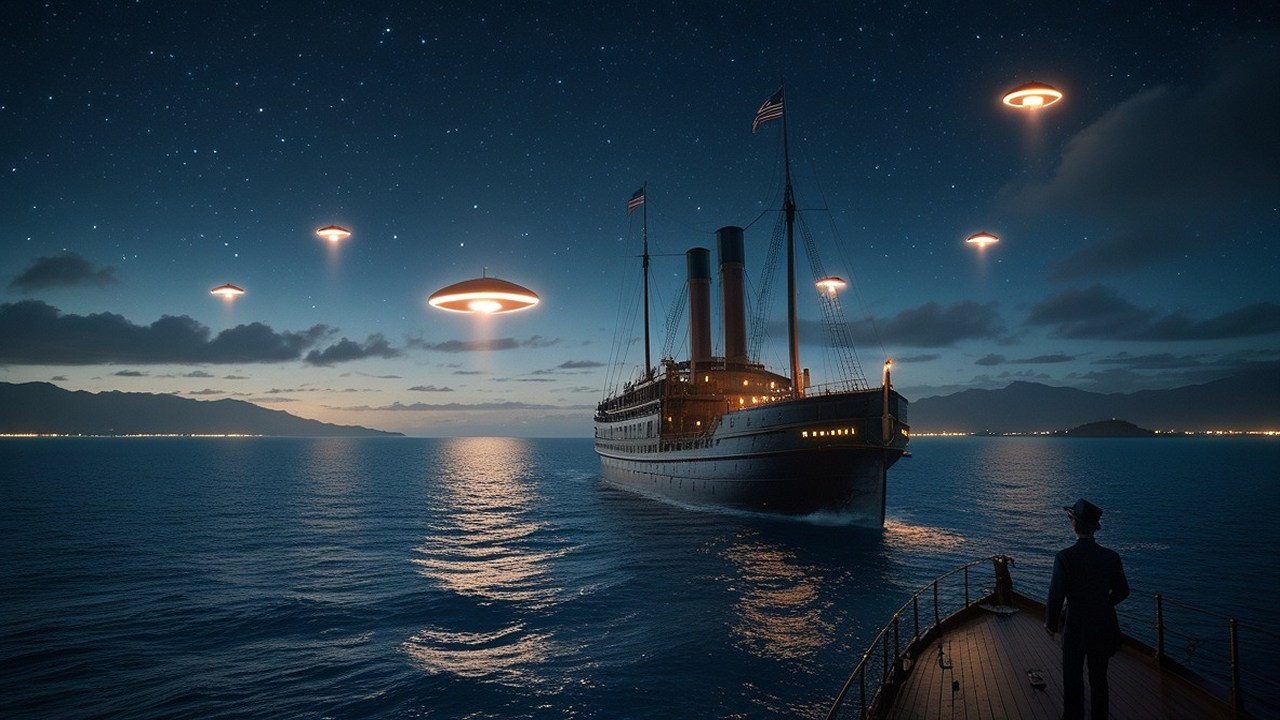
Picture yourself on the deck of a steamship in the middle of the night. The year is 1886. You are crossing the Maui Channel, the stretch of open water between Maui and the neighboring islands. The Pacific is dark. The stars are sharp. Your crew knows every light that should be out there — navigational markers, other vessels, shore lanterns, the familiar patterns of the Hawaiian night.
Then you see lights that do not belong.
They are not where any ship should be. They do not move like any vessel you have ever tracked. They behave in ways that make no sense to men who have spent their lives reading the ocean and the sky.
This is the 1886 Maui Channel sighting — one of the clearest and most credible anomalous light reports from 19th-century Hawaii.
Welcome back. Tonight we examine a case that predates the modern UFO era by more than sixty years, yet already shows the same core mystery we still confront today: experienced observers, in a familiar environment, watching luminous objects that refuse to fit any conventional explanation.
In 1886 the Kingdom of Hawaii was in a period of rapid change. Western trade, missionary influence, and political pressure were growing, yet traditional Hawaiian maritime knowledge remained strong. Inter-island steamship travel was becoming more common, carrying passengers, cargo, and government business between the major islands. The Maui Channel — the waters off North Maui separating the island from Moloka?i and others — was a critical route. Strong currents, changing weather, and regular traffic made it a place where captains and crews had to stay sharp.
These were professional mariners. They navigated by the stars, by compass, by charts, and by the visual memory of every reliable light along the coasts. At night, any light that did not match the expected pattern was immediately noticed. Safety depended on it.
It was during a routine passage through this channel that the captain and crew of the steamship James I. Daet — the name appears with slight spelling variations in the records — observed something that stood out even to men with years of experience in these waters.
The accounts tell us the crew saw strange lights that did not correspond to any known navigational aids, other vessels, or standard maritime signals. These lights behaved in ways inconsistent with the ordinary traffic of the channel. They appeared independent of normal maritime constraints. To sailors who knew the difference between a ship’s lantern, a buoy, a shore light, and a distant star, these objects registered as non-navigational.
Exact technical details — precise colors, exact duration, exact paths — are limited in the surviving records. What remains consistent is the core judgment of the witnesses: the lights were unusual enough, and persistent enough, that experienced seafarers took careful note and later discussed what they had seen. The event was considered significant enough to be remembered and referenced in later maritime and historical compilations of Pacific anomalies.
That is the heart of the case. Not a dramatic close encounter with beings stepping onto the deck. Not a crash or recovery. Simply lights that should not have been there, observed by men whose profession required them to know every light that belonged.
The strength of this report rests heavily on who made it. Steamship captains and crews in 1886 were not casual tourists. They were responsible for lives and cargo. Their training emphasized accurate observation. When something unusual appeared, they were expected to notice it, assess it, and, if necessary, record it. A collective observation by the captain and multiple crew members carries more weight than a single isolated claim. Shared perception reduces the chance of simple individual error or imagination.
These men knew the natural phenomena of Hawaiian waters. They understood how volcanic haze, atmospheric refraction, or bioluminescence could sometimes create unusual effects. They also knew the patterns of traditional Hawaiian canoes and the growing number of Western vessels. When they judged the lights non-navigational, that judgment came from a deep practical knowledge of the environment.
The Maui Channel itself offered long sightlines at night. Open water between the islands meant that distant lights could be visible across significant distances. North Maui’s coastal areas and the channel were active with both traditional voyaging and steamship traffic. The location — between islands rather than directly over a busy harbor — reduced the chance of simple confusion with shore-based lanterns or settlement lights. Whatever the crew saw was operating in the inter-island waters, in a space they knew intimately.
In 19th-century Hawaii, an unusual light over the ocean would have been interpreted through more than one cultural lens. Traditional Hawaiian understanding included rich beliefs about lights and phenomena in the sky and sea — associations with akua, with aumakua, with omens tied to the ocean and to Kanaloa. At the same time, increasing Western influence brought more technological and scientific habits of mind. Some might have wondered about experimental vessels or unknown atmospheric effects. The 1886 report sits at that transitional moment, when traditional and modern ways of seeing the world were both present in the islands.
This dual context makes the case especially interesting. It is not only a maritime anomaly report. It is also a window into how people in Hawaii at that time could encounter something unexplained and begin to process it through the frameworks available to them.
The Maui Channel sighting does not stand completely alone. Similar reports of strange lights over ocean waters appear in records from other Pacific routes and island groups during the 19th century. Lights that hover, move independently of wind or current, or display behavior inconsistent with known vessels form a recurring motif. The vastness of the Pacific and the central role of maritime travel made such observations almost inevitable if anomalous luminous phenomena were occurring. The 1886 Hawaiian case is one of the better-attested examples from the central Pacific in that era. It helps establish an early baseline for these reports in the region.
The account survives in fragmentary form. Steamship captains often kept logs of notable events, and stories of strange lights traveled among crews and through port communities. Later historical compilations of Pacific anomalies have continued to reference the James I. Daet sighting precisely because it was made by professional seafarers rather than casual onlookers. The lack of extensive contemporary documentation limits how far modern analysis can go. We do not have instrumental measurements or multiple independent written logs from different vessels. What we do have is the consistent core: experienced mariners, a specific location, lights that did not match anything they knew.
That limitation is real. It is also common to almost every pre-20th-century anomalous report. The value of the case lies in the quality of the witnesses and the clarity of their judgment that the lights were anomalous.
Within Hawaii’s longer record of unexplained aerial and maritime phenomena, the 1886 Maui Channel sighting serves as an important early marker. It shows that unusual luminous objects were already being noted in Hawaiian waters decades before aircraft, before widespread electric lighting, and long before the post-1947 flying saucer era. Later reports of strange lights in the early 20th century and the modern UFO wave in the islands can be seen as part of a continuum rather than sudden new arrivals. The maritime setting also ties the case directly to Hawaii’s identity as a seafaring culture — a place where the ocean has always been both livelihood and mystery.
For researchers looking at global patterns of unidentified aerial and transmedium phenomena, cases like this provide historical depth. They demonstrate that reports of anomalous lights over open water predate the technologies we now use to explain many modern sightings — drones, aircraft, satellites, or even advanced military craft. The core characteristics described in 1886 — lights that appear independent of normal maritime constraints and behave in ways experienced observers cannot readily classify — continue to appear in later maritime UAP reports around the world. The absence of modern instruments does not erase the testimony of the men who were there.
There is also a quieter cultural legacy. Stories of strange lights over the channels between the Hawaiian Islands have been carried by sailors and coastal families across generations. These accounts become part of the islands’ maritime folklore — practical knowledge mixed with wonder. In contemporary discussions, historical reports like the 1886 sighting sometimes invite reflection on traditional understandings of lights and spirits alongside modern conversations about unidentified phenomena. That continuity matters. It shows how anomalous experiences are absorbed into a people’s memory and continue to resonate.
The 1886 Maui Channel sighting remains one of the better-attested pre-1900 Hawaiian cases for a simple reason: it was documented by professional seafarers who knew the waters and the lights that belonged there. The captain and crew of the James I. Daet saw something that did not fit. They recognized it as non-navigational. They remembered it. And later compilations continued to cite it.
We will never have a perfect reconstruction of that night. The records are limited. Exact movements, colors, and duration are not fully preserved. What is preserved is the judgment of experienced men that the lights were strange enough to note and discuss.
In the dark waters between Maui and the other islands, on a routine steamship passage in 1886, the familiar Pacific night presented something that still sits outside easy explanation. That single fact is why the case endures. It reminds us that the mystery of luminous objects over Hawaiian waters is not a modern invention. It has a history — and that history includes the clear-eyed testimony of mariners who knew the difference between the ordinary and the unexplained.
The lights eventually faded from view. The steamship continued on its course. But the report remained. And more than a century and a quarter later, it still asks the same quiet question: what exactly did those experienced eyes see moving through the Maui Channel that night?
If you have additional historical references or family stories connected to early Hawaiian maritime anomalies, the comments are open. The record grows through careful attention to what the witnesses actually reported.
Thank you for watching. Stay curious. Respect the ocean. And keep looking up — and out across the water. I’ll see you in the next one.
Picture yourself on the deck of a steamship in the middle of the night. The year is 1886. You are crossing the Maui Channel, the stretch of open water between Maui and the neighboring islands. The Pacific is dark. The stars are sharp. Your crew knows every light that should be out there — navigational markers, other vessels, shore lanterns, the familiar patterns of the Hawaiian night.
Then you see lights that do not belong.
They are not where any ship should be. They do not move like any vessel you have ever tracked. They behave in ways that make no sense to men who have spent their lives reading the ocean and the sky.
This is the 1886 Maui Channel sighting — one of the clearest and most credible anomalous light reports from 19th-century Hawaii.
Welcome back. Tonight we examine a case that predates the modern UFO era by more than sixty years, yet already shows the same core mystery we still confront today: experienced observers, in a familiar environment, watching luminous objects that refuse to fit any conventional explanation.
In 1886 the Kingdom of Hawaii was in a period of rapid change. Western trade, missionary influence, and political pressure were growing, yet traditional Hawaiian maritime knowledge remained strong. Inter-island steamship travel was becoming more common, carrying passengers, cargo, and government business between the major islands. The Maui Channel — the waters off North Maui separating the island from Moloka?i and others — was a critical route. Strong currents, changing weather, and regular traffic made it a place where captains and crews had to stay sharp.
These were professional mariners. They navigated by the stars, by compass, by charts, and by the visual memory of every reliable light along the coasts. At night, any light that did not match the expected pattern was immediately noticed. Safety depended on it.
It was during a routine passage through this channel that the captain and crew of the steamship James I. Daet — the name appears with slight spelling variations in the records — observed something that stood out even to men with years of experience in these waters.
The accounts tell us the crew saw strange lights that did not correspond to any known navigational aids, other vessels, or standard maritime signals. These lights behaved in ways inconsistent with the ordinary traffic of the channel. They appeared independent of normal maritime constraints. To sailors who knew the difference between a ship’s lantern, a buoy, a shore light, and a distant star, these objects registered as non-navigational.
Exact technical details — precise colors, exact duration, exact paths — are limited in the surviving records. What remains consistent is the core judgment of the witnesses: the lights were unusual enough, and persistent enough, that experienced seafarers took careful note and later discussed what they had seen. The event was considered significant enough to be remembered and referenced in later maritime and historical compilations of Pacific anomalies.
That is the heart of the case. Not a dramatic close encounter with beings stepping onto the deck. Not a crash or recovery. Simply lights that should not have been there, observed by men whose profession required them to know every light that belonged.
The strength of this report rests heavily on who made it. Steamship captains and crews in 1886 were not casual tourists. They were responsible for lives and cargo. Their training emphasized accurate observation. When something unusual appeared, they were expected to notice it, assess it, and, if necessary, record it. A collective observation by the captain and multiple crew members carries more weight than a single isolated claim. Shared perception reduces the chance of simple individual error or imagination.
These men knew the natural phenomena of Hawaiian waters. They understood how volcanic haze, atmospheric refraction, or bioluminescence could sometimes create unusual effects. They also knew the patterns of traditional Hawaiian canoes and the growing number of Western vessels. When they judged the lights non-navigational, that judgment came from a deep practical knowledge of the environment.
The Maui Channel itself offered long sightlines at night. Open water between the islands meant that distant lights could be visible across significant distances. North Maui’s coastal areas and the channel were active with both traditional voyaging and steamship traffic. The location — between islands rather than directly over a busy harbor — reduced the chance of simple confusion with shore-based lanterns or settlement lights. Whatever the crew saw was operating in the inter-island waters, in a space they knew intimately.
In 19th-century Hawaii, an unusual light over the ocean would have been interpreted through more than one cultural lens. Traditional Hawaiian understanding included rich beliefs about lights and phenomena in the sky and sea — associations with akua, with aumakua, with omens tied to the ocean and to Kanaloa. At the same time, increasing Western influence brought more technological and scientific habits of mind. Some might have wondered about experimental vessels or unknown atmospheric effects. The 1886 report sits at that transitional moment, when traditional and modern ways of seeing the world were both present in the islands.
This dual context makes the case especially interesting. It is not only a maritime anomaly report. It is also a window into how people in Hawaii at that time could encounter something unexplained and begin to process it through the frameworks available to them.
The Maui Channel sighting does not stand completely alone. Similar reports of strange lights over ocean waters appear in records from other Pacific routes and island groups during the 19th century. Lights that hover, move independently of wind or current, or display behavior inconsistent with known vessels form a recurring motif. The vastness of the Pacific and the central role of maritime travel made such observations almost inevitable if anomalous luminous phenomena were occurring. The 1886 Hawaiian case is one of the better-attested examples from the central Pacific in that era. It helps establish an early baseline for these reports in the region.
The account survives in fragmentary form. Steamship captains often kept logs of notable events, and stories of strange lights traveled among crews and through port communities. Later historical compilations of Pacific anomalies have continued to reference the James I. Daet sighting precisely because it was made by professional seafarers rather than casual onlookers. The lack of extensive contemporary documentation limits how far modern analysis can go. We do not have instrumental measurements or multiple independent written logs from different vessels. What we do have is the consistent core: experienced mariners, a specific location, lights that did not match anything they knew.
That limitation is real. It is also common to almost every pre-20th-century anomalous report. The value of the case lies in the quality of the witnesses and the clarity of their judgment that the lights were anomalous.
Within Hawaii’s longer record of unexplained aerial and maritime phenomena, the 1886 Maui Channel sighting serves as an important early marker. It shows that unusual luminous objects were already being noted in Hawaiian waters decades before aircraft, before widespread electric lighting, and long before the post-1947 flying saucer era. Later reports of strange lights in the early 20th century and the modern UFO wave in the islands can be seen as part of a continuum rather than sudden new arrivals. The maritime setting also ties the case directly to Hawaii’s identity as a seafaring culture — a place where the ocean has always been both livelihood and mystery.
For researchers looking at global patterns of unidentified aerial and transmedium phenomena, cases like this provide historical depth. They demonstrate that reports of anomalous lights over open water predate the technologies we now use to explain many modern sightings — drones, aircraft, satellites, or even advanced military craft. The core characteristics described in 1886 — lights that appear independent of normal maritime constraints and behave in ways experienced observers cannot readily classify — continue to appear in later maritime UAP reports around the world. The absence of modern instruments does not erase the testimony of the men who were there.
There is also a quieter cultural legacy. Stories of strange lights over the channels between the Hawaiian Islands have been carried by sailors and coastal families across generations. These accounts become part of the islands’ maritime folklore — practical knowledge mixed with wonder. In contemporary discussions, historical reports like the 1886 sighting sometimes invite reflection on traditional understandings of lights and spirits alongside modern conversations about unidentified phenomena. That continuity matters. It shows how anomalous experiences are absorbed into a people’s memory and continue to resonate.
The 1886 Maui Channel sighting remains one of the better-attested pre-1900 Hawaiian cases for a simple reason: it was documented by professional seafarers who knew the waters and the lights that belonged there. The captain and crew of the James I. Daet saw something that did not fit. They recognized it as non-navigational. They remembered it. And later compilations continued to cite it.
We will never have a perfect reconstruction of that night. The records are limited. Exact movements, colors, and duration are not fully preserved. What is preserved is the judgment of experienced men that the lights were strange enough to note and discuss.
In the dark waters between Maui and the other islands, on a routine steamship passage in 1886, the familiar Pacific night presented something that still sits outside easy explanation. That single fact is why the case endures. It reminds us that the mystery of luminous objects over Hawaiian waters is not a modern invention. It has a history — and that history includes the clear-eyed testimony of mariners who knew the difference between the ordinary and the unexplained.
The lights eventually faded from view. The steamship continued on its course. But the report remained. And more than a century and a quarter later, it still asks the same quiet question: what exactly did those experienced eyes see moving through the Maui Channel that night?
If you have additional historical references or family stories connected to early Hawaiian maritime anomalies, the comments are open. The record grows through careful attention to what the witnesses actually reported.
Thank you for watching. Stay curious. Respect the ocean. And keep looking up — and out across the water. I’ll see you in the next one.