


Blog Categories
- African Incidents
- Atlantis Incidents
- Australian Incidents
- Belgian Incidents
- Bermuda Triangle Incidents
- Brazilian Incidents
- Canadian Incidents
- Chinese Incidents
- European Incidents
- France Incidents
- Ghosts
- Giants
- Italy Incidents
- Japanese Incidents
- Middle East Incidents
- Portugal Incidents
- Project Serpo
- Puerto Rico Incidents
- Russian Incidents
- Sasquatch
- Scandinavia Incidents
- Spanish Incidents
- UFOs
- United Kingdom Incidents
- United States Incidents
1901: The Luminous Sub-Surface Cylinder
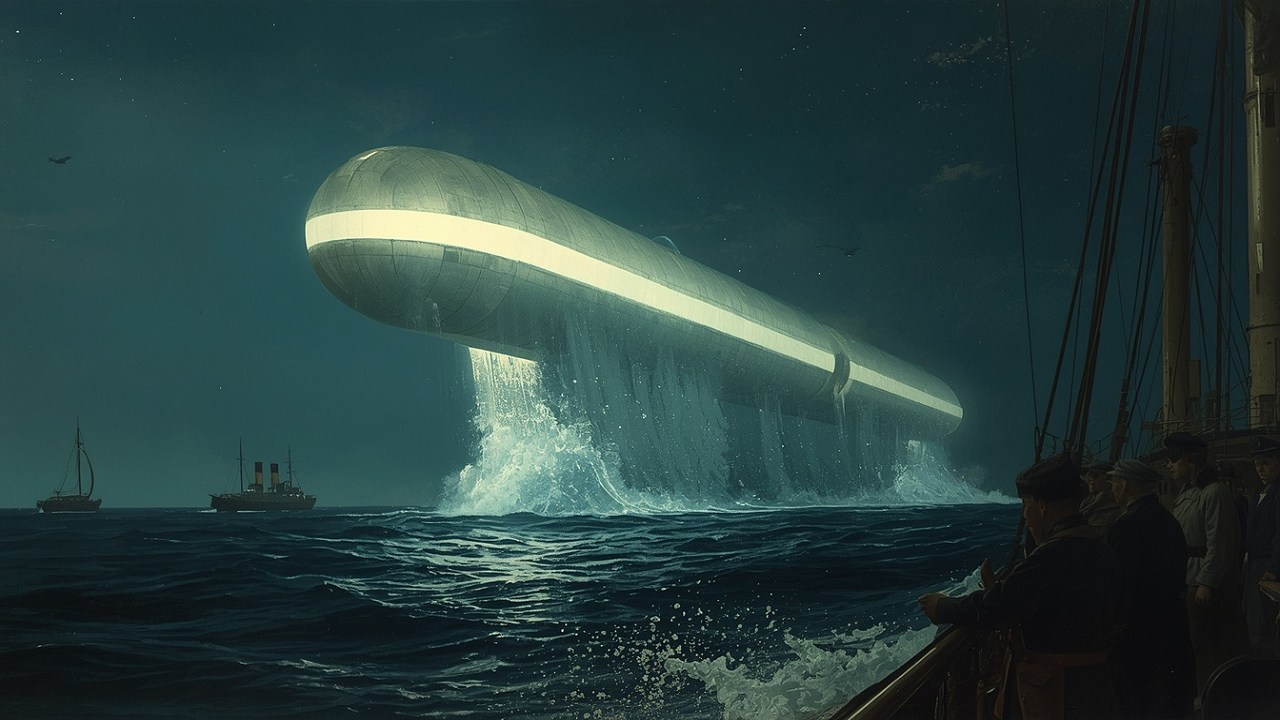
The turn of the twentieth century brought enormous changes to the world’s understanding of the oceans. Steamship commerce was expanding, long-distance communication via undersea cables was transforming global awareness, and nations were beginning to experiment with primitive submarines. Yet in early 1901, the North Atlantic near Newfoundland became the scene of an event that would challenge even the most confident assumptions about the limits of technology and nature. Several commercial vessels, traveling through one of the busiest shipping lanes in the northern hemisphere, reported the presence of a massive, luminous cylinder moving beneath the surface of the water. The object’s size, behavior, and luminous quality stunned the crews who observed it, and its vertical ascent into the sky placed the incident squarely in a category that would later be recognized as classic USO activity.
The 1901 luminous cylinder has endured because it occupies an unusual moment in history. It sits at a crossroads between the observational record of the nineteenth century—filled with mysterious “sea lights,” “phantom ships,” and strange atmospheric displays—and the more modern, technologically informed observations of the twentieth century, where witnesses were familiar with engines, electricity, and the idea that machines could be structured and built with purpose. The men who witnessed the cylinder in 1901 were not prone to dramatization. They were sailors and officers accustomed to long voyages, unpredictable weather, and the need to keep a level head during emergencies. Their reports, while concise, are consistent enough across vessels to establish that something anomalous occurred beneath the waves that winter.
Descriptions from crewmen agreed on several elements. First, the object was cylindrical. This alone separated it from known marine animals, drifting logs, or surface reflections. It maintained a distinct shape, long and smooth, and its outline could be seen beneath the water due to the intense white-blue glow it emitted. Witnesses had difficulty estimating its length, but most placed it well over one hundred feet, possibly two hundred or more. What made the event more astonishing was its behavior. Against the steady current of the North Atlantic, the cylinder moved smoothly and rapidly, a feat no submersible human technology could have achieved at the time. In 1901, submarines were small experimental craft, slow, fragile, and incapable of extended underwater travel. Nothing built by any navy possessed the speed or endurance exhibited by the cylinder that glided beneath the ships’ hulls.
The second consistency among accounts involved its movement relative to the vessels. Sailors noted that the cylinder seemed to pace the ships for moments at a time, maintaining a parallel track before shifting direction abruptly. Its course changed sharply and decisively, as though under intelligent control, not drifting with the current or pushed by environmental forces. Some crewmen suggested that it seemed to be observing the ships. While such speculation cannot be confirmed, the behavior does resemble patterns seen in later USO cases, where underwater objects appeared to “shadow” vessels, sometimes rising to the surface, sometimes diving deeper.
The most dramatic portion of the event unfolded when the cylinder finally surfaced. Several witnesses described the water bulging upward, as though displaced from below by a large mass. The surface broke, and the cylinder rose partially above the waves, still glowing. Water cascaded off its smooth surface, reflecting the strange white-blue light. The glow was described as steady rather than flickering, which distinguished it from combustion, lightning, or any chemical reaction common in seafaring explanations of luminous phenomena. The light had a quality sailors struggled to describe, a kind of stark clarity that seemed both unnatural and mesmerizing.
Then, before any crewman could respond, the cylinder shot vertically into the sky. This moment cemented the encounter as something beyond terrestrial technology. Submarines did not fly. Aircraft existed in the form of gliders and primitive experiments, none capable of lifting off from the sea, much less achieving instant vertical acceleration. Nor did any natural marine creature propel itself into the sky with the force described by the witnesses. The cylinder’s exit left the sailors stunned. For some, it was merely a bizarre event, something to be quietly noted and discussed only among themselves. For others, it was a life-altering moment that convinced them humanity was sharing the planet with technology far beyond its own.
Although the incident did not spread widely in the general press, it circulated within shipping and maritime communities. Sailors shared the story in ports throughout the Atlantic world. The early 1900s were not a time when newspapers embraced unexplained aerial or aquatic phenomena with enthusiasm. Such stories were often treated with skepticism, printed only sparingly, or left out entirely. Yet among professional mariners, the sighting carried weight. Seafarers have long traditions of reporting unusual events, and their accounts tend to be grounded in practical observation. In the absence of official investigation, their recollections formed the backbone of how the event entered maritime lore.
The impact of the 1901 cylinder on people at the time was subtle but meaningful. For the general public, it contributed indirectly to the broader atmosphere of mystery surrounding the oceans at the turn of the century. The world’s seas still contained vast unknowns, and technological progress was just beginning to peel back the edges of that darkness. Reports like the luminous cylinder reinforced the sense that the ocean held secrets beyond natural explanation. In maritime culture, the incident became another data point in a growing pattern of underwater anomalies that sailors had recorded for generations. Yet unlike earlier sightings, the cylinder possessed characteristics recognizable as mechanical or artificial. It behaved less like a creature and more like a vessel, but a vessel built with capabilities far beyond humanity’s reach.
In the decades that followed, researchers looking back on early USO cases came to regard the 1901 incident as an important transitional moment. It marked one of the first times in the twentieth century that an underwater object displayed unmistakably structured form, controlled movement, extraordinary speed, and atmospheric flight. The combination of these traits places the luminous cylinder firmly within the same category as modern USO reports from naval personnel. This continuity suggests that whatever intelligence or technology lies behind USOs has been present for far longer than the rise of advanced submarines and aircraft. The idea that unknown craft have been operating in Earth’s oceans for centuries gains credibility each time historical cases align with modern observations.
A notable aspect of the 1901 cylinder is the way it moved against the current. This is a recurring theme in USO encounters across the twentieth century, including well-known naval sightings where underwater objects displayed speeds or directional shifts no submarine could match. While the sailors of 1901 lacked modern terms to describe what they were seeing, they recognized the fundamental impossibility of a glowing cylinder outrunning the flow of the North Atlantic. This recognition made the event difficult to ignore. It also colored the sailors’ interpretations. Some considered the possibility of a supernatural manifestation. Others believed it must be a secret technological breakthrough, though no nation at the time had the capability to produce such a machine.
When considering the impact today, the story of the luminous cylinder has taken on new significance. In the era of modern UFO and USO research, historical accounts like this are invaluable. They demonstrate that phenomena we now associate with advanced unidentified craft did not begin with the age of radar, satellites, or nuclear submarines. Instead, they appear throughout history, showing consistent patterns of behavior and performance. The 1901 event adds depth to the argument that these craft have been present and active in Earth’s oceans long before humanity developed the means to observe them rigorously. This continuity strengthens the pro-UFO position by showing that the phenomenon is neither modern nor rooted in misunderstanding of contemporary technology. It transcends human technological development entirely.
Furthermore, the 1901 incident contributes to a broader reconsideration of how humanity interprets its place in the world. As oceanographers and naval analysts continue to examine unexplained underwater contacts, many now acknowledge that the ocean may serve as an operational domain for non-human intelligences. Modern naval encounters with fast-moving underwater objects echo the behaviors seen in the luminous cylinder more than a century ago. The consistency of descriptions—white-blue luminosity, silent movement, instantaneous acceleration, and seamless transition between water and air—suggests a technology optimized for multi-medium travel.
As public interest in USOs increases, the luminous cylinder has gained renewed attention among researchers compiling long-term patterns. Although the event did not include a crash, retrieval, or prolonged interaction, its place in early twentieth-century history gives it weight. It serves as a reminder that unexplained phenomena often occur far from land, recorded only by those whose work takes them into remote and often dangerous environments. These witnesses, accustomed to rational and practical decision-making, are some of the most reliable observers of anomalies. Their testimony offers a glimpse into a hidden reality operating alongside human activity.
Today, the 1901 luminous cylinder stands as a testament to the enduring mystery of the oceans and the possibility that humanity has been sharing the planet with advanced non-human technology for far longer than previously assumed. The witnesses did not exaggerate. They did not possess preconceived ideas about extraterrestrial visitation, multi-medium craft, or advanced propulsion systems. Their accounts reflect genuine astonishment at an object that defied every expectation of the time. In this sense, the incident has a credibility that later cases sometimes lack, because the witnesses could not have been influenced by decades of popular UFO narratives.
As researchers reconsider the long arc of USO history, the luminous cylinder emerges as a foundational moment. It demonstrates that the phenomena we now investigate with sensors, sonar, and advanced monitoring systems have roots stretching deeply into maritime history. It challenges the assumption that the modern age is the first time humanity has encountered such craft. And most importantly, it invites us to entertain a more expansive view of our world—one in which the oceans may be far more inhabited and technologically active than we ever imagined.
The North Atlantic cylinder of 1901 remains unexplained. Yet its legacy endures, shaping our understanding of early USO encounters and reinforcing the possibility that these events are part of a long-standing, intentional presence. For those who approach the subject with openness and curiosity, the incident is not merely a historical footnote. It is a reminder that even in an era of rapid technological advancement, the universe still holds mysteries capable of humbling us. The sailors of 1901 witnessed something extraordinary, something that pushed beyond the limits of human knowledge. Their testimony adds an important chapter to the collective chronicle of encounters that continue to challenge our understanding of what moves beneath and beyond our world.