


Blog Categories
- African Incidents
- Atlantis Incidents
- Australian Incidents
- Belgian Incidents
- Bermuda Triangle Incidents
- Brazilian Incidents
- Canadian Incidents
- Chinese Incidents
- European Incidents
- France Incidents
- Ghosts
- Giants
- Italy Incidents
- Japanese Incidents
- Middle East Incidents
- Portugal Incidents
- Project Serpo
- Puerto Rico Incidents
- Russian Incidents
- Sasquatch
- Scandinavia Incidents
- Spanish Incidents
- UFOs
- United Kingdom Incidents
- United States Incidents
1909-1910: Mystery Airship Wave
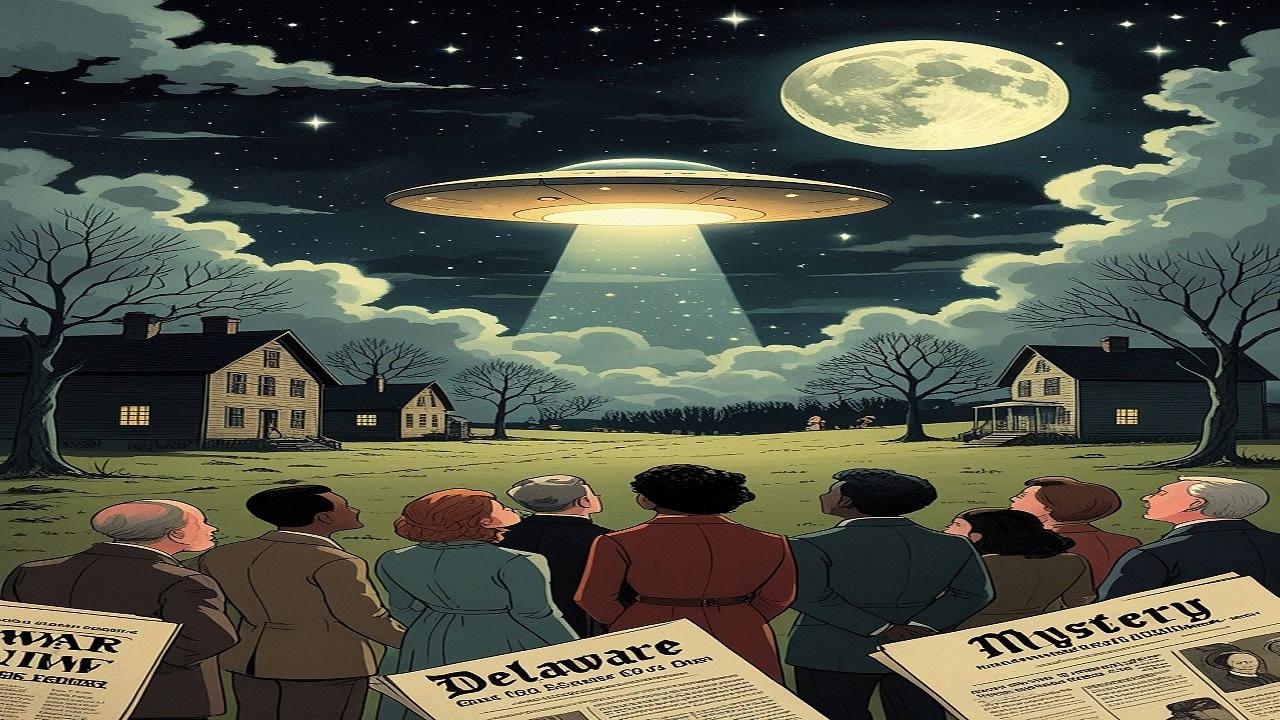
In the winter months of 1909 and 1910, a curious fever spread across the skies of the northeastern United States. Newspapers from Massachusetts to Maryland carried stories of strange, lighted craft gliding silently through the night. These sightings, later termed the “Mystery Airship” wave, occurred decades before the modern UFO era and remain one of the earliest large-scale instances of the public grappling with the unknown in the heavens. Though Delaware was not the epicenter of the phenomenon, its towns, editors, and readers were swept up in the same cultural tide that had gripped New England and parts of the mid-Atlantic.
For Delaware, this moment marked its quiet entry into what would later be called the UFO question. In December 1909, reports of unidentified flying craft began in the newspapers of Worcester, Massachusetts, and quickly cascaded southward by telegraph wire and syndication. The stories described cigar-shaped, illuminated objects that hovered, ascended, and even maneuvered intelligently in the night sky. Some accounts claimed to see wings or propellers, others mentioned searchlights, and a few even speculated about occupants waving from gondolas. When these reports reached the presses of Delaware, editors and citizens alike took note.
At the time, Delaware’s population was still largely rural, with Wilmington serving as the state’s principal industrial and cultural hub. Most towns relied on small, independent papers or regional reprints from Philadelphia and Baltimore. The result was that when the “airship craze” reached Delaware’s pages, it was already flavored by both sensationalism and skepticism. Editors would often reprint accounts from New England papers while adding commentary such as “Delaware skies may soon host one of these travelers.” Letters to the editor sometimes followed, with residents claiming to have seen “a moving light” or “a strange lantern in the clouds.”
Whether these were genuine attempts at observation or the echoes of imagination fed by daily headlines is difficult to know, but they form part of a clear social pattern that repeated across the country.
The public reaction in Delaware mirrored that of other East Coast states: fascination mixed with unease. Airships in 1909 were a technological novelty, still associated more with European experimenters like Zeppelin and Santos-Dumont than with local American builders. To the average citizen, the idea of a large, illuminated machine silently crossing the night sky bordered on science fiction. The sight of any light or moving object overhead could, in such a charged climate, easily be reinterpreted as evidence of “the airship.” Delaware farmers, fishermen, and railway workers reported such lights, often late at night or during poor weather, when celestial objects like Venus or Jupiter could appear unusually bright.
Historians studying this wave note that many of the 1909–1910 reports coincided with the bright apparition of Venus, which dominated the evening sky that winter. Newspapers themselves would later print corrective notes from astronomers explaining that the supposed airships were likely bright planets or stars misidentified by excited witnesses. Delaware’s newspapers carried at least one such retrospective, acknowledging that local excitement had been fueled by imagination more than evidence. In this sense, the state’s “UFO scare” was not rooted in deception but in the powerful combination of new technology, vivid journalism, and the mystery of the night sky.
Though Delaware’s documented sightings were few and mostly secondhand, their significance lies in how they reveal the early framework of UFO culture forming in America. Before radar, before jet aircraft, and before Roswell, there was already a readiness among the public to assign intelligent control and mystery to lights in the sky. Delaware’s participation in this early wave, through its press and readership, shows how deeply the phenomenon was woven into the nation’s shared imagination. Even if no physical “airship” ever passed above its fields, the idea of one certainly did — carried by print and belief alike.
The social context of the time amplified the impact. The years surrounding 1909 were marked by rapid technological progress — automobiles, wireless telegraphs, and heavier-than-air flight had entered public consciousness. The Wright brothers’ achievements were only a few years old, and newspapers routinely speculated about secret government aircraft or wealthy inventors testing new machines under cover of darkness. Delaware readers, already accustomed to hearing of new inventions from nearby Philadelphia and Baltimore, were primed to interpret mysterious lights as signs of human ingenuity rather than extraterrestrial visitation. Yet the tone of awe and uncertainty in many accounts foreshadowed the later shift toward the paranormal interpretation that would define UFO culture in the mid-20th century.
For the people of Delaware, the 1909–1910 airship wave offered both entertainment and reflection. It filled newspapers during quiet winter months and gave citizens a shared topic of wonder. Tavern discussions, church conversations, and family gatherings turned to speculation about who might be flying these machines and for what purpose. The sense of living in a time of marvels was strong, and even skeptical editors recognized the phenomenon’s cultural pull. The “airship” became a symbol of both human progress and cosmic mystery — an emblem of the early 20th century’s fascination with the sky.
As quickly as it began, the wave faded. By early 1910, most newspapers had dropped the story, and attention turned to the much-publicized approach of Halley’s Comet. In Delaware, as elsewhere, the airship excitement dissolved into memory. Yet the pattern it revealed would repeat in later decades: an unexplained aerial phenomenon, magnified by the press, igniting both fear and curiosity, only to be rationalized later through astronomy or psychology.
The enduring impact of the 1909–1910 wave lies in how it demonstrated the power of social context to shape perception. Delaware’s citizens, like those across the country, experienced firsthand how collective attention could transform mundane stimuli into extraordinary events.
This was not mass hysteria in the modern sense, but rather an early example of participatory mystery — the public becoming co-creators of the unknown through storytelling and observation. It established the psychological groundwork for later UFO movements, showing that mystery in the sky could unite communities in wonder just as easily as divide them in debate.
In today’s world, with instant communication and global networks, the echoes of that early airship wave remain visible. Reports of unidentified aerial phenomena continue to surface, and the same human mechanisms of fascination, skepticism, and collective interpretation still guide the discussion. Delaware, though rarely spotlighted in national UFO lore, retains its historical connection to the roots of the phenomenon. Local archives preserve the traces — newspaper columns, editorials, and small reports that collectively remind us that belief in the extraordinary does not require proof, only possibility.
Notable figures from that era in Delaware’s press played quiet roles in shaping how the story was told. Editors such as those at the Wilmington Evening Journal and smaller county weeklies often took measured stances, reprinting regional stories but adding cautious commentary urging readers to await verification. Their restraint helped temper what might have become a larger local panic. It is through their editorial judgment that Delaware’s experience with the airship wave remained a curiosity rather than a crisis.
Ultimately, the 1909–1910 “Mystery Airship” wave stands as an early chapter in Delaware’s contribution to the broader history of unidentified flying objects. It reflects not a visitation but a vision — the first time ordinary people, gazing upward, began to wonder whether the lights above them might hold secrets beyond human understanding. In that sense, Delaware’s skies became part of a collective dream, one that would later evolve into the enduring mystery of UFOs. The impact still lingers today, reminding us that belief in the unknown is as much a product of imagination as observation, and that the line between science and story can blur most beautifully when we look toward the stars.
In the winter months of 1909 and 1910, a curious fever spread across the skies of the northeastern United States. Newspapers from Massachusetts to Maryland carried stories of strange, lighted craft gliding silently through the night. These sightings, later termed the “Mystery Airship” wave, occurred decades before the modern UFO era and remain one of the earliest large-scale instances of the public grappling with the unknown in the heavens. Though Delaware was not the epicenter of the phenomenon, its towns, editors, and readers were swept up in the same cultural tide that had gripped New England and parts of the mid-Atlantic.
For Delaware, this moment marked its quiet entry into what would later be called the UFO question. In December 1909, reports of unidentified flying craft began in the newspapers of Worcester, Massachusetts, and quickly cascaded southward by telegraph wire and syndication. The stories described cigar-shaped, illuminated objects that hovered, ascended, and even maneuvered intelligently in the night sky. Some accounts claimed to see wings or propellers, others mentioned searchlights, and a few even speculated about occupants waving from gondolas. When these reports reached the presses of Delaware, editors and citizens alike took note.
At the time, Delaware’s population was still largely rural, with Wilmington serving as the state’s principal industrial and cultural hub. Most towns relied on small, independent papers or regional reprints from Philadelphia and Baltimore. The result was that when the “airship craze” reached Delaware’s pages, it was already flavored by both sensationalism and skepticism. Editors would often reprint accounts from New England papers while adding commentary such as “Delaware skies may soon host one of these travelers.” Letters to the editor sometimes followed, with residents claiming to have seen “a moving light” or “a strange lantern in the clouds.”
Whether these were genuine attempts at observation or the echoes of imagination fed by daily headlines is difficult to know, but they form part of a clear social pattern that repeated across the country.
The public reaction in Delaware mirrored that of other East Coast states: fascination mixed with unease. Airships in 1909 were a technological novelty, still associated more with European experimenters like Zeppelin and Santos-Dumont than with local American builders. To the average citizen, the idea of a large, illuminated machine silently crossing the night sky bordered on science fiction. The sight of any light or moving object overhead could, in such a charged climate, easily be reinterpreted as evidence of “the airship.” Delaware farmers, fishermen, and railway workers reported such lights, often late at night or during poor weather, when celestial objects like Venus or Jupiter could appear unusually bright.
Historians studying this wave note that many of the 1909–1910 reports coincided with the bright apparition of Venus, which dominated the evening sky that winter. Newspapers themselves would later print corrective notes from astronomers explaining that the supposed airships were likely bright planets or stars misidentified by excited witnesses. Delaware’s newspapers carried at least one such retrospective, acknowledging that local excitement had been fueled by imagination more than evidence. In this sense, the state’s “UFO scare” was not rooted in deception but in the powerful combination of new technology, vivid journalism, and the mystery of the night sky.
Though Delaware’s documented sightings were few and mostly secondhand, their significance lies in how they reveal the early framework of UFO culture forming in America. Before radar, before jet aircraft, and before Roswell, there was already a readiness among the public to assign intelligent control and mystery to lights in the sky. Delaware’s participation in this early wave, through its press and readership, shows how deeply the phenomenon was woven into the nation’s shared imagination. Even if no physical “airship” ever passed above its fields, the idea of one certainly did — carried by print and belief alike.
The social context of the time amplified the impact. The years surrounding 1909 were marked by rapid technological progress — automobiles, wireless telegraphs, and heavier-than-air flight had entered public consciousness. The Wright brothers’ achievements were only a few years old, and newspapers routinely speculated about secret government aircraft or wealthy inventors testing new machines under cover of darkness. Delaware readers, already accustomed to hearing of new inventions from nearby Philadelphia and Baltimore, were primed to interpret mysterious lights as signs of human ingenuity rather than extraterrestrial visitation. Yet the tone of awe and uncertainty in many accounts foreshadowed the later shift toward the paranormal interpretation that would define UFO culture in the mid-20th century.
For the people of Delaware, the 1909–1910 airship wave offered both entertainment and reflection. It filled newspapers during quiet winter months and gave citizens a shared topic of wonder. Tavern discussions, church conversations, and family gatherings turned to speculation about who might be flying these machines and for what purpose. The sense of living in a time of marvels was strong, and even skeptical editors recognized the phenomenon’s cultural pull. The “airship” became a symbol of both human progress and cosmic mystery — an emblem of the early 20th century’s fascination with the sky.
As quickly as it began, the wave faded. By early 1910, most newspapers had dropped the story, and attention turned to the much-publicized approach of Halley’s Comet. In Delaware, as elsewhere, the airship excitement dissolved into memory. Yet the pattern it revealed would repeat in later decades: an unexplained aerial phenomenon, magnified by the press, igniting both fear and curiosity, only to be rationalized later through astronomy or psychology.
The enduring impact of the 1909–1910 wave lies in how it demonstrated the power of social context to shape perception. Delaware’s citizens, like those across the country, experienced firsthand how collective attention could transform mundane stimuli into extraordinary events.
This was not mass hysteria in the modern sense, but rather an early example of participatory mystery — the public becoming co-creators of the unknown through storytelling and observation. It established the psychological groundwork for later UFO movements, showing that mystery in the sky could unite communities in wonder just as easily as divide them in debate.
In today’s world, with instant communication and global networks, the echoes of that early airship wave remain visible. Reports of unidentified aerial phenomena continue to surface, and the same human mechanisms of fascination, skepticism, and collective interpretation still guide the discussion. Delaware, though rarely spotlighted in national UFO lore, retains its historical connection to the roots of the phenomenon. Local archives preserve the traces — newspaper columns, editorials, and small reports that collectively remind us that belief in the extraordinary does not require proof, only possibility.
Notable figures from that era in Delaware’s press played quiet roles in shaping how the story was told. Editors such as those at the Wilmington Evening Journal and smaller county weeklies often took measured stances, reprinting regional stories but adding cautious commentary urging readers to await verification. Their restraint helped temper what might have become a larger local panic. It is through their editorial judgment that Delaware’s experience with the airship wave remained a curiosity rather than a crisis.
Ultimately, the 1909–1910 “Mystery Airship” wave stands as an early chapter in Delaware’s contribution to the broader history of unidentified flying objects. It reflects not a visitation but a vision — the first time ordinary people, gazing upward, began to wonder whether the lights above them might hold secrets beyond human understanding. In that sense, Delaware’s skies became part of a collective dream, one that would later evolve into the enduring mystery of UFOs. The impact still lingers today, reminding us that belief in the unknown is as much a product of imagination as observation, and that the line between science and story can blur most beautifully when we look toward the stars.