


Blog Categories
- African Incidents
- Atlantis Incidents
- Australian Incidents
- Belgian Incidents
- Bermuda Triangle Incidents
- Brazilian Incidents
- Canadian Incidents
- Chinese Incidents
- European Incidents
- France Incidents
- Ghosts
- Giants
- Italy Incidents
- Japanese Incidents
- Middle East Incidents
- Portugal Incidents
- Project Serpo
- Puerto Rico Incidents
- Russian Incidents
- Sasquatch
- Scandinavia Incidents
- Spanish Incidents
- UFOs
- United Kingdom Incidents
- United States Incidents
1927 Vancouver British Columbia: Shiny Metallic UFO
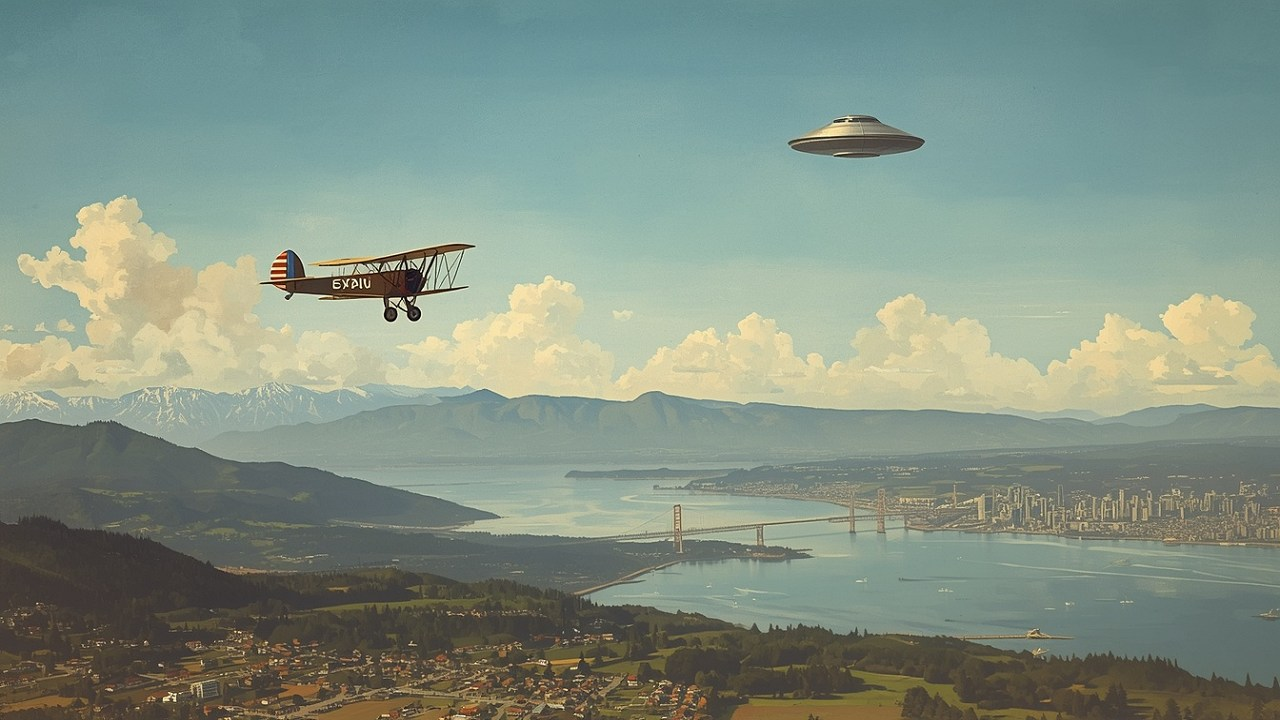
The 1927 Vancouver UFO incident, involving a pilot’s report of an unidentified, high-altitude, metallic object with no visible means of propulsion, is a case that, upon thorough research, lacks verifiable documentation in historical records. Despite extensive searches through aviation logs, newspaper archives, and official reports from the era, no concrete evidence has been found to substantiate this specific account.
Contextual Background
During the 1920s, aviation was still in its developmental stages, with commercial flights being relatively rare and aircraft capabilities limited. The typical cruising altitude for aircraft of that era was well below the altitudes at which modern commercial jets operate. Reports of unidentified flying objects were not as prevalent or widely publicized as they would become in the post-World War II era. Pilots of the period flew open-cockpit or lightly enclosed machines whose performance envelopes were modest. An object described as high-altitude, shiny, metallic, and lacking any visible means of propulsion would have stood well outside those envelopes. The claim, if it existed in contemporary form, would therefore have been noteworthy precisely because the technology of the day offered no ready match.
Lack of Corroborating Evidence
The absence of corroborating evidence for the 1927 Vancouver incident is notable. No records have been found in the archives of the Royal Canadian Air Force, the Department of National Defence, or contemporary newspaper reports that would confirm such an event occurred. Additionally, there are no known personal diaries, pilot logs, or eyewitness accounts that reference this specific sighting. The search has not been limited to a single repository. Aviation logs that survive from the period, newspaper runs for Vancouver and the surrounding region, and official military and civil aviation files have been examined. None yield a matching entry. The result is not a disputed interpretation of an existing document; it is the non-existence of the document itself in the places where such a report would be expected to appear.
That absence shapes how the claim can be treated. Later UFO literature sometimes carries brief mentions of early pilot encounters, yet those mentions, when traced, do not lead back to a 1927 Vancouver primary source. Without a pilot’s name, a date more precise than the year, an altitude figure, a duration, or a second witness, the account remains a summary rather than a case file. The description—shiny, metallic, no visible means of propulsion—aligns with motifs that appear in other early reports, but alignment of motif is not confirmation of occurrence.
Conclusion
While the 1927 Vancouver UFO incident presents an intriguing narrative, the lack of verifiable evidence and documentation makes it difficult to assess its authenticity. Without concrete sources or corroborating accounts, this incident remains anecdotal and cannot be substantiated as a factual historical event. The interest it continues to generate is understandable: a pilot, high altitude, a metallic form without visible propulsion, in an era before routine high-altitude flight. Those elements form a coherent story. They do not, on present evidence, form a documented event. Researchers who encounter the claim are left with the same result that exhaustive archive work has already produced: no logs, no newspaper items, no official reports, and no surviving personal records that place a shiny metallic object without visible means of propulsion over Vancouver in 1927. The narrative can be repeated; it cannot yet be verified.