


Blog Categories
- African Incidents
- Atlantis Incidents
- Australian Incidents
- Belgian Incidents
- Bermuda Triangle Incidents
- Brazilian Incidents
- Canadian Incidents
- Chinese Incidents
- European Incidents
- France Incidents
- Ghosts
- Giants
- Italy Incidents
- Japanese Incidents
- Middle East Incidents
- Portugal Incidents
- Project Serpo
- Puerto Rico Incidents
- Russian Incidents
- Sasquatch
- Scandinavia Incidents
- Spanish Incidents
- UFOs
- United Kingdom Incidents
- United States Incidents
1941: Delaware Foo Fighter Sightings
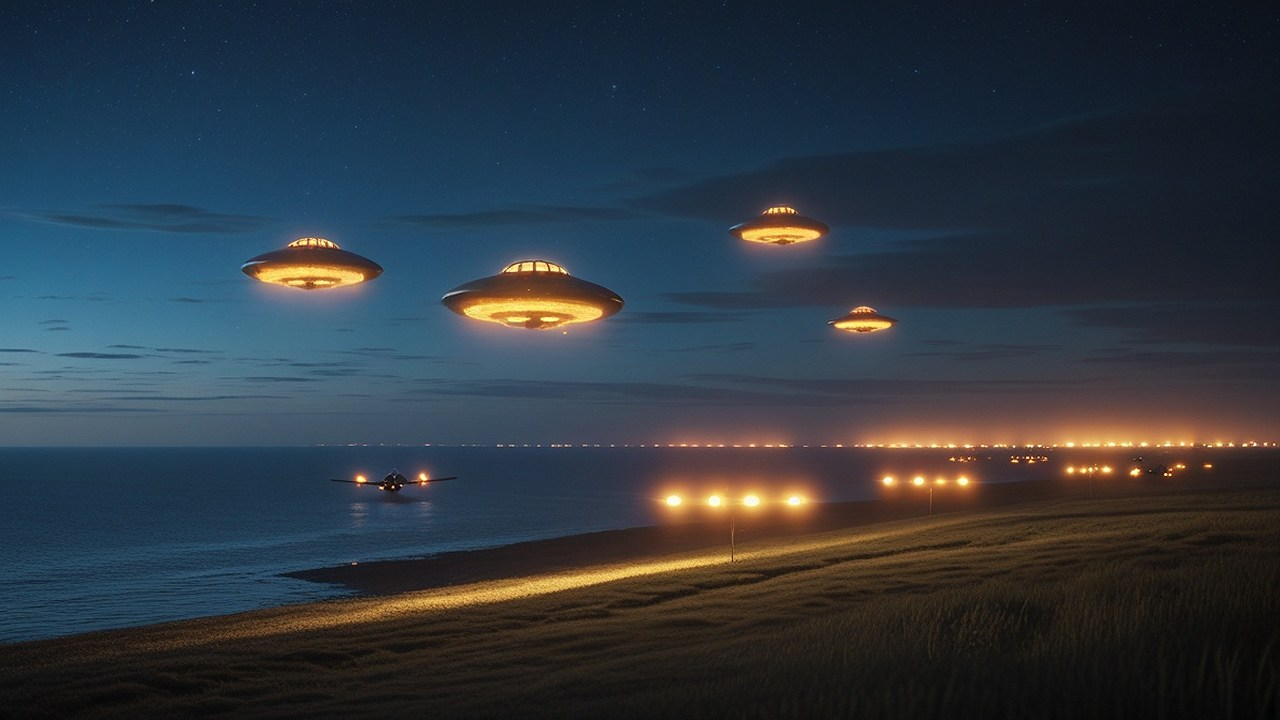
In the months before America formally entered World War II, Delaware’s coastline stood as both a military frontier and a quiet observer of the growing tension sweeping the Atlantic world. It was during this uneasy year—1941—that several accounts surfaced along the U.S. Eastern Seaboard describing strange, luminous spheres or “balls of fire” trailing or pacing aircraft. Among the regions mentioned in later analyses was Delaware’s coastal zone, a stretch of shoreline increasingly tied to the nation’s air defense infrastructure.
Though the surviving documentation is sparse, the mention of these Delaware sightings in later UFO literature provides an intriguing glimpse into what some researchers regard as “Foo Fighter precursors”—unexplained aerial lights that baffled military pilots years before the term “UFO” entered public consciousness. These early observations, fragmentary though they are, form part of a longer historical arc that connects prewar coastal mysteries to the well-documented luminous phenomena reported by Allied airmen during the height of the conflict.
By 1941, Delaware had become strategically important to the United States’ growing military aviation efforts. Dover Army Airfield (which would later become Dover Air Force Base) had been established as a training and support facility during this prewar mobilization period. Pilots, navigators, and ground crews were conducting regular exercises up and down the East Coast, often over Delaware’s flat terrain and adjacent coastal waters. The airfield’s location made it a natural hub for coastal defense training, reconnaissance flights, and the testing of early warning systems as the nation prepared for the possibility of conflict in the Atlantic.
At the same time, the Atlantic seaboard was tense with rumors of German U-boats and strange lights offshore. Merchant ships reported mysterious glows on the horizon, often attributed to distant naval vessels or reflections from coastal cities practicing blackout drills. Yet among these understandable phenomena, a handful of reports described something more enigmatic: self-luminous, spherical lights moving with apparent intelligence or awareness of aircraft. These accounts emerged against a backdrop of heightened national vigilance, where any unusual light in the sky could be interpreted through the lens of potential enemy reconnaissance or experimental defense technology.
The lights were sometimes said to pace military planes, matching their speed and maneuvering without sound. Others appeared stationary at first, then moved rapidly or winked out. In the Delaware region—particularly along its coastline near Cape Henlopen and down toward the Maryland border—several postwar compilations of pre-Foo Fighter events noted “unclassified luminous object sightings” in 1941 that fit this general pattern. While no official record from Dover Army Airfield confirms these incidents, the area’s proximity to other East Coast training operations makes such encounters plausible. Early radar systems, still experimental, were being tested at various points along the coast. Electrical phenomena, high-altitude lightning, and ionospheric reflections were also being studied. Yet, as researchers later pointed out, many eyewitness descriptions from 1941 did not match the known behavior of such phenomena.
Accounts of these “pre-Foo Fighter” lights share several consistent characteristics across the Eastern Seaboard, including Delaware. Witnesses described spherical or globular shapes—“balls of fire” or “glowing spheres”—typically amber, white, or orange in hue. The objects often appeared to pace aircraft or move deliberately, unlike meteors or lightning. Pilots or observers on the ground reported complete silence, suggesting either extreme altitude or non-mechanical propulsion. The lights would vanish instantly rather than fade, a trait later echoed in Foo Fighter encounters over Europe and the Pacific. Delaware’s sightings were few but fit this pattern. One 1941 report mentioned in later analyses by the National Investigations Committee on Aerial Phenomena (NICAP) suggested that pilots from coastal defense flights observed a “luminous sphere” near the Delaware-Maryland air corridor. Another, relayed secondhand through postwar interviews, spoke of fishermen seeing “a glowing orb that followed a plane inland” before vanishing. Though impossible to verify today, these fragmentary details form part of a broader national tapestry. Similar events occurred over Virginia, New Jersey, and Massachusetts that same year, all involving lights that seemed to act under control. Together, they suggest an emerging pattern of aerial phenomena—one that would only intensify once the United States entered the war.
When Allied pilots in Europe began reporting “Foo Fighters” in 1943 and 1944—mysterious balls of light that followed bombers—the descriptions bore uncanny similarities to those early coastal accounts. Some researchers, including NICAP affiliates and independent historians, began to trace the origins of these encounters back to the prewar period. Delaware’s 1941 coastal sightings thus represent part of that developmental arc. The state’s geography placed it within the flight paths of both training and reconnaissance missions. Its coastline, facing the Atlantic, was also a natural boundary where unusual lights could be mistaken for enemy reconnaissance or naval activity. When the Foo Fighter reports later became public knowledge, researchers retrospectively included Delaware among the states that had seen “prewar luminous object” activity.
The distinction is important. It suggests that these lights were not purely wartime phenomena triggered by combat stress or enemy technology but had already been manifesting before full-scale global conflict began. In that sense, Delaware’s role becomes one of the first documented intersections between military aviation and unexplained aerial lights in North America. The prewar timing challenges any assumption that such phenomena were solely products of wartime conditions, radar interference, or psychological stress among combat crews. Instead, the 1941 accounts point to a continuity that predates the global conflict.
In 1941, few civilians in Delaware were aware of these strange aerial incidents. The nation was still officially at peace, and military censorship limited what local papers could print about defense operations. However, rumors circulated quietly among coastal residents. Fishermen, lighthouse keepers, and early aviators occasionally discussed the “wandering lights” over the bay or the ocean. When similar phenomena later appeared overseas, veterans who had trained in Delaware or along the Eastern Seaboard recalled those earlier experiences. Some claimed that the Foo Fighters of Europe were “the same kind of thing” they had glimpsed in U.S. skies years before. Such recollections added weight to the theory that the luminous spheres were not weapons or enemy craft but something natural—or perhaps something unknown.
For Delaware communities, the long-term impact was subtle but lasting. The idea that mysterious aerial phenomena had appeared before the war reinforced a sense of historical continuity once the UFO age dawned in 1947. In local circles, older residents sometimes pointed to “that strange light during the war buildup” as proof that these things had been around for decades. The sightings thus became embedded in regional memory, passed down through oral histories and family stories rather than official records.
In the 1950s and 1960s, as NICAP and other organizations compiled historical UFO cases, researchers began mining old news archives, Air Force documents, and eyewitness testimonies for early examples. Delaware’s 1941 coastal case was one of many brief mentions in these catalogues, often cited as evidence that unexplained luminous objects were observed in connection with aircraft years before the UFO phenomenon became mainstream. NICAP’s interpretation leaned toward atmospheric or electrical explanations—perhaps ball lightning, static discharge, or reflections caused by the interaction of radar and moisture in the air. Still, the group acknowledged that the behavior and apparent intelligence of some lights defied easy explanation. For modern scholars of aerial anomalies, Delaware’s inclusion in this lineage underscores the region’s quiet but persistent presence in America’s UFO history.
Dover Air Force Base itself would later feature in numerous postwar UFO compilations due to unrelated cases in the 1950s and 1960s. The fact that its predecessor airfield had been part of the early 1940s observation network adds another layer of continuity. From 1941’s “luminous spheres” to later radar-visual reports, Delaware’s skies remained a consistent canvas for unexplained phenomena. This continuity highlights how certain geographic locations can serve as repeated focal points for anomalous sightings across decades, influenced by factors such as military presence, coastal geography, and open skies.
Today, the 1941 Delaware coastal sightings occupy a small but meaningful place in the pre-UFO chronology. They represent an era when America’s aviation frontier and its curiosity about the unknown were expanding simultaneously. These sightings remind researchers that “unidentified aerial phenomena” were part of the military’s lived experience even before the formal establishment of modern air defense systems. In a broader sense, they highlight the fragility of historical documentation. Many early accounts were lost to censorship, destroyed records, or simple disinterest. Yet their echoes remain in later reports, correspondence, and oral histories. For Delaware, that means the state’s contribution to the early UFO timeline is not one of sensationalism but of quiet observation—moments when trained eyes saw something that didn’t belong, recorded it, and moved on, leaving the rest of us to wonder.
The 1941 “Foo Fighter precursor” sighting off Delaware’s coast marks one of the state’s earliest known intersections between aviation and unexplained aerial lights. Though the record is incomplete, the consistency of the descriptions and their alignment with later wartime Foo Fighter encounters make the case historically important. It shows that before America entered the war, strange luminous phenomena were already interacting with aircraft, confounding witnesses, and sparking questions that would persist for generations. For Delaware, it is another chapter in its enduring role as both a watcher and participant in the evolving mystery of the skies—a reminder that history’s great enigmas often begin quietly, glowing faintly over a darkened coastline before vanishing into the night.
In the months before America formally entered World War II, Delaware’s coastline stood as both a military frontier and a quiet observer of the growing tension sweeping the Atlantic world. It was during this uneasy year—1941—that several accounts surfaced along the U.S. Eastern Seaboard describing strange, luminous spheres or “balls of fire” trailing or pacing aircraft. Among the regions mentioned in later analyses was Delaware’s coastal zone, a stretch of shoreline increasingly tied to the nation’s air defense infrastructure.
Though the surviving documentation is sparse, the mention of these Delaware sightings in later UFO literature provides an intriguing glimpse into what some researchers regard as “Foo Fighter precursors”—unexplained aerial lights that baffled military pilots years before the term “UFO” entered public consciousness. These early observations, fragmentary though they are, form part of a longer historical arc that connects prewar coastal mysteries to the well-documented luminous phenomena reported by Allied airmen during the height of the conflict.
By 1941, Delaware had become strategically important to the United States’ growing military aviation efforts. Dover Army Airfield (which would later become Dover Air Force Base) had been established as a training and support facility during this prewar mobilization period. Pilots, navigators, and ground crews were conducting regular exercises up and down the East Coast, often over Delaware’s flat terrain and adjacent coastal waters. The airfield’s location made it a natural hub for coastal defense training, reconnaissance flights, and the testing of early warning systems as the nation prepared for the possibility of conflict in the Atlantic.
At the same time, the Atlantic seaboard was tense with rumors of German U-boats and strange lights offshore. Merchant ships reported mysterious glows on the horizon, often attributed to distant naval vessels or reflections from coastal cities practicing blackout drills. Yet among these understandable phenomena, a handful of reports described something more enigmatic: self-luminous, spherical lights moving with apparent intelligence or awareness of aircraft. These accounts emerged against a backdrop of heightened national vigilance, where any unusual light in the sky could be interpreted through the lens of potential enemy reconnaissance or experimental defense technology.
The lights were sometimes said to pace military planes, matching their speed and maneuvering without sound. Others appeared stationary at first, then moved rapidly or winked out. In the Delaware region—particularly along its coastline near Cape Henlopen and down toward the Maryland border—several postwar compilations of pre-Foo Fighter events noted “unclassified luminous object sightings” in 1941 that fit this general pattern. While no official record from Dover Army Airfield confirms these incidents, the area’s proximity to other East Coast training operations makes such encounters plausible. Early radar systems, still experimental, were being tested at various points along the coast. Electrical phenomena, high-altitude lightning, and ionospheric reflections were also being studied. Yet, as researchers later pointed out, many eyewitness descriptions from 1941 did not match the known behavior of such phenomena.
Accounts of these “pre-Foo Fighter” lights share several consistent characteristics across the Eastern Seaboard, including Delaware. Witnesses described spherical or globular shapes—“balls of fire” or “glowing spheres”—typically amber, white, or orange in hue. The objects often appeared to pace aircraft or move deliberately, unlike meteors or lightning. Pilots or observers on the ground reported complete silence, suggesting either extreme altitude or non-mechanical propulsion. The lights would vanish instantly rather than fade, a trait later echoed in Foo Fighter encounters over Europe and the Pacific. Delaware’s sightings were few but fit this pattern. One 1941 report mentioned in later analyses by the National Investigations Committee on Aerial Phenomena (NICAP) suggested that pilots from coastal defense flights observed a “luminous sphere” near the Delaware-Maryland air corridor. Another, relayed secondhand through postwar interviews, spoke of fishermen seeing “a glowing orb that followed a plane inland” before vanishing. Though impossible to verify today, these fragmentary details form part of a broader national tapestry. Similar events occurred over Virginia, New Jersey, and Massachusetts that same year, all involving lights that seemed to act under control. Together, they suggest an emerging pattern of aerial phenomena—one that would only intensify once the United States entered the war.
When Allied pilots in Europe began reporting “Foo Fighters” in 1943 and 1944—mysterious balls of light that followed bombers—the descriptions bore uncanny similarities to those early coastal accounts. Some researchers, including NICAP affiliates and independent historians, began to trace the origins of these encounters back to the prewar period. Delaware’s 1941 coastal sightings thus represent part of that developmental arc. The state’s geography placed it within the flight paths of both training and reconnaissance missions. Its coastline, facing the Atlantic, was also a natural boundary where unusual lights could be mistaken for enemy reconnaissance or naval activity. When the Foo Fighter reports later became public knowledge, researchers retrospectively included Delaware among the states that had seen “prewar luminous object” activity.
The distinction is important. It suggests that these lights were not purely wartime phenomena triggered by combat stress or enemy technology but had already been manifesting before full-scale global conflict began. In that sense, Delaware’s role becomes one of the first documented intersections between military aviation and unexplained aerial lights in North America. The prewar timing challenges any assumption that such phenomena were solely products of wartime conditions, radar interference, or psychological stress among combat crews. Instead, the 1941 accounts point to a continuity that predates the global conflict.
In 1941, few civilians in Delaware were aware of these strange aerial incidents. The nation was still officially at peace, and military censorship limited what local papers could print about defense operations. However, rumors circulated quietly among coastal residents. Fishermen, lighthouse keepers, and early aviators occasionally discussed the “wandering lights” over the bay or the ocean. When similar phenomena later appeared overseas, veterans who had trained in Delaware or along the Eastern Seaboard recalled those earlier experiences. Some claimed that the Foo Fighters of Europe were “the same kind of thing” they had glimpsed in U.S. skies years before. Such recollections added weight to the theory that the luminous spheres were not weapons or enemy craft but something natural—or perhaps something unknown.
For Delaware communities, the long-term impact was subtle but lasting. The idea that mysterious aerial phenomena had appeared before the war reinforced a sense of historical continuity once the UFO age dawned in 1947. In local circles, older residents sometimes pointed to “that strange light during the war buildup” as proof that these things had been around for decades. The sightings thus became embedded in regional memory, passed down through oral histories and family stories rather than official records.
In the 1950s and 1960s, as NICAP and other organizations compiled historical UFO cases, researchers began mining old news archives, Air Force documents, and eyewitness testimonies for early examples. Delaware’s 1941 coastal case was one of many brief mentions in these catalogues, often cited as evidence that unexplained luminous objects were observed in connection with aircraft years before the UFO phenomenon became mainstream. NICAP’s interpretation leaned toward atmospheric or electrical explanations—perhaps ball lightning, static discharge, or reflections caused by the interaction of radar and moisture in the air. Still, the group acknowledged that the behavior and apparent intelligence of some lights defied easy explanation. For modern scholars of aerial anomalies, Delaware’s inclusion in this lineage underscores the region’s quiet but persistent presence in America’s UFO history.
Dover Air Force Base itself would later feature in numerous postwar UFO compilations due to unrelated cases in the 1950s and 1960s. The fact that its predecessor airfield had been part of the early 1940s observation network adds another layer of continuity. From 1941’s “luminous spheres” to later radar-visual reports, Delaware’s skies remained a consistent canvas for unexplained phenomena. This continuity highlights how certain geographic locations can serve as repeated focal points for anomalous sightings across decades, influenced by factors such as military presence, coastal geography, and open skies.
Today, the 1941 Delaware coastal sightings occupy a small but meaningful place in the pre-UFO chronology. They represent an era when America’s aviation frontier and its curiosity about the unknown were expanding simultaneously. These sightings remind researchers that “unidentified aerial phenomena” were part of the military’s lived experience even before the formal establishment of modern air defense systems. In a broader sense, they highlight the fragility of historical documentation. Many early accounts were lost to censorship, destroyed records, or simple disinterest. Yet their echoes remain in later reports, correspondence, and oral histories. For Delaware, that means the state’s contribution to the early UFO timeline is not one of sensationalism but of quiet observation—moments when trained eyes saw something that didn’t belong, recorded it, and moved on, leaving the rest of us to wonder.
The 1941 “Foo Fighter precursor” sighting off Delaware’s coast marks one of the state’s earliest known intersections between aviation and unexplained aerial lights. Though the record is incomplete, the consistency of the descriptions and their alignment with later wartime Foo Fighter encounters make the case historically important. It shows that before America entered the war, strange luminous phenomena were already interacting with aircraft, confounding witnesses, and sparking questions that would persist for generations. For Delaware, it is another chapter in its enduring role as both a watcher and participant in the evolving mystery of the skies—a reminder that history’s great enigmas often begin quietly, glowing faintly over a darkened coastline before vanishing into the night.