

Blog Categories
- African Incidents
- Atlantis Incidents
- Australian Incidents
- Belgian Incidents
- Bermuda Triangle Incidents
- Brazilian Incidents
- Canadian Incidents
- Chinese Incidents
- European Incidents
- France Incidents
- Ghosts
- Giants
- Italy Incidents
- Japanese Incidents
- Middle East Incidents
- Portugal Incidents
- Project Serpo
- Puerto Rico Incidents
- Russian Incidents
- Sasquatch
- Scandinavia Incidents
- Spanish Incidents
- UFOs
- United Kingdom Incidents
- United States Incidents
1942: The Battle of Los Angeles
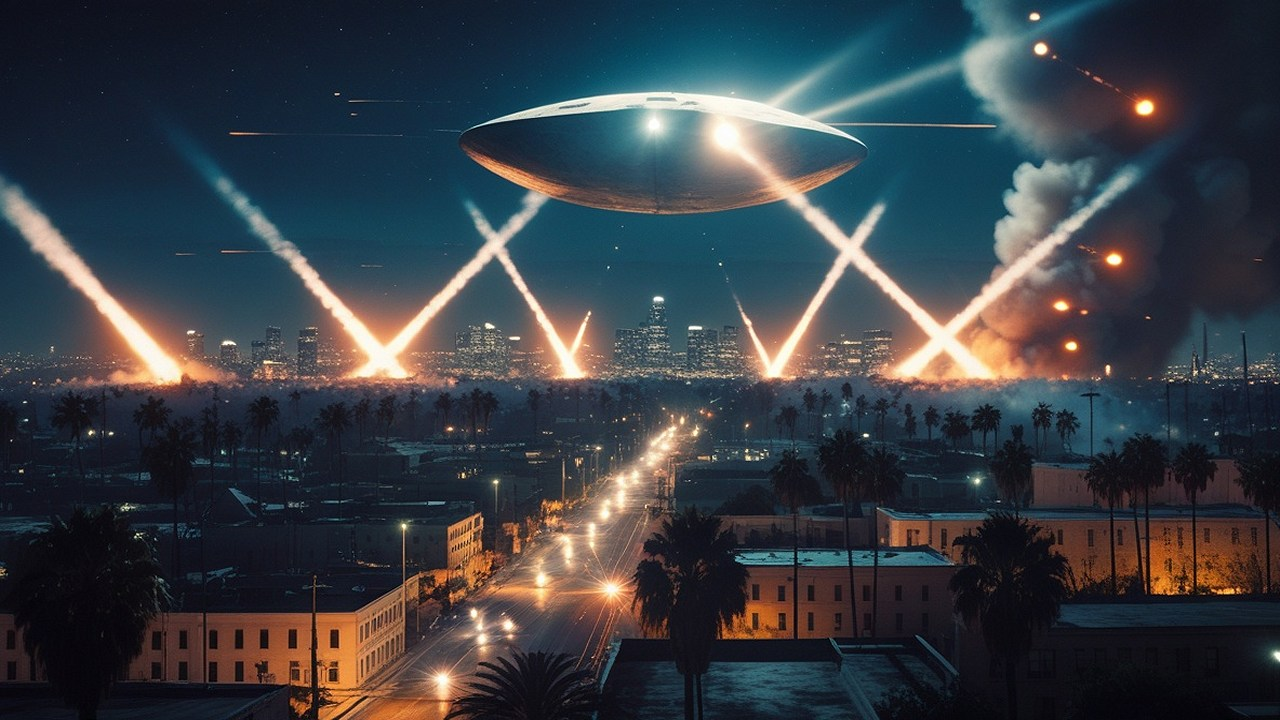
In the early morning hours of February 25, 1942, the skies above Southern California turned into a battlefield. Air raid sirens screamed across Los Angeles. Searchlights pierced the darkness. Antiaircraft guns opened fire, launching over 1,400 shells into the night sky. All of this was directed at something the military initially believed was an enemy aircraft — or multiple aircraft — hovering over one of America’s largest cities.
But what exactly was up there? To this day, no definitive answer has satisfied everyone. The event, forever known as the “Battle of Los Angeles,” remains one of the most dramatic and perplexing incidents of the entire Second World War on American soil.
This is the full story of the Battle of Los Angeles — a moment when wartime fear, unidentified aerial phenomena, and military response collided in spectacular fashion.
Let’s go back to February 1942.
The United States had been at war for less than three months following the devastating attack on Pearl Harbor. The American public and military were on edge, especially on the West Coast. Just two days earlier, on February 23, a Japanese submarine had surfaced off Santa Barbara and shelled an oil refinery. It was the first direct Axis attack on the U.S. mainland. Panic spread rapidly. Rumors of imminent invasion circulated wildly. Civil defense volunteers, many with minimal training, were on high alert for blackouts and enemy aircraft.
In this atmosphere of extreme tension, the stage was set for what would happen in the early hours of February 25.
Shortly after 2:00 a.m., military radar detected an unidentified object approaching the Southern California coastline. Although this detection was later reassessed as inconclusive, the report reached the Western Defense Command and triggered an immediate air raid warning. Sirens began wailing across Los Angeles County. The city plunged into blackout. Searchlights swept the skies while antiaircraft crews prepared for action.
Around 3:00 a.m., searchlights converged on what appeared to be a large object drifting over the city. Witness accounts varied. Some described seeing a group of aircraft. Others insisted they saw a single large craft. Many reported that the lights illuminated a solid structure. In response, antiaircraft batteries opened fire. For the next hour or more, over 1,400 shells exploded in the sky above Los Angeles.
The barrage was intense. Exploding shells rained shrapnel across neighborhoods. The night sky lit up with tracers and searchlights. By the time the all-clear sounded around 4:15 a.m., no enemy planes had been shot down. No bombs had fallen. But the city was left littered with debris from spent ammunition. Several civilians had died — not from enemy action, but from heart attacks, traffic accidents during the blackout, and injuries caused by falling shrapnel.
The immediate aftermath was chaotic. At first, the military offered no clear explanation. Local commanders insisted they had engaged enemy aircraft. Army Chief of Staff George C. Marshall suggested the possibility that commercial aircraft had been used as a diversion. Secretary of the Navy Frank Knox, however, dismissed the entire event as a case of “war nerves,” attributing it to weather balloons or atmospheric conditions being misinterpreted.
These conflicting official statements only fueled public confusion and anger. Newspapers criticized the military for either exaggerating threats or withholding the truth. How could America’s defense forces fire thousands of rounds over a major city without knowing what they were shooting at?
For the residents of Los Angeles, the night was traumatic. Families were awakened by sirens and explosions, unsure whether the city was under invasion. The event deepened fear, especially in communities with large Japanese American populations who were already facing intense suspicion. The incident exposed serious weaknesses in civil defense systems and communication between different branches of the military.
In the weeks and months that followed, the government implemented new training programs, standardized communication protocols, and expanded radar networks. But public trust had been damaged. Many Americans began to wonder whether the military fully understood the threats they faced — or whether they were being completely honest about what had happened that night.
The Battle of Los Angeles quickly became more than just a wartime footnote. It evolved into one of the foundational events in modern UFO history. The now-famous photograph showing searchlights converging on a glowing object in the sky became an iconic image — one that appeared to show something solid and structured hanging in the air while under heavy fire.
For UFO researchers, the case has several compelling elements. Multiple witnesses, including trained military personnel, reported seeing a large object that withstood antiaircraft fire without being destroyed. The object reportedly moved slowly and deliberately. Some accounts described it as hovering or drifting in ways inconsistent with conventional aircraft of the era. The sheer volume of shells fired, combined with the lack of any confirmed enemy wreckage, raised serious questions.
Official explanations have never fully satisfied everyone. While weather balloons and war nerves were cited, many researchers point out that the intensity of the military response suggests something more substantial was present. The conflicting statements from high-ranking officials — some insisting enemy aircraft were involved, others calling it a false alarm — only deepened the mystery.
The cultural impact of the Battle of Los Angeles has been enormous. The event has inspired films, books, documentaries, and countless discussions about government transparency and unidentified aerial phenomena. It stands as a powerful symbol of how fear and uncertainty can shape public perception during times of crisis. It also serves as an early example of how unidentified objects in restricted or populated airspace can trigger massive military responses with limited understanding of what is actually being engaged.
More than eighty years later, the Battle of Los Angeles continues to fascinate. It reminds us that even during one of the most documented periods in modern history, with thousands of eyes on the sky and massive firepower deployed, something unidentified could appear over a major American city and leave behind more questions than answers.
Whether one ultimately concludes the object was a Japanese reconnaissance craft, a weather balloon, an experimental American vehicle, or something truly unknown, the event remains a compelling case study in how aerial mysteries intersect with national security, public psychology, and historical memory.
The night of February 25, 1942, proved that the skies above America could still hold surprises — even in the middle of the largest war the world had ever seen. The searchlights, the shells, and the mystery object over Los Angeles that night continue to challenge our understanding of what really happened — and what might still be flying in our skies today.
In the early morning hours of February 25, 1942, the skies above Southern California turned into a battlefield. Air raid sirens screamed across Los Angeles. Searchlights pierced the darkness. Antiaircraft guns opened fire, launching over 1,400 shells into the night sky. All of this was directed at something the military initially believed was an enemy aircraft — or multiple aircraft — hovering over one of America’s largest cities.
But what exactly was up there? To this day, no definitive answer has satisfied everyone. The event, forever known as the “Battle of Los Angeles,” remains one of the most dramatic and perplexing incidents of the entire Second World War on American soil.
This is the full story of the Battle of Los Angeles — a moment when wartime fear, unidentified aerial phenomena, and military response collided in spectacular fashion.
Let’s go back to February 1942.
The United States had been at war for less than three months following the devastating attack on Pearl Harbor. The American public and military were on edge, especially on the West Coast. Just two days earlier, on February 23, a Japanese submarine had surfaced off Santa Barbara and shelled an oil refinery. It was the first direct Axis attack on the U.S. mainland. Panic spread rapidly. Rumors of imminent invasion circulated wildly. Civil defense volunteers, many with minimal training, were on high alert for blackouts and enemy aircraft.
In this atmosphere of extreme tension, the stage was set for what would happen in the early hours of February 25.
Shortly after 2:00 a.m., military radar detected an unidentified object approaching the Southern California coastline. Although this detection was later reassessed as inconclusive, the report reached the Western Defense Command and triggered an immediate air raid warning. Sirens began wailing across Los Angeles County. The city plunged into blackout. Searchlights swept the skies while antiaircraft crews prepared for action.
Around 3:00 a.m., searchlights converged on what appeared to be a large object drifting over the city. Witness accounts varied. Some described seeing a group of aircraft. Others insisted they saw a single large craft. Many reported that the lights illuminated a solid structure. In response, antiaircraft batteries opened fire. For the next hour or more, over 1,400 shells exploded in the sky above Los Angeles.
The barrage was intense. Exploding shells rained shrapnel across neighborhoods. The night sky lit up with tracers and searchlights. By the time the all-clear sounded around 4:15 a.m., no enemy planes had been shot down. No bombs had fallen. But the city was left littered with debris from spent ammunition. Several civilians had died — not from enemy action, but from heart attacks, traffic accidents during the blackout, and injuries caused by falling shrapnel.
The immediate aftermath was chaotic. At first, the military offered no clear explanation. Local commanders insisted they had engaged enemy aircraft. Army Chief of Staff George C. Marshall suggested the possibility that commercial aircraft had been used as a diversion. Secretary of the Navy Frank Knox, however, dismissed the entire event as a case of “war nerves,” attributing it to weather balloons or atmospheric conditions being misinterpreted.
These conflicting official statements only fueled public confusion and anger. Newspapers criticized the military for either exaggerating threats or withholding the truth. How could America’s defense forces fire thousands of rounds over a major city without knowing what they were shooting at?
For the residents of Los Angeles, the night was traumatic. Families were awakened by sirens and explosions, unsure whether the city was under invasion. The event deepened fear, especially in communities with large Japanese American populations who were already facing intense suspicion. The incident exposed serious weaknesses in civil defense systems and communication between different branches of the military.
In the weeks and months that followed, the government implemented new training programs, standardized communication protocols, and expanded radar networks. But public trust had been damaged. Many Americans began to wonder whether the military fully understood the threats they faced — or whether they were being completely honest about what had happened that night.
The Battle of Los Angeles quickly became more than just a wartime footnote. It evolved into one of the foundational events in modern UFO history. The now-famous photograph showing searchlights converging on a glowing object in the sky became an iconic image — one that appeared to show something solid and structured hanging in the air while under heavy fire.
For UFO researchers, the case has several compelling elements. Multiple witnesses, including trained military personnel, reported seeing a large object that withstood antiaircraft fire without being destroyed. The object reportedly moved slowly and deliberately. Some accounts described it as hovering or drifting in ways inconsistent with conventional aircraft of the era. The sheer volume of shells fired, combined with the lack of any confirmed enemy wreckage, raised serious questions.
Official explanations have never fully satisfied everyone. While weather balloons and war nerves were cited, many researchers point out that the intensity of the military response suggests something more substantial was present. The conflicting statements from high-ranking officials — some insisting enemy aircraft were involved, others calling it a false alarm — only deepened the mystery.
The cultural impact of the Battle of Los Angeles has been enormous. The event has inspired films, books, documentaries, and countless discussions about government transparency and unidentified aerial phenomena. It stands as a powerful symbol of how fear and uncertainty can shape public perception during times of crisis. It also serves as an early example of how unidentified objects in restricted or populated airspace can trigger massive military responses with limited understanding of what is actually being engaged.
More than eighty years later, the Battle of Los Angeles continues to fascinate. It reminds us that even during one of the most documented periods in modern history, with thousands of eyes on the sky and massive firepower deployed, something unidentified could appear over a major American city and leave behind more questions than answers.
Whether one ultimately concludes the object was a Japanese reconnaissance craft, a weather balloon, an experimental American vehicle, or something truly unknown, the event remains a compelling case study in how aerial mysteries intersect with national security, public psychology, and historical memory.
The night of February 25, 1942, proved that the skies above America could still hold surprises — even in the middle of the largest war the world had ever seen. The searchlights, the shells, and the mystery object over Los Angeles that night continue to challenge our understanding of what really happened — and what might still be flying in our skies today.