


Blog Categories
- African Incidents
- Atlantis Incidents
- Australian Incidents
- Belgian Incidents
- Bermuda Triangle Incidents
- Brazilian Incidents
- Canadian Incidents
- Chinese Incidents
- European Incidents
- France Incidents
- Ghosts
- Giants
- Italy Incidents
- Japanese Incidents
- Middle East Incidents
- Portugal Incidents
- Project Serpo
- Puerto Rico Incidents
- Russian Incidents
- Sasquatch
- Scandinavia Incidents
- Spanish Incidents
- UFOs
- United Kingdom Incidents
- United States Incidents
1945: Delaware and the Foo Fighter Era
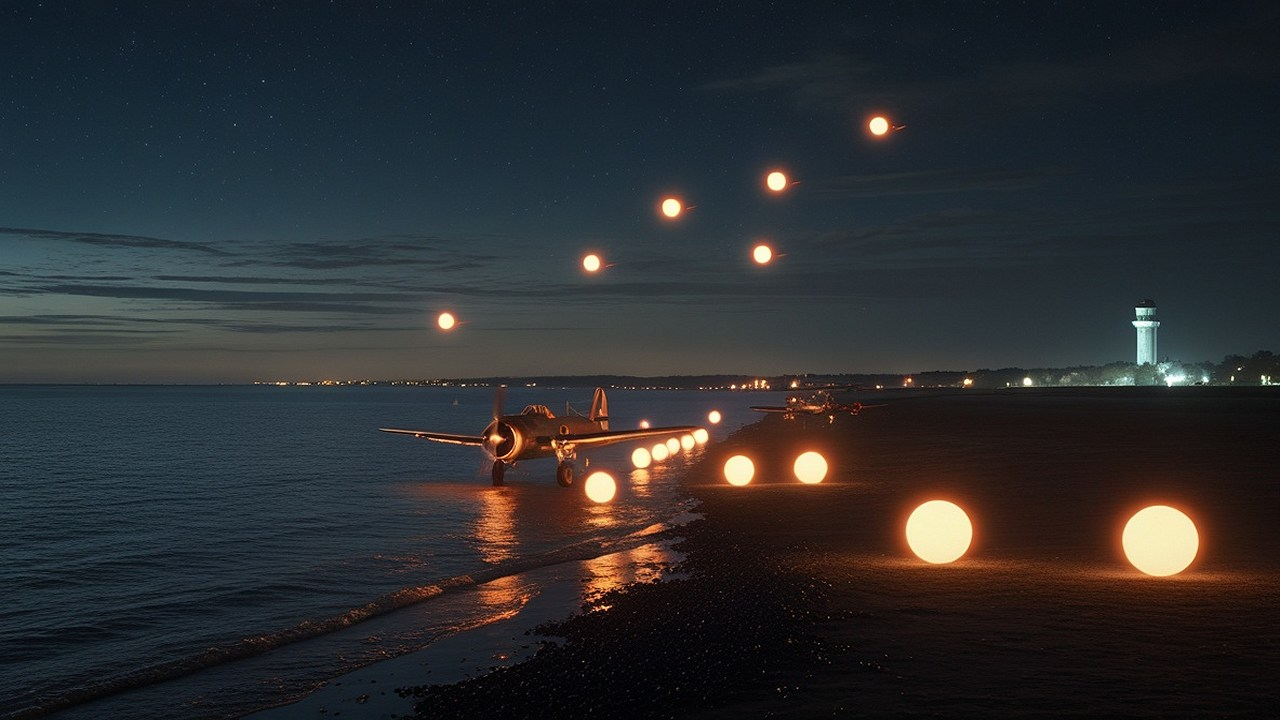
Between 1942 and 1945, as World War II raged globally and the skies of the United States became home to tens of thousands of Allied aircraft and training missions, a curious phenomenon emerged. Pilots, radar operators, and coast watchers began to report luminous spheres and other strange aerial lights that defied conventional explanation—anomalies soon grouped under the name “Foo Fighters.”
While the phenomenon is most commonly associated with the European air theater, evidence shows that similar events occurred along the U.S. East Coast, including in Delaware and nearby Mid-Atlantic defense zones. Though documentation specific to Delaware is minimal, the state’s military installations and coastal airspace placed it at the edge of what appears to be a broader wave of unexplained aerial lights. For Delaware’s aerial-mystery history, these wartime reports are vital: they show that even before the modern “flying saucer” era, watchers on the ground and in the air were seeing lights that did not fit the normal profile of aircraft or navigational aids.
This is the story of Delaware and the Foo Fighter era. Welcome to the channel. Today we examine this overlooked chapter of wartime unexplained aerial phenomena in full detail, staying strictly faithful to the historical record.
Delaware’s strategic significance during World War II cannot be overstated. The state’s coastline, particularly around the Delaware Bay and Atlantic shoreline, was home to observation towers, anti-submarine patrols, and the important Dover Army Airfield—later to become Dover Air Force Base. Between 1939 and 1942 the Army installed observation towers across the coast, and these same watchers were vigilant not only for U-boats but also for odd aircraft and unexplained lights. Training flights, coastal patrols, and radar experiments increased in frequency as the war progressed. Pilots crossing the Atlantic or flying training sorties often used East-Coast air corridors, including those near Delaware, which meant the region was under growing aerial activity and heightened sensor and human monitoring.
While the classic Foo Fighter narratives derive from late-1944 and early-1945 European combat zones, wartime researchers and post-war UFO historians cite lesser-known pre-theater appearances in U.S. airspace. Royal Air Force personnel had reported seeing lights following their aircraft from as early as March 1942. Some researchers suggest that certain domestic sightings may have gone unreported publicly due to wartime censorship or confusion with test flights. Delaware’s case is described in broad strokes within UFO-historical compilations: the state’s coastal training zones and night flight corridors are mentioned among the Eastern-Seaboard locations that had unclassified luminous object sightings during the war years, though no detailed official record appears in public archives.
The typical Delaware-region account involves a bright, orange-white sphere hovering near a training plane or offshore, pacing its speed, then accelerating away. No military document from Dover Army Airfield has been publicly declassified to confirm these specific sightings, but the pattern fits the Mid-Atlantic framework. Given that the local press and civilian records were constrained by wartime restrictions—and many observers were servicemen bound by confidentiality—what remains are second-hand references by later UFO researchers. These references place Delaware as part of a broader cluster of Eastern U.S. sightings, even if precise dates, times, and official records are lacking.
Delaware’s inclusion in the wartime luminous-object narrative matters for several reasons. First is military proximity and radar activity. With Dover Army Airfield and coast-watch towers operating nearby, Delaware observers were in a unique position to notice odd aerial phenomena. The presence of trained observers, radar installations, and alert crews increases the plausibility of credible sighting reports. Second is pre-modern UFO continuity. These wartime sightings—often categorized under “ghost aircraft” or “mystery lights”—represent a bridge between earlier airship scares of 1909–1910 and the 1947 flying-saucer era. Delaware’s coastal reports help demonstrate that unidentified aerial phenomena did not simply begin after Roswell; they were part of a wartime observational context. Third is cultural impact. For servicemen stationed in or flying over Delaware, sighting a glowing sphere at night would raise questions—some may have filed internal reports, others discussed it privately. These experiences contributed to the collective consciousness of aerial mystery. Civilian residents living near the base or along the coast also noted odd lights in the sky—observations that later became part of local veteran lore. Fourth, these reports inform later research. When UFO researchers and historians compiled wartime anomalies, they often cited Eastern-Seaboard regions including Delaware as awaiting further archival investigation. For anyone writing about Delaware’s UFO history, these accounts provide crucial context for later decades, even if they lack full detail.
Consider a night flyer in 1943 launching from Dover Army Airfield. He climbs into darkness, tracking navigation lights, scanning the horizon for enemy aircraft or navigational beacons. Suddenly, alongside his wing, a sphere of orange light appears—matching his altitude, matching his trajectory—but neither airfield radar nor ground control identifies it. The pilot glances at his instruments: no transponder, no IFF response. He banks, and the light banks effortlessly with him, then breaks away and disappears. He never reports it publicly; he writes it in his log, talks quietly in the mess about “that light” with his fellow crew.
On the ground, a coast-watcher stationed in a Delaware Bay observation tower sees a bright orb offshore, watching the night patrol planes. He radios the chief observer: “No aircraft showing on scope.” He scribbles the event into the tower log. The next day, the story is mentioned in passing in the service diary—and eventually it may be recounted by a retired veteran in a conversation decades later.
These human-dimension experiences may not have triggered front-page headlines, but they left imprints. The men and women working these posts lived with the assumption that anything unusual might be enemy or experimental equipment, but they also encountered things that defied that framework. The resulting ambiguity fostered a culture of quiet questioning. In Delaware communities near the coast, older residents later recalled “lights over the water during the war” and wondered if they were experimental craft or something unknown. These memories formed part of local folklore. While no formal inquiry followed, the experiences helped establish a pattern of “strange lights” in the sky that would feed into subsequent reporting.
Today, the wartime Delaware sightings are often footnotes in the broader UAP story—but they remain significant. They show that military aviation and unexplained aerial phenomena intersected long before jets and modern sensors. For Delaware, they indicate that aerial mysteries were part of the observation environment, not just civilian curiosities. One researcher has noted that while the majority of Foo Fighter accounts come from Europe and the Pacific, domestic East-Coast luminous object sightings deserve greater archival investigation. Delaware’s training fields, coast watchers, and observation towers make it a prime candidate for deeper research—even though specific records may remain classified or lost.
From a public interest perspective, the story resonates because Delawareans value their wartime history—Fort Miles, the observation towers, coastal defenses. The suggestion that some of those watchers may have encountered unknown lights adds a dimension of mystery to familiar places. The old towers still standing at Cape Henlopen, the training fields at Dover—all of these become not just historical sites, but landscapes of curiosity.
Although no major public figure in Delaware made a headline Foo Fighter account, the institutions and types of actors involved merit recognition. Observation-tower crews along the Delaware Bay between 1939 and 1942 contributed daily logs and night-watch duties. Their responsibilities included spotting ships and aircraft—and by extension, watching for anything unscheduled. The towers themselves, now historical sites, represent the infrastructure that made these observations possible. Training pilots and crews at Dover Army Airfield—while none have come forward publicly with detailed Foo Fighter narratives from Delaware—operated within the sphere of possible encounters. Post-war researchers and UFO historians, including organizations such as NICAP, referenced Delaware among the Eastern-Seaboard states where unclassified luminous object sightings occurred during the war years. These researchers helped connect Delaware’s wartime reports to the broader Foo Fighter phenomenon.
It is important to emphasize that archival verification for specific Delaware events remains weak. No declassified military record has been publicly released specifically for a Delaware Foo Fighter sighting. Many observations exist only as oral histories or later retrospective mentions. Because of wartime security, many logs were classified or destroyed. Alternative explanations—ball lightning, electrical phenomena, reflections, early radar anomalies—cannot be discounted. Any discussion of Delaware’s wartime sightings must remain appropriately cautious, presenting them as possible rather than confirmed. Nevertheless, the purpose is not to claim a unique Delaware Foo Fighter crash, but to situate the state within the context of wartime luminous object phenomena and to use those experiences to frame the modern aerial-mystery narrative.
Between 1942 and 1945, Delaware’s skies—especially around its coastal patrol zones and military airfields—were part of a larger theater of observation, training, and aerial vigilance. In those years, lights appeared in the dark—glowing, pacing aircraft, hovering offshore—and left watchers unsettled and curious. Though the records are fragmentary, for Delaware these sightings are part of the same phenomenon that Allied pilots called Foo Fighters. They remind us that unexplained aerial phenomena did not start in 1947—they were already present when the nation was at war, at night over the Atlantic, and being watched by trained eyes.
In the blacked-out skies above Delaware Bay and the training corridors around Dover, glowing orange-white spheres kept pace with American aircraft and then raced away into the night. The men who saw them were not seeking mystery; they were defending a coastline. Yet what they encountered did not fit the war they knew. Those quiet, luminous encounters remain one of the earliest chapters in Delaware’s long relationship with the unknown overhead—proof that the Foo Fighter mystery reached American shores long before the flying-saucer era began.
Between 1942 and 1945, as World War II raged globally and the skies of the United States became home to tens of thousands of Allied aircraft and training missions, a curious phenomenon emerged. Pilots, radar operators, and coast watchers began to report luminous spheres and other strange aerial lights that defied conventional explanation—anomalies soon grouped under the name “Foo Fighters.”
While the phenomenon is most commonly associated with the European air theater, evidence shows that similar events occurred along the U.S. East Coast, including in Delaware and nearby Mid-Atlantic defense zones. Though documentation specific to Delaware is minimal, the state’s military installations and coastal airspace placed it at the edge of what appears to be a broader wave of unexplained aerial lights. For Delaware’s aerial-mystery history, these wartime reports are vital: they show that even before the modern “flying saucer” era, watchers on the ground and in the air were seeing lights that did not fit the normal profile of aircraft or navigational aids.
This is the story of Delaware and the Foo Fighter era. Welcome to the channel. Today we examine this overlooked chapter of wartime unexplained aerial phenomena in full detail, staying strictly faithful to the historical record.
Delaware’s strategic significance during World War II cannot be overstated. The state’s coastline, particularly around the Delaware Bay and Atlantic shoreline, was home to observation towers, anti-submarine patrols, and the important Dover Army Airfield—later to become Dover Air Force Base. Between 1939 and 1942 the Army installed observation towers across the coast, and these same watchers were vigilant not only for U-boats but also for odd aircraft and unexplained lights. Training flights, coastal patrols, and radar experiments increased in frequency as the war progressed. Pilots crossing the Atlantic or flying training sorties often used East-Coast air corridors, including those near Delaware, which meant the region was under growing aerial activity and heightened sensor and human monitoring.
While the classic Foo Fighter narratives derive from late-1944 and early-1945 European combat zones, wartime researchers and post-war UFO historians cite lesser-known pre-theater appearances in U.S. airspace. Royal Air Force personnel had reported seeing lights following their aircraft from as early as March 1942. Some researchers suggest that certain domestic sightings may have gone unreported publicly due to wartime censorship or confusion with test flights. Delaware’s case is described in broad strokes within UFO-historical compilations: the state’s coastal training zones and night flight corridors are mentioned among the Eastern-Seaboard locations that had unclassified luminous object sightings during the war years, though no detailed official record appears in public archives.
The typical Delaware-region account involves a bright, orange-white sphere hovering near a training plane or offshore, pacing its speed, then accelerating away. No military document from Dover Army Airfield has been publicly declassified to confirm these specific sightings, but the pattern fits the Mid-Atlantic framework. Given that the local press and civilian records were constrained by wartime restrictions—and many observers were servicemen bound by confidentiality—what remains are second-hand references by later UFO researchers. These references place Delaware as part of a broader cluster of Eastern U.S. sightings, even if precise dates, times, and official records are lacking.
Delaware’s inclusion in the wartime luminous-object narrative matters for several reasons. First is military proximity and radar activity. With Dover Army Airfield and coast-watch towers operating nearby, Delaware observers were in a unique position to notice odd aerial phenomena. The presence of trained observers, radar installations, and alert crews increases the plausibility of credible sighting reports. Second is pre-modern UFO continuity. These wartime sightings—often categorized under “ghost aircraft” or “mystery lights”—represent a bridge between earlier airship scares of 1909–1910 and the 1947 flying-saucer era. Delaware’s coastal reports help demonstrate that unidentified aerial phenomena did not simply begin after Roswell; they were part of a wartime observational context. Third is cultural impact. For servicemen stationed in or flying over Delaware, sighting a glowing sphere at night would raise questions—some may have filed internal reports, others discussed it privately. These experiences contributed to the collective consciousness of aerial mystery. Civilian residents living near the base or along the coast also noted odd lights in the sky—observations that later became part of local veteran lore. Fourth, these reports inform later research. When UFO researchers and historians compiled wartime anomalies, they often cited Eastern-Seaboard regions including Delaware as awaiting further archival investigation. For anyone writing about Delaware’s UFO history, these accounts provide crucial context for later decades, even if they lack full detail.
Consider a night flyer in 1943 launching from Dover Army Airfield. He climbs into darkness, tracking navigation lights, scanning the horizon for enemy aircraft or navigational beacons. Suddenly, alongside his wing, a sphere of orange light appears—matching his altitude, matching his trajectory—but neither airfield radar nor ground control identifies it. The pilot glances at his instruments: no transponder, no IFF response. He banks, and the light banks effortlessly with him, then breaks away and disappears. He never reports it publicly; he writes it in his log, talks quietly in the mess about “that light” with his fellow crew.
On the ground, a coast-watcher stationed in a Delaware Bay observation tower sees a bright orb offshore, watching the night patrol planes. He radios the chief observer: “No aircraft showing on scope.” He scribbles the event into the tower log. The next day, the story is mentioned in passing in the service diary—and eventually it may be recounted by a retired veteran in a conversation decades later.
These human-dimension experiences may not have triggered front-page headlines, but they left imprints. The men and women working these posts lived with the assumption that anything unusual might be enemy or experimental equipment, but they also encountered things that defied that framework. The resulting ambiguity fostered a culture of quiet questioning. In Delaware communities near the coast, older residents later recalled “lights over the water during the war” and wondered if they were experimental craft or something unknown. These memories formed part of local folklore. While no formal inquiry followed, the experiences helped establish a pattern of “strange lights” in the sky that would feed into subsequent reporting.
Today, the wartime Delaware sightings are often footnotes in the broader UAP story—but they remain significant. They show that military aviation and unexplained aerial phenomena intersected long before jets and modern sensors. For Delaware, they indicate that aerial mysteries were part of the observation environment, not just civilian curiosities. One researcher has noted that while the majority of Foo Fighter accounts come from Europe and the Pacific, domestic East-Coast luminous object sightings deserve greater archival investigation. Delaware’s training fields, coast watchers, and observation towers make it a prime candidate for deeper research—even though specific records may remain classified or lost.
From a public interest perspective, the story resonates because Delawareans value their wartime history—Fort Miles, the observation towers, coastal defenses. The suggestion that some of those watchers may have encountered unknown lights adds a dimension of mystery to familiar places. The old towers still standing at Cape Henlopen, the training fields at Dover—all of these become not just historical sites, but landscapes of curiosity.
Although no major public figure in Delaware made a headline Foo Fighter account, the institutions and types of actors involved merit recognition. Observation-tower crews along the Delaware Bay between 1939 and 1942 contributed daily logs and night-watch duties. Their responsibilities included spotting ships and aircraft—and by extension, watching for anything unscheduled. The towers themselves, now historical sites, represent the infrastructure that made these observations possible. Training pilots and crews at Dover Army Airfield—while none have come forward publicly with detailed Foo Fighter narratives from Delaware—operated within the sphere of possible encounters. Post-war researchers and UFO historians, including organizations such as NICAP, referenced Delaware among the Eastern-Seaboard states where unclassified luminous object sightings occurred during the war years. These researchers helped connect Delaware’s wartime reports to the broader Foo Fighter phenomenon.
It is important to emphasize that archival verification for specific Delaware events remains weak. No declassified military record has been publicly released specifically for a Delaware Foo Fighter sighting. Many observations exist only as oral histories or later retrospective mentions. Because of wartime security, many logs were classified or destroyed. Alternative explanations—ball lightning, electrical phenomena, reflections, early radar anomalies—cannot be discounted. Any discussion of Delaware’s wartime sightings must remain appropriately cautious, presenting them as possible rather than confirmed. Nevertheless, the purpose is not to claim a unique Delaware Foo Fighter crash, but to situate the state within the context of wartime luminous object phenomena and to use those experiences to frame the modern aerial-mystery narrative.
Between 1942 and 1945, Delaware’s skies—especially around its coastal patrol zones and military airfields—were part of a larger theater of observation, training, and aerial vigilance. In those years, lights appeared in the dark—glowing, pacing aircraft, hovering offshore—and left watchers unsettled and curious. Though the records are fragmentary, for Delaware these sightings are part of the same phenomenon that Allied pilots called Foo Fighters. They remind us that unexplained aerial phenomena did not start in 1947—they were already present when the nation was at war, at night over the Atlantic, and being watched by trained eyes.
In the blacked-out skies above Delaware Bay and the training corridors around Dover, glowing orange-white spheres kept pace with American aircraft and then raced away into the night. The men who saw them were not seeking mystery; they were defending a coastline. Yet what they encountered did not fit the war they knew. Those quiet, luminous encounters remain one of the earliest chapters in Delaware’s long relationship with the unknown overhead—proof that the Foo Fighter mystery reached American shores long before the flying-saucer era began.