


Blog Categories
- African Incidents
- Atlantis Incidents
- Australian Incidents
- Belgian Incidents
- Bermuda Triangle Incidents
- Brazilian Incidents
- Canadian Incidents
- Chinese Incidents
- European Incidents
- France Incidents
- Ghosts
- Giants
- Italy Incidents
- Japanese Incidents
- Middle East Incidents
- Portugal Incidents
- Project Serpo
- Puerto Rico Incidents
- Russian Incidents
- Sasquatch
- Scandinavia Incidents
- Spanish Incidents
- UFOs
- United Kingdom Incidents
- United States Incidents
1945: Trinity Crash (San Antonio, New Mexico)
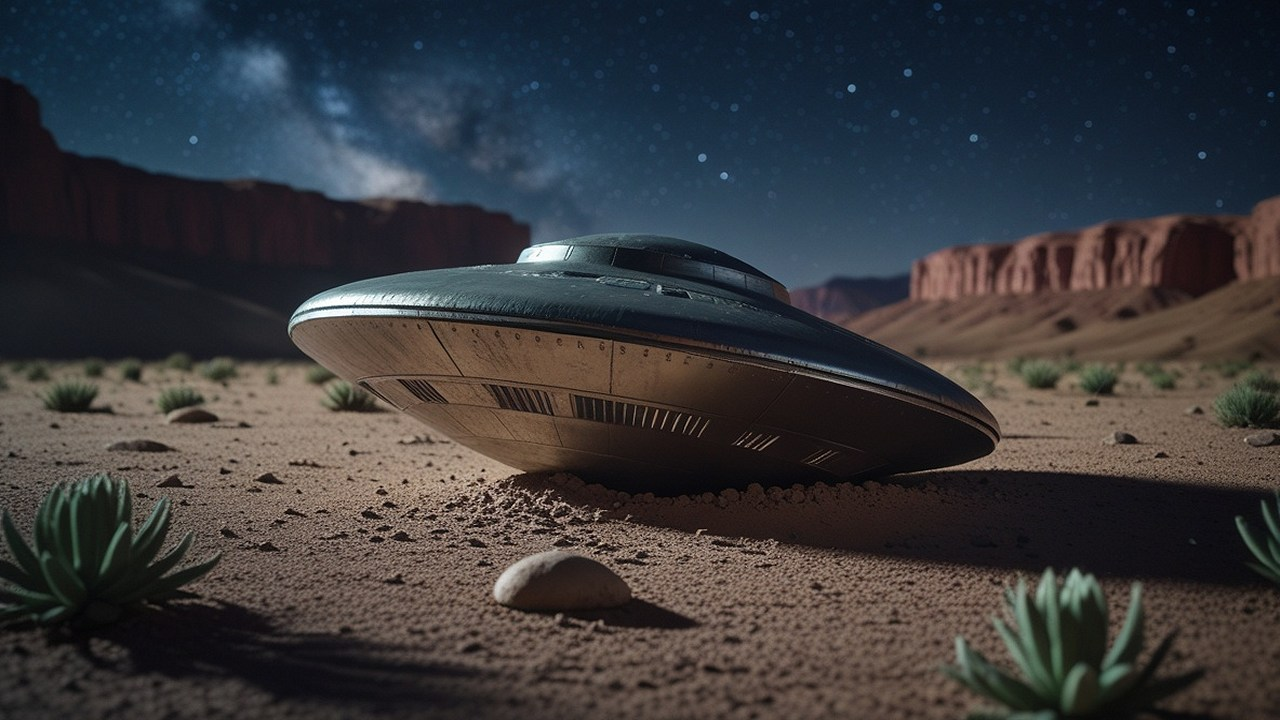
In the annals of UFO lore, few cases are as provocative — or as contested — as the alleged 1945 crash near San Antonio, New Mexico, often called the Trinity UFO Incident. The story is anchored by the well-documented Trinity atomic test, the first nuclear detonation in history, conducted by the United States on July 16, 1945. According to certain UFO researchers, just weeks after this epochal test, two young boys — José Padilla (then 9) and Remigio "Reme" Baca (then 7) — witnessed a bizarre crash in their desert ranchland, claiming an "avocado shaped" craft with small humanoid beings was involved. Their account, first brought to wide attention by Jacques Vallée and Paola Harris in their book Trinity: The Best-Kept Secret, has since generated passionate debate, investigation, skepticism, and speculation.
This is the story of the 1945 Trinity UFO crash — a case that connects the dawn of the Atomic Age directly to the modern UFO phenomenon, raising profound questions about government retrievals, advanced technology, and humanity’s place in the cosmos. Welcome to the channel. Today we examine this early and controversial incident in full detail, staying faithful to the historical accounts and research.
The Trinity atomic test on July 16, 1945, marked a turning point in human history. In the remote desert of New Mexico, the United States detonated the first nuclear device, ushering in the Atomic Age and forever changing the nature of warfare and global power. Just one month later, on August 16, 1945, two young boys riding horses near their family ranch northwest of San Antonio, New Mexico, claimed they witnessed something extraordinary.
According to the testimony of José Padilla and Remigio "Reme" Baca, they heard a loud bang, felt the ground shake, and saw smoke rising in the distance. Investigating the source, the boys found a large gouge in the ground — a shallow trench about 30 cm deep and up to 30 meters wide — and at its far end, an intact craft partially embedded in the earth. They described the object as about 7.5 to 9 meters long, approximately 4 meters high, with a dull metallic surface and an unusual "avocado" shape.
Using binoculars, they claimed to see three to four small, insect-like humanoid beings inside the craft. These figures, according to Baca, moved rapidly — almost teleporting from place to place — and emitted a high-pitched, distressed sound, which the boys interpreted as either pain or the wail of a newborn. Over the next few days, Padilla said, military personnel arrived, setting up a recovery operation. They observed soldiers loading debris onto a flatbed truck and moving parts of the craft under a tarp. They also reported that they were able to sneak closer: on one occasion, Padilla says, he removed part of the tarp, entered the craft, and retrieved a small metallic part — what he called a "souvenir." This piece, by his account, weighed about 425 g, measured roughly 30 cm, and had holes drilled into it as though for pins or fasteners.
Eventually, according to their story, the site was cleaned up, and all traces of the crash — except for the piece Padilla kept — were removed.
The strongest pro-UFO account of this incident comes from Jacques Vallée and Paola Harris, whose research led to the detailed book Trinity: The Best-Kept Secret. Vallée, a respected computer scientist and longtime UFO investigator, and Harris, a journalist and ufologist, interviewed Padilla and Baca extensively, cross-referencing their stories with local history and other data. They documented not only the boys’ detailed descriptions but also their emotional memory: the fear, the curiosity, and the sustained presence at the crash site for roughly 30–45 minutes per witness.
Vallée and Harris argue that the cleanup was not a minor operation. They claim the Army recovered both the craft and, possibly, occupants, and transported them away. In their account, they stress how implausible the "weather balloon" explanation was, offered by soldiers, given the object’s design, the behavior of the witnesses, and the size and weight of the wreckage. They also discuss the "souvenir" piece taken by Padilla, noting the testimony that it had memory-metal-like properties, unfolding itself when freed.
A key component in supporting the claims has been material analysis. In 2015, the Mutual UFO Network (MUFON) commissioned P.A. Budinger, a scientist, to analyze two metallic fragments claimed to come from the crash site. According to his report, one piece unfolded itself when freed — something Padilla and Baca had described — and resembled previously reported "memory-metal" material from other UFO cases.
The Trinity crash story has its fair share of critics. Some researchers and skeptics argue that the tale lacks independent corroboration, pointing out discrepancies and raising serious questions about the credibility of the witnesses. One of the most damaging critiques arises from Sammy Padilla, son of José Padilla. According to a New Mexico State Police recording, Sammy described his father as a "pathological liar" and expressed doubt about the entire crash narrative. He claimed that José Padilla made false claims about his past, including exaggerated or invented service records, and questioned the consistency of his UFO story.
Further skepticism is fueled by doubts around Eddie Apodaca, a state trooper who allegedly helped with the recovery in 1945. According to critics, the real Eddie Apodaca was not in New Mexico at the time of the reported crash — he was serving with the Army in Europe. Moreover, some say he didn’t become a police officer until years later, casting doubt on the part of the narrative that involves him. These critical voices argue that over time, Padilla and Baca may have reshaped their story or added details, particularly under pressure from UFO researchers.
Despite — or perhaps because of — the controversy, the 1945 Trinity incident holds a special place in UFO history. It connects the phenomenon directly to the dawn of the Atomic Age: a narrative link that many find symbolically powerful. For some believers, the notion that a craft crashed shortly after the first nuclear explosion suggests a connection between human nuclear technology and alien interest.
The crash story aligns with a broader pattern: the idea that advanced, non-human technology is being surveilled, recovered, and possibly even reverse-engineered by governments. In this respect, the Padilla-Baca account feeds into longstanding themes about cover-ups, secret retrieval programs, and covert operations. The participation of Jacques Vallée, a highly respected figure in ufology, gives the story considerable weight. His scientific background and methodical approach make the case more compelling to serious researchers than many more sensationalistic UFO accounts.
Today, the story of Trinity is still debated by both UFO researchers and skeptics. It continues to inspire field investigations, documentary projects, and interviews with José Padilla and (historically) Reme Baca. The "souvenir" piece Padilla claims to have retrieved remains a subject of interest, drawing attention whenever laboratory analyses are discussed or published.
For the broader UFO field, the Trinity case exemplifies a critical juncture between postwar governmental secrecy, nuclear technology, and unidentified aerial phenomena. It is frequently referenced alongside more famous incidents — like Roswell — not just because of its dramatic story, but because it raises deeper questions about how world-changing technologies and unexplained phenomena may be interconnected.
On a cultural level, the incident resonates with themes of childhood memory, trauma, and secrecy. Padilla and Baca’s story is not just about a crash — it’s about how truth is preserved (or distorted) over decades, how governments act in extreme circumstances, and how ordinary people might believe they have witnessed something extraordinary.
If the account is true — or even partially true — the 1945 Trinity crash could be more than just another UFO story. It suggests that the U.S. military may have had access to, and possibly recovered, an advanced craft immediately after the first atomic test. This raises profound questions about whether some portion of UFO lore intersects with real, contemporaneous national security concerns. Additionally, the story emphasizes a human dimension: two boys witnessing something beyond their comprehension, and a military operation that may have hidden as much as it revealed.
The 1945 Trinity UFO crash case is a deeply layered mystery. It combines youthful eyewitness testimony, scientific curiosity, military secrecy, and the existential implications of the Atomic Age. Whether one believes the story or regards it with skepticism, its themes and questions continue to reverberate through UFO research and popular culture.
At its heart, the Trinity incident asks us: What happens when human technology leaps forward so quickly that the skies themselves seem to change? And when such change comes, are we prepared to understand — and possibly hide — the consequences? For believers, it may be evidence of an ancient or ongoing alien interest in Earth; for skeptics, it might be a cautionary tale about memory, myth, and motivation. Either way, its place in UFO history is secure — and its influence still felt by those who continue to look for answers in the New Mexico desert.
In the annals of UFO lore, few cases are as provocative — or as contested — as the alleged 1945 crash near San Antonio, New Mexico, often called the Trinity UFO Incident. The story is anchored by the well-documented Trinity atomic test, the first nuclear detonation in history, conducted by the United States on July 16, 1945. According to certain UFO researchers, just weeks after this epochal test, two young boys — José Padilla (then 9) and Remigio "Reme" Baca (then 7) — witnessed a bizarre crash in their desert ranchland, claiming an "avocado shaped" craft with small humanoid beings was involved. Their account, first brought to wide attention by Jacques Vallée and Paola Harris in their book Trinity: The Best-Kept Secret, has since generated passionate debate, investigation, skepticism, and speculation.
This is the story of the 1945 Trinity UFO crash — a case that connects the dawn of the Atomic Age directly to the modern UFO phenomenon, raising profound questions about government retrievals, advanced technology, and humanity’s place in the cosmos. Welcome to the channel. Today we examine this early and controversial incident in full detail, staying faithful to the historical accounts and research.
The Trinity atomic test on July 16, 1945, marked a turning point in human history. In the remote desert of New Mexico, the United States detonated the first nuclear device, ushering in the Atomic Age and forever changing the nature of warfare and global power. Just one month later, on August 16, 1945, two young boys riding horses near their family ranch northwest of San Antonio, New Mexico, claimed they witnessed something extraordinary.
According to the testimony of José Padilla and Remigio "Reme" Baca, they heard a loud bang, felt the ground shake, and saw smoke rising in the distance. Investigating the source, the boys found a large gouge in the ground — a shallow trench about 30 cm deep and up to 30 meters wide — and at its far end, an intact craft partially embedded in the earth. They described the object as about 7.5 to 9 meters long, approximately 4 meters high, with a dull metallic surface and an unusual "avocado" shape.
Using binoculars, they claimed to see three to four small, insect-like humanoid beings inside the craft. These figures, according to Baca, moved rapidly — almost teleporting from place to place — and emitted a high-pitched, distressed sound, which the boys interpreted as either pain or the wail of a newborn. Over the next few days, Padilla said, military personnel arrived, setting up a recovery operation. They observed soldiers loading debris onto a flatbed truck and moving parts of the craft under a tarp. They also reported that they were able to sneak closer: on one occasion, Padilla says, he removed part of the tarp, entered the craft, and retrieved a small metallic part — what he called a "souvenir." This piece, by his account, weighed about 425 g, measured roughly 30 cm, and had holes drilled into it as though for pins or fasteners.
Eventually, according to their story, the site was cleaned up, and all traces of the crash — except for the piece Padilla kept — were removed.
The strongest pro-UFO account of this incident comes from Jacques Vallée and Paola Harris, whose research led to the detailed book Trinity: The Best-Kept Secret. Vallée, a respected computer scientist and longtime UFO investigator, and Harris, a journalist and ufologist, interviewed Padilla and Baca extensively, cross-referencing their stories with local history and other data. They documented not only the boys’ detailed descriptions but also their emotional memory: the fear, the curiosity, and the sustained presence at the crash site for roughly 30–45 minutes per witness.
Vallée and Harris argue that the cleanup was not a minor operation. They claim the Army recovered both the craft and, possibly, occupants, and transported them away. In their account, they stress how implausible the "weather balloon" explanation was, offered by soldiers, given the object’s design, the behavior of the witnesses, and the size and weight of the wreckage. They also discuss the "souvenir" piece taken by Padilla, noting the testimony that it had memory-metal-like properties, unfolding itself when freed.
A key component in supporting the claims has been material analysis. In 2015, the Mutual UFO Network (MUFON) commissioned P.A. Budinger, a scientist, to analyze two metallic fragments claimed to come from the crash site. According to his report, one piece unfolded itself when freed — something Padilla and Baca had described — and resembled previously reported "memory-metal" material from other UFO cases.
The Trinity crash story has its fair share of critics. Some researchers and skeptics argue that the tale lacks independent corroboration, pointing out discrepancies and raising serious questions about the credibility of the witnesses. One of the most damaging critiques arises from Sammy Padilla, son of José Padilla. According to a New Mexico State Police recording, Sammy described his father as a "pathological liar" and expressed doubt about the entire crash narrative. He claimed that José Padilla made false claims about his past, including exaggerated or invented service records, and questioned the consistency of his UFO story.
Further skepticism is fueled by doubts around Eddie Apodaca, a state trooper who allegedly helped with the recovery in 1945. According to critics, the real Eddie Apodaca was not in New Mexico at the time of the reported crash — he was serving with the Army in Europe. Moreover, some say he didn’t become a police officer until years later, casting doubt on the part of the narrative that involves him. These critical voices argue that over time, Padilla and Baca may have reshaped their story or added details, particularly under pressure from UFO researchers.
Despite — or perhaps because of — the controversy, the 1945 Trinity incident holds a special place in UFO history. It connects the phenomenon directly to the dawn of the Atomic Age: a narrative link that many find symbolically powerful. For some believers, the notion that a craft crashed shortly after the first nuclear explosion suggests a connection between human nuclear technology and alien interest.
The crash story aligns with a broader pattern: the idea that advanced, non-human technology is being surveilled, recovered, and possibly even reverse-engineered by governments. In this respect, the Padilla-Baca account feeds into longstanding themes about cover-ups, secret retrieval programs, and covert operations. The participation of Jacques Vallée, a highly respected figure in ufology, gives the story considerable weight. His scientific background and methodical approach make the case more compelling to serious researchers than many more sensationalistic UFO accounts.
Today, the story of Trinity is still debated by both UFO researchers and skeptics. It continues to inspire field investigations, documentary projects, and interviews with José Padilla and (historically) Reme Baca. The "souvenir" piece Padilla claims to have retrieved remains a subject of interest, drawing attention whenever laboratory analyses are discussed or published.
For the broader UFO field, the Trinity case exemplifies a critical juncture between postwar governmental secrecy, nuclear technology, and unidentified aerial phenomena. It is frequently referenced alongside more famous incidents — like Roswell — not just because of its dramatic story, but because it raises deeper questions about how world-changing technologies and unexplained phenomena may be interconnected.
On a cultural level, the incident resonates with themes of childhood memory, trauma, and secrecy. Padilla and Baca’s story is not just about a crash — it’s about how truth is preserved (or distorted) over decades, how governments act in extreme circumstances, and how ordinary people might believe they have witnessed something extraordinary.
If the account is true — or even partially true — the 1945 Trinity crash could be more than just another UFO story. It suggests that the U.S. military may have had access to, and possibly recovered, an advanced craft immediately after the first atomic test. This raises profound questions about whether some portion of UFO lore intersects with real, contemporaneous national security concerns. Additionally, the story emphasizes a human dimension: two boys witnessing something beyond their comprehension, and a military operation that may have hidden as much as it revealed.
The 1945 Trinity UFO crash case is a deeply layered mystery. It combines youthful eyewitness testimony, scientific curiosity, military secrecy, and the existential implications of the Atomic Age. Whether one believes the story or regards it with skepticism, its themes and questions continue to reverberate through UFO research and popular culture.
At its heart, the Trinity incident asks us: What happens when human technology leaps forward so quickly that the skies themselves seem to change? And when such change comes, are we prepared to understand — and possibly hide — the consequences? For believers, it may be evidence of an ancient or ongoing alien interest in Earth; for skeptics, it might be a cautionary tale about memory, myth, and motivation. Either way, its place in UFO history is secure — and its influence still felt by those who continue to look for answers in the New Mexico desert.