


Blog Categories
- African Incidents
- Atlantis Incidents
- Australian Incidents
- Belgian Incidents
- Bermuda Triangle Incidents
- Brazilian Incidents
- Canadian Incidents
- Chinese Incidents
- European Incidents
- France Incidents
- Ghosts
- Giants
- Italy Incidents
- Japanese Incidents
- Middle East Incidents
- Portugal Incidents
- Project Serpo
- Puerto Rico Incidents
- Russian Incidents
- Sasquatch
- Scandinavia Incidents
- Spanish Incidents
- UFOs
- United Kingdom Incidents
- United States Incidents
1947: A Quiet Encounter at Pine Bluff Arsenal
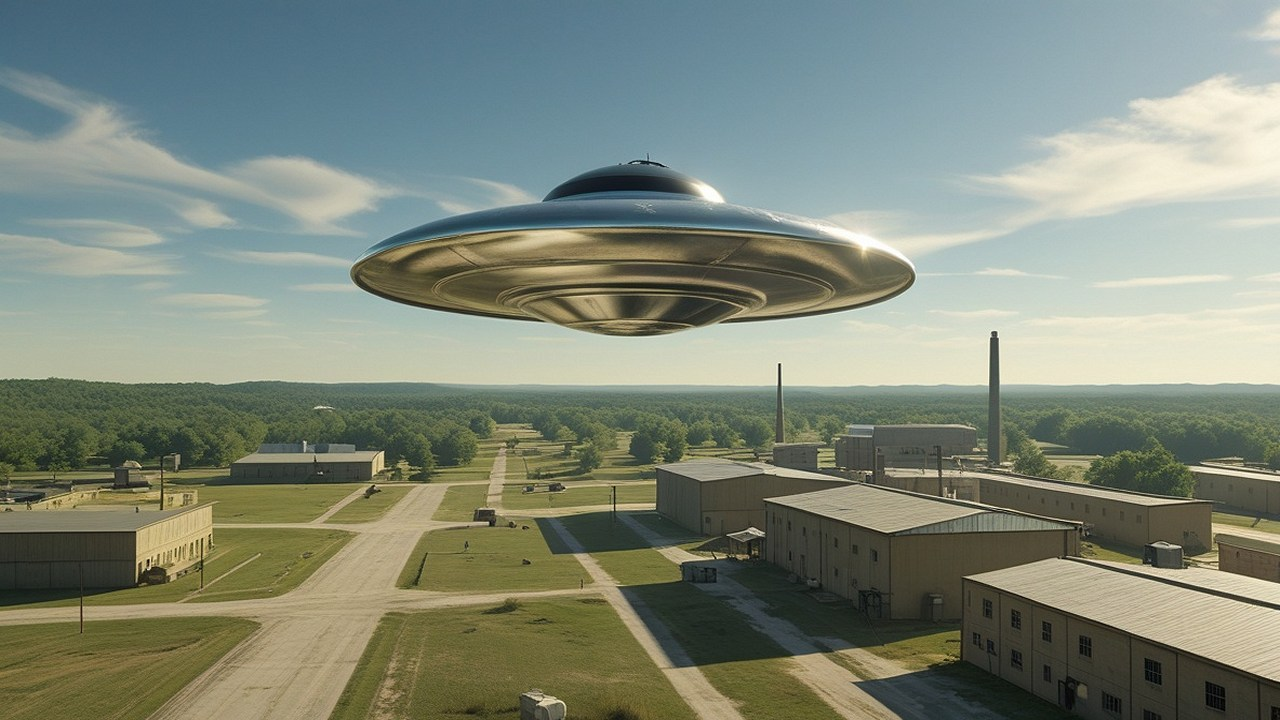
On July 4, 1947, as much of America celebrated Independence Day with fireworks and family gatherings, the skies above Pine Bluff, Arkansas, were graced—or perhaps haunted—by an unexpected spectacle. T.L. Huckaby, then stationed at the Pine Bluff Arsenal, reported witnessing an odd, silver, circular object in flight. Remarkably, the object exhibited no discernible sound, sparkled like a polished metal disc, and measured approximately the size of a common wash tub. While less widely publicized than other events of that summer—most notably the Roswell crash—this incident nevertheless struck a chord with those who heard of it, laying the seeds for intrigue both then and now.
This is the story of the quiet encounter at Pine Bluff Arsenal. Welcome to the channel. Today we examine this understated yet highly credible 1947 sighting in full detail, staying strictly faithful to the historical record.
T.L. Huckaby was a civilian contractor employed at the Pine Bluff Arsenal, which was engaged in producing chemicals and munitions essential to the post-war military effort. With a reputation for precision and low-key reliability, Huckaby’s testimony carried more weight than the typical UFO report of the time. He was not a paranormal enthusiast or amateur astronomer; he was simply a steady professional who saw something he could not explain.
According to his report, on the afternoon of July 4, a circular object glimmered overhead at a relatively low altitude. Huckaby described it as having a reflective silver sheen, with no sound, vapor trails, or exhaust plumes. He measured its size in comparative terms familiar to him—and his fellow plant workers—suggesting it was about the size of a wash tub or small car hood. It hovered gracefully, performed several silent loops, and then disappeared with sudden acceleration, vanishing into thin air.
Huckaby’s account was later documented in an internal report at the Arsenal, though it did not attract immediate national attention. At the time, the priority of the Department of Defense and other government agencies was on the nascent Cold War, while UFOs remained largely speculative curiosities. Still, the report did circulate among local officials, military colleagues, and a small network of UFO researchers who began to archive it as significant proof of post-war aerial anomalies.
Unlike scenes of panic or mass hysteria, the reaction in Pine Bluff was measured and somewhat mystified. That summer, the post-war community was transforming, full of returning soldiers, civic expansion, and a dawning interest in scientific exploration. In such an atmosphere, a civilian contractor describing a flying silver disc elicited a range of responses.
Some nearest to the Arsenal considered Huckaby’s sighting a case of atmospheric illusion—perhaps a sky tanker or balloon reflecting sunlight. In lunchrooms and offices, engineers and mechanics debated whether the object could have been prototype technology—perhaps early American experimentation in remote control drones—or even a Soviet spy craft. Others treated it with quiet fascination, discussing it privately as an anomaly unworthy of panic but worthy of serious consideration.
Local newspapers mentioned rumors of “strange disc-shaped silver objects” in the sky but lacked the courage to offer definitive conclusions. And because the object was observed by only one primary witness, no mass observation occurred. But for those who believed in the unfettered possibility of aerial mysteries, Huckaby’s testimony remained resonant—a calm, credible observer telling of something silent, shining, and unexplained.
The incident owes much of its lasting credibility to T.L. Huckaby himself. As a civilian contractor in a secure military facility, he had no incentive to fabricate. Crucially, there were no financial motives, scientific aspirations, or personal agendas reported. And while his exact discretion has left little record of follow-up interviews or public appearances, archival memoirs by veterans and employees at the Arsenal of the period acknowledge the tale.
No high-ranking officials or famous physicists formally endorsed Huckaby’s sighting. It remained unclassified and obscure, bypassed by the public disclosures that followed Roswell and Project Sign. Yet its quiet presence in local memory afforded it a certain purity. The lack of fanfare meant that it avoided sensationalism, becoming instead a reflective anecdote in the summer of 1947.
While overshadowed in UFO circles by the more dramatic Roswell affair, the Pine Bluff sighting gained renewed attention in later decades as historians reexamined early reports from 1947, a year many point to as the start of modern extraterrestrial fascination. Within Arkansas, the incident is sometimes cited in local historical collections, UFO symposiums, and cold case studies looking at military-connected sightings.
More broadly, Huckaby’s report contributes to understanding the environment in which public perception of UFOs shifted—from the skies of wartime secrecy to the openness of Cold War paranoia. His account shows that even in the detail-oriented world of military contracting, individuals could observe unexplainable aerial phenomena and keep their testimony intact. This suggests that reports of UFOs were not limited to afterthoughts or conspiracy theories; they arose in the minds of trained professionals maintaining security and routine.
In contemporary contexts, Huckaby’s story speaks to several enduring themes in UFO and UAP discourse. First is the question of soundless flight. Most man-made aircraft of the day produced loud engines. A craft moving at speed, yet completely silent, still raises curiosity about advanced propulsion concepts far beyond 1947 technology. Second is the value of civilian credibility. The integrity of everyday professionals like Huckaby reinforces the need for open-minded yet critical investigation into UFO reports without automatic dismissal. Third is institutional silence. The Arsenal’s lack of public statement or explanation reflects a time when government agencies treated such affairs with passive secrecy, resulting in oral history rather than press coverage.
For these reasons, UFO analysts and historians still cite the Pine Bluff incident when charting the transition from moonlit wartime shock to the sharply-whispered Cold War anxieties woven into UFO culture.
A mid-20th-century Arkansas working-class community rarely commanded attention in national narratives—but the Pine Bluff incident remains a legend of grounded mystery. In local recollection, residents recount tales of the silver disc that swept by overhead—no sound, no promise, no closure. For the region, it stands as a local expression of the “unknown in our sky,” unbound by extreme theories and carried only by the testimony of the man who came forward.
Over the decades, the story has slipped into anthologies and historical compilations. At local museum displays, the account is sometimes featured among other civilian sightings. In UFO documentaries featuring regional mysteries, Pine Bluff is cited as an outlier: notable not for its drama, but for its quiet, unadorned reliability.
Today, in an era defined by government acknowledgment of Unidentified Anomalous Phenomena and renewed interest in higher-credibility sighting reports, T.L. Huckaby’s sighting stands as a historical parallel. The modern movement emphasizes witness credibility, transparency, and careful evaluation of reports that originate from trained observers in sensitive locations. Huckaby’s account checks many of those boxes: a civilian contractor at a military arsenal, a clear daytime or afternoon observation, a silent reflective disc performing controlled maneuvers including loops and sudden acceleration, and an official internal notation without public sensationalism.
The July 4, 1947, Pine Bluff Arsenal sighting performed no fireworks display—but in its hush, it gave a single man and his hometown something else: a question, a memory, and a bit of cosmic wonder. Through T.L. Huckaby’s simple yet profound testimony, we glimpse a time when America was learning to expect the unexpected in its skies.
Though the encounter may never yield to definitive explanation, it remains a small but compelling thread in the tapestry of UFO history. It testifies to the fact that mysteries have long hovered over ordinary lives—silent, silver, and unclassified. And while some tales disappear with time, Huckaby’s story endures—a wash-tub-sized silver disc, circling gently over Arkansas on Independence Day, and leaving behind only a shimmer of inquiry and a legacy of measured wonder.
In the summer that launched the modern UFO era, one steady professional at a secure military facility looked up and saw something that did not belong to the world he knew. No sound. No exhaust. Just polished silver metal performing silent loops before vanishing with impossible acceleration. That single, credible observation continues to remind us that the unknown has always been closer than we think—sometimes right above the places where the nation’s most serious work was being done.
On July 4, 1947, as much of America celebrated Independence Day with fireworks and family gatherings, the skies above Pine Bluff, Arkansas, were graced—or perhaps haunted—by an unexpected spectacle. T.L. Huckaby, then stationed at the Pine Bluff Arsenal, reported witnessing an odd, silver, circular object in flight. Remarkably, the object exhibited no discernible sound, sparkled like a polished metal disc, and measured approximately the size of a common wash tub. While less widely publicized than other events of that summer—most notably the Roswell crash—this incident nevertheless struck a chord with those who heard of it, laying the seeds for intrigue both then and now.
This is the story of the quiet encounter at Pine Bluff Arsenal. Welcome to the channel. Today we examine this understated yet highly credible 1947 sighting in full detail, staying strictly faithful to the historical record.
T.L. Huckaby was a civilian contractor employed at the Pine Bluff Arsenal, which was engaged in producing chemicals and munitions essential to the post-war military effort. With a reputation for precision and low-key reliability, Huckaby’s testimony carried more weight than the typical UFO report of the time. He was not a paranormal enthusiast or amateur astronomer; he was simply a steady professional who saw something he could not explain.
According to his report, on the afternoon of July 4, a circular object glimmered overhead at a relatively low altitude. Huckaby described it as having a reflective silver sheen, with no sound, vapor trails, or exhaust plumes. He measured its size in comparative terms familiar to him—and his fellow plant workers—suggesting it was about the size of a wash tub or small car hood. It hovered gracefully, performed several silent loops, and then disappeared with sudden acceleration, vanishing into thin air.
Huckaby’s account was later documented in an internal report at the Arsenal, though it did not attract immediate national attention. At the time, the priority of the Department of Defense and other government agencies was on the nascent Cold War, while UFOs remained largely speculative curiosities. Still, the report did circulate among local officials, military colleagues, and a small network of UFO researchers who began to archive it as significant proof of post-war aerial anomalies.
Unlike scenes of panic or mass hysteria, the reaction in Pine Bluff was measured and somewhat mystified. That summer, the post-war community was transforming, full of returning soldiers, civic expansion, and a dawning interest in scientific exploration. In such an atmosphere, a civilian contractor describing a flying silver disc elicited a range of responses.
Some nearest to the Arsenal considered Huckaby’s sighting a case of atmospheric illusion—perhaps a sky tanker or balloon reflecting sunlight. In lunchrooms and offices, engineers and mechanics debated whether the object could have been prototype technology—perhaps early American experimentation in remote control drones—or even a Soviet spy craft. Others treated it with quiet fascination, discussing it privately as an anomaly unworthy of panic but worthy of serious consideration.
Local newspapers mentioned rumors of “strange disc-shaped silver objects” in the sky but lacked the courage to offer definitive conclusions. And because the object was observed by only one primary witness, no mass observation occurred. But for those who believed in the unfettered possibility of aerial mysteries, Huckaby’s testimony remained resonant—a calm, credible observer telling of something silent, shining, and unexplained.
The incident owes much of its lasting credibility to T.L. Huckaby himself. As a civilian contractor in a secure military facility, he had no incentive to fabricate. Crucially, there were no financial motives, scientific aspirations, or personal agendas reported. And while his exact discretion has left little record of follow-up interviews or public appearances, archival memoirs by veterans and employees at the Arsenal of the period acknowledge the tale.
No high-ranking officials or famous physicists formally endorsed Huckaby’s sighting. It remained unclassified and obscure, bypassed by the public disclosures that followed Roswell and Project Sign. Yet its quiet presence in local memory afforded it a certain purity. The lack of fanfare meant that it avoided sensationalism, becoming instead a reflective anecdote in the summer of 1947.
While overshadowed in UFO circles by the more dramatic Roswell affair, the Pine Bluff sighting gained renewed attention in later decades as historians reexamined early reports from 1947, a year many point to as the start of modern extraterrestrial fascination. Within Arkansas, the incident is sometimes cited in local historical collections, UFO symposiums, and cold case studies looking at military-connected sightings.
More broadly, Huckaby’s report contributes to understanding the environment in which public perception of UFOs shifted—from the skies of wartime secrecy to the openness of Cold War paranoia. His account shows that even in the detail-oriented world of military contracting, individuals could observe unexplainable aerial phenomena and keep their testimony intact. This suggests that reports of UFOs were not limited to afterthoughts or conspiracy theories; they arose in the minds of trained professionals maintaining security and routine.
In contemporary contexts, Huckaby’s story speaks to several enduring themes in UFO and UAP discourse. First is the question of soundless flight. Most man-made aircraft of the day produced loud engines. A craft moving at speed, yet completely silent, still raises curiosity about advanced propulsion concepts far beyond 1947 technology. Second is the value of civilian credibility. The integrity of everyday professionals like Huckaby reinforces the need for open-minded yet critical investigation into UFO reports without automatic dismissal. Third is institutional silence. The Arsenal’s lack of public statement or explanation reflects a time when government agencies treated such affairs with passive secrecy, resulting in oral history rather than press coverage.
For these reasons, UFO analysts and historians still cite the Pine Bluff incident when charting the transition from moonlit wartime shock to the sharply-whispered Cold War anxieties woven into UFO culture.
A mid-20th-century Arkansas working-class community rarely commanded attention in national narratives—but the Pine Bluff incident remains a legend of grounded mystery. In local recollection, residents recount tales of the silver disc that swept by overhead—no sound, no promise, no closure. For the region, it stands as a local expression of the “unknown in our sky,” unbound by extreme theories and carried only by the testimony of the man who came forward.
Over the decades, the story has slipped into anthologies and historical compilations. At local museum displays, the account is sometimes featured among other civilian sightings. In UFO documentaries featuring regional mysteries, Pine Bluff is cited as an outlier: notable not for its drama, but for its quiet, unadorned reliability.
Today, in an era defined by government acknowledgment of Unidentified Anomalous Phenomena and renewed interest in higher-credibility sighting reports, T.L. Huckaby’s sighting stands as a historical parallel. The modern movement emphasizes witness credibility, transparency, and careful evaluation of reports that originate from trained observers in sensitive locations. Huckaby’s account checks many of those boxes: a civilian contractor at a military arsenal, a clear daytime or afternoon observation, a silent reflective disc performing controlled maneuvers including loops and sudden acceleration, and an official internal notation without public sensationalism.
The July 4, 1947, Pine Bluff Arsenal sighting performed no fireworks display—but in its hush, it gave a single man and his hometown something else: a question, a memory, and a bit of cosmic wonder. Through T.L. Huckaby’s simple yet profound testimony, we glimpse a time when America was learning to expect the unexpected in its skies.
Though the encounter may never yield to definitive explanation, it remains a small but compelling thread in the tapestry of UFO history. It testifies to the fact that mysteries have long hovered over ordinary lives—silent, silver, and unclassified. And while some tales disappear with time, Huckaby’s story endures—a wash-tub-sized silver disc, circling gently over Arkansas on Independence Day, and leaving behind only a shimmer of inquiry and a legacy of measured wonder.
In the summer that launched the modern UFO era, one steady professional at a secure military facility looked up and saw something that did not belong to the world he knew. No sound. No exhaust. Just polished silver metal performing silent loops before vanishing with impossible acceleration. That single, credible observation continues to remind us that the unknown has always been closer than we think—sometimes right above the places where the nation’s most serious work was being done.