


Blog Categories
- African Incidents
- Atlantis Incidents
- Australian Incidents
- Belgian Incidents
- Bermuda Triangle Incidents
- Brazilian Incidents
- Canadian Incidents
- Chinese Incidents
- European Incidents
- France Incidents
- Ghosts
- Giants
- Italy Incidents
- Japanese Incidents
- Middle East Incidents
- Portugal Incidents
- Project Serpo
- Puerto Rico Incidents
- Russian Incidents
- Sasquatch
- Scandinavia Incidents
- Spanish Incidents
- UFOs
- United Kingdom Incidents
- United States Incidents
1947: Panama City An Echo After the Wave
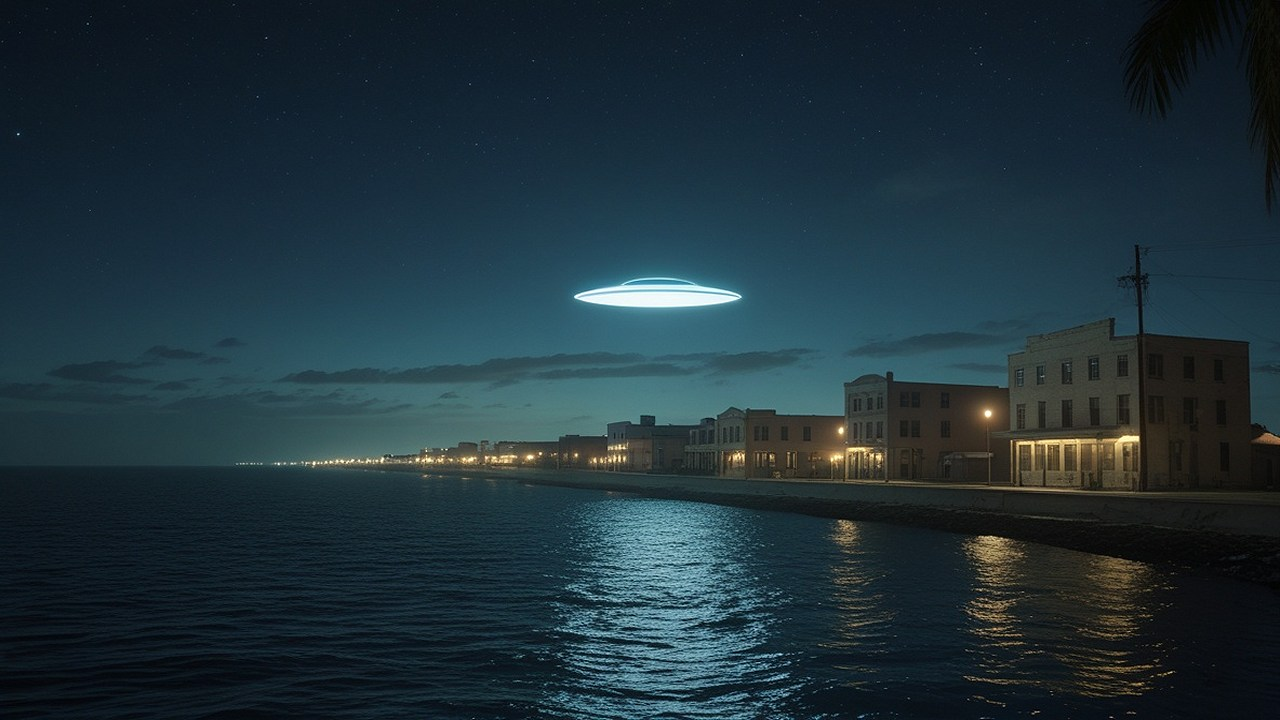
The year 1947 remains a foundational point in the evolution of public awareness surrounding unidentified flying objects. The term “flying disc” had entered popular vocabulary by early July of that year, following Kenneth Arnold’s widely reported sighting near Mount Rainier and the extensive nationwide attention that followed. Newspapers across the United States reacted quickly, reprinting stories, requesting eyewitness statements, and sometimes contributing more speculation than confirmation. Florida was no exception to this atmosphere of fascination and suspicion.
While most of the state’s clearly documented sightings during the peak of the summer 1947 wave occurred in cities such as Tampa, Miami, St. Petersburg, Gainesville, and Fort Myers, the months that followed continued to generate local conversations and occasional reports of unusual lights or airborne objects. Panama City stands out during the late months of 1947, not because of a singular dramatic account, but because of the mere fact that the local newspaper, the Panama City News Herald, carried relevant dates that coincide with ongoing national attention to the flying disc phenomenon.
This is the story of Panama City’s quiet echo after the wave. Welcome to the channel. Today we examine this understated but revealing chapter of early UFO history in full detail, staying strictly faithful to the historical record.
The issues of the Panama City News Herald dated November 5 and November 14, 1947, are noted in archival timelines, though the specific entries are not yet firmly categorized as confirmed flying disc sightings. Instead, researchers suggest searching for terms such as “strange light,” “airship,” or “mysterious craft” within these dates. This kind of recommendation reflects the reality of researching early UFO history: many sightings, mentions, and rumors remain buried in non-digitized or poorly indexed microfilm records that require manual review. The absence of a definitive, clearly quoted sighting does not diminish the importance of Panama City’s appearance in these archives. Rather, it demonstrates how the flying disc wave spread beyond major headlines and persisted in local discourse long after national attention shifted.
The social climate in Panama City in November 1947 likely mirrored that of many other small American communities. The Second World War had ended only two years earlier. Military aircraft were familiar sights along the Florida coast, and the region had a growing connection to aviation and naval operations. People were accustomed to seeing planes overhead, especially training flights and operational craft. This familiarity made unusual sightings both less and more remarkable. On one hand, residents knew what conventional aircraft looked like. On the other hand, the same residents were primed to notice anything that deviated from what they considered normal. In this environment, a flicker of light over the Gulf at night, an unusually fast-moving silhouette, or even a story passed through a neighbor or shopkeeper might quickly become part of a growing narrative of mystery.
The broader national environment played a key role as well. The flying disc wave had triggered military interest, including internal memoranda, Air Force intelligence inquiries, and public statements that alternated between skepticism and acknowledgment that some reports remained unexplained. In many towns during late 1947, citizens debated whether sightings were secret American test aircraft, foreign reconnaissance devices, misunderstood natural phenomena, or something entirely unfamiliar. Newspapers sometimes portrayed these discussions with a lighthearted tone, but the underlying curiosity was real and widespread.
Panama City’s potential mentions in November 1947 fall into a transitional period. The nationwide frenzy of July had dimmed, but the questions had not disappeared. Most large newspapers were no longer printing daily reports of flying discs, but smaller papers continued to occasionally note local reports or reprint wire-service items from other regions. This means that any Panama City reference may have been brief, perhaps a small paragraph noting a local resident who claimed to have seen something in the sky at dusk, or a night fisherman who reported a distant moving light offshore. Alternatively, the mentions could involve editorial commentary, humor, or speculation referencing the earlier summer wave. Each of these possibilities would still provide a valuable reflection of how the idea of unidentified aerial phenomena took root in everyday thought.
The effect on the local population would likely have varied. Some would have dismissed such mentions as mere curiosity or newspaper filler. Others would have taken the subject seriously, especially those who had observed something themselves during the year but had not reported it. People often hesitated to speak openly about unusual experiences for fear of ridicule. Yet the continued appearance of stories, even brief ones, could give them confidence that the subject was still part of public conversation. In some communities, the flying disc reports created informal local folklore, with residents telling stories for decades about something strange they had seen once in the night sky.
The long-term impact of late-1947 sightings, including those possibly reported in Panama City, can be seen in how they contributed to a gradual normalization of the idea that unusual airborne objects might occasionally be observed. The flying disc wave of 1947 did not end with a single explanation. It continued into military investigations that would lead to official projects including Sign, Grudge, and ultimately Blue Book. The cultural effect lingered: people increasingly accepted the idea that one could see something unexplained in the sky and that reporting it was not inherently irrational.
Another important effect lies in historical documentation. Cases like Panama City in November 1947 highlight the importance of local newspapers as primary sources. Many small-town papers from the mid-twentieth century remain difficult to search digitally. When researchers identify dates where relevant articles may exist, those leads help guide future archival work. The simple fact that the Panama City News Herald for November 5 and November 14 has been flagged suggests that the region may have played a small but meaningful role in the persistence of UFO-related dialogue in Florida during that time.
No specific notable individuals are directly tied to the Panama City mentions as presently documented. Instead, the importance lies in the ordinary voices that may yet be uncovered. A farmer reporting lights over his field, a boat captain seeing something above the Gulf, a schoolteacher recounting a strange sighting during an evening walk—each of these would reflect the way unidentified aerial phenomena entered the daily lives of regular citizens. These were not always spectacular encounters. They were quiet, brief, and sometimes uncertain. Yet they contributed to a widespread cultural experience: the sense that the skies themselves had become part of an unfolding mystery.
Today, researchers and historians continue to revisit these early sightings not to prove or disprove any single explanation, but to understand how the phenomenon shaped collective awareness. The 1947 wave introduced Americans to a new category of experience. Panama City’s possible sightings in November 1947 represent part of the ongoing story of how ordinary communities responded to the unknown. Whether the object reported was ultimately explainable or not, its significance lies in the fact that it was noticed, discussed, and recorded enough to leave a trace in the historical record.
The mystery remains open not because evidence is lacking, but because the event took place in a time when documentation was inconsistent and public reactions were varied. Even without a firmly confirmed sighting, the Panama City mentions contribute to the broader chronological landscape of aerial mystery in Florida. They show that interest in the skies did not fade after the initial excitement of the summer, but continued quietly in local conversations, newspaper offices, and private recollections.
In this way, Panama City stands as part of the broader narrative of how ordinary people encountered, interpreted, and preserved experiences that did not fit the conventional expectations of their time. The great wave of 1947 did not simply end when the headlines moved on. In places like Panama City, the questions lingered—quietly, persistently—through the autumn months, kept alive by local papers, local talk, and the lingering sense that something new had entered the American sky.
In November 1947, while the rest of the country was already looking elsewhere, the Panama City News Herald still carried dates that researchers flag as potentially relevant to the flying disc story. That small archival trace is enough to remind us that the phenomenon did not vanish with the summer. It simply moved into the quieter corners of American life—into Gulf Coast towns, evening conversations, and the pages of small newspapers—where the mystery continued to echo long after the national wave had passed.
The year 1947 remains a foundational point in the evolution of public awareness surrounding unidentified flying objects. The term “flying disc” had entered popular vocabulary by early July of that year, following Kenneth Arnold’s widely reported sighting near Mount Rainier and the extensive nationwide attention that followed. Newspapers across the United States reacted quickly, reprinting stories, requesting eyewitness statements, and sometimes contributing more speculation than confirmation. Florida was no exception to this atmosphere of fascination and suspicion.
While most of the state’s clearly documented sightings during the peak of the summer 1947 wave occurred in cities such as Tampa, Miami, St. Petersburg, Gainesville, and Fort Myers, the months that followed continued to generate local conversations and occasional reports of unusual lights or airborne objects. Panama City stands out during the late months of 1947, not because of a singular dramatic account, but because of the mere fact that the local newspaper, the Panama City News Herald, carried relevant dates that coincide with ongoing national attention to the flying disc phenomenon.
This is the story of Panama City’s quiet echo after the wave. Welcome to the channel. Today we examine this understated but revealing chapter of early UFO history in full detail, staying strictly faithful to the historical record.
The issues of the Panama City News Herald dated November 5 and November 14, 1947, are noted in archival timelines, though the specific entries are not yet firmly categorized as confirmed flying disc sightings. Instead, researchers suggest searching for terms such as “strange light,” “airship,” or “mysterious craft” within these dates. This kind of recommendation reflects the reality of researching early UFO history: many sightings, mentions, and rumors remain buried in non-digitized or poorly indexed microfilm records that require manual review. The absence of a definitive, clearly quoted sighting does not diminish the importance of Panama City’s appearance in these archives. Rather, it demonstrates how the flying disc wave spread beyond major headlines and persisted in local discourse long after national attention shifted.
The social climate in Panama City in November 1947 likely mirrored that of many other small American communities. The Second World War had ended only two years earlier. Military aircraft were familiar sights along the Florida coast, and the region had a growing connection to aviation and naval operations. People were accustomed to seeing planes overhead, especially training flights and operational craft. This familiarity made unusual sightings both less and more remarkable. On one hand, residents knew what conventional aircraft looked like. On the other hand, the same residents were primed to notice anything that deviated from what they considered normal. In this environment, a flicker of light over the Gulf at night, an unusually fast-moving silhouette, or even a story passed through a neighbor or shopkeeper might quickly become part of a growing narrative of mystery.
The broader national environment played a key role as well. The flying disc wave had triggered military interest, including internal memoranda, Air Force intelligence inquiries, and public statements that alternated between skepticism and acknowledgment that some reports remained unexplained. In many towns during late 1947, citizens debated whether sightings were secret American test aircraft, foreign reconnaissance devices, misunderstood natural phenomena, or something entirely unfamiliar. Newspapers sometimes portrayed these discussions with a lighthearted tone, but the underlying curiosity was real and widespread.
Panama City’s potential mentions in November 1947 fall into a transitional period. The nationwide frenzy of July had dimmed, but the questions had not disappeared. Most large newspapers were no longer printing daily reports of flying discs, but smaller papers continued to occasionally note local reports or reprint wire-service items from other regions. This means that any Panama City reference may have been brief, perhaps a small paragraph noting a local resident who claimed to have seen something in the sky at dusk, or a night fisherman who reported a distant moving light offshore. Alternatively, the mentions could involve editorial commentary, humor, or speculation referencing the earlier summer wave. Each of these possibilities would still provide a valuable reflection of how the idea of unidentified aerial phenomena took root in everyday thought.
The effect on the local population would likely have varied. Some would have dismissed such mentions as mere curiosity or newspaper filler. Others would have taken the subject seriously, especially those who had observed something themselves during the year but had not reported it. People often hesitated to speak openly about unusual experiences for fear of ridicule. Yet the continued appearance of stories, even brief ones, could give them confidence that the subject was still part of public conversation. In some communities, the flying disc reports created informal local folklore, with residents telling stories for decades about something strange they had seen once in the night sky.
The long-term impact of late-1947 sightings, including those possibly reported in Panama City, can be seen in how they contributed to a gradual normalization of the idea that unusual airborne objects might occasionally be observed. The flying disc wave of 1947 did not end with a single explanation. It continued into military investigations that would lead to official projects including Sign, Grudge, and ultimately Blue Book. The cultural effect lingered: people increasingly accepted the idea that one could see something unexplained in the sky and that reporting it was not inherently irrational.
Another important effect lies in historical documentation. Cases like Panama City in November 1947 highlight the importance of local newspapers as primary sources. Many small-town papers from the mid-twentieth century remain difficult to search digitally. When researchers identify dates where relevant articles may exist, those leads help guide future archival work. The simple fact that the Panama City News Herald for November 5 and November 14 has been flagged suggests that the region may have played a small but meaningful role in the persistence of UFO-related dialogue in Florida during that time.
No specific notable individuals are directly tied to the Panama City mentions as presently documented. Instead, the importance lies in the ordinary voices that may yet be uncovered. A farmer reporting lights over his field, a boat captain seeing something above the Gulf, a schoolteacher recounting a strange sighting during an evening walk—each of these would reflect the way unidentified aerial phenomena entered the daily lives of regular citizens. These were not always spectacular encounters. They were quiet, brief, and sometimes uncertain. Yet they contributed to a widespread cultural experience: the sense that the skies themselves had become part of an unfolding mystery.
Today, researchers and historians continue to revisit these early sightings not to prove or disprove any single explanation, but to understand how the phenomenon shaped collective awareness. The 1947 wave introduced Americans to a new category of experience. Panama City’s possible sightings in November 1947 represent part of the ongoing story of how ordinary communities responded to the unknown. Whether the object reported was ultimately explainable or not, its significance lies in the fact that it was noticed, discussed, and recorded enough to leave a trace in the historical record.
The mystery remains open not because evidence is lacking, but because the event took place in a time when documentation was inconsistent and public reactions were varied. Even without a firmly confirmed sighting, the Panama City mentions contribute to the broader chronological landscape of aerial mystery in Florida. They show that interest in the skies did not fade after the initial excitement of the summer, but continued quietly in local conversations, newspaper offices, and private recollections.
In this way, Panama City stands as part of the broader narrative of how ordinary people encountered, interpreted, and preserved experiences that did not fit the conventional expectations of their time. The great wave of 1947 did not simply end when the headlines moved on. In places like Panama City, the questions lingered—quietly, persistently—through the autumn months, kept alive by local papers, local talk, and the lingering sense that something new had entered the American sky.
In November 1947, while the rest of the country was already looking elsewhere, the Panama City News Herald still carried dates that researchers flag as potentially relevant to the flying disc story. That small archival trace is enough to remind us that the phenomenon did not vanish with the summer. It simply moved into the quieter corners of American life—into Gulf Coast towns, evening conversations, and the pages of small newspapers—where the mystery continued to echo long after the national wave had passed.