


Blog Categories
- African Incidents
- Atlantis Incidents
- Australian Incidents
- Belgian Incidents
- Bermuda Triangle Incidents
- Brazilian Incidents
- Canadian Incidents
- Chinese Incidents
- European Incidents
- France Incidents
- Ghosts
- Giants
- Italy Incidents
- Japanese Incidents
- Middle East Incidents
- Portugal Incidents
- Project Serpo
- Puerto Rico Incidents
- Russian Incidents
- Sasquatch
- Scandinavia Incidents
- Spanish Incidents
- UFOs
- United Kingdom Incidents
- United States Incidents
1948 -1950: Growing Rocket Activity in Coastal Florida
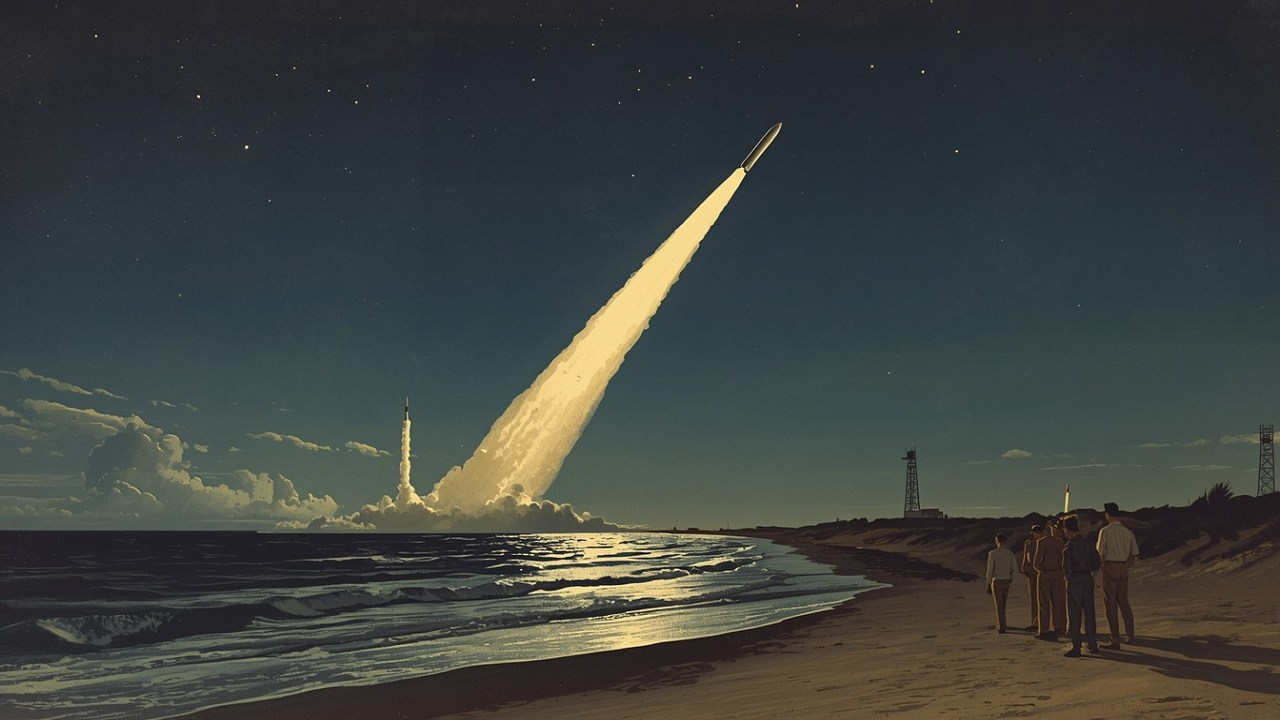
The years immediately following 1947 saw a shift in the national discussion surrounding unidentified aerial phenomena. While earlier reports were dominated by eyewitness accounts of flying discs and unusual lights, the context in which these sightings occurred began to change. In Florida, the change was tied directly to developments in military planning, missile testing, and the transfer of key coastal facilities into what would become some of the most important aerospace sites in the United States. From 1948 to 1950, coastal Florida underwent a transformation that brought new flight testing programs, rocket development, and long-range radar and tracking operations. These advancements played a significant role in shaping how residents and observers understood aerial sightings during that time.
Following the end of the Second World War, the United States was engaged in both postwar demobilization and rapid rearmament. The onset of the Cold War prompted new priorities. The U.S. military recognized the strategic need for open-range testing areas suited to long-distance missile research. Florida offered geography that made such activities possible. Its extensive coastline, proximity to open ocean test corridors, and year-round favorable weather conditions made it an ideal location for missile, aircraft, and tracking-range development. As a result, installations that had previously served local or wartime functions were reorganized and expanded for new technological missions.
One of the most significant organizational developments during this period was the formation of the Joint Long Range Proving Ground. This proving ground was created to support testing of experimental weapons, rockets, and guidance systems. The selection of Florida for this purpose was not accidental. The eastern coast allowed test vehicles to be launched over the Atlantic Ocean, minimizing risks to populations and providing vast distances for tracking and measurement. The proving ground established the foundation for future space and missile programs, linking Florida to the emerging narrative of advanced aerospace research.
A critical part of this activity centered around Cape Canaveral. Prior to 1948, the Cape was relatively quiet, used for scattered military exercises and occasional patrol operations. The shift began when the U.S. government transferred coastal installations to the Air Force and designated the region for missile development. By 1949, Cape Canaveral had become one of the central testing areas for the nation’s early rocket programs. The nearby Banana River Naval Air Station was restructured and eventually emerged as Patrick Air Force Base. These new organizational frameworks signaled the start of Florida’s transformation into a major aerospace development center.
The changes taking place in coastal Florida influenced public perception of the skies. New equipment, newly tested rockets, and experimental aircraft were unfamiliar to civilians. Lights observed near the Cape or above coastal waters could be part of range operations. High-altitude tracking tests, missile exhaust trails, and radar reflections occasionally produced visual effects that witnesses found difficult to explain. At the same time, the memory of the 1947 flying-disc wave was still fresh. Many residents were already primed to interpret unusual objects in the sky through the lens of mystery rather than technology. The two forces overlapped: new military programs introduced new sources of aerial phenomena, while the earlier wave of sightings provided a cultural framework for interpreting them.
For many residents, the presence of expanding military operations represented the arrival of modernization and strategic importance. Communities near the Cape and along the central coastline saw new employment opportunities and growing infrastructure. Yet the unfamiliar nature of the technologies being tested created an atmosphere of curiosity. People who lived near the proving ground could occasionally hear distant detonations, see streaks of light ascending toward the upper atmosphere, or observe unusual flight behavior from aircraft undergoing evaluation. These experiences were real, even when the underlying causes were routine military procedures.
Some of the unidentified aerial reports from this period can be understood within this context. Observers sometimes saw objects traveling at speeds that seemed extraordinary. Others reported lights that changed direction abruptly or hovered in ways that did not align with their knowledge of aviation. These accounts were not necessarily inaccurate in terms of what was seen. Early missile tests could rise vertically, then arc, then vanish from view entirely as they passed beyond local atmospheric visibility. Tracking balloons used to calibrate radar behaved differently from aircraft. Test vehicles under development did not resemble conventional planes and could appear disc-like, elongated, or luminous, depending on lighting and angle of observation.
It is also important to acknowledge that not all sightings from this period can be attributed directly to military activity. Some reports came from areas far from the proving ground or involved shapes and characteristics that did not match known tests. However, the military expansion provided an explanatory backdrop that was increasingly used by officials, reporters, and investigators. When residents reported luminous objects or rapid aerial movements, responses often pointed toward aircraft tests, missile activities, or weather balloons. This explanation was not always intended to dismiss public concern. Rather, it reflected an emerging awareness that United States air technology was advancing rapidly and that not all new developments were publicly known.
The shift in public understanding during these years had long-term effects. As Florida continued to expand its role in aerospace research through the 1950s and beyond, the region developed a dual identity. It became known both as a center of scientific progress and as a location where unexplained aerial events occurred. This dual identity persisted into later eras when the Space Age and Cold War missile programs brought new waves of sightings and speculation. The earliest stages of that identity trace back to the 1948–1950 period, when missiles first lifted off from the Cape and communities along the coast began to adjust to the reality of living near a proving ground.
Notable individuals involved during this foundational stage were primarily military planners, engineers, and administrative officials overseeing the developing missile range. While their roles were technical rather than sensational, their work established the systems and infrastructure that would later support major launch programs. Their decisions influenced not only military strategy but also the cultural landscape of Florida. The public reaction to unidentified sightings cannot be separated from the growing awareness that advanced technologies were being tested in the state.
The importance of this period lies in its ability to explain later patterns. When unidentified sightings occurred in Florida in subsequent decades, there was often debate about whether they represented classified aircraft, missile tests, atmospheric phenomena, or something unknown. The groundwork for that debate was laid in the years when the proving ground was first formed. The presence of new technologies provided plausible explanations for many sightings, but it also ensured that Florida would remain a region where unusual observations were taken seriously.
In summary, the years from 1948 to 1950 were a foundational period in Florida’s aerospace history. The establishment of the Joint Long Range Proving Ground and the development of Cape Canaveral and Patrick Air Force Base brought advanced testing programs to the state. These developments provided new explanations for unidentified aerial sightings while also contributing to a lasting cultural connection between Florida and the study of aerial phenomena. The transformation of coastal Florida during this period shaped both the technological and interpretive landscape of the skies for decades to come.