


Blog Categories
- African Incidents
- Atlantis Incidents
- Australian Incidents
- Belgian Incidents
- Bermuda Triangle Incidents
- Brazilian Incidents
- Canadian Incidents
- Chinese Incidents
- European Incidents
- France Incidents
- Ghosts
- Giants
- Italy Incidents
- Japanese Incidents
- Middle East Incidents
- Portugal Incidents
- Project Serpo
- Puerto Rico Incidents
- Russian Incidents
- Sasquatch
- Scandinavia Incidents
- Spanish Incidents
- UFOs
- United Kingdom Incidents
- United States Incidents
1952 - 1953: International Flying Saucer Bureau
In the early 1950s, at the height of postwar curiosity about flying saucers, one man in Bridgeport, Connecticut, became a central figure in what would become one of the most enduring legends of UFO culture. His name was Albert K. Bender. He was a quiet but imaginative office worker whose interest in the mysteries of the universe led him to found one of the first major civilian UFO organizations in the world: the International Flying Saucer Bureau. Between 1952 and 1953, Bender’s group and its journal, Space Review, drew international attention. But what truly set him apart was how abruptly it all ended, and the strange story that followed.
When Bender dissolved his organization in 1953, he claimed that he had been visited by shadowy figures, Men in Black, who warned him to stop his investigations. Whether seen as psychological drama, folklore, or genuine encounter, Bender’s experience in Bridgeport left a permanent imprint on the American UFO narrative and helped establish Connecticut as an early epicenter of UFO subculture.
The early 1950s were a transformative time for UFO interest in the United States. The 1947 flying saucer wave, sparked by Kenneth Arnold’s famous sighting near Mount Rainier and followed by the Roswell incident, had evolved into a national fascination. Newspapers across the country printed daily reports of lights and discs in the sky. The U.S. Air Force had launched Project Blue Book to investigate the sightings, but its mixed results and vague conclusions left the public unsatisfied. Civilian enthusiasts, sensing that official channels might be withholding information, began forming their own groups to collect reports and study the phenomenon independently.
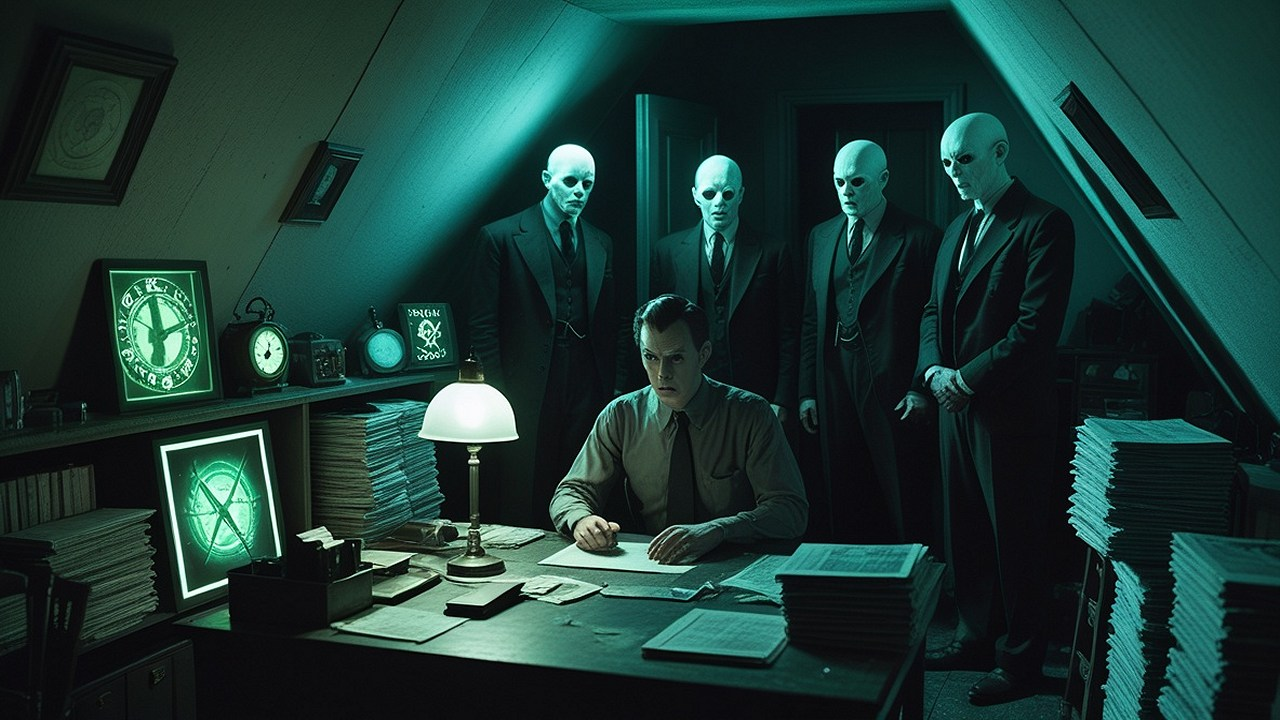
Albert Bender was among the first of these pioneers. Born in 1921, Bender lived in a small attic apartment on Broad Street in Bridgeport, where he worked as a timekeeper at a local factory. A meticulous and artistic man, he decorated his room with eerie symbols, strange clocks, and glow-in-the-dark artwork. He was fascinated by the paranormal, folklore, and the possibility of life beyond Earth. In 1952, combining his organizational skills and imaginative vision, Bender founded the International Flying Saucer Bureau. His idea was simple but ambitious: create a global network of ordinary citizens dedicated to studying UFO sightings, exchanging reports, and pressing for government disclosure.
From his Bridgeport apartment, Bender began publishing Space Review, a modest newsletter that would soon gain international circulation. Written in straightforward language, it invited readers from all over the world to submit their own accounts and speculations. The IFSB’s slogan, “Truth shall triumph,” reflected Bender’s conviction that humanity was on the verge of discovering cosmic visitors. At its height, the IFSB claimed members in more than a dozen countries, including Britain, Australia, and South Africa.
What made Bender’s work so significant was not just its scope but its timing. In 1952, the United States experienced another surge of UFO sightings, culminating in the famous Washington, D.C., radar-visual incidents in July. Mainstream media attention skyrocketed, and suddenly the UFO issue was front-page news again. For a brief period, Bender’s IFSB stood as one of the few organized civilian voices trying to make sense of it all. The group represented an early form of citizen science, a grassroots effort to collect and analyze data outside official institutions.
Then, in 1953, everything changed. Without warning, Bender abruptly announced the shutdown of the IFSB and the discontinuation of Space Review. In its final issue, he hinted cryptically that he had been advised not to continue and that the truth had been revealed to him but that he was forbidden to share it. He wrote that the group was bringing its work to a close because of the advice of those in a position to know the truth. Readers were stunned. Within weeks, rumors began circulating that Bender had been silenced by government agents or by the very extraterrestrials he had been trying to expose.
Three years later, in 1956, Bender resurfaced with a book titled Flying Saucers and the Three Men, written with Gray Barker, a fellow UFO researcher. In it, Bender described being visited in 1953 by three darkly dressed men with glowing eyes who communicated telepathically and warned him to stop his investigations. They allegedly revealed to him that flying saucers were not what humanity believed them to be, and that continuing to share information would put him in danger. This encounter, he said, left him physically ill and emotionally shaken.
This story of the Men in Black would become one of the most enduring motifs in UFO folklore. It shaped an entire subgenre of UFO conspiracy thought, one suggesting that shadowy forces, either governmental or extraterrestrial, actively suppress the truth. Later UFO writers like John Keel, and even pop culture creators in television and film, drew inspiration from Bender’s account. By the late twentieth century, the Men in Black had become iconic symbols of secrecy and intimidation in UFO lore, appearing in books, documentaries, and Hollywood films.
Bridgeport’s role in this story is rarely emphasized but deeply important. In 1952 and 1953, this small Connecticut city became the operational center of an international UFO network, something few other towns could claim. The IFSB demonstrated how ordinary citizens, even without official resources, could organize globally through correspondence and shared curiosity. In many ways, Bender’s Bureau prefigured modern online UFO communities, where enthusiasts trade data, theories, and news across borders.
Culturally, Bender’s saga reflected a deep anxiety of the Cold War era. The early 1950s were a time of government secrecy, nuclear fear, and technological awe. The idea that mysterious figures could silence citizens resonated with a public that already feared unseen powers: atomic secrets, espionage, and Cold War conspiracies. The Men in Black became a symbolic mirror of those anxieties, blending the modern fear of authority with the ancient theme of forbidden knowledge.
From a historical standpoint, the Bender story remains controversial. Many researchers believe that his claims were psychological or symbolic, a creative expression of fear, isolation, or exhaustion from managing an international correspondence network. Others suggest that his meeting with Men in Black might have been a dramatized metaphor for receiving pressure from either skeptics or overzealous believers. Regardless of the interpretation, the fact that his account resonated so powerfully shows how deeply UFO culture was entwined with the emotional and social climate of its time.
Today, Bender’s influence persists quietly but firmly. Bridgeport is still referenced in UFO literature as the birthplace of the IFSB and the Men in Black legend. Researchers studying the history of UFO organizations often identify Bender as a foundational figure, a man who, through vision and imagination, helped shape the mythic language of the UFO phenomenon. His story is studied not just by UFO enthusiasts but also by sociologists, folklorists, and historians examining how new myths emerge in the modern age.
For Connecticut, Bender’s legacy underscores the state’s unexpected role in UFO history. Though often overshadowed by better-known locations like Roswell or Area 51, Connecticut contributed to the culture of inquiry and belief that surrounds UFO studies. The Bender episode demonstrated that the UFO mystery was as much about people and stories as about technology and evidence.
Think about what this man actually built. From a small attic apartment decorated with glow-in-the-dark artwork and strange clocks, Albert Bender created an international network when most people still treated flying saucers as newspaper curiosities. He published a journal that reached Britain, Australia, and South Africa. He collected reports from ordinary people who felt official channels were not telling them everything. His slogan was simple and bold: Truth shall triumph.
Then the work stopped. Not gradually. Not because of money or fading interest. It stopped after Bender said he had been visited and warned. The final issue of Space Review did not offer a full explanation. It offered a warning of its own. He had been advised. The truth had been revealed. He was forbidden to share it. Those in a position to know the truth had told him to close the bureau.
When he finally spoke at length in 1956, the details were unforgettable. Three men. Dark clothing. Glowing eyes. Telepathic communication. A message that flying saucers were not what the public believed. A threat that continued investigation would put him in danger. Physical illness and emotional shock afterward. That account did not fade. It became the template.
Every later story of silent, pale, officially dressed visitors who appear after a witness gets too close traces a line back to Bender’s Bridgeport apartment. John Keel studied the pattern. Filmmakers turned the figures into pop-culture icons. But the original report was not a movie pitch. It was the reason a functioning international civilian UFO organization vanished almost overnight.
The Cold War context matters. People already lived with the knowledge that governments kept secrets about weapons, about radar, about what was flying over Washington in July 1952. Bender’s claim that someone, or something, could walk into a private home and shut down an entire research network felt plausible to many readers precisely because the era already taught them that powerful forces operated out of sight.
Even those who prefer a psychological reading cannot erase the historical result. The International Flying Saucer Bureau existed. Space Review circulated internationally. Then it ended with a cryptic farewell. Then came the book that named the three men. The sequence is documented. The cultural explosion that followed is documented. The motif that still appears in UFO discussions today is documented.
Bender did not have radar tapes or gun-camera film. What he had was organization, timing, and a story that refused to die. He showed that civilians could build a global information network from a single apartment. He also showed how quickly that network could be dismantled, and how lasting the explanation for that dismantling would become.
Connecticut is not usually listed beside Roswell or Area 51. Yet for two critical years, Bridgeport was the mailing address of an international flying saucer bureau. That fact alone should change how we map the early history of the phenomenon. The mystery was never only in the desert or over military bases. It was also in an attic on Broad Street, where a factory timekeeper decided the public deserved its own channel for the truth.
In the end, the tale of Albert K. Bender and the International Flying Saucer Bureau stands as one of the most influential and haunting chapters in the history of UFO research. It bridged the gap between early postwar curiosity and the modern era of conspiracy-laden UFO subculture. Whether seen as fact, fiction, or something in between, Bender’s 1953 encounter from his small Bridgeport apartment helped to shape how generations of Americans, and people around the world, would think about the boundaries between secrecy, imagination, and the unknown. It remains one of Connecticut’s most intriguing cultural exports and a cornerstone in the mythos of the unexplained.
The International Flying Saucer Bureau lasted only a short time. The warning Bender said he received has lasted more than seventy years. That is the measure of the story. A quiet man in Bridgeport built a worldwide network dedicated to the idea that truth shall triumph. Then three dark figures, he said, told him the truth was already known and must not be shared. The bureau closed. The legend opened. And UFO history has never looked the same.
In the early 1950s, at the height of postwar curiosity about flying saucers, one man in Bridgeport, Connecticut, became a central figure in what would become one of the most enduring legends of UFO culture. His name was Albert K. Bender. He was a quiet but imaginative office worker whose interest in the mysteries of the universe led him to found one of the first major civilian UFO organizations in the world: the International Flying Saucer Bureau. Between 1952 and 1953, Bender’s group and its journal, Space Review, drew international attention. But what truly set him apart was how abruptly it all ended, and the strange story that followed.
When Bender dissolved his organization in 1953, he claimed that he had been visited by shadowy figures, Men in Black, who warned him to stop his investigations. Whether seen as psychological drama, folklore, or genuine encounter, Bender’s experience in Bridgeport left a permanent imprint on the American UFO narrative and helped establish Connecticut as an early epicenter of UFO subculture.
The early 1950s were a transformative time for UFO interest in the United States. The 1947 flying saucer wave, sparked by Kenneth Arnold’s famous sighting near Mount Rainier and followed by the Roswell incident, had evolved into a national fascination. Newspapers across the country printed daily reports of lights and discs in the sky. The U.S. Air Force had launched Project Blue Book to investigate the sightings, but its mixed results and vague conclusions left the public unsatisfied. Civilian enthusiasts, sensing that official channels might be withholding information, began forming their own groups to collect reports and study the phenomenon independently.
Albert Bender was among the first of these pioneers. Born in 1921, Bender lived in a small attic apartment on Broad Street in Bridgeport, where he worked as a timekeeper at a local factory. A meticulous and artistic man, he decorated his room with eerie symbols, strange clocks, and glow-in-the-dark artwork. He was fascinated by the paranormal, folklore, and the possibility of life beyond Earth. In 1952, combining his organizational skills and imaginative vision, Bender founded the International Flying Saucer Bureau. His idea was simple but ambitious: create a global network of ordinary citizens dedicated to studying UFO sightings, exchanging reports, and pressing for government disclosure.
From his Bridgeport apartment, Bender began publishing Space Review, a modest newsletter that would soon gain international circulation. Written in straightforward language, it invited readers from all over the world to submit their own accounts and speculations. The IFSB’s slogan, “Truth shall triumph,” reflected Bender’s conviction that humanity was on the verge of discovering cosmic visitors. At its height, the IFSB claimed members in more than a dozen countries, including Britain, Australia, and South Africa.
What made Bender’s work so significant was not just its scope but its timing. In 1952, the United States experienced another surge of UFO sightings, culminating in the famous Washington, D.C., radar-visual incidents in July. Mainstream media attention skyrocketed, and suddenly the UFO issue was front-page news again. For a brief period, Bender’s IFSB stood as one of the few organized civilian voices trying to make sense of it all. The group represented an early form of citizen science, a grassroots effort to collect and analyze data outside official institutions.
Then, in 1953, everything changed. Without warning, Bender abruptly announced the shutdown of the IFSB and the discontinuation of Space Review. In its final issue, he hinted cryptically that he had been advised not to continue and that the truth had been revealed to him but that he was forbidden to share it. He wrote that the group was bringing its work to a close because of the advice of those in a position to know the truth. Readers were stunned. Within weeks, rumors began circulating that Bender had been silenced by government agents or by the very extraterrestrials he had been trying to expose.
Three years later, in 1956, Bender resurfaced with a book titled Flying Saucers and the Three Men, written with Gray Barker, a fellow UFO researcher. In it, Bender described being visited in 1953 by three darkly dressed men with glowing eyes who communicated telepathically and warned him to stop his investigations. They allegedly revealed to him that flying saucers were not what humanity believed them to be, and that continuing to share information would put him in danger. This encounter, he said, left him physically ill and emotionally shaken.
This story of the Men in Black would become one of the most enduring motifs in UFO folklore. It shaped an entire subgenre of UFO conspiracy thought, one suggesting that shadowy forces, either governmental or extraterrestrial, actively suppress the truth. Later UFO writers like John Keel, and even pop culture creators in television and film, drew inspiration from Bender’s account. By the late twentieth century, the Men in Black had become iconic symbols of secrecy and intimidation in UFO lore, appearing in books, documentaries, and Hollywood films.
Bridgeport’s role in this story is rarely emphasized but deeply important. In 1952 and 1953, this small Connecticut city became the operational center of an international UFO network, something few other towns could claim. The IFSB demonstrated how ordinary citizens, even without official resources, could organize globally through correspondence and shared curiosity. In many ways, Bender’s Bureau prefigured modern online UFO communities, where enthusiasts trade data, theories, and news across borders.
Culturally, Bender’s saga reflected a deep anxiety of the Cold War era. The early 1950s were a time of government secrecy, nuclear fear, and technological awe. The idea that mysterious figures could silence citizens resonated with a public that already feared unseen powers: atomic secrets, espionage, and Cold War conspiracies. The Men in Black became a symbolic mirror of those anxieties, blending the modern fear of authority with the ancient theme of forbidden knowledge.
From a historical standpoint, the Bender story remains controversial. Many researchers believe that his claims were psychological or symbolic, a creative expression of fear, isolation, or exhaustion from managing an international correspondence network. Others suggest that his meeting with Men in Black might have been a dramatized metaphor for receiving pressure from either skeptics or overzealous believers. Regardless of the interpretation, the fact that his account resonated so powerfully shows how deeply UFO culture was entwined with the emotional and social climate of its time.
Today, Bender’s influence persists quietly but firmly. Bridgeport is still referenced in UFO literature as the birthplace of the IFSB and the Men in Black legend. Researchers studying the history of UFO organizations often identify Bender as a foundational figure, a man who, through vision and imagination, helped shape the mythic language of the UFO phenomenon. His story is studied not just by UFO enthusiasts but also by sociologists, folklorists, and historians examining how new myths emerge in the modern age.
For Connecticut, Bender’s legacy underscores the state’s unexpected role in UFO history. Though often overshadowed by better-known locations like Roswell or Area 51, Connecticut contributed to the culture of inquiry and belief that surrounds UFO studies. The Bender episode demonstrated that the UFO mystery was as much about people and stories as about technology and evidence.
Think about what this man actually built. From a small attic apartment decorated with glow-in-the-dark artwork and strange clocks, Albert Bender created an international network when most people still treated flying saucers as newspaper curiosities. He published a journal that reached Britain, Australia, and South Africa. He collected reports from ordinary people who felt official channels were not telling them everything. His slogan was simple and bold: Truth shall triumph.
Then the work stopped. Not gradually. Not because of money or fading interest. It stopped after Bender said he had been visited and warned. The final issue of Space Review did not offer a full explanation. It offered a warning of its own. He had been advised. The truth had been revealed. He was forbidden to share it. Those in a position to know the truth had told him to close the bureau.
When he finally spoke at length in 1956, the details were unforgettable. Three men. Dark clothing. Glowing eyes. Telepathic communication. A message that flying saucers were not what the public believed. A threat that continued investigation would put him in danger. Physical illness and emotional shock afterward. That account did not fade. It became the template.
Every later story of silent, pale, officially dressed visitors who appear after a witness gets too close traces a line back to Bender’s Bridgeport apartment. John Keel studied the pattern. Filmmakers turned the figures into pop-culture icons. But the original report was not a movie pitch. It was the reason a functioning international civilian UFO organization vanished almost overnight.
The Cold War context matters. People already lived with the knowledge that governments kept secrets about weapons, about radar, about what was flying over Washington in July 1952. Bender’s claim that someone, or something, could walk into a private home and shut down an entire research network felt plausible to many readers precisely because the era already taught them that powerful forces operated out of sight.
Even those who prefer a psychological reading cannot erase the historical result. The International Flying Saucer Bureau existed. Space Review circulated internationally. Then it ended with a cryptic farewell. Then came the book that named the three men. The sequence is documented. The cultural explosion that followed is documented. The motif that still appears in UFO discussions today is documented.
Bender did not have radar tapes or gun-camera film. What he had was organization, timing, and a story that refused to die. He showed that civilians could build a global information network from a single apartment. He also showed how quickly that network could be dismantled, and how lasting the explanation for that dismantling would become.
Connecticut is not usually listed beside Roswell or Area 51. Yet for two critical years, Bridgeport was the mailing address of an international flying saucer bureau. That fact alone should change how we map the early history of the phenomenon. The mystery was never only in the desert or over military bases. It was also in an attic on Broad Street, where a factory timekeeper decided the public deserved its own channel for the truth.
In the end, the tale of Albert K. Bender and the International Flying Saucer Bureau stands as one of the most influential and haunting chapters in the history of UFO research. It bridged the gap between early postwar curiosity and the modern era of conspiracy-laden UFO subculture. Whether seen as fact, fiction, or something in between, Bender’s 1953 encounter from his small Bridgeport apartment helped to shape how generations of Americans, and people around the world, would think about the boundaries between secrecy, imagination, and the unknown. It remains one of Connecticut’s most intriguing cultural exports and a cornerstone in the mythos of the unexplained.
The International Flying Saucer Bureau lasted only a short time. The warning Bender said he received has lasted more than seventy years. That is the measure of the story. A quiet man in Bridgeport built a worldwide network dedicated to the idea that truth shall triumph. Then three dark figures, he said, told him the truth was already known and must not be shared. The bureau closed. The legend opened. And UFO history has never looked the same.