


Blog Categories
- African Incidents
- Atlantis Incidents
- Australian Incidents
- Belgian Incidents
- Bermuda Triangle Incidents
- Brazilian Incidents
- Canadian Incidents
- Chinese Incidents
- European Incidents
- France Incidents
- Ghosts
- Giants
- Italy Incidents
- Japanese Incidents
- Middle East Incidents
- Portugal Incidents
- Project Serpo
- Puerto Rico Incidents
- Russian Incidents
- Sasquatch
- Scandinavia Incidents
- Spanish Incidents
- UFOs
- United Kingdom Incidents
- United States Incidents
1952: Huntsville Multiple Witnesses
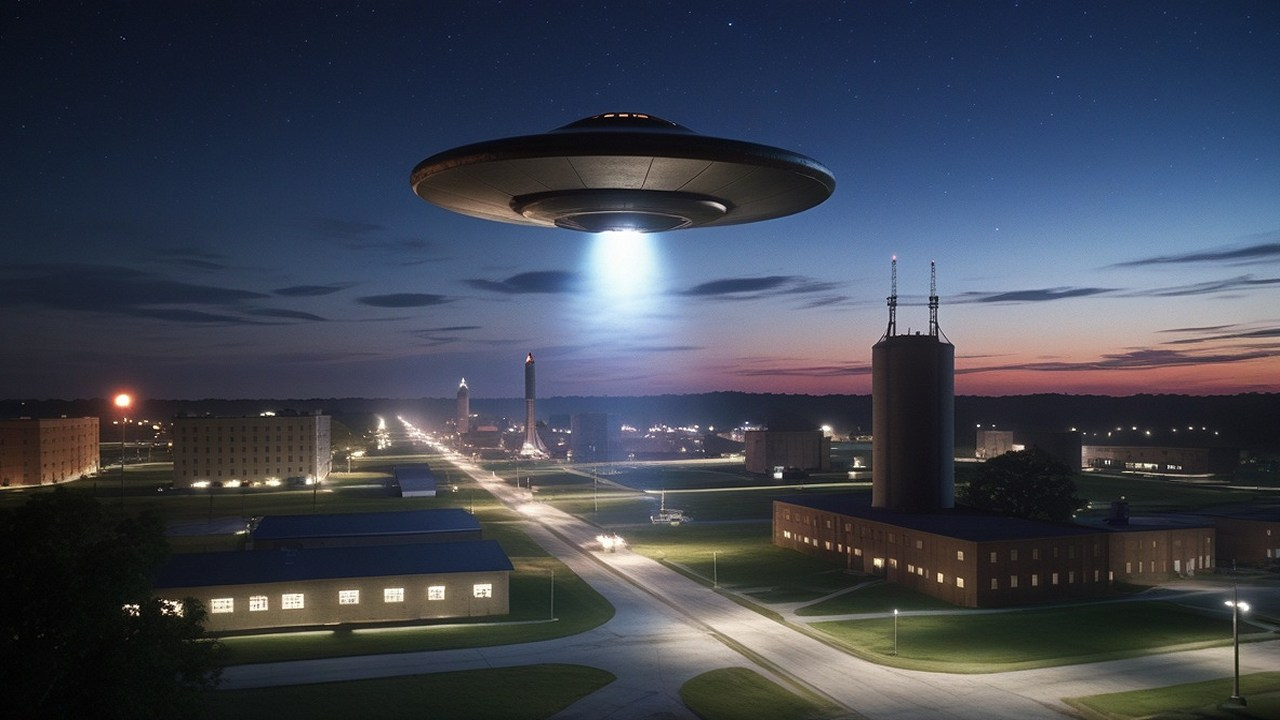
In the annals of unidentified flying object sightings, the year 1952 stands out as a period of heightened activity and public interest. Among the numerous reports from that year, the city of Huntsville, Alabama, was the site of a notable incident involving multiple witnesses observing a craft exhibiting non-ballistic movements. These were not ordinary lights in the sky. Witnesses described an object capable of sudden changes in direction, hovering, and rapid acceleration—behaviors that defied the known capabilities of any aircraft flying in 1952.
This is the story of the 1952 Huntsville UFO sightings. Welcome to the channel. Today we examine this compelling multi-witness case in full detail, staying faithful to the historical record.
In 1952, Huntsville was transitioning from a modest Southern town into a burgeoning center for aerospace and defense research, largely due to the presence of Redstone Arsenal. The U.S. Army had established a major rocket and missile development effort there, and the city was rapidly filling with engineers, scientists, and military personnel. It was precisely during this transformative period that two significant UFO sightings were reported. Multiple witnesses described observing a craft performing non-ballistic movements—maneuvers that did not follow the smooth ballistic arcs or gradual turns expected of conventional aircraft. The object demonstrated sudden changes in direction, the ability to hover, and rapid acceleration. These behaviors were inconsistent with the physics and engineering limits of known man-made vehicles of the era.
The reports were compelling enough to be noted in discussions of notable UFO incidents in Huntsville’s history. In a city increasingly populated by people who understood propulsion, aerodynamics, and the performance envelopes of contemporary aircraft, the observation of an object that could stop, hover, and then accelerate in ways no jet or rocket could match carried particular weight. These were not casual observers unfamiliar with the sky. Many lived and worked in an environment saturated with advanced aviation and rocketry.
The impact on the local community must be understood in context. The 1952 sightings occurred during a time when public fascination with UFOs was at a peak, fueled by numerous reports across the United States. In Huntsville, a city deeply intertwined with military and aerospace developments, such sightings would have resonated profoundly. The local community, comprising scientists, engineers, and military personnel, was uniquely positioned to assess and interpret these events. While specific records of community reactions are scarce, the presence of multiple credible witnesses suggests that the sightings were taken seriously and likely spurred discussions about aerial phenomena and national security. In a place where the future of American rocketry was being built, an object that appeared to outperform everything then known would naturally provoke both professional curiosity and concern.
The Huntsville sightings did not occur in isolation. They were part of a larger wave of UFO reports in 1952, a year that saw an unprecedented number of such incidents. This surge in sightings prompted the United States Air Force to intensify its investigations through Project Blue Book, a systematic study of UFOs aimed at determining their nature and potential threat to national security. By the end of Project Blue Book in 1969, 12,618 reports had been collected, with 701 remaining unexplained. The 1952 wave was one of the primary reasons the investigation was expanded and formalized.
The proliferation of UFO reports also led to the formation of the Robertson Panel in 1953, a CIA-convened group of scientists tasked with evaluating the UFO phenomenon. The panel concluded that while UFOs did not pose a direct threat, the potential for mass hysteria and the clogging of communication channels during a national emergency warranted a public education campaign to demystify UFOs and reduce public interest. That official response only underscores how seriously the volume of 1952 reports—including those from places like Huntsville—was being taken at the highest levels.
While specific names of witnesses to the 1952 Huntsville sightings are not readily available, the city’s association with prominent figures in aerospace cannot be overlooked. Wernher von Braun, the former German rocket scientist who became a leading figure in American space exploration, was working at Redstone Arsenal during this period. Although there is no direct evidence linking von Braun to the UFO sightings, his presence underscores the city’s significance in aerospace developments and the potential implications of unexplained aerial phenomena in such a context. When objects demonstrating advanced performance appear over a community filled with the very people building the cutting edge of propulsion technology, the reports gain an additional layer of historical interest.
The enduring significance of the 1952 Huntsville sightings lies in several factors. First, the involvement of multiple witnesses elevates the case above single-observer reports. When more than one person describes the same non-ballistic behaviors—hovering, abrupt direction changes, and rapid acceleration—the likelihood of simple individual misperception decreases. Second, the technical character of the Huntsville community in 1952 means that at least some of the observers possessed the background to recognize when an object’s performance fell outside known limits. Third, the timing within the major 1952 wave places the sightings inside one of the most intense periods of UFO activity ever recorded in the United States.
Non-ballistic movement is a critical descriptor. Ballistic trajectories are governed by momentum and gravity once thrust is removed. Conventional aircraft turn in curves limited by speed, wing loading, and structural integrity. An object that can hover motionless, then accelerate rapidly, or change direction in ways that appear instantaneous, is operating outside those constraints. In 1952, no public—or publicly acknowledged—aircraft could perform such maneuvers. The fact that multiple witnesses in an aerospace-focused city reported exactly these capabilities is what keeps the case relevant more than seventy years later.
The Huntsville reports also illustrate the intersection of public curiosity, scientific inquiry, and national security concerns that defined the early 1950s. The United States was locked in the early Cold War. Advanced aircraft and missiles were matters of intense secrecy and competition. At the same time, thousands of ordinary citizens and military personnel were reporting objects in the sky that did not match known technology. Project Blue Book was the official attempt to resolve the tension between those reports and national security requirements. Cases like Huntsville, occurring in the backyard of a major rocket development center, sat at the precise intersection of those concerns.
Although many questions remain unanswered, the core facts of the Huntsville sightings are clear. In 1952, during a period of extraordinary national UFO activity, multiple witnesses in Huntsville, Alabama, observed a craft that performed non-ballistic maneuvers including sudden direction changes, hovering, and rapid acceleration. The sightings took place in a city rapidly becoming a cornerstone of American aerospace and missile development. The reports were serious enough to become part of the local historical discussion of unexplained aerial phenomena.
The 1952 Huntsville case does not offer radar tracks, clear photographs, or named high-profile witnesses in the available record. What it does offer is something equally valuable: multiple observers in a technically sophisticated community describing performance characteristics that exceeded the known limits of aviation at the time. That combination places the sightings firmly within the category of cases that continue to justify open-minded investigation.
When we look back at 1952, we see a year in which the skies over America seemed unusually active. From the well-known Washington, D.C. events to lesser-known reports in cities like Huntsville, witnesses described objects that challenged conventional explanation. The Huntsville sightings remind us that these observations were not confined to remote wilderness or small rural towns. They occurred over communities filled with engineers and military personnel who understood better than most what conventional aircraft could and could not do.
The craft seen over Huntsville in 1952, according to those who watched it, did not behave like anything in the contemporary inventory. It hovered. It changed direction abruptly. It accelerated in ways that appeared to disregard the normal constraints of momentum and aerodynamics. Multiple people saw it. The city in which they saw it was in the process of becoming one of the most important aerospace centers in the United States. Those facts remain the durable core of the case.
The 1952 UFO sightings in Huntsville, Alabama, represent a compelling chapter in the study of unexplained aerial phenomena. Set against the backdrop of a city at the forefront of aerospace innovation, these incidents underscore the complexities of interpreting and responding to events that challenge our understanding of physics and technology. While many questions remain unanswered, the Huntsville sightings continue to intrigue researchers and enthusiasts alike, serving as a reminder of the mysteries that still linger in our skies.
In a year already overflowing with reports of unidentified objects, Huntsville added its own multi-witness testimony of a craft that refused to obey the expected rules of flight. That testimony still stands.
In the annals of unidentified flying object sightings, the year 1952 stands out as a period of heightened activity and public interest. Among the numerous reports from that year, the city of Huntsville, Alabama, was the site of a notable incident involving multiple witnesses observing a craft exhibiting non-ballistic movements. These were not ordinary lights in the sky. Witnesses described an object capable of sudden changes in direction, hovering, and rapid acceleration—behaviors that defied the known capabilities of any aircraft flying in 1952.
This is the story of the 1952 Huntsville UFO sightings. Welcome to the channel. Today we examine this compelling multi-witness case in full detail, staying faithful to the historical record.
In 1952, Huntsville was transitioning from a modest Southern town into a burgeoning center for aerospace and defense research, largely due to the presence of Redstone Arsenal. The U.S. Army had established a major rocket and missile development effort there, and the city was rapidly filling with engineers, scientists, and military personnel. It was precisely during this transformative period that two significant UFO sightings were reported. Multiple witnesses described observing a craft performing non-ballistic movements—maneuvers that did not follow the smooth ballistic arcs or gradual turns expected of conventional aircraft. The object demonstrated sudden changes in direction, the ability to hover, and rapid acceleration. These behaviors were inconsistent with the physics and engineering limits of known man-made vehicles of the era.
The reports were compelling enough to be noted in discussions of notable UFO incidents in Huntsville’s history. In a city increasingly populated by people who understood propulsion, aerodynamics, and the performance envelopes of contemporary aircraft, the observation of an object that could stop, hover, and then accelerate in ways no jet or rocket could match carried particular weight. These were not casual observers unfamiliar with the sky. Many lived and worked in an environment saturated with advanced aviation and rocketry.
The impact on the local community must be understood in context. The 1952 sightings occurred during a time when public fascination with UFOs was at a peak, fueled by numerous reports across the United States. In Huntsville, a city deeply intertwined with military and aerospace developments, such sightings would have resonated profoundly. The local community, comprising scientists, engineers, and military personnel, was uniquely positioned to assess and interpret these events. While specific records of community reactions are scarce, the presence of multiple credible witnesses suggests that the sightings were taken seriously and likely spurred discussions about aerial phenomena and national security. In a place where the future of American rocketry was being built, an object that appeared to outperform everything then known would naturally provoke both professional curiosity and concern.
The Huntsville sightings did not occur in isolation. They were part of a larger wave of UFO reports in 1952, a year that saw an unprecedented number of such incidents. This surge in sightings prompted the United States Air Force to intensify its investigations through Project Blue Book, a systematic study of UFOs aimed at determining their nature and potential threat to national security. By the end of Project Blue Book in 1969, 12,618 reports had been collected, with 701 remaining unexplained. The 1952 wave was one of the primary reasons the investigation was expanded and formalized.
The proliferation of UFO reports also led to the formation of the Robertson Panel in 1953, a CIA-convened group of scientists tasked with evaluating the UFO phenomenon. The panel concluded that while UFOs did not pose a direct threat, the potential for mass hysteria and the clogging of communication channels during a national emergency warranted a public education campaign to demystify UFOs and reduce public interest. That official response only underscores how seriously the volume of 1952 reports—including those from places like Huntsville—was being taken at the highest levels.
While specific names of witnesses to the 1952 Huntsville sightings are not readily available, the city’s association with prominent figures in aerospace cannot be overlooked. Wernher von Braun, the former German rocket scientist who became a leading figure in American space exploration, was working at Redstone Arsenal during this period. Although there is no direct evidence linking von Braun to the UFO sightings, his presence underscores the city’s significance in aerospace developments and the potential implications of unexplained aerial phenomena in such a context. When objects demonstrating advanced performance appear over a community filled with the very people building the cutting edge of propulsion technology, the reports gain an additional layer of historical interest.
The enduring significance of the 1952 Huntsville sightings lies in several factors. First, the involvement of multiple witnesses elevates the case above single-observer reports. When more than one person describes the same non-ballistic behaviors—hovering, abrupt direction changes, and rapid acceleration—the likelihood of simple individual misperception decreases. Second, the technical character of the Huntsville community in 1952 means that at least some of the observers possessed the background to recognize when an object’s performance fell outside known limits. Third, the timing within the major 1952 wave places the sightings inside one of the most intense periods of UFO activity ever recorded in the United States.
Non-ballistic movement is a critical descriptor. Ballistic trajectories are governed by momentum and gravity once thrust is removed. Conventional aircraft turn in curves limited by speed, wing loading, and structural integrity. An object that can hover motionless, then accelerate rapidly, or change direction in ways that appear instantaneous, is operating outside those constraints. In 1952, no public—or publicly acknowledged—aircraft could perform such maneuvers. The fact that multiple witnesses in an aerospace-focused city reported exactly these capabilities is what keeps the case relevant more than seventy years later.
The Huntsville reports also illustrate the intersection of public curiosity, scientific inquiry, and national security concerns that defined the early 1950s. The United States was locked in the early Cold War. Advanced aircraft and missiles were matters of intense secrecy and competition. At the same time, thousands of ordinary citizens and military personnel were reporting objects in the sky that did not match known technology. Project Blue Book was the official attempt to resolve the tension between those reports and national security requirements. Cases like Huntsville, occurring in the backyard of a major rocket development center, sat at the precise intersection of those concerns.
Although many questions remain unanswered, the core facts of the Huntsville sightings are clear. In 1952, during a period of extraordinary national UFO activity, multiple witnesses in Huntsville, Alabama, observed a craft that performed non-ballistic maneuvers including sudden direction changes, hovering, and rapid acceleration. The sightings took place in a city rapidly becoming a cornerstone of American aerospace and missile development. The reports were serious enough to become part of the local historical discussion of unexplained aerial phenomena.
The 1952 Huntsville case does not offer radar tracks, clear photographs, or named high-profile witnesses in the available record. What it does offer is something equally valuable: multiple observers in a technically sophisticated community describing performance characteristics that exceeded the known limits of aviation at the time. That combination places the sightings firmly within the category of cases that continue to justify open-minded investigation.
When we look back at 1952, we see a year in which the skies over America seemed unusually active. From the well-known Washington, D.C. events to lesser-known reports in cities like Huntsville, witnesses described objects that challenged conventional explanation. The Huntsville sightings remind us that these observations were not confined to remote wilderness or small rural towns. They occurred over communities filled with engineers and military personnel who understood better than most what conventional aircraft could and could not do.
The craft seen over Huntsville in 1952, according to those who watched it, did not behave like anything in the contemporary inventory. It hovered. It changed direction abruptly. It accelerated in ways that appeared to disregard the normal constraints of momentum and aerodynamics. Multiple people saw it. The city in which they saw it was in the process of becoming one of the most important aerospace centers in the United States. Those facts remain the durable core of the case.
The 1952 UFO sightings in Huntsville, Alabama, represent a compelling chapter in the study of unexplained aerial phenomena. Set against the backdrop of a city at the forefront of aerospace innovation, these incidents underscore the complexities of interpreting and responding to events that challenge our understanding of physics and technology. While many questions remain unanswered, the Huntsville sightings continue to intrigue researchers and enthusiasts alike, serving as a reminder of the mysteries that still linger in our skies.
In a year already overflowing with reports of unidentified objects, Huntsville added its own multi-witness testimony of a craft that refused to obey the expected rules of flight. That testimony still stands.