

Blog Categories
- African Incidents
- Atlantis Incidents
- Australian Incidents
- Belgian Incidents
- Bermuda Triangle Incidents
- Brazilian Incidents
- Canadian Incidents
- Chinese Incidents
- European Incidents
- France Incidents
- Ghosts
- Giants
- Italy Incidents
- Japanese Incidents
- Middle East Incidents
- Portugal Incidents
- Project Serpo
- Puerto Rico Incidents
- Russian Incidents
- Sasquatch
- Scandinavia Incidents
- Spanish Incidents
- UFOs
- United Kingdom Incidents
- United States Incidents
1957 - 1967: Strangers in the Sky
Throughout the mid-twentieth century, Connecticut—like much of the United States—was caught in the rising tide of UFO fascination. The Cold War had deepened, the space race was beginning, and strange lights in the night sky were no longer just curiosities—they were symbols of both hope and fear. In northern Connecticut, a handful of striking reports from 1957 to 1967 captured the imagination of local residents and newspapers alike. These stories, preserved in regional archives and remembered in later retrospectives like the CT Insider “From the Archives” feature, stand as some of the most peculiar in the state’s UFO history.
Among these cases, two stand out as particularly emblematic of the era’s mood: the 1957 Old Saybrook sighting and the 1967 “Winsted Creature” incident. Each involved not only claims of unusual aerial phenomena but direct encounters—or near encounters—with apparent humanoid beings. Though neither case was proven, both illustrate how Connecticut residents in the 1950s and 1960s were grappling with the mystery of the skies, filtering new and frightening possibilities through the lens of their own communities and cultural beliefs.
The first of these cases, the Old Saybrook encounter of 1957, occurred during a period of heightened national interest in UFOs. Just ten years after Kenneth Arnold’s famous sighting had launched the “flying saucer” era, and the same year that the Soviet Union launched Sputnik, people were already accustomed to associating strange lights in the sky with both extraterrestrial and technological possibilities. Against that backdrop, the Old Saybrook report captured the eerie intersection of wonder and fear that characterized the time.
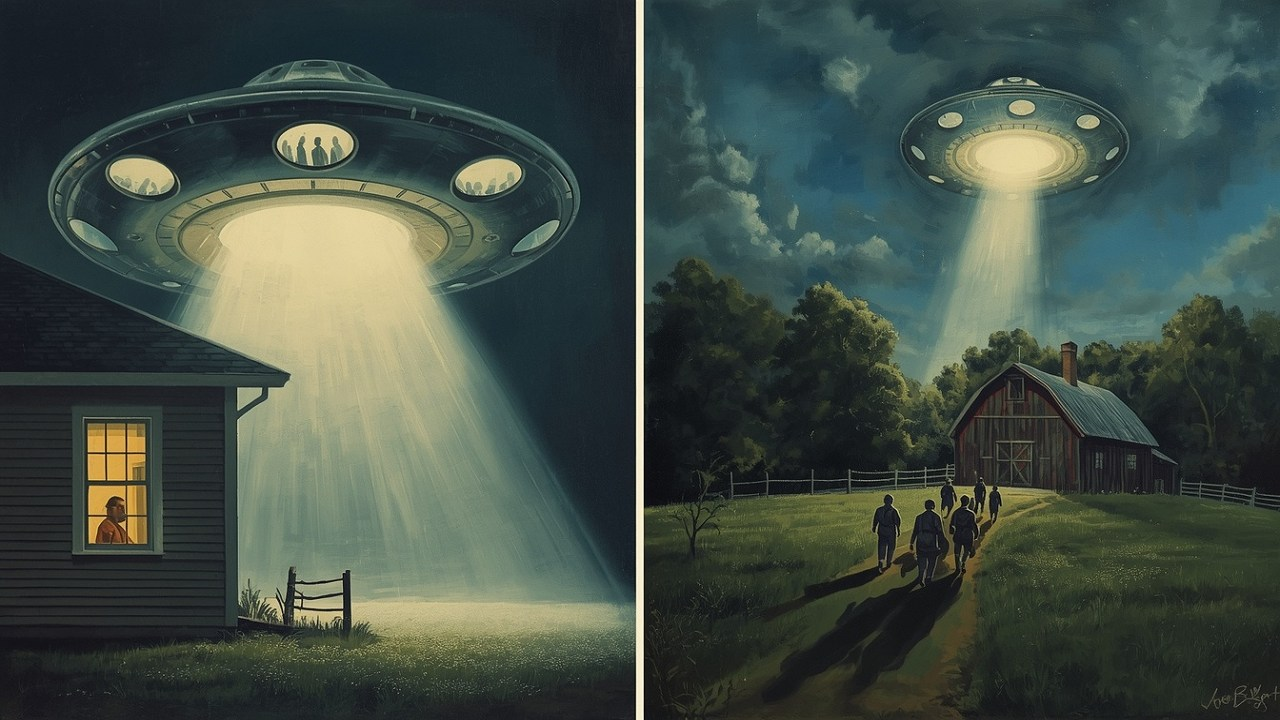
According to later accounts summarized in Connecticut newspaper archives, a woman in Old Saybrook reported waking suddenly one night in 1957 to an intense white light streaming through her bedroom window. Startled, she looked outside and saw what she described as a metallic craft hovering close to her home. It had round portholes along its side, and through those small windows she could see figures moving inside—beings roughly four feet tall, humanoid in shape but unlike any human she had ever seen. Their heads appeared larger than normal, and their movements were described as deliberate and synchronized. The witness said she felt a mixture of paralysis and calm, unable to look away as the craft hovered for a short time before departing silently into the night.
While such accounts might seem familiar today, in 1957 they were deeply unsettling. Reports of “occupants” or “aliens” were still relatively rare compared to the more common sightings of unidentified lights or discs. The Old Saybrook case thus occupies a transitional moment in UFO history—just before the explosion of “contactee” narratives and abduction reports that would define the 1960s and 1970s. Locally, it caused a stir; the woman’s account was circulated among neighbors and eventually made its way into local media reports, though most coverage was cautious or skeptical. Still, the sighting became part of a small but growing archive of Connecticut residents claiming not only to have seen something in the sky, but something—or someone—looking back at them.
A decade later, another northern Connecticut incident would once again bring humanoid encounters into local headlines: the so-called “Winsted Creature Report” of around 1967. This case emerged in the small, rural community of Winsted, located near the Litchfield Hills—a quiet area where strange lights and odd aerial activity were occasionally reported throughout the 1960s. According to later summaries and local recollections, two young girls claimed to have seen several small, human-like figures near a barn one evening. The beings were described as diminutive, child-sized, and moving quickly. Startled by the girls’ screams, a nearby car’s headlights illuminated the area, apparently frightening the figures, which ran toward a hill behind the barn. Moments later, a glowing object—interpreted by witnesses as a craft—was seen rising from that same hillside and disappearing into the night sky.
The Winsted case, though dismissed by many at the time as the product of imagination or mistaken perception, nevertheless left an impression on the small town. Reports of UFOs were already circulating nationally during the mid-1960s, as public attention turned toward cases like the 1965 Exeter incident in neighboring New Hampshire. The idea that something similar—something that merged both craft and creatures—might occur in quiet Winsted reflected how deeply UFO folklore had embedded itself in American consciousness by then. For many residents, the story became part of local lore, whispered about for years afterward.
Both the Old Saybrook and Winsted cases share a pattern familiar to UFO historians: ordinary people, often unprepared for the experience, suddenly confronted by something extraordinary. Neither case produced physical evidence, photographs, or corroborating radar data, and both relied on witness testimony alone. Yet in studying these accounts, one finds a consistent emotional throughline—an encounter with the unknown that leaves a lasting mark on memory and community identity.
In Connecticut, as elsewhere, such reports affected people in subtle but significant ways. For witnesses, these events often provoked lifelong questions and a lingering sense of awe or unease. For the public, reading about them in local newspapers provided a small thrill of mystery amid daily life, a reminder that the world might contain secrets beyond the reach of ordinary understanding. Some were inspired to take up amateur sky-watching or join emerging UFO organizations, while others dismissed the stories as fantasy or hysteria. Yet even skeptics could not deny the emotional power these accounts carried in small-town settings, where word of mouth and newspaper gossip spread quickly.
From a cultural standpoint, these mid-century encounters helped shape the state’s identity within the broader American UFO narrative. Connecticut was home to both quiet, rural communities—ideal settings for eerie nighttime sightings—and centers of advanced industry, such as the defense plants and laboratories of the postwar period. The contrast between cutting-edge science and rural mystery made the state fertile ground for UFO speculation. To many, the idea that strange visitors might appear in the skies above their quiet neighborhoods seemed both plausible and unsettling.
The impact of these incidents continues today, not in the sense of ongoing investigation or evidence, but as cultural memory. Stories like the Old Saybrook sighting and the Winsted Creature report are revisited in modern retrospectives, such as the CT Insider archives, precisely because they capture the mood of their times. They evoke a Connecticut where modern technology, Cold War anxiety, and folk imagination converged. Each retelling serves as a window into how people once made sense of the unknown—using the language of flying saucers, visitors, and celestial mystery.
Importantly, these encounters also illustrate the democratization of mystery. The witnesses were not scientists, military personnel, or pilots; they were ordinary citizens—mothers, children, and neighbors—who found themselves at the center of extraordinary stories. Their experiences show that the UFO phenomenon was not limited to isolated military encounters or secret programs, but part of a shared cultural experience that spanned geography and class.
No notable investigators or government officials became involved in either of the Connecticut cases, and neither was followed by major media investigation. Yet their endurance in local folklore speaks to their power. They serve as reminders of how deeply personal experiences can become collective legends, passed down and reshaped by time.
Today, when UFOs—now often called UAPs—are once again a subject of national discussion, Connecticut’s mid-century encounters invite reflection on the continuity of human curiosity. The questions that haunted witnesses in Old Saybrook and Winsted remain the same ones that drive inquiry today: What did they see? What does it mean? And are we truly alone?
Viewed through that lens, the “Strangers in the Sky” of northern Connecticut were more than fleeting curiosities. They were part of a long human tradition of confronting the unknown, of transforming fear and wonder into story and meaning. Whether literal or symbolic, their lights still echo faintly in the imagination of those who look up, wondering if somewhere above the Connecticut hills, something—or someone—might still be watching.