


Blog Categories
- African Incidents
- Atlantis Incidents
- Australian Incidents
- Belgian Incidents
- Bermuda Triangle Incidents
- Brazilian Incidents
- Canadian Incidents
- Chinese Incidents
- European Incidents
- France Incidents
- Ghosts
- Giants
- Italy Incidents
- Japanese Incidents
- Middle East Incidents
- Portugal Incidents
- Project Serpo
- Puerto Rico Incidents
- Russian Incidents
- Sasquatch
- Scandinavia Incidents
- Spanish Incidents
- UFOs
- United Kingdom Incidents
- United States Incidents
1957: Russellville Impact
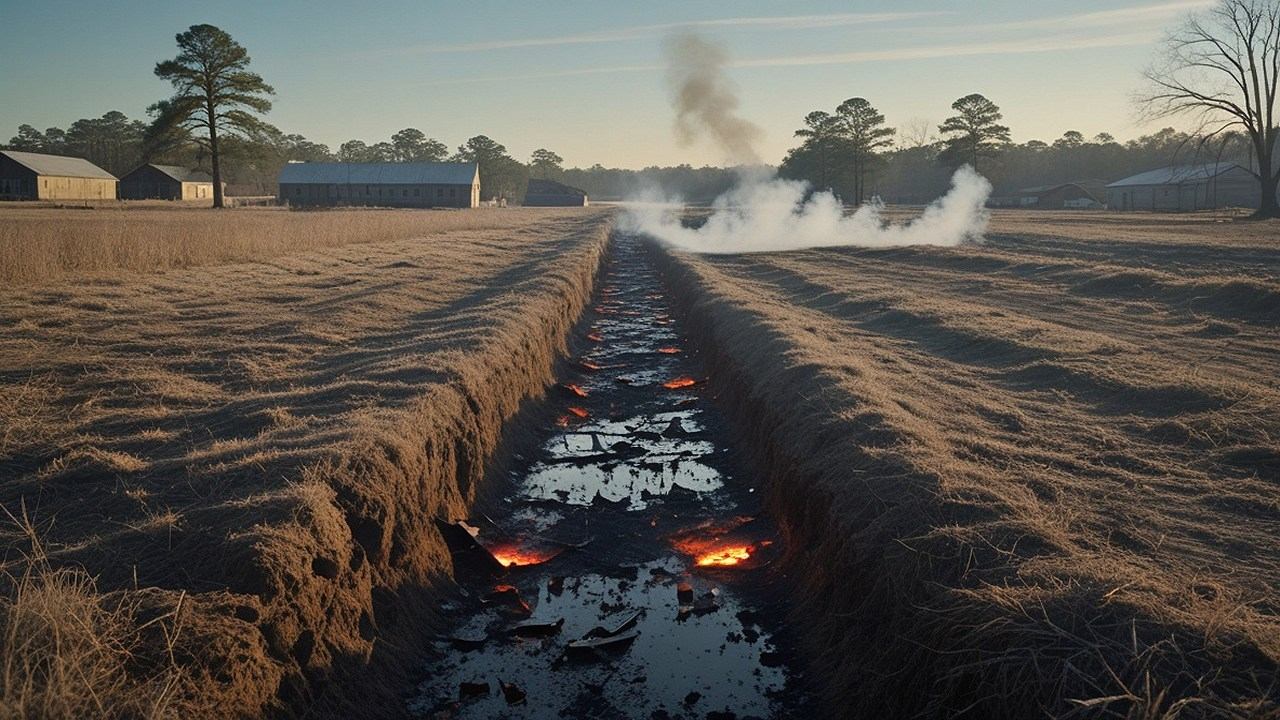
On December 2, 1957, something violent and unexplained happened roughly fifteen miles west of Russellville, Alabama. A property owner heard a sudden explosion. Six days later he walked his land and found a trench forty feet long and three feet wide. Around it lay pieces of burned and melted metal. The heat had been intense enough to melt metal and scar the ground. Local authorities were called. The Huntsville Army duty officer was notified. Army personnel conducted a reconnaissance. They could not determine what had caused the damage. The case was passed to the U.S. Air Force’s Project Blue Book, which ultimately labeled the object a tip tank—an external fuel tank from the tip of an aircraft wing.
That official conclusion has never fully satisfied those who examine the physical evidence. The Russellville Impact remains one of the more intriguing cases from the late 1950s precisely because it left tangible traces rather than relying solely on fleeting visual sightings. In an era when most UFO reports consisted of lights in the sky or distant shapes, here was a ground scar, melted metal, and a reported explosion. The combination still invites closer attention.
Let us examine the sequence of events as documented.
The date was December 2, 1957. The location was farmland approximately fifteen miles west of Russellville in northwestern Alabama. The property owner heard an explosion. He did not immediately locate the source. Six days passed before he discovered the trench. It measured forty feet in length and three feet in width. Scattered around the excavation were fragments of metal that showed clear signs of burning and melting. The condition of the metal indicated exposure to high temperatures. The owner and the local sheriff recognized that something out of the ordinary had occurred. They contacted the Huntsville Army duty officer and requested an investigation.
Army personnel arrived and conducted a reconnaissance of the site. They examined the trench and the surrounding debris. Despite their efforts, they were unable to identify the nature of the object responsible for the damage. The case was then referred to Project Blue Book, the Air Force’s formal program for collecting and analyzing reports of unidentified flying objects. After review, Blue Book concluded that the object was a tip tank—a jettisonable fuel tank carried at the end of an aircraft wing.
That explanation is plausible on its face. Aircraft of the period did carry external tip tanks, and such tanks could in theory separate and impact the ground. Yet several elements of the Russellville case sit uneasily with a routine tip-tank scenario. First is the reported explosion heard by the property owner on December 2. A falling tip tank does not typically produce an explosive report of the kind described. Second is the character of the trench itself: a clean, elongated excavation forty feet long and three feet wide. Third is the presence of burned and melted metal fragments distributed around the impact area. These details suggest an energetic event involving considerable heat, not merely the passive fall of a hollow metal container.
The 1950s formed a period of intense public and official interest in unidentified aerial phenomena. Sightings surged across the United States. Project Blue Book and its predecessors, Project Sign and Project Grudge, processed thousands of reports. Most of those reports rested on eyewitness testimony alone. Physical-trace cases were comparatively rare. When an object left measurable damage on the ground—trenches, burns, melted material—the incident automatically carried greater weight for researchers. The Russellville Impact belongs to that smaller, more evidential category.
The involvement of both Army and Air Force investigators is itself significant. The property owner and sheriff did not simply speculate; they escalated the matter through official channels. The Army’s reconnaissance established that the site was examined by trained personnel. The subsequent referral to Project Blue Book placed the case inside the formal Air Force investigative structure. J. Allen Hynek, the astronomer who served as scientific consultant to Blue Book, operated within the same system that reviewed such reports. While the precise degree of Hynek’s personal attention to the Russellville file is not detailed in the available record, the case fell within the body of material he and the project staff examined during that era.
Blue Book’s final classification as a tip tank closed the official file. Yet the classification does not erase the observational data. An explosion was heard. A substantial trench was formed. Metal was burned and melted. Army investigators could not identify the object on site. These facts remain part of the historical record. In the broader study of unidentified aerial phenomena, physical-trace cases like Russellville continue to draw attention precisely because they supply material that can, in principle, be measured, photographed, and chemically analyzed—even if such detailed scientific follow-up did not occur in 1957.
The community impact is harder to quantify from the surviving documentation. The chapter notes that specific records of immediate local reaction are limited. It is reasonable, however, to recognize that the presence of military investigators, the discovery of melted metal, and the official interest of Project Blue Book would have generated discussion among residents. In a decade already saturated with newspaper stories about flying saucers, an actual ground impact only fifteen miles from a small Alabama town would not have passed unnoticed. Over time, as with many mid-century cases, public attention moved on. The physical scar and the official paperwork remained.
What elevates the Russellville Impact above routine debris falls is the combination of auditory, topographic, and metallurgical evidence. An explosion implies rapid energy release. A forty-foot trench implies momentum and structural integrity sufficient to plow the earth. Melted metal implies temperatures high enough to alter the physical state of the fragments. A tip tank might account for some of these features under specific circumstances, yet the full set of observations leaves open the possibility that the object was something other than ordinary aircraft hardware.
Researchers who study the history of UFO investigations often point to physical-trace cases as especially valuable. They provide a bridge between pure testimony and material science. The Russellville trench and its associated debris constitute one such bridge. Even if the Air Force ultimately preferred a conventional explanation, the initial inability of Army personnel to identify the object on the ground, combined with the energetic character of the event, keeps the case within the conversation about unidentified aerial phenomena.
December 1957 fell near the end of a decade marked by repeated waves of sightings. Public fascination was high. Official skepticism was also high. Project Blue Book’s mandate included both investigation and, in many instances, rapid conventional attribution. The tip-tank conclusion fits that pattern. Yet the pattern itself does not eliminate the underlying data. The property owner heard an explosion. Six days later a substantial trench and melted metal were found. Military investigators examined the site and could not determine the nature of the causative object. Those steps are documented.
In the years since, the Russellville Impact has remained a minor but persistent entry in compilations of physical-trace UFO cases. It is cited not because it produced dramatic photographs or multiple independent visual witnesses of a craft in flight, but because the ground itself recorded an energetic event. The trench is a measurable feature. The burned and melted fragments are tangible. The official investigation path—from local sheriff to Army duty officer to Project Blue Book—is clear.
The case also illustrates the limitations of mid-twentieth-century investigative methods. Without modern forensic tools, detailed metallurgical analysis, or systematic soil sampling, investigators of 1957 worked with more limited means. They could measure the trench, collect fragments, and compare the material to known aircraft components. When the comparison pointed toward a tip tank, the file was closed. Later researchers, reviewing the same limited data set, note that the explosion and the scale of the thermal effects continue to raise questions.
No claim is made here that the object was extraterrestrial. The chapter itself does not advance such a claim. What the record does show is an unidentified object that produced an explosion, excavated a forty-foot trench, and left burned and melted metal on Alabama farmland. Army reconnaissance failed to identify it on site. Project Blue Book later classified it as a tip tank. The discrepancy between the on-site uncertainty and the final classification is part of the historical texture of the case.
For those who study the history of unidentified aerial phenomena, physical-trace incidents occupy a special place. They supply something more durable than memory. The Russellville Impact of December 2, 1957, supplies a trench, melted metal, a reported explosion, and an official investigative trail that ends in an explanation many still regard as incomplete. That combination keeps the case alive in the literature more than six decades later.
The property owner who heard the explosion and later found the trench performed a public service by reporting the event. The local sheriff who joined him in contacting military authorities ensured that the site received official attention. The Army personnel who conducted the reconnaissance documented their inability to identify the object. Project Blue Book’s subsequent review and conclusion form the final official layer. Together these steps created a paper trail that allows later generations to examine the evidence and the interpretation side by side.
In the end, the Russellville Impact stands as a reminder that not every anomalous event of the 1950s was a distant light in the sky. Some left marks on the earth. The forty-foot trench, the three-foot width, the burned and melted metal fragments, and the explosion heard on December 2, 1957, constitute the core of the case. The official explanation exists. The physical evidence also exists. The tension between the two continues to invite careful reconsideration of what actually struck the ground near Russellville that winter day.
Whether ultimately conventional or still unidentified, the incident contributed to the broader mid-century discussion of unexplained aerial phenomena. It demonstrated that objects capable of high-energy interaction with the surface could appear over rural Alabama and leave measurable traces. For researchers who value physical evidence, the Russellville case remains a modest but durable data point—one explosion, one trench, melted metal, and an official file that never entirely closed the questions it raised.
On December 2, 1957, something violent and unexplained happened roughly fifteen miles west of Russellville, Alabama. A property owner heard a sudden explosion. Six days later he walked his land and found a trench forty feet long and three feet wide. Around it lay pieces of burned and melted metal. The heat had been intense enough to melt metal and scar the ground. Local authorities were called. The Huntsville Army duty officer was notified. Army personnel conducted a reconnaissance. They could not determine what had caused the damage. The case was passed to the U.S. Air Force’s Project Blue Book, which ultimately labeled the object a tip tank—an external fuel tank from the tip of an aircraft wing.
That official conclusion has never fully satisfied those who examine the physical evidence. The Russellville Impact remains one of the more intriguing cases from the late 1950s precisely because it left tangible traces rather than relying solely on fleeting visual sightings. In an era when most UFO reports consisted of lights in the sky or distant shapes, here was a ground scar, melted metal, and a reported explosion. The combination still invites closer attention.
Let us examine the sequence of events as documented.
The date was December 2, 1957. The location was farmland approximately fifteen miles west of Russellville in northwestern Alabama. The property owner heard an explosion. He did not immediately locate the source. Six days passed before he discovered the trench. It measured forty feet in length and three feet in width. Scattered around the excavation were fragments of metal that showed clear signs of burning and melting. The condition of the metal indicated exposure to high temperatures. The owner and the local sheriff recognized that something out of the ordinary had occurred. They contacted the Huntsville Army duty officer and requested an investigation.
Army personnel arrived and conducted a reconnaissance of the site. They examined the trench and the surrounding debris. Despite their efforts, they were unable to identify the nature of the object responsible for the damage. The case was then referred to Project Blue Book, the Air Force’s formal program for collecting and analyzing reports of unidentified flying objects. After review, Blue Book concluded that the object was a tip tank—a jettisonable fuel tank carried at the end of an aircraft wing.
That explanation is plausible on its face. Aircraft of the period did carry external tip tanks, and such tanks could in theory separate and impact the ground. Yet several elements of the Russellville case sit uneasily with a routine tip-tank scenario. First is the reported explosion heard by the property owner on December 2. A falling tip tank does not typically produce an explosive report of the kind described. Second is the character of the trench itself: a clean, elongated excavation forty feet long and three feet wide. Third is the presence of burned and melted metal fragments distributed around the impact area. These details suggest an energetic event involving considerable heat, not merely the passive fall of a hollow metal container.
The 1950s formed a period of intense public and official interest in unidentified aerial phenomena. Sightings surged across the United States. Project Blue Book and its predecessors, Project Sign and Project Grudge, processed thousands of reports. Most of those reports rested on eyewitness testimony alone. Physical-trace cases were comparatively rare. When an object left measurable damage on the ground—trenches, burns, melted material—the incident automatically carried greater weight for researchers. The Russellville Impact belongs to that smaller, more evidential category.
The involvement of both Army and Air Force investigators is itself significant. The property owner and sheriff did not simply speculate; they escalated the matter through official channels. The Army’s reconnaissance established that the site was examined by trained personnel. The subsequent referral to Project Blue Book placed the case inside the formal Air Force investigative structure. J. Allen Hynek, the astronomer who served as scientific consultant to Blue Book, operated within the same system that reviewed such reports. While the precise degree of Hynek’s personal attention to the Russellville file is not detailed in the available record, the case fell within the body of material he and the project staff examined during that era.
Blue Book’s final classification as a tip tank closed the official file. Yet the classification does not erase the observational data. An explosion was heard. A substantial trench was formed. Metal was burned and melted. Army investigators could not identify the object on site. These facts remain part of the historical record. In the broader study of unidentified aerial phenomena, physical-trace cases like Russellville continue to draw attention precisely because they supply material that can, in principle, be measured, photographed, and chemically analyzed—even if such detailed scientific follow-up did not occur in 1957.
The community impact is harder to quantify from the surviving documentation. The chapter notes that specific records of immediate local reaction are limited. It is reasonable, however, to recognize that the presence of military investigators, the discovery of melted metal, and the official interest of Project Blue Book would have generated discussion among residents. In a decade already saturated with newspaper stories about flying saucers, an actual ground impact only fifteen miles from a small Alabama town would not have passed unnoticed. Over time, as with many mid-century cases, public attention moved on. The physical scar and the official paperwork remained.
What elevates the Russellville Impact above routine debris falls is the combination of auditory, topographic, and metallurgical evidence. An explosion implies rapid energy release. A forty-foot trench implies momentum and structural integrity sufficient to plow the earth. Melted metal implies temperatures high enough to alter the physical state of the fragments. A tip tank might account for some of these features under specific circumstances, yet the full set of observations leaves open the possibility that the object was something other than ordinary aircraft hardware.
Researchers who study the history of UFO investigations often point to physical-trace cases as especially valuable. They provide a bridge between pure testimony and material science. The Russellville trench and its associated debris constitute one such bridge. Even if the Air Force ultimately preferred a conventional explanation, the initial inability of Army personnel to identify the object on the ground, combined with the energetic character of the event, keeps the case within the conversation about unidentified aerial phenomena.
December 1957 fell near the end of a decade marked by repeated waves of sightings. Public fascination was high. Official skepticism was also high. Project Blue Book’s mandate included both investigation and, in many instances, rapid conventional attribution. The tip-tank conclusion fits that pattern. Yet the pattern itself does not eliminate the underlying data. The property owner heard an explosion. Six days later a substantial trench and melted metal were found. Military investigators examined the site and could not determine the nature of the causative object. Those steps are documented.
In the years since, the Russellville Impact has remained a minor but persistent entry in compilations of physical-trace UFO cases. It is cited not because it produced dramatic photographs or multiple independent visual witnesses of a craft in flight, but because the ground itself recorded an energetic event. The trench is a measurable feature. The burned and melted fragments are tangible. The official investigation path—from local sheriff to Army duty officer to Project Blue Book—is clear.
The case also illustrates the limitations of mid-twentieth-century investigative methods. Without modern forensic tools, detailed metallurgical analysis, or systematic soil sampling, investigators of 1957 worked with more limited means. They could measure the trench, collect fragments, and compare the material to known aircraft components. When the comparison pointed toward a tip tank, the file was closed. Later researchers, reviewing the same limited data set, note that the explosion and the scale of the thermal effects continue to raise questions.
No claim is made here that the object was extraterrestrial. The chapter itself does not advance such a claim. What the record does show is an unidentified object that produced an explosion, excavated a forty-foot trench, and left burned and melted metal on Alabama farmland. Army reconnaissance failed to identify it on site. Project Blue Book later classified it as a tip tank. The discrepancy between the on-site uncertainty and the final classification is part of the historical texture of the case.
For those who study the history of unidentified aerial phenomena, physical-trace incidents occupy a special place. They supply something more durable than memory. The Russellville Impact of December 2, 1957, supplies a trench, melted metal, a reported explosion, and an official investigative trail that ends in an explanation many still regard as incomplete. That combination keeps the case alive in the literature more than six decades later.
The property owner who heard the explosion and later found the trench performed a public service by reporting the event. The local sheriff who joined him in contacting military authorities ensured that the site received official attention. The Army personnel who conducted the reconnaissance documented their inability to identify the object. Project Blue Book’s subsequent review and conclusion form the final official layer. Together these steps created a paper trail that allows later generations to examine the evidence and the interpretation side by side.
In the end, the Russellville Impact stands as a reminder that not every anomalous event of the 1950s was a distant light in the sky. Some left marks on the earth. The forty-foot trench, the three-foot width, the burned and melted metal fragments, and the explosion heard on December 2, 1957, constitute the core of the case. The official explanation exists. The physical evidence also exists. The tension between the two continues to invite careful reconsideration of what actually struck the ground near Russellville that winter day.
Whether ultimately conventional or still unidentified, the incident contributed to the broader mid-century discussion of unexplained aerial phenomena. It demonstrated that objects capable of high-energy interaction with the surface could appear over rural Alabama and leave measurable traces. For researchers who value physical evidence, the Russellville case remains a modest but durable data point—one explosion, one trench, melted metal, and an official file that never entirely closed the questions it raised.