


Blog Categories
- African Incidents
- Atlantis Incidents
- Australian Incidents
- Belgian Incidents
- Bermuda Triangle Incidents
- Brazilian Incidents
- Canadian Incidents
- Chinese Incidents
- European Incidents
- France Incidents
- Ghosts
- Giants
- Italy Incidents
- Japanese Incidents
- Middle East Incidents
- Portugal Incidents
- Project Serpo
- Puerto Rico Incidents
- Russian Incidents
- Sasquatch
- Scandinavia Incidents
- Spanish Incidents
- UFOs
- United Kingdom Incidents
- United States Incidents
1973: Silent Tracks Beneath the Caribbean
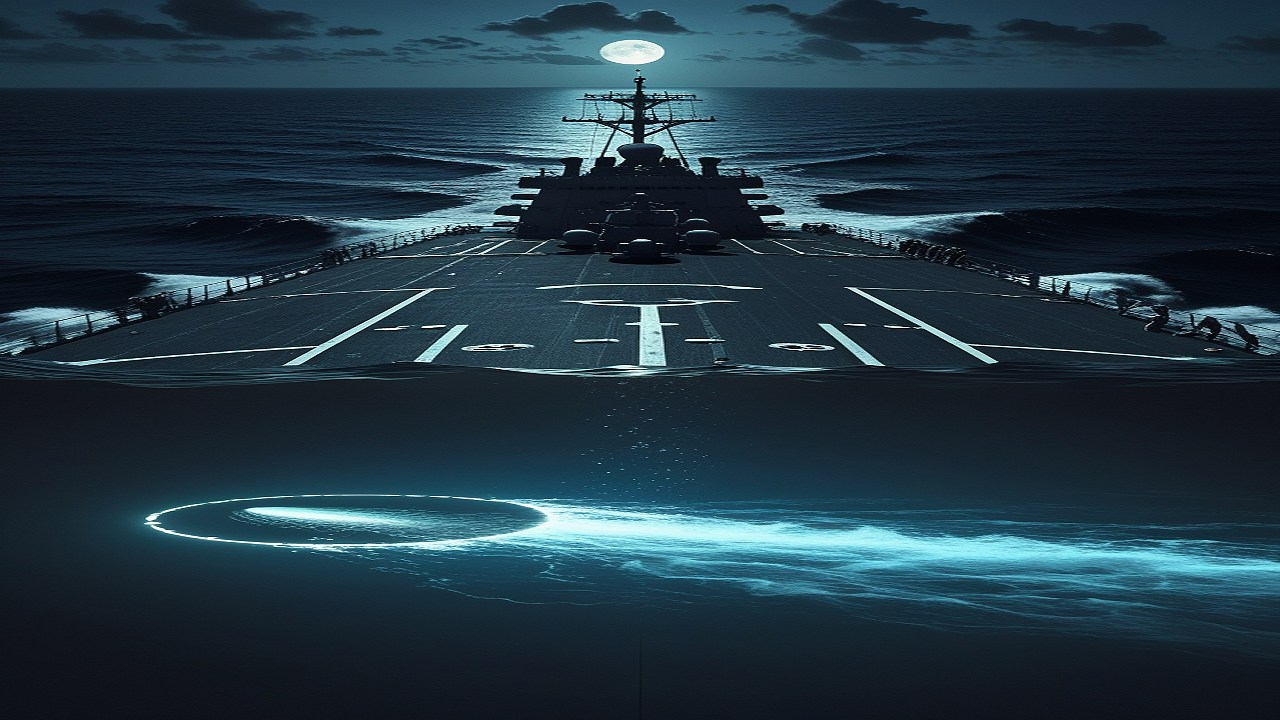
In the early 1970s, at the height of the Cold War and amid a rapidly intensifying era of naval surveillance, the world’s oceans had become one of the most closely monitored environments on Earth. Submarines, sonar nets, and anti-submarine warfare exercises turned vast stretches of water into invisible battlegrounds of sound and signal. It was within this context, in 1973, that Captain Thomas Wilson of the United States Navy later claimed to have encountered something profoundly unsettling while operating in the Caribbean. Speaking decades after the events in question, Wilson asserted that naval sonar systems repeatedly detected fast-moving underwater objects exhibiting speed, maneuverability, and operational characteristics far beyond any known human technology of the time. More striking than the detections themselves was his insistence that higher command deliberately suppressed the information, fearing public panic and geopolitical consequences. Whether one interprets Wilson’s account as evidence of an extraordinary unknown presence or as a reflection of classified military encounters still hidden from public view, his testimony occupies a significant place in the broader narrative of unidentified submerged objects and the enduring mystery of what may exist beneath the waves.
According to Wilson’s recollections, the encounters occurred during routine naval operations in the Caribbean, a region of strategic importance due to its proximity to the United States, major shipping lanes, and Cold War-era flashpoints. Sonar operators aboard his vessel reportedly began tracking contacts that defied established performance envelopes. These objects, as described, were not slow-moving or drifting anomalies, nor did they behave like known marine life. Instead, they appeared as sharply defined sonar returns capable of accelerating rapidly, executing abrupt directional changes, and maintaining speeds underwater that conventional submarines could not approach without catastrophic structural failure.
At a time when even the most advanced nuclear submarines were constrained by hydrodynamics and noise signatures, the tracked objects seemed to operate under entirely different principles. Wilson emphasized that these were not fleeting blips or isolated incidents, but repeated detections over time, involving trained personnel accustomed to distinguishing between false contacts and genuine underwater targets.
Wilson’s later statements stressed the professionalism of the crews involved and the seriousness with which the contacts were initially treated. Sonar operators, officers, and analysts reportedly cross-checked readings using multiple systems to rule out equipment malfunction. Yet the objects persisted, sometimes entering monitored areas at extraordinary speed, loitering briefly, and then departing just as quickly. Wilson claimed that the behavior of these objects suggested intelligence or at least controlled movement, rather than random natural phenomena. In an era when sonar technology had already matured through decades of submarine warfare research, such performance raised urgent questions within the chain of command. What could move like that underwater, and who or what was responsible?
The response from higher command, according to Wilson, was swift and unequivocal. He asserted that reports were classified beyond normal operational secrecy and that personnel were instructed not to discuss the encounters outside approved channels. Briefings emphasized the importance of silence, framing the issue as one of national security rather than scientific curiosity. Wilson later interpreted this as an attempt to avoid public alarm, particularly during a time when trust in institutions was already strained by events such as the Vietnam War and the Watergate scandal.
The idea that unknown objects could penetrate naval monitoring zones with impunity was not something military or political leaders wished to acknowledge openly. Suppression, in this view, became a method of control, preserving public confidence while quietly grappling with an unsettling unknown.
The broader impact of such suppression, if Wilson’s account is accurate, extends far beyond a single naval incident. For the sailors involved, the experience reportedly left a lasting impression, challenging their understanding of technology, security, and humanity’s place in the world. Trained to identify threats and anomalies, they were confronted with something that did not fit any established framework. Yet they were also required to compartmentalize that experience, returning to duty as if nothing extraordinary had occurred. This enforced silence may have contributed to a culture in which anomalous encounters were quietly endured rather than openly examined. Over time, such a culture can erode trust within institutions, particularly if those who witness unexplained phenomena feel their experiences are dismissed or buried rather than investigated transparently.
On a societal level, accounts like Wilson’s contribute to a growing realization that the history of unidentified objects is not confined to the skies. For decades, public fascination focused primarily on aerial sightings, radar contacts, and pilot encounters. However, the ocean, covering the majority of the planet’s surface and remaining largely unexplored, presents an equally compelling arena for mystery. Wilson’s testimony aligns with a pattern reported by other naval personnel over the years, involving objects that transition seamlessly between air and water or operate entirely beneath the surface at remarkable speeds. Such patterns suggest that whatever is being observed may not be constrained by the same environmental limitations as human technology. This realization has gradually influenced public discourse, expanding the conversation from flying saucers to a more complex and holistic view of unidentified phenomena.
The long-term impact of the 1973 Caribbean encounters is perhaps most evident in how they resonate with contemporary developments. In recent years, governments and military institutions have become more open about acknowledging unidentified aerial phenomena, and by extension, submerged ones. While official statements remain cautious, there is now greater recognition that unexplained contacts deserve serious study rather than reflexive dismissal.
Wilson’s account, once relegated to the margins, can be seen as an early data point in a much larger pattern that is only now being addressed openly. His insistence that suppression was motivated by fear of public reaction mirrors modern debates about transparency, accountability, and the public’s right to know about potential unknowns that challenge existing paradigms.
Notable individuals indirectly connected to this narrative include other naval officers and sonar operators who, over the decades, have come forward with similar stories. While Wilson did not name specific colleagues in detail, his account fits within a broader tradition of military testimony that emphasizes consistency of observation rather than sensationalism. These individuals often describe the same characteristics: extraordinary underwater speed, abrupt maneuvers, and an apparent disregard for known physical limits. Collectively, such testimonies lend weight to the argument that the phenomenon is not merely anecdotal but systemic, spanning different eras, regions, and levels of technological sophistication. Even skeptics who question extraterrestrial interpretations must contend with the persistence and similarity of these reports.
The psychological and cultural effects of such encounters are subtle but profound. When authoritative institutions suppress information, whether intentionally or as a byproduct of classification, they shape public understanding in powerful ways. The absence of information can foster speculation, mistrust, and polarized beliefs. In the case of underwater UFOs, decades of silence may have delayed scientific inquiry into genuinely unknown phenomena, whether they ultimately prove to be advanced human technology, novel natural processes, or something entirely outside current models. Wilson’s reflections highlight a missed opportunity for open investigation, suggesting that fear of panic may have outweighed curiosity and transparency.
Today, the impact of the 1973 events can be felt in the renewed interest in oceanic mysteries and the growing call for interdisciplinary research. Advances in sonar, satellite monitoring, and autonomous underwater vehicles have expanded humanity’s ability to observe the deep, yet the ocean remains largely unexplored.
Wilson’s account serves as a reminder that the unknown is not a recent discovery but a long-standing presence, quietly tracked and often ignored. His testimony challenges readers to reconsider assumptions about dominance and control in environments we assume are well understood. If objects capable of such performance existed in 1973 and perhaps still do today, they represent a gap in knowledge that demands attention.
In reflecting on Captain Thomas Wilson’s story, it is important to maintain a balanced perspective. His claims, made years after the fact, rely on memory and personal conviction. Yet they also align with a growing body of similar accounts that cannot be easily dismissed without explanation. The protracted silence surrounding such encounters may say as much about human institutions as it does about the phenomena themselves. Fear of the unknown, concern over public reaction, and the inertia of secrecy have historically shaped how extraordinary information is handled. Wilson’s willingness to speak later in life suggests a desire to correct the record, or at least to ensure that what he and others witnessed is not lost to time.
Ultimately, the significance of the 1973 Caribbean sonar encounters lies not in providing definitive answers, but in raising enduring questions. What was detected beneath those waters, moving with apparent ease beyond known limits. Why was the response to classify and suppress rather than investigate openly. And how many similar encounters have occurred, unrecorded or undisclosed, shaping an unseen history beneath the waves. As interest in unidentified phenomena continues to grow, Captain Thomas Wilson’s account stands as a quiet but compelling chapter in that history, urging a deeper, more open engagement with the mysteries that surround and perhaps accompany humanity on this planet.
In the early 1970s, at the height of the Cold War and amid a rapidly intensifying era of naval surveillance, the world’s oceans had become one of the most closely monitored environments on Earth. Submarines, sonar nets, and anti-submarine warfare exercises turned vast stretches of water into invisible battlegrounds of sound and signal. It was within this context, in 1973, that Captain Thomas Wilson of the United States Navy later claimed to have encountered something profoundly unsettling while operating in the Caribbean. Speaking decades after the events in question, Wilson asserted that naval sonar systems repeatedly detected fast-moving underwater objects exhibiting speed, maneuverability, and operational characteristics far beyond any known human technology of the time. More striking than the detections themselves was his insistence that higher command deliberately suppressed the information, fearing public panic and geopolitical consequences. Whether one interprets Wilson’s account as evidence of an extraordinary unknown presence or as a reflection of classified military encounters still hidden from public view, his testimony occupies a significant place in the broader narrative of unidentified submerged objects and the enduring mystery of what may exist beneath the waves.
According to Wilson’s recollections, the encounters occurred during routine naval operations in the Caribbean, a region of strategic importance due to its proximity to the United States, major shipping lanes, and Cold War-era flashpoints. Sonar operators aboard his vessel reportedly began tracking contacts that defied established performance envelopes. These objects, as described, were not slow-moving or drifting anomalies, nor did they behave like known marine life. Instead, they appeared as sharply defined sonar returns capable of accelerating rapidly, executing abrupt directional changes, and maintaining speeds underwater that conventional submarines could not approach without catastrophic structural failure.
At a time when even the most advanced nuclear submarines were constrained by hydrodynamics and noise signatures, the tracked objects seemed to operate under entirely different principles. Wilson emphasized that these were not fleeting blips or isolated incidents, but repeated detections over time, involving trained personnel accustomed to distinguishing between false contacts and genuine underwater targets.
Wilson’s later statements stressed the professionalism of the crews involved and the seriousness with which the contacts were initially treated. Sonar operators, officers, and analysts reportedly cross-checked readings using multiple systems to rule out equipment malfunction. Yet the objects persisted, sometimes entering monitored areas at extraordinary speed, loitering briefly, and then departing just as quickly. Wilson claimed that the behavior of these objects suggested intelligence or at least controlled movement, rather than random natural phenomena. In an era when sonar technology had already matured through decades of submarine warfare research, such performance raised urgent questions within the chain of command. What could move like that underwater, and who or what was responsible?
The response from higher command, according to Wilson, was swift and unequivocal. He asserted that reports were classified beyond normal operational secrecy and that personnel were instructed not to discuss the encounters outside approved channels. Briefings emphasized the importance of silence, framing the issue as one of national security rather than scientific curiosity. Wilson later interpreted this as an attempt to avoid public alarm, particularly during a time when trust in institutions was already strained by events such as the Vietnam War and the Watergate scandal.
The idea that unknown objects could penetrate naval monitoring zones with impunity was not something military or political leaders wished to acknowledge openly. Suppression, in this view, became a method of control, preserving public confidence while quietly grappling with an unsettling unknown.
The broader impact of such suppression, if Wilson’s account is accurate, extends far beyond a single naval incident. For the sailors involved, the experience reportedly left a lasting impression, challenging their understanding of technology, security, and humanity’s place in the world. Trained to identify threats and anomalies, they were confronted with something that did not fit any established framework. Yet they were also required to compartmentalize that experience, returning to duty as if nothing extraordinary had occurred. This enforced silence may have contributed to a culture in which anomalous encounters were quietly endured rather than openly examined. Over time, such a culture can erode trust within institutions, particularly if those who witness unexplained phenomena feel their experiences are dismissed or buried rather than investigated transparently.
On a societal level, accounts like Wilson’s contribute to a growing realization that the history of unidentified objects is not confined to the skies. For decades, public fascination focused primarily on aerial sightings, radar contacts, and pilot encounters. However, the ocean, covering the majority of the planet’s surface and remaining largely unexplored, presents an equally compelling arena for mystery. Wilson’s testimony aligns with a pattern reported by other naval personnel over the years, involving objects that transition seamlessly between air and water or operate entirely beneath the surface at remarkable speeds. Such patterns suggest that whatever is being observed may not be constrained by the same environmental limitations as human technology. This realization has gradually influenced public discourse, expanding the conversation from flying saucers to a more complex and holistic view of unidentified phenomena.
The long-term impact of the 1973 Caribbean encounters is perhaps most evident in how they resonate with contemporary developments. In recent years, governments and military institutions have become more open about acknowledging unidentified aerial phenomena, and by extension, submerged ones. While official statements remain cautious, there is now greater recognition that unexplained contacts deserve serious study rather than reflexive dismissal.
Wilson’s account, once relegated to the margins, can be seen as an early data point in a much larger pattern that is only now being addressed openly. His insistence that suppression was motivated by fear of public reaction mirrors modern debates about transparency, accountability, and the public’s right to know about potential unknowns that challenge existing paradigms.
Notable individuals indirectly connected to this narrative include other naval officers and sonar operators who, over the decades, have come forward with similar stories. While Wilson did not name specific colleagues in detail, his account fits within a broader tradition of military testimony that emphasizes consistency of observation rather than sensationalism. These individuals often describe the same characteristics: extraordinary underwater speed, abrupt maneuvers, and an apparent disregard for known physical limits. Collectively, such testimonies lend weight to the argument that the phenomenon is not merely anecdotal but systemic, spanning different eras, regions, and levels of technological sophistication. Even skeptics who question extraterrestrial interpretations must contend with the persistence and similarity of these reports.
The psychological and cultural effects of such encounters are subtle but profound. When authoritative institutions suppress information, whether intentionally or as a byproduct of classification, they shape public understanding in powerful ways. The absence of information can foster speculation, mistrust, and polarized beliefs. In the case of underwater UFOs, decades of silence may have delayed scientific inquiry into genuinely unknown phenomena, whether they ultimately prove to be advanced human technology, novel natural processes, or something entirely outside current models. Wilson’s reflections highlight a missed opportunity for open investigation, suggesting that fear of panic may have outweighed curiosity and transparency.
Today, the impact of the 1973 events can be felt in the renewed interest in oceanic mysteries and the growing call for interdisciplinary research. Advances in sonar, satellite monitoring, and autonomous underwater vehicles have expanded humanity’s ability to observe the deep, yet the ocean remains largely unexplored.
Wilson’s account serves as a reminder that the unknown is not a recent discovery but a long-standing presence, quietly tracked and often ignored. His testimony challenges readers to reconsider assumptions about dominance and control in environments we assume are well understood. If objects capable of such performance existed in 1973 and perhaps still do today, they represent a gap in knowledge that demands attention.
In reflecting on Captain Thomas Wilson’s story, it is important to maintain a balanced perspective. His claims, made years after the fact, rely on memory and personal conviction. Yet they also align with a growing body of similar accounts that cannot be easily dismissed without explanation. The protracted silence surrounding such encounters may say as much about human institutions as it does about the phenomena themselves. Fear of the unknown, concern over public reaction, and the inertia of secrecy have historically shaped how extraordinary information is handled. Wilson’s willingness to speak later in life suggests a desire to correct the record, or at least to ensure that what he and others witnessed is not lost to time.
Ultimately, the significance of the 1973 Caribbean sonar encounters lies not in providing definitive answers, but in raising enduring questions. What was detected beneath those waters, moving with apparent ease beyond known limits. Why was the response to classify and suppress rather than investigate openly. And how many similar encounters have occurred, unrecorded or undisclosed, shaping an unseen history beneath the waves. As interest in unidentified phenomena continues to grow, Captain Thomas Wilson’s account stands as a quiet but compelling chapter in that history, urging a deeper, more open engagement with the mysteries that surround and perhaps accompany humanity on this planet.