


Blog Categories
- African Incidents
- Atlantis Incidents
- Australian Incidents
- Belgian Incidents
- Bermuda Triangle Incidents
- Brazilian Incidents
- Canadian Incidents
- Chinese Incidents
- European Incidents
- France Incidents
- Ghosts
- Giants
- Italy Incidents
- Japanese Incidents
- Middle East Incidents
- Portugal Incidents
- Project Serpo
- Puerto Rico Incidents
- Russian Incidents
- Sasquatch
- Scandinavia Incidents
- Spanish Incidents
- UFOs
- United Kingdom Incidents
- United States Incidents
1982 Valdosta UFO: The Silent Triangle
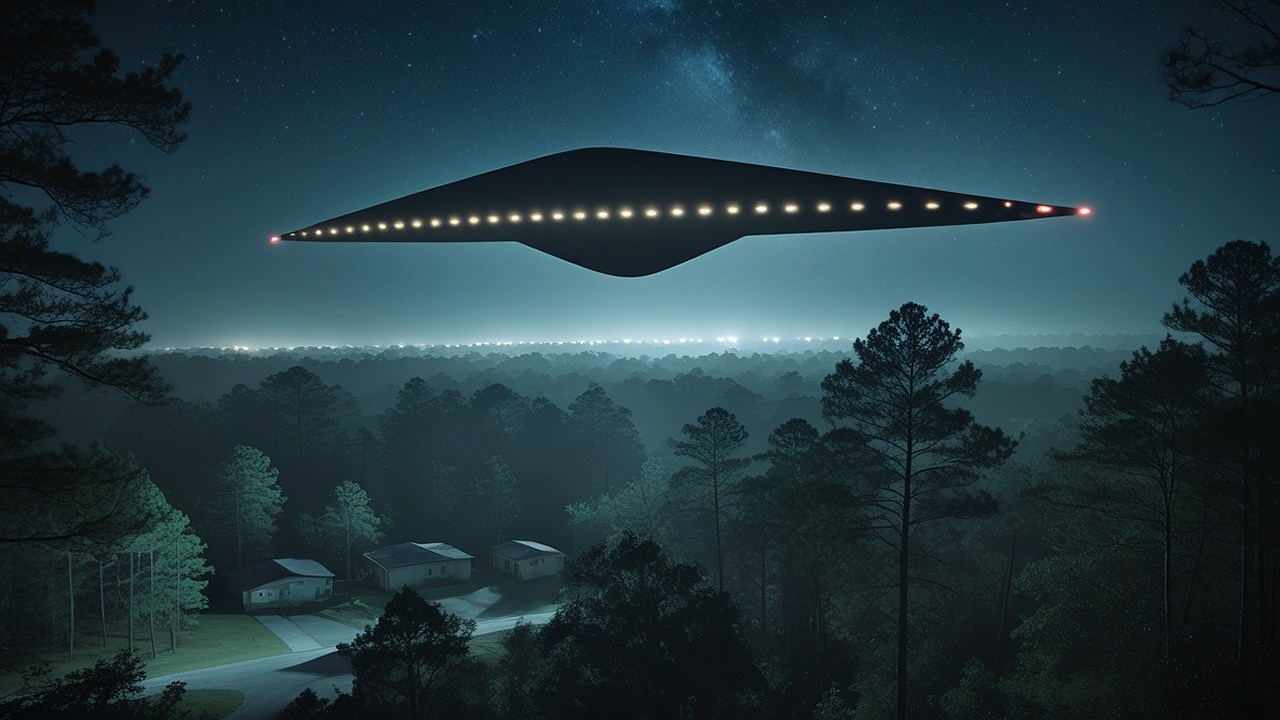
Imagine standing outside on an ordinary night in southern Georgia. The air is still. The pines stand dark against the sky. Somewhere in the distance you hear the usual sounds of a small city winding down. Then something moves just above the treetops. Not a plane. Not a helicopter. Something large. Geometric. Quiet… except for a deep, resonant hum that you feel as much as you hear.
That is the essence of what multiple residents of Valdosta, Georgia reported in 1982.
Welcome back. Tonight we examine one of the quieter yet more consistent triangular UFO cases from the early 1980s: the Valdosta Low-Flying Craft. This is not a crash story. There are no recovered materials here. What we do have is a clear, multi-witness description of a structured object operating at low altitude in a way that still challenges conventional explanation more than four decades later.
Valdosta sits in Lowndes County, near the Florida border. In the early 1980s it was a regional hub of neighborhoods, farmland, and thick pine forests. Roughly ten miles to the northeast stands Moody Air Force Base, a major training and operational installation. Routine military and civilian air traffic was common. People who lived there knew the sound of jets and the silhouette of ordinary aircraft.
Against that familiar backdrop, something different appeared.
Witnesses described the object at night or during twilight, when distant lights and shapes become more distinct. It moved slowly and deliberately, just above the treetops. Low enough that its overall form could be made out. High enough to clear the canopy without striking anything. The shape was consistently reported as triangular or boomerang-like — a large, flat, delta or broad V configuration.
Along its edges ran dim lights. Not the bright, blinking navigation lights of commercial or military aircraft. Soft, subdued points of illumination that outlined the craft without drawing loud attention. The result was a stealthy appearance. The object could blend partially into the night while remaining visible to those who happened to look up at the right moment.
One of the most striking details was the sound — or more accurately, the unusual auditory signature. Witnesses did not report the sharp whine of jet engines or the rhythmic thump of helicopter rotors. Instead they described a deep, resonant humming or vibrating sensation. It was felt as much as heard. A low-frequency vibration that seemed to permeate the surrounding air and, according to some accounts, even affect nearby structures or vehicles.
This kind of acoustic signature appears in other triangular reports from the same era. Whatever system was generating lift and propulsion, it did not behave like the aircraft people in Valdosta were accustomed to hearing.
The early 1980s saw a noticeable rise in reports of large, structured craft with advanced flight characteristics. Around the same period, the famous Hudson Valley “Boomerang” sightings in New York and Connecticut were intensifying. Those reports described massive V-shaped or triangular objects, low-altitude passes, and silent or nearly silent flight. The Valdosta object did not generate the thousands of reports that the Hudson Valley wave produced, yet the morphological and behavioral similarities are clear: geometry, altitude, lighting, and acoustic profile.
This alignment suggests the Valdosta craft may belong to a broader pattern of triangular activity observed across different regions during that decade.
Georgia’s geography and military presence make Valdosta a logical place for such a sighting to occur. The state hosts several significant installations. Southern Georgia’s relatively flat terrain mixed with dense pine woods offers both open sightlines and secluded corridors. Moody Air Force Base’s proximity naturally raises questions about classified testing.
In the early 1980s the United States was developing stealth technology. Programs that would eventually produce the F-117 Nighthawk were still highly classified. Yet known stealth aircraft of that era were generally smaller, produced more noise at low altitude, and were not typically described as large boomerang-shaped platforms matching the scale implied by Valdosta witnesses. The deep humming vibration further separates the reported object from conventional jets or the early stealth prototypes that have since been publicly acknowledged.
From a research standpoint, the strength of the Valdosta case lies in the consistency across multiple independent residents in different parts of the city. They described the same basic shape, the same edge lighting, the same low altitude, and the same unusual sound. The low treetop-level flight allowed for more detailed observation than high-altitude lights usually permit.
At the same time, comprehensive public documentation is limited. There are no widely publicized radar tracks, pilot intercepts, or official military statements that specifically address this incident. Reports traveled primarily through local conversation, regional investigators, and later compilations of Georgia sightings.
This absence of official acknowledgment is typical of the post-Project Blue Book era. The Air Force generally declined to investigate UFO reports unless they directly affected national security or flight safety. Sightings near installations such as Moody AFB could have been logged internally as unexplained, attributed to misidentified aircraft, experimental vehicles, or atmospheric effects. For the people on the ground, the experience remained vivid precisely because it resisted easy classification. The combination of clear geometry, subdued lighting, and anomalous acoustics created a sense of something outside ordinary aviation.
When placed alongside the broader category often called “Black Triangles,” the Valdosta reports fit a recurring pattern. These objects are frequently described as large, sometimes estimated at football-field scale in other cases, capable of slow flight or hovering, equipped with lights at the corners or along the edges, and either silent or producing a low hum. Proponents of the extraterrestrial hypothesis note the apparent violation of known aerodynamic limits: sustained low-speed flight without stalling, minimal acoustic signature, and the ability to operate near military airspace without generating widespread official alerts.
Skeptics point toward advanced classified human technology — early drones, experimental platforms, or psychological amplification during a tense Cold War period. Both interpretations must confront the same descriptive core provided by the Valdosta witnesses.
Consider the human side of the event. Residents going about ordinary evening routines — driving home, walking, simply being outdoors — suddenly encountered something extraordinary in familiar skies. The low altitude would have intensified the sense of immediacy. The object showed no overtly aggressive behavior, yet its presence alone was enough to leave a lasting impression.
In a city the size of Valdosta, stories like this travel through social networks. They become part of local memory even when they remain largely absent from mainstream historical records. For some witnesses the experience may have opened deeper questions about secrecy, technology, or the possibility that the sky holds more than official narratives admit.
The 1982 sighting also fits within Georgia’s longer record of anomalous aerial activity. The state has accumulated hundreds of reports over decades, with noticeable clusters near military facilities. Earlier accounts from the Valdosta area, including a well-publicized 1949 “ball of fire” observed by both police and civilians, show that unusual lights and objects were already part of the regional experience. The low-flying triangular craft of 1982 bridges older disc and orb reports with the emerging wave of structured triangular objects that would become more prominent later in the decade and into the 1990s.
Several research themes stand out. First, the value of consistency across independent witnesses. Second, the importance of acoustic data as a secondary signature beyond pure visual description. Third, the ongoing difficulty of cleanly separating classified human technology from genuinely anomalous phenomena. Even with greater public knowledge of stealth programs today, certain performance characteristics — especially large size combined with quiet, controlled low-speed flight — remain difficult to match with known aircraft of the early 1980s.
The case also illustrates the limits of purely anecdotal evidence. Without photographs, video (rare in 1982), or instrument data, the Valdosta reports stay in the category of high-credibility but unproven accounts. Their alignment with contemporaneous triangular sightings elsewhere, however, gives them additional weight inside the larger study of unidentified aerial phenomena.
Looking back more than forty years later, the 1982 Valdosta Low-Flying Craft remains a clean example of the stealth-like triangular archetype. Slow passage just above the treetops. Geometric shape. Dim edge lighting. A deep, resonant hum instead of jet noise. These elements set it apart from routine air traffic while linking it to a pattern observed in multiple regions during the same period.
For the residents who saw it, the event was a brief rupture in the ordinary. An object that should not have been there, moving in a way that conventional explanations still struggle to fully absorb. Whether future declassification, veteran testimony, or improved analytical methods eventually place the craft in a known category, or whether it continues to stand as unexplained, the reports themselves form a durable thread in Georgia’s contribution to the global record of aerial mysteries.
The skies above American communities are busy. They are monitored. They are familiar. And yet, on certain nights, something still passes just above the trees — large, quiet, geometric — leaving witnesses with the same unsettled recognition: we do not fully understand everything that moves through our airspace.
The Valdosta Low-Flying Craft of 1982 is one of those moments. A quiet but persistent reminder that the unexplained has never been confined to remote deserts or distant oceans. Sometimes it flies low over southern Georgia pine forests, humming just loud enough to be felt, and then continues on its way.
If you have information about this or similar sightings from the early 1980s near Moody Air Force Base or Valdosta, the comments are open. The historical record grows one careful witness account at a time.
Thank you for watching. Stay curious. Look up. And I’ll see you in the next one.
Imagine standing outside on an ordinary night in southern Georgia. The air is still. The pines stand dark against the sky. Somewhere in the distance you hear the usual sounds of a small city winding down. Then something moves just above the treetops. Not a plane. Not a helicopter. Something large. Geometric. Quiet… except for a deep, resonant hum that you feel as much as you hear.
That is the essence of what multiple residents of Valdosta, Georgia reported in 1982.
Welcome back. Tonight we examine one of the quieter yet more consistent triangular UFO cases from the early 1980s: the Valdosta Low-Flying Craft. This is not a crash story. There are no recovered materials here. What we do have is a clear, multi-witness description of a structured object operating at low altitude in a way that still challenges conventional explanation more than four decades later.
Valdosta sits in Lowndes County, near the Florida border. In the early 1980s it was a regional hub of neighborhoods, farmland, and thick pine forests. Roughly ten miles to the northeast stands Moody Air Force Base, a major training and operational installation. Routine military and civilian air traffic was common. People who lived there knew the sound of jets and the silhouette of ordinary aircraft.
Against that familiar backdrop, something different appeared.
Witnesses described the object at night or during twilight, when distant lights and shapes become more distinct. It moved slowly and deliberately, just above the treetops. Low enough that its overall form could be made out. High enough to clear the canopy without striking anything. The shape was consistently reported as triangular or boomerang-like — a large, flat, delta or broad V configuration.
Along its edges ran dim lights. Not the bright, blinking navigation lights of commercial or military aircraft. Soft, subdued points of illumination that outlined the craft without drawing loud attention. The result was a stealthy appearance. The object could blend partially into the night while remaining visible to those who happened to look up at the right moment.
One of the most striking details was the sound — or more accurately, the unusual auditory signature. Witnesses did not report the sharp whine of jet engines or the rhythmic thump of helicopter rotors. Instead they described a deep, resonant humming or vibrating sensation. It was felt as much as heard. A low-frequency vibration that seemed to permeate the surrounding air and, according to some accounts, even affect nearby structures or vehicles.
This kind of acoustic signature appears in other triangular reports from the same era. Whatever system was generating lift and propulsion, it did not behave like the aircraft people in Valdosta were accustomed to hearing.
The early 1980s saw a noticeable rise in reports of large, structured craft with advanced flight characteristics. Around the same period, the famous Hudson Valley “Boomerang” sightings in New York and Connecticut were intensifying. Those reports described massive V-shaped or triangular objects, low-altitude passes, and silent or nearly silent flight. The Valdosta object did not generate the thousands of reports that the Hudson Valley wave produced, yet the morphological and behavioral similarities are clear: geometry, altitude, lighting, and acoustic profile.
This alignment suggests the Valdosta craft may belong to a broader pattern of triangular activity observed across different regions during that decade.
Georgia’s geography and military presence make Valdosta a logical place for such a sighting to occur. The state hosts several significant installations. Southern Georgia’s relatively flat terrain mixed with dense pine woods offers both open sightlines and secluded corridors. Moody Air Force Base’s proximity naturally raises questions about classified testing.
In the early 1980s the United States was developing stealth technology. Programs that would eventually produce the F-117 Nighthawk were still highly classified. Yet known stealth aircraft of that era were generally smaller, produced more noise at low altitude, and were not typically described as large boomerang-shaped platforms matching the scale implied by Valdosta witnesses. The deep humming vibration further separates the reported object from conventional jets or the early stealth prototypes that have since been publicly acknowledged.
From a research standpoint, the strength of the Valdosta case lies in the consistency across multiple independent residents in different parts of the city. They described the same basic shape, the same edge lighting, the same low altitude, and the same unusual sound. The low treetop-level flight allowed for more detailed observation than high-altitude lights usually permit.
At the same time, comprehensive public documentation is limited. There are no widely publicized radar tracks, pilot intercepts, or official military statements that specifically address this incident. Reports traveled primarily through local conversation, regional investigators, and later compilations of Georgia sightings.
This absence of official acknowledgment is typical of the post-Project Blue Book era. The Air Force generally declined to investigate UFO reports unless they directly affected national security or flight safety. Sightings near installations such as Moody AFB could have been logged internally as unexplained, attributed to misidentified aircraft, experimental vehicles, or atmospheric effects. For the people on the ground, the experience remained vivid precisely because it resisted easy classification. The combination of clear geometry, subdued lighting, and anomalous acoustics created a sense of something outside ordinary aviation.
When placed alongside the broader category often called “Black Triangles,” the Valdosta reports fit a recurring pattern. These objects are frequently described as large, sometimes estimated at football-field scale in other cases, capable of slow flight or hovering, equipped with lights at the corners or along the edges, and either silent or producing a low hum. Proponents of the extraterrestrial hypothesis note the apparent violation of known aerodynamic limits: sustained low-speed flight without stalling, minimal acoustic signature, and the ability to operate near military airspace without generating widespread official alerts.
Skeptics point toward advanced classified human technology — early drones, experimental platforms, or psychological amplification during a tense Cold War period. Both interpretations must confront the same descriptive core provided by the Valdosta witnesses.
Consider the human side of the event. Residents going about ordinary evening routines — driving home, walking, simply being outdoors — suddenly encountered something extraordinary in familiar skies. The low altitude would have intensified the sense of immediacy. The object showed no overtly aggressive behavior, yet its presence alone was enough to leave a lasting impression.
In a city the size of Valdosta, stories like this travel through social networks. They become part of local memory even when they remain largely absent from mainstream historical records. For some witnesses the experience may have opened deeper questions about secrecy, technology, or the possibility that the sky holds more than official narratives admit.
The 1982 sighting also fits within Georgia’s longer record of anomalous aerial activity. The state has accumulated hundreds of reports over decades, with noticeable clusters near military facilities. Earlier accounts from the Valdosta area, including a well-publicized 1949 “ball of fire” observed by both police and civilians, show that unusual lights and objects were already part of the regional experience. The low-flying triangular craft of 1982 bridges older disc and orb reports with the emerging wave of structured triangular objects that would become more prominent later in the decade and into the 1990s.
Several research themes stand out. First, the value of consistency across independent witnesses. Second, the importance of acoustic data as a secondary signature beyond pure visual description. Third, the ongoing difficulty of cleanly separating classified human technology from genuinely anomalous phenomena. Even with greater public knowledge of stealth programs today, certain performance characteristics — especially large size combined with quiet, controlled low-speed flight — remain difficult to match with known aircraft of the early 1980s.
The case also illustrates the limits of purely anecdotal evidence. Without photographs, video (rare in 1982), or instrument data, the Valdosta reports stay in the category of high-credibility but unproven accounts. Their alignment with contemporaneous triangular sightings elsewhere, however, gives them additional weight inside the larger study of unidentified aerial phenomena.
Looking back more than forty years later, the 1982 Valdosta Low-Flying Craft remains a clean example of the stealth-like triangular archetype. Slow passage just above the treetops. Geometric shape. Dim edge lighting. A deep, resonant hum instead of jet noise. These elements set it apart from routine air traffic while linking it to a pattern observed in multiple regions during the same period.
For the residents who saw it, the event was a brief rupture in the ordinary. An object that should not have been there, moving in a way that conventional explanations still struggle to fully absorb. Whether future declassification, veteran testimony, or improved analytical methods eventually place the craft in a known category, or whether it continues to stand as unexplained, the reports themselves form a durable thread in Georgia’s contribution to the global record of aerial mysteries.
The skies above American communities are busy. They are monitored. They are familiar. And yet, on certain nights, something still passes just above the trees — large, quiet, geometric — leaving witnesses with the same unsettled recognition: we do not fully understand everything that moves through our airspace.
The Valdosta Low-Flying Craft of 1982 is one of those moments. A quiet but persistent reminder that the unexplained has never been confined to remote deserts or distant oceans. Sometimes it flies low over southern Georgia pine forests, humming just loud enough to be felt, and then continues on its way.
If you have information about this or similar sightings from the early 1980s near Moody Air Force Base or Valdosta, the comments are open. The historical record grows one careful witness account at a time.
Thank you for watching. Stay curious. Look up. And I’ll see you in the next one.