


Blog Categories
- African Incidents
- Atlantis Incidents
- Australian Incidents
- Belgian Incidents
- Bermuda Triangle Incidents
- Brazilian Incidents
- Canadian Incidents
- Chinese Incidents
- European Incidents
- France Incidents
- Ghosts
- Giants
- Italy Incidents
- Japanese Incidents
- Middle East Incidents
- Portugal Incidents
- Project Serpo
- Puerto Rico Incidents
- Russian Incidents
- Sasquatch
- Scandinavia Incidents
- Spanish Incidents
- UFOs
- United Kingdom Incidents
- United States Incidents
1989: Pensacola Beach Mass Sightings
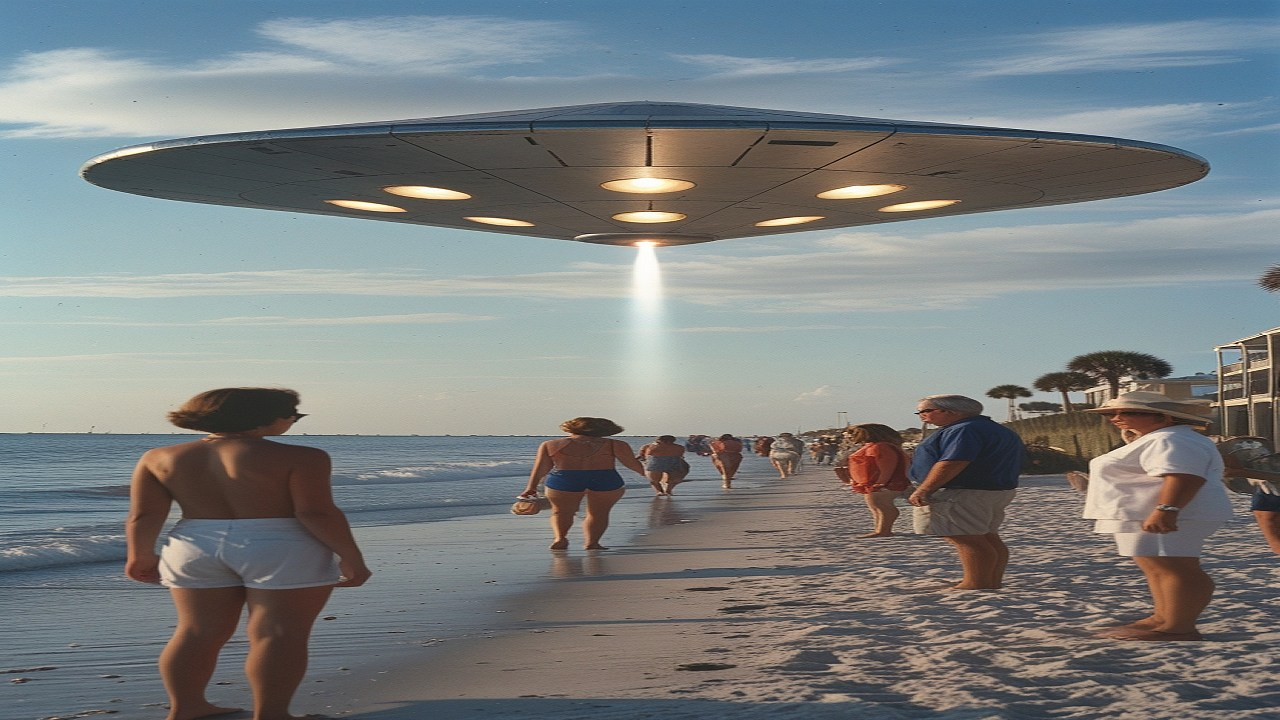
The summer of 1989 marked a high point in public fascination with unidentified aerial phenomena across the Gulf Coast of Florida. On the evening of July 14, as the air over Pensacola Beach shimmered with heat and tourists gathered for another balmy night near the shoreline, an event unfolded that would not only deepen the mystery surrounding the Gulf Breeze wave but would also push Florida’s UFO history to the forefront of international attention.
The incident—now referred to as the Pensacola Beach Mass Sightings— stands as one of the best-documented and most widely witnessed UFO cases in the state’s history, second only to the earlier 1987 and 1988 Gulf Breeze encounters.
According to dozens of independent witnesses, around 9:00 p.m., a large, silent, diamond-shaped craft appeared in the southern sky, hovering just beyond the beach’s lighting zone. Its size was estimated by multiple onlookers to be at least the width of a small passenger jet. Witnesses described three bright white or amber lights arranged in a triangular pattern along its underside, with a faint central glow suggesting a fourth point or reflective metallic surface. It moved without sound, and some claimed it shimmered slightly, as if wrapped in a thin layer of heat distortion.
Tourists and locals alike stood in silence, many pointing upward as the object drifted slowly along the coastline, hovering for several minutes before rising vertically and vanishing toward the west. A number of people on the beach that evening captured portions of the event using consumer-grade camcorders. These videos, while grainy by modern standards, provided consistent imagery: a diamond or V-shaped formation of lights moving in perfect silence across the dark sky.
Among the witnesses were off-duty law enforcement officers, families vacationing from out of state, and at least one military contractor from nearby Eglin Air Force Base who later confirmed the object’s unusual behavior. Some witnesses reported feeling a low-frequency vibration, not heard but sensed, as the craft passed overhead. Others mentioned that their car radios emitted bursts of static during the encounter.
Within twenty-four hours, reports began to flood local newsrooms. The Pensacola News Journal and regional radio stations were inundated with phone calls from individuals seeking answers. Local television outlets aired interviews with witnesses who appeared visibly shaken, describing the craft in nearly identical terms. It was during this time that Air Force radar operators reportedly detected an unidentified object moving westward along the Gulf Coast corridor, briefly tracking it before losing contact near Fort Walton Beach. While this radar contact was never officially tied to the visual sighting, the coincidence fueled speculation that the event had indeed involved something physical and measurable.
At the time, Gulf Breeze was already under international scrutiny for the ongoing UFO wave initiated by contractor Ed Walters two years earlier. Walters’ Polaroid photographs of hovering disc-shaped craft had made headlines around the world, dividing researchers into believers and skeptics. For many, the 1989 mass sightings provided independent corroboration that something unexplained was indeed active in the skies over the Florida Panhandle. Unlike Walters’ photographs, however, the Pensacola Beach incident involved dozens of unaffiliated witnesses, multiple recordings, and real-time radar involvement—all of which elevated its credibility among serious investigators.
The Mutual UFO Network (MUFON), which had already established a semi-permanent presence in the Gulf Breeze area, dispatched field investigators to collect statements, videotapes, and environmental readings. They interviewed over fifty individuals, many of whom had no prior involvement with the UFO subject. Several key witnesses were interviewed under oath, their testimony recorded and later presented at the 1990 MUFON Symposium.
Among the more notable eyewitnesses was a retired Air Force radar technician, identified in early reports only as “Harold,” who described the object’s flight as “too steady and geometrically perfect to be an aircraft or balloon.” Another witness, a high school science teacher vacationing from Georgia, provided detailed notes of the object’s angular displacement and estimated altitude, concluding that the craft had traveled silently at less than 1,000 feet. Her observations lent a technical credibility that reporters and researchers seized upon.
The psychological and cultural impact of the Pensacola Beach sightings cannot be overstated. For the residents of the Florida Panhandle, the incident represented a climax in what had already become a local phenomenon. Restaurants, souvenir shops, and tourist businesses began to sell T-shirts and postcards referencing the Gulf Breeze UFOs. Television news crews from Japan, the United Kingdom, and France arrived in the weeks following the sighting, interviewing locals and recording footage of the beach.
For those who witnessed the event firsthand, the experience often carried profound personal effects. Many described a lingering sense of awe or confusion, while others reported difficulty sleeping or an obsessive need to understand what they had seen. A few experienced recurring dreams of bright lights and hovering shapes over the water. Though these psychological aftereffects could not be clinically verified, they demonstrated the depth of the event’s emotional resonance within the community.
In the broader UFO research field, the Pensacola Beach mass sightings reinforced Florida’s reputation as one of the most active regions for aerial anomalies during the 1980s. Researchers drew comparisons to other mass sightings of the era, including the Hudson Valley wave in New York and the Belgian triangle incidents in Europe. In each of these cases, witnesses described large, silent, triangular or diamond-shaped craft equipped with multiple bright lights, capable of hovering or accelerating with extraordinary speed.
Skeptics proposed more conventional explanations, suggesting that what witnesses saw might have been a formation of aircraft, possibly part of a nighttime exercise from nearby military bases. However, the Air Force firmly denied any such operations that evening, noting that flight records for Eglin, Hurlburt Field, and Tyndall Air Force Base contained no scheduled or unscheduled formation flights at the time of the sightings. Others suggested that atmospheric or astronomical phenomena could account for the lights, though few found these explanations satisfying given the consistent triangular structure described.
The debate over the true nature of the Pensacola Beach craft soon extended beyond Florida. National publications such as Omni and Fate Magazine referenced the event in broader analyses of UFO activity across the United States. Some writers proposed that the Gulf Breeze and Pensacola sightings represented an ongoing pattern of surveillance by unknown intelligences, while others suggested that the region’s heavy military presence made it a testing ground for classified aircraft.
What set the Pensacola Beach incident apart from other mass sightings was the convergence of credible witnesses, video evidence, and regional radar data—all within a defined geographic corridor that had already produced years of similar reports. The Gulf Coast corridor between Pensacola and Fort Walton Beach became, for a time, one of the most studied UFO “hot zones” in the country. Researchers began to map sightings by date, weather condition, and direction of travel, discovering that many reports followed a west-to-east flight path along the coastline.
In the years following the 1989 event, interest in the Gulf Breeze wave gradually waned, yet the Pensacola Beach sightings remained a key reference point in discussions of multiple-witness cases. MUFON’s final report on the incident concluded that the object observed “could not be explained as any known aircraft, celestial body, or atmospheric phenomenon.” The group classified the case as “unknown,” one of fewer than two percent of investigations to receive that designation at the time.
For the witnesses themselves, the experience became a defining memory. Decades later, some continued to recount their encounter in interviews or local gatherings. Their consistency over the years—repeating the same descriptions without embellishment—lent ongoing credibility to their testimony.
In terms of cultural impact, the Pensacola Beach sightings contributed to a surge of UFO documentaries, news specials, and public lectures throughout the late 1980s and early 1990s. The incident helped cement Gulf Breeze’s reputation as a global focal point for UFO research, attracting scientists, skeptics, and believers alike. It also inspired local folklore and tourism, with some residents capitalizing on the event’s fame by hosting annual “Skywatch” nights where locals and visitors would gather along the beach, hoping to glimpse another mysterious light over the Gulf.
Today, the 1989 Pensacola Beach mass sightings remain one of Florida’s most referenced UFO cases. Although modern researchers continue to analyze the available footage and testimony, no definitive explanation has emerged. Some recent analysts have compared the radar and visual characteristics of the 1989 object with modern military encounters recorded by U.S. Navy pilots off the same coast in the early 2000s. The similarities—particularly in terms of acceleration, silence, and apparent anti-gravity maneuvers—have led some to argue that the Gulf Breeze and Pensacola events were early manifestations of what is now referred to as UAP (Unidentified Aerial Phenomena).
The lasting significance of the Pensacola Beach sightings lies not only in what was seen but in how it changed public perception. The event marked a transition from isolated witness accounts to community-wide experiences, pushing the UFO discussion from fringe speculation into mainstream conversation. By the close of 1989, Florida had become synonymous with credible, well-documented UFO activity, and Pensacola Beach had earned its place in American UFO history as the scene of one of the decade’s defining events.
Whether one views the 1989 Pensacola Beach mass sightings as proof of an unknown intelligence or as a testament to human curiosity under extraordinary circumstances, the event endures as a powerful reminder of how mystery can unify a community. The shared experience of the witnesses—ordinary people who found themselves gazing up at something beyond explanation—created a bond that still resonates decades later. The photographs and videos remain imperfect, yet the consistency of testimony, the calmness of the accounts, and the sincerity of those who reported the event have kept it alive in public consciousness.
In the end, the 1989 Pensacola Beach sightings encapsulate the spirit of the late twentieth-century UFO phenomenon: ordinary citizens confronting the extraordinary, their experience defying simple classification. It stands as both a caution and an invitation—to keep looking, to keep asking, and to acknowledge that some mysteries, even after decades, continue to hover just beyond the reach of explanation.
The summer of 1989 marked a high point in public fascination with unidentified aerial phenomena across the Gulf Coast of Florida. On the evening of July 14, as the air over Pensacola Beach shimmered with heat and tourists gathered for another balmy night near the shoreline, an event unfolded that would not only deepen the mystery surrounding the Gulf Breeze wave but would also push Florida’s UFO history to the forefront of international attention.
The incident—now referred to as the Pensacola Beach Mass Sightings— stands as one of the best-documented and most widely witnessed UFO cases in the state’s history, second only to the earlier 1987 and 1988 Gulf Breeze encounters.
According to dozens of independent witnesses, around 9:00 p.m., a large, silent, diamond-shaped craft appeared in the southern sky, hovering just beyond the beach’s lighting zone. Its size was estimated by multiple onlookers to be at least the width of a small passenger jet. Witnesses described three bright white or amber lights arranged in a triangular pattern along its underside, with a faint central glow suggesting a fourth point or reflective metallic surface. It moved without sound, and some claimed it shimmered slightly, as if wrapped in a thin layer of heat distortion.
Tourists and locals alike stood in silence, many pointing upward as the object drifted slowly along the coastline, hovering for several minutes before rising vertically and vanishing toward the west. A number of people on the beach that evening captured portions of the event using consumer-grade camcorders. These videos, while grainy by modern standards, provided consistent imagery: a diamond or V-shaped formation of lights moving in perfect silence across the dark sky.
Among the witnesses were off-duty law enforcement officers, families vacationing from out of state, and at least one military contractor from nearby Eglin Air Force Base who later confirmed the object’s unusual behavior. Some witnesses reported feeling a low-frequency vibration, not heard but sensed, as the craft passed overhead. Others mentioned that their car radios emitted bursts of static during the encounter.
Within twenty-four hours, reports began to flood local newsrooms. The Pensacola News Journal and regional radio stations were inundated with phone calls from individuals seeking answers. Local television outlets aired interviews with witnesses who appeared visibly shaken, describing the craft in nearly identical terms. It was during this time that Air Force radar operators reportedly detected an unidentified object moving westward along the Gulf Coast corridor, briefly tracking it before losing contact near Fort Walton Beach. While this radar contact was never officially tied to the visual sighting, the coincidence fueled speculation that the event had indeed involved something physical and measurable.
At the time, Gulf Breeze was already under international scrutiny for the ongoing UFO wave initiated by contractor Ed Walters two years earlier. Walters’ Polaroid photographs of hovering disc-shaped craft had made headlines around the world, dividing researchers into believers and skeptics. For many, the 1989 mass sightings provided independent corroboration that something unexplained was indeed active in the skies over the Florida Panhandle. Unlike Walters’ photographs, however, the Pensacola Beach incident involved dozens of unaffiliated witnesses, multiple recordings, and real-time radar involvement—all of which elevated its credibility among serious investigators.
The Mutual UFO Network (MUFON), which had already established a semi-permanent presence in the Gulf Breeze area, dispatched field investigators to collect statements, videotapes, and environmental readings. They interviewed over fifty individuals, many of whom had no prior involvement with the UFO subject. Several key witnesses were interviewed under oath, their testimony recorded and later presented at the 1990 MUFON Symposium.
Among the more notable eyewitnesses was a retired Air Force radar technician, identified in early reports only as “Harold,” who described the object’s flight as “too steady and geometrically perfect to be an aircraft or balloon.” Another witness, a high school science teacher vacationing from Georgia, provided detailed notes of the object’s angular displacement and estimated altitude, concluding that the craft had traveled silently at less than 1,000 feet. Her observations lent a technical credibility that reporters and researchers seized upon.
The psychological and cultural impact of the Pensacola Beach sightings cannot be overstated. For the residents of the Florida Panhandle, the incident represented a climax in what had already become a local phenomenon. Restaurants, souvenir shops, and tourist businesses began to sell T-shirts and postcards referencing the Gulf Breeze UFOs. Television news crews from Japan, the United Kingdom, and France arrived in the weeks following the sighting, interviewing locals and recording footage of the beach.
For those who witnessed the event firsthand, the experience often carried profound personal effects. Many described a lingering sense of awe or confusion, while others reported difficulty sleeping or an obsessive need to understand what they had seen. A few experienced recurring dreams of bright lights and hovering shapes over the water. Though these psychological aftereffects could not be clinically verified, they demonstrated the depth of the event’s emotional resonance within the community.
In the broader UFO research field, the Pensacola Beach mass sightings reinforced Florida’s reputation as one of the most active regions for aerial anomalies during the 1980s. Researchers drew comparisons to other mass sightings of the era, including the Hudson Valley wave in New York and the Belgian triangle incidents in Europe. In each of these cases, witnesses described large, silent, triangular or diamond-shaped craft equipped with multiple bright lights, capable of hovering or accelerating with extraordinary speed.
Skeptics proposed more conventional explanations, suggesting that what witnesses saw might have been a formation of aircraft, possibly part of a nighttime exercise from nearby military bases. However, the Air Force firmly denied any such operations that evening, noting that flight records for Eglin, Hurlburt Field, and Tyndall Air Force Base contained no scheduled or unscheduled formation flights at the time of the sightings. Others suggested that atmospheric or astronomical phenomena could account for the lights, though few found these explanations satisfying given the consistent triangular structure described.
The debate over the true nature of the Pensacola Beach craft soon extended beyond Florida. National publications such as Omni and Fate Magazine referenced the event in broader analyses of UFO activity across the United States. Some writers proposed that the Gulf Breeze and Pensacola sightings represented an ongoing pattern of surveillance by unknown intelligences, while others suggested that the region’s heavy military presence made it a testing ground for classified aircraft.
What set the Pensacola Beach incident apart from other mass sightings was the convergence of credible witnesses, video evidence, and regional radar data—all within a defined geographic corridor that had already produced years of similar reports. The Gulf Coast corridor between Pensacola and Fort Walton Beach became, for a time, one of the most studied UFO “hot zones” in the country. Researchers began to map sightings by date, weather condition, and direction of travel, discovering that many reports followed a west-to-east flight path along the coastline.
In the years following the 1989 event, interest in the Gulf Breeze wave gradually waned, yet the Pensacola Beach sightings remained a key reference point in discussions of multiple-witness cases. MUFON’s final report on the incident concluded that the object observed “could not be explained as any known aircraft, celestial body, or atmospheric phenomenon.” The group classified the case as “unknown,” one of fewer than two percent of investigations to receive that designation at the time.
For the witnesses themselves, the experience became a defining memory. Decades later, some continued to recount their encounter in interviews or local gatherings. Their consistency over the years—repeating the same descriptions without embellishment—lent ongoing credibility to their testimony.
In terms of cultural impact, the Pensacola Beach sightings contributed to a surge of UFO documentaries, news specials, and public lectures throughout the late 1980s and early 1990s. The incident helped cement Gulf Breeze’s reputation as a global focal point for UFO research, attracting scientists, skeptics, and believers alike. It also inspired local folklore and tourism, with some residents capitalizing on the event’s fame by hosting annual “Skywatch” nights where locals and visitors would gather along the beach, hoping to glimpse another mysterious light over the Gulf.
Today, the 1989 Pensacola Beach mass sightings remain one of Florida’s most referenced UFO cases. Although modern researchers continue to analyze the available footage and testimony, no definitive explanation has emerged. Some recent analysts have compared the radar and visual characteristics of the 1989 object with modern military encounters recorded by U.S. Navy pilots off the same coast in the early 2000s. The similarities—particularly in terms of acceleration, silence, and apparent anti-gravity maneuvers—have led some to argue that the Gulf Breeze and Pensacola events were early manifestations of what is now referred to as UAP (Unidentified Aerial Phenomena).
The lasting significance of the Pensacola Beach sightings lies not only in what was seen but in how it changed public perception. The event marked a transition from isolated witness accounts to community-wide experiences, pushing the UFO discussion from fringe speculation into mainstream conversation. By the close of 1989, Florida had become synonymous with credible, well-documented UFO activity, and Pensacola Beach had earned its place in American UFO history as the scene of one of the decade’s defining events.
Whether one views the 1989 Pensacola Beach mass sightings as proof of an unknown intelligence or as a testament to human curiosity under extraordinary circumstances, the event endures as a powerful reminder of how mystery can unify a community. The shared experience of the witnesses—ordinary people who found themselves gazing up at something beyond explanation—created a bond that still resonates decades later. The photographs and videos remain imperfect, yet the consistency of testimony, the calmness of the accounts, and the sincerity of those who reported the event have kept it alive in public consciousness.
In the end, the 1989 Pensacola Beach sightings encapsulate the spirit of the late twentieth-century UFO phenomenon: ordinary citizens confronting the extraordinary, their experience defying simple classification. It stands as both a caution and an invitation—to keep looking, to keep asking, and to acknowledge that some mysteries, even after decades, continue to hover just beyond the reach of explanation.