


Blog Categories
- African Incidents
- Atlantis Incidents
- Australian Incidents
- Belgian Incidents
- Bermuda Triangle Incidents
- Brazilian Incidents
- Canadian Incidents
- Chinese Incidents
- European Incidents
- France Incidents
- Ghosts
- Giants
- Italy Incidents
- Japanese Incidents
- Middle East Incidents
- Portugal Incidents
- Project Serpo
- Puerto Rico Incidents
- Russian Incidents
- Sasquatch
- Scandinavia Incidents
- Spanish Incidents
- UFOs
- United Kingdom Incidents
- United States Incidents
1991: Orlando Triangle Encounter
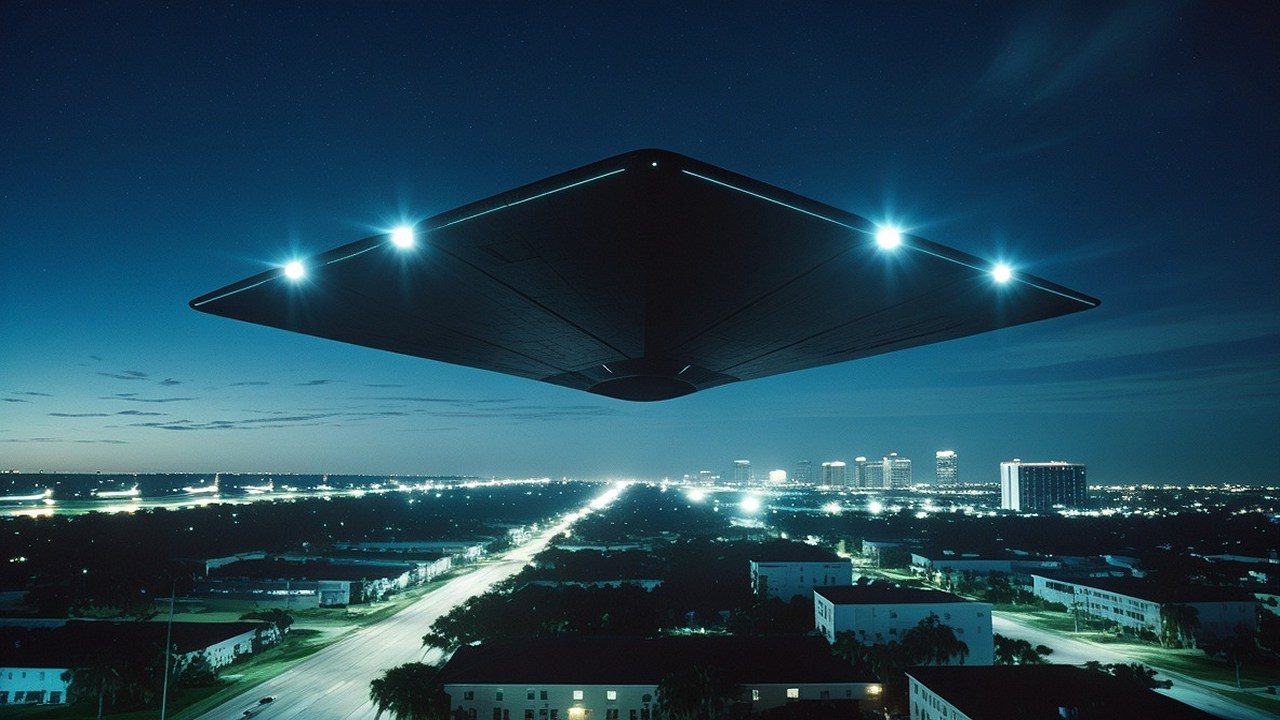
In August 1991, something extraordinary moved across the night sky over Orlando, Florida. Multiple independent witnesses — including commercial airline pilots and dozens of ground observers — reported seeing a massive, silent, triangular craft gliding slowly overhead. The object was estimated to be over 300 feet across, with three bright lights at its corners. It made no sound, showed no conventional aircraft behavior, and left radar systems with no corresponding target.
This is the story of the 1991 Orlando Triangle Encounter — one of the strongest and most intriguing UFO cases in Florida’s history.
Welcome to the channel. Tonight we’re diving deep into a classic early-1990s triangular craft sighting that involved professional aviators, multiple civilian witnesses, and an official “unidentified aerial phenomenon” classification. Let’s go back to that clear August evening in Central Florida.
The year was 1991. The Gulf War had just ended, and the United States was in a period of heightened aviation activity. Orlando International Airport was one of the busiest in the country, handling thousands of commercial flights every week. Residents and tourists alike were used to seeing planes in the sky. But on this particular evening, something appeared that did not belong to any known flight schedule.
It started with scattered reports from ground observers around the greater Orlando area. People noticed bright lights at treetop height that didn’t behave like normal aircraft. As more eyes turned upward, the full shape became clear: a enormous dark triangle with three bright lights fixed at each corner. Witnesses described the craft as moving slowly and silently across the sky — a smooth, gliding motion with no engine noise whatsoever. Some estimated its size at over 300 feet — comparable to the wingspan of a large commercial airliner, yet shaped nothing like one.
What elevated this sighting beyond a typical nocturnal lights report was the involvement of commercial pilots. As airliners approached Orlando International Airport, flight crews at approximately 10,000 feet also spotted the object. Two separate airliners reported seeing the massive triangle from their cockpits. The pilots described it maintaining a steady course, moving much slower than expected for an object of that size, and showing no transponder signal. When they queried air traffic control, they were told there was no other traffic logged in that zone. FAA records later classified the incident as an “unidentified aerial phenomenon.” No conventional explanation was ever publicly provided.
Ground witnesses gave remarkably consistent descriptions. The craft featured three fixed orbs of light at the corners of a dark triangular body, sometimes with a dimmer central light or panel. It glided smoothly for several minutes, passing over residential areas, highways, and near the busy airport corridor before disappearing toward the west. Several people grabbed camcorders and cameras, though the resulting footage was often grainy, showing mainly three bright points of light against the dark sky. Still, the consistency across independent observers — both on the ground and in the air — made the case particularly strong.
The silence of the object was one of the most striking features. Despite its enormous size and low altitude, it produced no audible engine noise, rotor sound, or sonic disturbance. This acoustic stealth, combined with its deliberate slow movement and perfect geometric shape, ruled out conventional explanations for many who saw it. Helicopters and airplanes of 1991 simply did not operate this way.
Investigation and Documentation
Because commercial pilots were involved, the incident drew attention from both aviation authorities and researchers. While the FAA did not release a detailed public statement, internal logs acknowledged the event. Pilots who spoke privately described the encounter as one of the most unusual of their careers. The combination of visual sightings from the air and ground, plus the lack of radar correlation, created a classic radar-visual discrepancy that UFO researchers find especially compelling.
Later investigators highlighted several key strengths of the case:
Multiple independent credible witnesses, including professional airline crews
Clear structured craft description rather than ambiguous lights
Large estimated size and unusual flight characteristics
Occurrence in a busy aerospace corridor near a major international airport
The 1991 Orlando sighting also fit into a much larger global pattern. During the early 1990s, similar silent triangular craft were being reported in Belgium (the famous 1989–1991 wave), the United Kingdom, and various locations across the United States. The Belgian cases even involved F-16 jet intercepts and radar confirmation. Researchers often cite the Orlando event as part of this international wave of triangular UFO activity that seemed to peak in the late 1980s and early 1990s.
Cultural and Public Impact in Florida
For Central Florida, the encounter became a landmark case. Orlando is a high-visibility area with heavy tourism, major air traffic, and proximity to aerospace infrastructure. When something this unusual appears in such a busy airspace, it captures attention. Witnesses — including families, vacationers, and local residents — described feelings of awe mixed with unease. For the airline pilots, the event was professionally significant. Seeing an enormous unidentified craft operating near their flight path raised legitimate safety questions.
Local media covered the story with a mix of curiosity and restraint. Newspapers and television segments collected witness statements and noted the lack of official explanation. The coverage helped normalize discussion of UFO sightings in Florida. It showed that these events were not limited to remote rural areas — they could happen right over one of America’s busiest tourist and aviation hubs.
Broader Patterns and Relevance
The Orlando Triangle Encounter is frequently referenced in UFO research as an important example of the 1990s triangular craft wave. Its strengths — multiple witness types, professional aviation observers, consistent descriptions, and occurrence near controlled airspace — make it difficult to dismiss lightly. The case demonstrates that unidentified triangular objects were being seen not just in isolated locations but near major population centers and airports.
In the decades since, the sighting has remained a benchmark in Florida UFO history. It helped establish that the state was experiencing the same types of structured craft reports seen elsewhere in the world. It also raised ongoing questions about how such large objects could operate in busy airspace without triggering stronger official responses or radar confirmation.
Today, more than thirty years later, the 1991 Orlando case continues to intrigue researchers. It serves as a reminder that even in heavily monitored skies near major airports, unknown objects can still appear. For those who witnessed it — both on the ground and in the air — the event remains one of the most memorable experiences of their lives.
The massive silent triangle that glided over Orlando in August 1991 may have eventually disappeared into the western sky, but its place in Florida’s UFO history is secure. It stands as powerful evidence that something highly unusual was operating in American airspace during the early 1990s — witnessed by ordinary people and professional pilots alike.
As we continue to seek answers about unidentified aerial phenomena in the 21st century, cases like the Orlando Triangle Encounter provide crucial historical context. They show us that this mystery has been unfolding for decades, observed by credible witnesses who simply looked up at the right moment and saw something that defied explanation.
The skies over Orlando on that August night in 1991 were not empty. Something large, silent, and extraordinary moved through them — and people noticed.
In August 1991, something extraordinary moved across the night sky over Orlando, Florida. Multiple independent witnesses — including commercial airline pilots and dozens of ground observers — reported seeing a massive, silent, triangular craft gliding slowly overhead. The object was estimated to be over 300 feet across, with three bright lights at its corners. It made no sound, showed no conventional aircraft behavior, and left radar systems with no corresponding target.
This is the story of the 1991 Orlando Triangle Encounter — one of the strongest and most intriguing UFO cases in Florida’s history.
Welcome to the channel. Tonight we’re diving deep into a classic early-1990s triangular craft sighting that involved professional aviators, multiple civilian witnesses, and an official “unidentified aerial phenomenon” classification. Let’s go back to that clear August evening in Central Florida.
The year was 1991. The Gulf War had just ended, and the United States was in a period of heightened aviation activity. Orlando International Airport was one of the busiest in the country, handling thousands of commercial flights every week. Residents and tourists alike were used to seeing planes in the sky. But on this particular evening, something appeared that did not belong to any known flight schedule.
It started with scattered reports from ground observers around the greater Orlando area. People noticed bright lights at treetop height that didn’t behave like normal aircraft. As more eyes turned upward, the full shape became clear: a enormous dark triangle with three bright lights fixed at each corner. Witnesses described the craft as moving slowly and silently across the sky — a smooth, gliding motion with no engine noise whatsoever. Some estimated its size at over 300 feet — comparable to the wingspan of a large commercial airliner, yet shaped nothing like one.
What elevated this sighting beyond a typical nocturnal lights report was the involvement of commercial pilots. As airliners approached Orlando International Airport, flight crews at approximately 10,000 feet also spotted the object. Two separate airliners reported seeing the massive triangle from their cockpits. The pilots described it maintaining a steady course, moving much slower than expected for an object of that size, and showing no transponder signal. When they queried air traffic control, they were told there was no other traffic logged in that zone. FAA records later classified the incident as an “unidentified aerial phenomenon.” No conventional explanation was ever publicly provided.
Ground witnesses gave remarkably consistent descriptions. The craft featured three fixed orbs of light at the corners of a dark triangular body, sometimes with a dimmer central light or panel. It glided smoothly for several minutes, passing over residential areas, highways, and near the busy airport corridor before disappearing toward the west. Several people grabbed camcorders and cameras, though the resulting footage was often grainy, showing mainly three bright points of light against the dark sky. Still, the consistency across independent observers — both on the ground and in the air — made the case particularly strong.
The silence of the object was one of the most striking features. Despite its enormous size and low altitude, it produced no audible engine noise, rotor sound, or sonic disturbance. This acoustic stealth, combined with its deliberate slow movement and perfect geometric shape, ruled out conventional explanations for many who saw it. Helicopters and airplanes of 1991 simply did not operate this way.
Investigation and Documentation
Because commercial pilots were involved, the incident drew attention from both aviation authorities and researchers. While the FAA did not release a detailed public statement, internal logs acknowledged the event. Pilots who spoke privately described the encounter as one of the most unusual of their careers. The combination of visual sightings from the air and ground, plus the lack of radar correlation, created a classic radar-visual discrepancy that UFO researchers find especially compelling.
Later investigators highlighted several key strengths of the case:
Multiple independent credible witnesses, including professional airline crews
Clear structured craft description rather than ambiguous lights
Large estimated size and unusual flight characteristics
Occurrence in a busy aerospace corridor near a major international airport
The 1991 Orlando sighting also fit into a much larger global pattern. During the early 1990s, similar silent triangular craft were being reported in Belgium (the famous 1989–1991 wave), the United Kingdom, and various locations across the United States. The Belgian cases even involved F-16 jet intercepts and radar confirmation. Researchers often cite the Orlando event as part of this international wave of triangular UFO activity that seemed to peak in the late 1980s and early 1990s.
Cultural and Public Impact in Florida
For Central Florida, the encounter became a landmark case. Orlando is a high-visibility area with heavy tourism, major air traffic, and proximity to aerospace infrastructure. When something this unusual appears in such a busy airspace, it captures attention. Witnesses — including families, vacationers, and local residents — described feelings of awe mixed with unease. For the airline pilots, the event was professionally significant. Seeing an enormous unidentified craft operating near their flight path raised legitimate safety questions.
Local media covered the story with a mix of curiosity and restraint. Newspapers and television segments collected witness statements and noted the lack of official explanation. The coverage helped normalize discussion of UFO sightings in Florida. It showed that these events were not limited to remote rural areas — they could happen right over one of America’s busiest tourist and aviation hubs.
Broader Patterns and Relevance
The Orlando Triangle Encounter is frequently referenced in UFO research as an important example of the 1990s triangular craft wave. Its strengths — multiple witness types, professional aviation observers, consistent descriptions, and occurrence near controlled airspace — make it difficult to dismiss lightly. The case demonstrates that unidentified triangular objects were being seen not just in isolated locations but near major population centers and airports.
In the decades since, the sighting has remained a benchmark in Florida UFO history. It helped establish that the state was experiencing the same types of structured craft reports seen elsewhere in the world. It also raised ongoing questions about how such large objects could operate in busy airspace without triggering stronger official responses or radar confirmation.
Today, more than thirty years later, the 1991 Orlando case continues to intrigue researchers. It serves as a reminder that even in heavily monitored skies near major airports, unknown objects can still appear. For those who witnessed it — both on the ground and in the air — the event remains one of the most memorable experiences of their lives.
The massive silent triangle that glided over Orlando in August 1991 may have eventually disappeared into the western sky, but its place in Florida’s UFO history is secure. It stands as powerful evidence that something highly unusual was operating in American airspace during the early 1990s — witnessed by ordinary people and professional pilots alike.
As we continue to seek answers about unidentified aerial phenomena in the 21st century, cases like the Orlando Triangle Encounter provide crucial historical context. They show us that this mystery has been unfolding for decades, observed by credible witnesses who simply looked up at the right moment and saw something that defied explanation.
The skies over Orlando on that August night in 1991 were not empty. Something large, silent, and extraordinary moved through them — and people noticed.