


Blog Categories
- African Incidents
- Atlantis Incidents
- Australian Incidents
- Belgian Incidents
- Bermuda Triangle Incidents
- Brazilian Incidents
- Canadian Incidents
- Chinese Incidents
- European Incidents
- France Incidents
- Ghosts
- Giants
- Italy Incidents
- Japanese Incidents
- Middle East Incidents
- Portugal Incidents
- Project Serpo
- Puerto Rico Incidents
- Russian Incidents
- Sasquatch
- Scandinavia Incidents
- Spanish Incidents
- UFOs
- United Kingdom Incidents
- United States Incidents
1992: Lake Okeechobee Sugar Field Circles
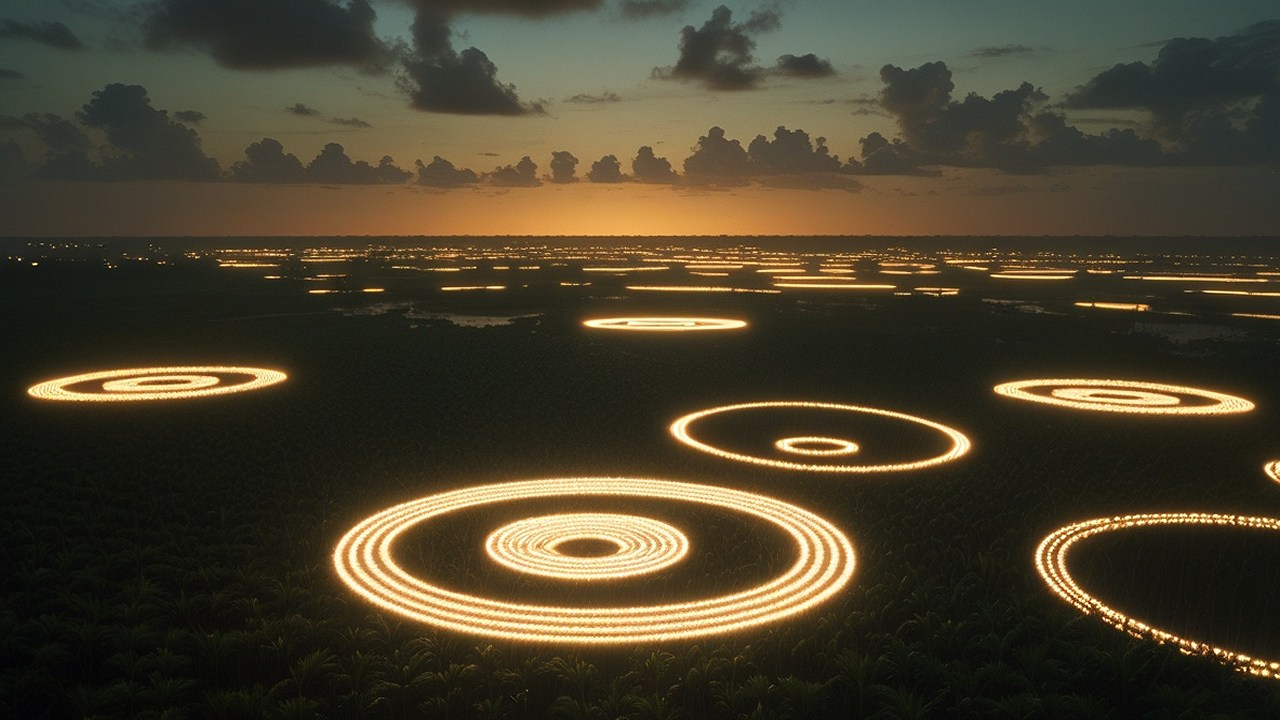
In 1992, in the agriculture-rich region surrounding Lake Okeechobee in Florida’s interior, a series of unusual ground impressions appeared overnight in expansive sugar-cane fields. These impressions—perfectly circular in form, overlapping in patterned geometry, and located in remote farmland—emerged amidst accompanying witness reports of bright, silent objects moving over the fields at night. Initially dismissed by field crews as possible prankster activity or natural crop damage, a closer inspection revealed features that challenged conventional explanation: the circles were uniform in depth, the cane was bent rather than broken, and no obvious footprints or wheel tracks were found.
The incident, now known as the Lake Okeechobee Sugar-Field Circles case, stands as one of Florida’s more intriguing trace-phenomena reports. While documentation remains limited compared to coastal aerial sightings, the sequence of circular impressions combined with aerial witness claims broadened the scope of regional encounters from sky-only phenomena to physical imprints on the land.
This is the story of the 1992 Lake Okeechobee circles. Welcome to the channel. Today we examine this rare American land-trace case in full detail, staying strictly faithful to the historical record.
The area surrounding Lake Okeechobee is characterized by large sugar-cane plantations and vast flat terrain—factors that ordinarily facilitate standard agricultural operations and randomized field damage from machinery or weather. In late June 1992, workers at one plantation found a perfectly circular impression in the cane—approximately thirty feet in diameter, the cane laid uniformly to the ground in a smooth, spiral pattern rather than snapped or torn. At first, management suggested vandalism or pranksters driving a low-profile vehicle across the field. However, when additional circles appeared within days, each with similar characteristics and spaced in even formation, suspicions grew that something else was at work.
Over one week, three such circles were documented across the plantation. Their diameters ranged from twenty to thirty-five feet, and each appeared with no visible tire or track imprint, no displaced soil, and with the cane bent rather than broken. Farmers described the flattened cane as lying in tight concentric windings—an effect they had never witnessed from machinery or weather events. The circles overlapped in certain cases. Plant researchers were called to inspect and noted that the circle pattern did not align with row directions, irrigation lines, or harvesting paths.
Concurrently with the ground impressions, several field workers and nearby residents reported seeing bright objects in the skies over the fields late at night. One cane-truck driver described pulling off the access road around 2:00 a.m. to inspect a strange hum in the air. He recounted a silent light descending from the sky, hovering approximately one hundred feet above the field before disappearing upward in a flash. Others reported glows over the cane fields—slowly moving lights that changed color from white to pale green, paused, then vanished abruptly. Though no visual object was captured on formal camera, multiple independent witness statements matched this pattern: hover, disappearance, then next-morning ground impressions.
While night-time crop-circle-style phenomena had often been associated with the English countryside, the Florida field impressions and aerial accounts suggested a domestic manifestation of a similar trace phenomenon within the United States.
For the sugar-cane industry around Lake Okeechobee, the circles were initially a matter of equipment and crop damage: each circle prevented harvesting of that area, and the cost of lost cane raised concern. Managers anticipated that pranksters or nighttime trespassers would require increased security. Yet as inspection revealed no wheel marks or human footprints, the situation went beyond simple vandalism. Some workers admitted to unease when recounting their nighttime sightings—unwilling to use the word “UFO” but certain they had seen something that didn’t fit helicopters or drones.
Local media outlets covered the story in agricultural news segments, noting that the field damage resembled “crop-circle phenomena” previously seen overseas. Some farmers joked that Florida’s sugar-cane fields might be next in line for the same attention as British wheat fields. Others took the phenomenon more seriously, especially after the overlapping, geometrically precise circles emerged.
No large-scale official investigation followed; the circles were treated primarily as property damage by the plantation management. However, a regional crop-research extension agent visited the site and documented photographs of the impressions. In his report, he noted the absence of mechanical damage, wheel tracks, or broken stalks; instead, the cane was bent at the base and laid uniformly flat in spiral form. The report became part of a regional agricultural archive though was never officially published in a UFO-related venue.
UFO researchers, encouraged by local reports, visited the site. They collected soil samples, low-resolution photographs, sketches of the circle layouts, and witness testimonies. Reports claim that some magnetic anomalies were measured—slight changes in compass behavior within the circle boundaries—though these measurements were not replicated by any formal scientific study and were never peer-reviewed.
The Lake Okeechobee incident fits a broader pattern of trace-evidence UFO cases—events in which physical marks, burn rings, or circulatory ground impressions accompany sightings of unknown aerial objects. Such cases often emphasize overlap between aerial visibility and land traces, bridging eyewitness accounts and material phenomena. In Florida, while many UFO reports focus on lights, discs, or structured craft over the water or airspace, the sugar-cane circles added a terrestrial component, extending the geographical scope of encounters from sky to field.
In the early 1990s, researchers documented an increase in reports of triangular or multi-light aircraft hovering silently, followed by ground impressions in remote fields or wooded areas. The Lake Okeechobee circles are therefore referenced as a domestic counterpart to crop-circle phenomena more traditionally associated with other countries. The presence of witness aerial observations and subsequent ground marks strengthens the argument that something besides misinterpretation or prank was potentially involved.
Media coverage of the circles was modest compared to the high-profile Gulf Breeze sightings, but local newspapers and agricultural publications carried the story. A Tampa Tribune piece in July 1992 referenced the phenomenon under the headline: “Florida Cane Field Circles: Vandalism or Something Else?” Local television news interviewed farmers and workers, some of whom admitted to disbelief, but also to confusion about what was happening. The combination of financial loss (cane crop damage) and mystery (unexplained lights) made the matter both economic and existential for the local community.
Public interest polarized somewhat. Some members of the farming community treated the event as a curiosity, others as a nuisance. A few welcomed the attention, speculating that it could bring tourist curiosity or media interest. Many, however, expressed frustration at the lack of explanation from authorities and the potential for future crop damage. Local law-enforcement agencies recorded the incidents as trespass or equipment vandalism but closed cases once no evidence of human intrusion was found.
From a sociological perspective, the Lake Okeechobee circles illustrate how UFO phenomena can move beyond the aerial event and become rooted in land-based context—blending everyday work (harvesting cane) with extraordinary experience (overnight circles, nighttime lights). For the workers—the cane cutters, truck drivers, field managers—this created an intersection of normal occupational routine and unsettling unknowns. Many recall a change in the nighttime atmosphere after the incidents: they watched the skies differently, looked for lights, felt uneasy in fields after dusk.
The sense of community awareness grew. Workers talked among themselves about “that night when the lights came down,” and security crews patrolling at night reported heightened alertness. Some trucks had their drivers roll windows and watch the tree line. The psychological shift is subtle but real: a once-mundane swamp/cane region became a field of potential mystery, of caution and speculation.
More than thirty years later, the Lake Okeechobee sugar-field circles remain one of Florida’s less-publicized yet critical cases of trace phenomenon. While lacking the widespread media coverage of some aerial waves, its importance lies in the physical imprint component. It reminds investigators that unidentified aerial phenomena may leave marks on the ground, not just in the sky. For this reason, it is often cited in compilations of trace cases and land-impact studies.
In addition, the case influenced later researchers to pay closer attention to agricultural sites, swamps, and remote fields—not just beaches and airspace. It expanded the geographic suspicion zones for unidentified anomalies beyond mere coastal hover events. In Florida, it encouraged field teams to carry compasses, soil meters, and photographic equipment when investigating ground impressions. The result is that even today, the Lake Okeechobee circles serve as a template: witness lights, then findings next morning; field-crew involvement; remote terrain; no official explanation.
From a public perspective, the circles contributed to a perception that Florida’s mystery is not solely in the skies over Cape Canaveral or the Gulf, but in the interior lands as well—swamps, fields, quiet stretches where light shows and crop damage intersect. This helps explain why Florida remains a locus of sighting interest: wide open terrain, limited overnight observers, and complex aerospace/military geography.
The Lake Okeechobee case is sometimes overshadowed by more dramatic craft sightings, but among dedicated researchers it holds a niche as a “pure trace” event—almost akin to crop circles, yet completely domestic and American. Specific names of farmers or truck drivers involved have rarely been publicized—largely due to the agricultural community’s desire to avoid stigma or media intrusion. However, local extension agents who documented the circles played a crucial role in preserving the evidence. One unnamed sugar-cane manager associated with one of the plantations later told an investigator: “We never saw anything land, but the next morning it was like someone walked a giant cookie-cutter through the field.”
As with many UFO and trace-phenomenon cases, the Lake Okeechobee circles face limitations and unanswered questions. Because the field impressions occurred in private farmland and investigations were largely informal, there is no peer-reviewed scientific study documenting the soil chemistry or long-term plant growth effects. Some skeptics argue the circles could have resulted from mechanical flattening using low-profile farm equipment or drainage vehicle tire tracks, although the lack of tread marks weakens this explanation. Others note that the nighttime light reports might have been misidentified aircraft, flares, or atmospheric reflections—not necessarily connected to the ground impressions.
Nonetheless, the strength of the case lies in the convergence of multiple factors: remote agricultural terrain, physical impressions found promptly after eyewitness reports, and multiple circles with geometric precision. The ability to tie the phenomenon to a defined timeframe (late June 1992) and to gather documented witness statements gives the event greater weight than many anecdotal cases.
The 1992 Lake Okeechobee Sugar-Field Circles represent a distinctive chapter in Florida’s aerial-phenomenon record—one grounded in land as much as sky. For the sugar-cane workers, security crews, and field managers who discovered the impressions, the event transformed routine agricultural nights into episodes of unexplained encounter. For UFO researchers, the case expanded the geography of interest from beaches and airfields to interior fields, swamps, and farmlands. The absence of an official explanation, combined with consistent witness reports of silent lights overhead, ensures the incident remains an open case in the archive of Florida’s aerial mysteries.
Whether one interprets the event as prank, misidentification, mechanical damage, or a genuine trace of unknown craft, its existence cannot be fully dismissed. The circles appeared, uniform and precise, in one of Florida’s largest agricultural sectors. They were accompanied by nighttime lights, reported by credible witnesses, in a terrain seldom visited by the public at midnight. Decades later, the Lake Okeechobee circles continue to challenge assumptions about where, when, and how unidentified aerial phenomena might manifest—and invite continued observation, documentation, and open inquiry into the hidden hours and remote fields of the Sunshine State.
In the dark sugar-cane fields around Lake Okeechobee in late June 1992, something silent moved overhead. By morning, the cane lay flattened in perfect circles—bent, not broken, with no tracks leading in or out. The lights and the land marks remain linked by witness testimony and physical evidence that still has no conventional explanation.
In 1992, in the agriculture-rich region surrounding Lake Okeechobee in Florida’s interior, a series of unusual ground impressions appeared overnight in expansive sugar-cane fields. These impressions—perfectly circular in form, overlapping in patterned geometry, and located in remote farmland—emerged amidst accompanying witness reports of bright, silent objects moving over the fields at night. Initially dismissed by field crews as possible prankster activity or natural crop damage, a closer inspection revealed features that challenged conventional explanation: the circles were uniform in depth, the cane was bent rather than broken, and no obvious footprints or wheel tracks were found.
The incident, now known as the Lake Okeechobee Sugar-Field Circles case, stands as one of Florida’s more intriguing trace-phenomena reports. While documentation remains limited compared to coastal aerial sightings, the sequence of circular impressions combined with aerial witness claims broadened the scope of regional encounters from sky-only phenomena to physical imprints on the land.
This is the story of the 1992 Lake Okeechobee circles. Welcome to the channel. Today we examine this rare American land-trace case in full detail, staying strictly faithful to the historical record.
The area surrounding Lake Okeechobee is characterized by large sugar-cane plantations and vast flat terrain—factors that ordinarily facilitate standard agricultural operations and randomized field damage from machinery or weather. In late June 1992, workers at one plantation found a perfectly circular impression in the cane—approximately thirty feet in diameter, the cane laid uniformly to the ground in a smooth, spiral pattern rather than snapped or torn. At first, management suggested vandalism or pranksters driving a low-profile vehicle across the field. However, when additional circles appeared within days, each with similar characteristics and spaced in even formation, suspicions grew that something else was at work.
Over one week, three such circles were documented across the plantation. Their diameters ranged from twenty to thirty-five feet, and each appeared with no visible tire or track imprint, no displaced soil, and with the cane bent rather than broken. Farmers described the flattened cane as lying in tight concentric windings—an effect they had never witnessed from machinery or weather events. The circles overlapped in certain cases. Plant researchers were called to inspect and noted that the circle pattern did not align with row directions, irrigation lines, or harvesting paths.
Concurrently with the ground impressions, several field workers and nearby residents reported seeing bright objects in the skies over the fields late at night. One cane-truck driver described pulling off the access road around 2:00 a.m. to inspect a strange hum in the air. He recounted a silent light descending from the sky, hovering approximately one hundred feet above the field before disappearing upward in a flash. Others reported glows over the cane fields—slowly moving lights that changed color from white to pale green, paused, then vanished abruptly. Though no visual object was captured on formal camera, multiple independent witness statements matched this pattern: hover, disappearance, then next-morning ground impressions.
While night-time crop-circle-style phenomena had often been associated with the English countryside, the Florida field impressions and aerial accounts suggested a domestic manifestation of a similar trace phenomenon within the United States.
For the sugar-cane industry around Lake Okeechobee, the circles were initially a matter of equipment and crop damage: each circle prevented harvesting of that area, and the cost of lost cane raised concern. Managers anticipated that pranksters or nighttime trespassers would require increased security. Yet as inspection revealed no wheel marks or human footprints, the situation went beyond simple vandalism. Some workers admitted to unease when recounting their nighttime sightings—unwilling to use the word “UFO” but certain they had seen something that didn’t fit helicopters or drones.
Local media outlets covered the story in agricultural news segments, noting that the field damage resembled “crop-circle phenomena” previously seen overseas. Some farmers joked that Florida’s sugar-cane fields might be next in line for the same attention as British wheat fields. Others took the phenomenon more seriously, especially after the overlapping, geometrically precise circles emerged.
No large-scale official investigation followed; the circles were treated primarily as property damage by the plantation management. However, a regional crop-research extension agent visited the site and documented photographs of the impressions. In his report, he noted the absence of mechanical damage, wheel tracks, or broken stalks; instead, the cane was bent at the base and laid uniformly flat in spiral form. The report became part of a regional agricultural archive though was never officially published in a UFO-related venue.
UFO researchers, encouraged by local reports, visited the site. They collected soil samples, low-resolution photographs, sketches of the circle layouts, and witness testimonies. Reports claim that some magnetic anomalies were measured—slight changes in compass behavior within the circle boundaries—though these measurements were not replicated by any formal scientific study and were never peer-reviewed.
The Lake Okeechobee incident fits a broader pattern of trace-evidence UFO cases—events in which physical marks, burn rings, or circulatory ground impressions accompany sightings of unknown aerial objects. Such cases often emphasize overlap between aerial visibility and land traces, bridging eyewitness accounts and material phenomena. In Florida, while many UFO reports focus on lights, discs, or structured craft over the water or airspace, the sugar-cane circles added a terrestrial component, extending the geographical scope of encounters from sky to field.
In the early 1990s, researchers documented an increase in reports of triangular or multi-light aircraft hovering silently, followed by ground impressions in remote fields or wooded areas. The Lake Okeechobee circles are therefore referenced as a domestic counterpart to crop-circle phenomena more traditionally associated with other countries. The presence of witness aerial observations and subsequent ground marks strengthens the argument that something besides misinterpretation or prank was potentially involved.
Media coverage of the circles was modest compared to the high-profile Gulf Breeze sightings, but local newspapers and agricultural publications carried the story. A Tampa Tribune piece in July 1992 referenced the phenomenon under the headline: “Florida Cane Field Circles: Vandalism or Something Else?” Local television news interviewed farmers and workers, some of whom admitted to disbelief, but also to confusion about what was happening. The combination of financial loss (cane crop damage) and mystery (unexplained lights) made the matter both economic and existential for the local community.
Public interest polarized somewhat. Some members of the farming community treated the event as a curiosity, others as a nuisance. A few welcomed the attention, speculating that it could bring tourist curiosity or media interest. Many, however, expressed frustration at the lack of explanation from authorities and the potential for future crop damage. Local law-enforcement agencies recorded the incidents as trespass or equipment vandalism but closed cases once no evidence of human intrusion was found.
From a sociological perspective, the Lake Okeechobee circles illustrate how UFO phenomena can move beyond the aerial event and become rooted in land-based context—blending everyday work (harvesting cane) with extraordinary experience (overnight circles, nighttime lights). For the workers—the cane cutters, truck drivers, field managers—this created an intersection of normal occupational routine and unsettling unknowns. Many recall a change in the nighttime atmosphere after the incidents: they watched the skies differently, looked for lights, felt uneasy in fields after dusk.
The sense of community awareness grew. Workers talked among themselves about “that night when the lights came down,” and security crews patrolling at night reported heightened alertness. Some trucks had their drivers roll windows and watch the tree line. The psychological shift is subtle but real: a once-mundane swamp/cane region became a field of potential mystery, of caution and speculation.
More than thirty years later, the Lake Okeechobee sugar-field circles remain one of Florida’s less-publicized yet critical cases of trace phenomenon. While lacking the widespread media coverage of some aerial waves, its importance lies in the physical imprint component. It reminds investigators that unidentified aerial phenomena may leave marks on the ground, not just in the sky. For this reason, it is often cited in compilations of trace cases and land-impact studies.
In addition, the case influenced later researchers to pay closer attention to agricultural sites, swamps, and remote fields—not just beaches and airspace. It expanded the geographic suspicion zones for unidentified anomalies beyond mere coastal hover events. In Florida, it encouraged field teams to carry compasses, soil meters, and photographic equipment when investigating ground impressions. The result is that even today, the Lake Okeechobee circles serve as a template: witness lights, then findings next morning; field-crew involvement; remote terrain; no official explanation.
From a public perspective, the circles contributed to a perception that Florida’s mystery is not solely in the skies over Cape Canaveral or the Gulf, but in the interior lands as well—swamps, fields, quiet stretches where light shows and crop damage intersect. This helps explain why Florida remains a locus of sighting interest: wide open terrain, limited overnight observers, and complex aerospace/military geography.
The Lake Okeechobee case is sometimes overshadowed by more dramatic craft sightings, but among dedicated researchers it holds a niche as a “pure trace” event—almost akin to crop circles, yet completely domestic and American. Specific names of farmers or truck drivers involved have rarely been publicized—largely due to the agricultural community’s desire to avoid stigma or media intrusion. However, local extension agents who documented the circles played a crucial role in preserving the evidence. One unnamed sugar-cane manager associated with one of the plantations later told an investigator: “We never saw anything land, but the next morning it was like someone walked a giant cookie-cutter through the field.”
As with many UFO and trace-phenomenon cases, the Lake Okeechobee circles face limitations and unanswered questions. Because the field impressions occurred in private farmland and investigations were largely informal, there is no peer-reviewed scientific study documenting the soil chemistry or long-term plant growth effects. Some skeptics argue the circles could have resulted from mechanical flattening using low-profile farm equipment or drainage vehicle tire tracks, although the lack of tread marks weakens this explanation. Others note that the nighttime light reports might have been misidentified aircraft, flares, or atmospheric reflections—not necessarily connected to the ground impressions.
Nonetheless, the strength of the case lies in the convergence of multiple factors: remote agricultural terrain, physical impressions found promptly after eyewitness reports, and multiple circles with geometric precision. The ability to tie the phenomenon to a defined timeframe (late June 1992) and to gather documented witness statements gives the event greater weight than many anecdotal cases.
The 1992 Lake Okeechobee Sugar-Field Circles represent a distinctive chapter in Florida’s aerial-phenomenon record—one grounded in land as much as sky. For the sugar-cane workers, security crews, and field managers who discovered the impressions, the event transformed routine agricultural nights into episodes of unexplained encounter. For UFO researchers, the case expanded the geography of interest from beaches and airfields to interior fields, swamps, and farmlands. The absence of an official explanation, combined with consistent witness reports of silent lights overhead, ensures the incident remains an open case in the archive of Florida’s aerial mysteries.
Whether one interprets the event as prank, misidentification, mechanical damage, or a genuine trace of unknown craft, its existence cannot be fully dismissed. The circles appeared, uniform and precise, in one of Florida’s largest agricultural sectors. They were accompanied by nighttime lights, reported by credible witnesses, in a terrain seldom visited by the public at midnight. Decades later, the Lake Okeechobee circles continue to challenge assumptions about where, when, and how unidentified aerial phenomena might manifest—and invite continued observation, documentation, and open inquiry into the hidden hours and remote fields of the Sunshine State.
In the dark sugar-cane fields around Lake Okeechobee in late June 1992, something silent moved overhead. By morning, the cane lay flattened in perfect circles—bent, not broken, with no tracks leading in or out. The lights and the land marks remain linked by witness testimony and physical evidence that still has no conventional explanation.