


Blog Categories
- African Incidents
- Atlantis Incidents
- Australian Incidents
- Belgian Incidents
- Bermuda Triangle Incidents
- Brazilian Incidents
- Canadian Incidents
- Chinese Incidents
- European Incidents
- France Incidents
- Ghosts
- Giants
- Italy Incidents
- Japanese Incidents
- Middle East Incidents
- Portugal Incidents
- Project Serpo
- Puerto Rico Incidents
- Russian Incidents
- Sasquatch
- Scandinavia Incidents
- Spanish Incidents
- UFOs
- United Kingdom Incidents
- United States Incidents
1992: Tampa Bay Flashing Light Sequence
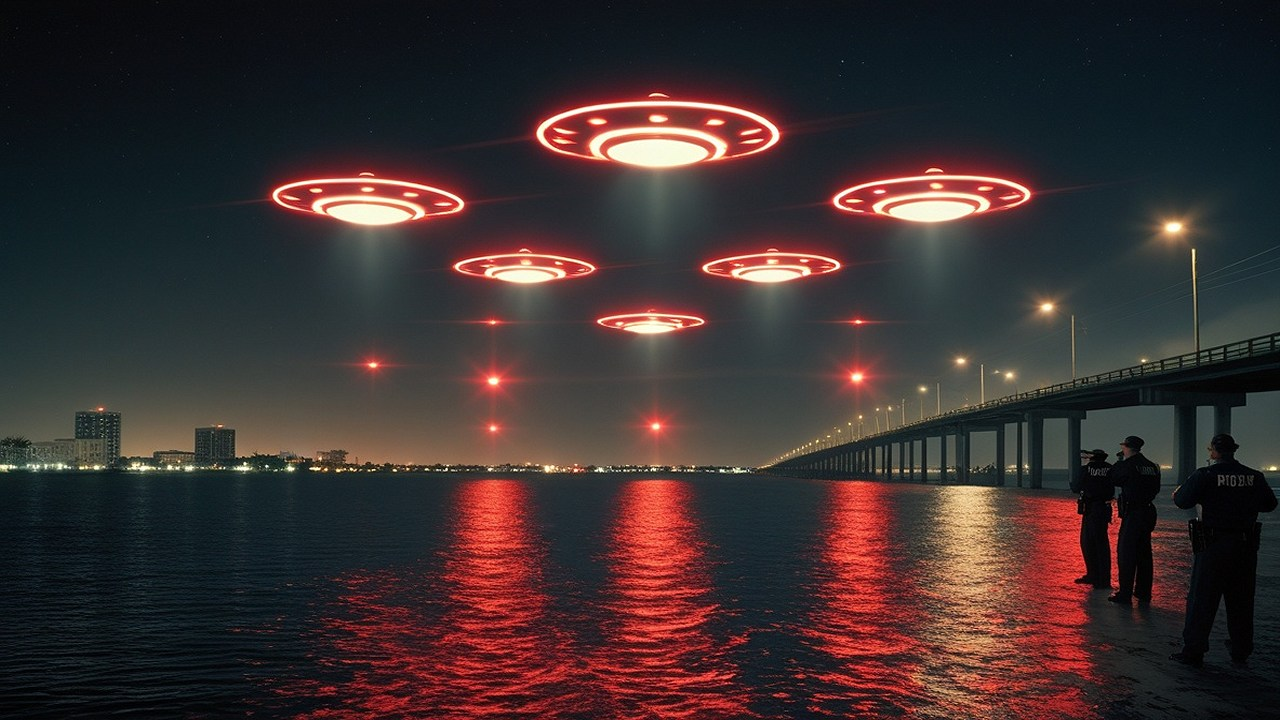
On the evening of March 23, 1992, the skies over Tampa Bay became the stage for one of Florida’s most widely observed UFO events of the early 1990s. Dozens of witnesses—ranging from everyday residents to police officers, pilots, and amateur astronomers—reported seeing a series of flashing red and white lights hovering silently over the bay for nearly half an hour. The lights, witnesses said, were not random. They appeared to move in deliberate, geometric patterns before suddenly vanishing without a trace. MacDill Air Force Base, situated along the bay and known for its strategic operations, issued a brief statement denying any aircraft activity that could explain the event. The following morning, The Tampa Tribune ran its front-page headline: “UFOs Return to the Bay.”
This is the story of the Tampa Bay “Flashing Light” Sequence — a landmark case from the post-Gulf Breeze era that reignited serious UFO discussion across Florida and beyond. Welcome to the channel. Today we examine this well-documented, multi-witness event from 1992 in full detail, staying faithful to the historical record.
The early 1990s were a transitional period in UFO studies. The intense Gulf Breeze sightings of the late 1980s had drawn national attention to Florida’s Gulf Coast, but by 1992 public focus had begun to shift. Against this backdrop, the Tampa Bay event stood out for its scale, duration, and the credibility of those who saw it. What made this case particularly compelling was not only the number of witnesses but also the precision of the light formations, the complete silence, and the immediate official denial from a major military installation.
At approximately 9:15 p.m., multiple calls began reaching local law enforcement and news stations around Tampa Bay. People were reporting “flashing lights” hovering over the water — red and white, stationary at first, then forming a triangular pattern. Officers from both Tampa and St. Petersburg police departments confirmed that they could see the lights from their patrol cars and marine units. One officer reportedly used binoculars to observe them, describing “brilliant points of light rotating in place.”
Across the bay in Clearwater, amateur astronomers setting up their telescopes for a lunar observation session spotted the same phenomenon. One observer noted that the lights appeared to move in synchronization, as if connected by an invisible structure. According to reports collected later by researchers, the lights hovered for approximately twenty to thirty minutes, shifting positions slightly and forming what several witnesses described as a geometric configuration. Then, without acceleration or trailing effect, the lights blinked out — all at once.
Pilots approaching Tampa International Airport also radioed in visual confirmations. One commercial pilot on approach from Atlanta described the lights as “high-intensity beacons in formation” that remained stationary relative to the horizon. Air traffic controllers at the time found no radar returns corresponding to the sighting, which eliminated the possibility of known aircraft, helicopters, or weather balloons. With the bay’s waters calm and no military exercises scheduled, the explanation vacuum grew rapidly.
MacDill Air Force Base, a major installation on the southern edge of Tampa Bay, was immediately suspected as the source. Given its role as a hub for aerial training and command operations, residents frequently looked to it for answers when mysterious lights appeared. But this time, the base’s public affairs office quickly issued a statement asserting that no aircraft were operating in that airspace at the time of the sightings. There were no scheduled training flights, no aerial refueling operations, and no low-altitude exercises planned or authorized for that evening.
The official denial, while brief, only intensified public interest. For decades, MacDill had been associated with both conventional and covert operations. Its statement denying involvement lent weight to the idea that the lights were either unknown craft or something outside traditional explanation. Many residents recalled similar incidents during the 1950s and 1970s when unexplained lights were seen over the bay, occasionally coinciding with nearby radar anomalies. The 1992 event, however, stood apart for its duration, precision, and the number of experienced observers.
Across Tampa, Clearwater, and St. Petersburg, witnesses provided consistent testimony. Most described between four and six red and white lights, arranged in triangular or diamond-like formations. Some said the lights pulsed rhythmically, while others observed that each light alternated flashes with a perfectly timed sequence, suggesting intelligent control. There were no sounds — no engine noise, rotor wash, or sonic booms. Several observers claimed that the lights seemed to reflect slightly off the bay’s surface, though others disagreed, saying they were too high for such reflection. One of the most striking details reported by multiple witnesses was the synchronization of the lights’ disappearance: rather than fading or flying away, they blinked out simultaneously, leaving a clear, star-filled sky.
Amateur astronomers cross-checked with stellar maps and confirmed that no known celestial objects matched the configuration or motion of the lights that night.
The next morning, The Tampa Tribune ran its now-famous headline: “UFOs Return to the Bay.” The story detailed witness accounts and included comments from both police and MacDill AFB spokesmen. Local television news segments followed, interviewing residents and playing shaky home video footage that captured portions of the flashing sequence. Although the video quality was poor by modern standards, it corroborated the timing and patterning described by witnesses.
Public reaction was divided between excitement and skepticism. Some residents saw the event as proof that the Gulf Coast continued to be a focus of aerial mystery, connecting it to the Gulf Breeze wave of the late 1980s. Others dismissed it as misidentified aircraft or even pranks using flares, though no physical evidence of such was ever produced. For a community already accustomed to the nearby presence of military aircraft, what distinguished this incident was the total silence, the precision of the light movements, and the simultaneous denial by both civil and military authorities of any operations that night.
Local UFO investigators and regional members of MUFON quickly descended upon the Tampa Bay area to document the event. They interviewed over forty witnesses, including law enforcement officers, astronomers, and pilots. The consistency of the testimonies led them to classify the case as a “multiple-witness structured-light event.” No radar data from nearby control towers or military installations was made public, though MUFON investigators stated that informal sources within aviation confirmed radar silence during the entire period of observation.
Independent researchers conducted light pattern analysis using the few surviving video clips. The results showed organized motion with measurable angular displacement — too regular for random lights such as aircraft navigation beacons or flares drifting in the wind. Atmospheric explanations, including temperature inversions or mirages, were considered and ruled out based on the lights’ behavior and duration. MacDill’s denial also fueled speculation that the incident involved classified technology, potentially related to stealth aircraft experiments. However, experts familiar with known stealth programs pointed out that the lights’ open visibility and hovering motion were inconsistent with the stealth aircraft testing of the early 1990s, which emphasized minimal radar and visual profiles, not bright flashing patterns over populated areas.
For the people of Tampa Bay, the event left a lasting impression. Residents who witnessed the lights firsthand described it as both awe-inspiring and disorienting. Some said it reignited their sense of curiosity about what might share the skies with humanity. Others found it deeply unsettling, particularly those living near MacDill AFB, who wondered what else might occur unseen above their neighborhoods.
Law enforcement officers who filed informal notes about the event found themselves reluctant to discuss it publicly afterward. The stigma associated with UFO sightings — particularly among professionals — remained strong. Still, several off-duty officers and firefighters privately admitted to watching the lights from shorelines and bridges, convinced that what they saw could not be explained conventionally.
The case also sparked a minor wave of renewed UFO enthusiasm across western Florida. Skywatch groups formed, amateur videographers began scanning the skies nightly, and local radio talk shows devoted extended segments to eyewitnesses. The Tampa Bay “Flashing Light” Sequence reawakened the region’s identity as one of the world’s enduring UFO hotspots, reinforcing a lineage of unexplained aerial activity stretching from the 1940s through the 1980s Gulf Breeze events.
The early 1990s were a transitional period in UFO studies. The Cold War had recently ended, and with it came new discussions about declassified military technology and the potential for secret experimental aircraft. At the same time, a new wave of triangular and luminous UFO sightings was being documented across the United States, Belgium, and the United Kingdom. Florida’s 1992 Tampa Bay case fit this larger pattern, suggesting that whatever people were observing might not be isolated incidents but part of a broader series of encounters with similar features: silence, lighted formations, and controlled geometric movement.
Researchers have since noted parallels between the Tampa Bay lights and other multi-light UFO events, including the 1997 Phoenix Lights in Arizona. Both involved large numbers of witnesses, stationary or slow-moving light formations, and immediate denials of military involvement. Though separated by five years, these events shared the same fundamental characteristics and left comparable cultural footprints in their respective regions.
More than three decades later, the 1992 Tampa Bay “Flashing Light” Sequence still holds a unique place in Florida’s long history of aerial phenomena. For many, it marked the transition between the older era of metallic disc sightings and the newer era of luminous formations and triangular configurations. The case also stands as an early example of community-wide documentation — coming at a time when camcorders were becoming more common, but before the ubiquity of digital recording.
The event helped shape public attitudes toward unidentified aerial phenomena in Florida. It served as a reminder that sightings could occur over heavily populated urban areas and involve credible observers, not just isolated individuals. The cultural echo of the Tampa Bay lights also influenced how later UFO events were reported and perceived. Local newspapers continued to reference the 1992 case when covering subsequent aerial anomalies, and it remained a benchmark for comparison whenever unexplained lights were seen over the bay.
For contemporary UFO researchers, the Tampa Bay incident remains a reference point in analyzing structured-light phenomena. Its witness pool, official denial, and pattern complexity make it an enduring case study for both skeptical and pro-UFO scholars. The combination of public openness, professional observation, and lack of official explanation has kept the case alive in conferences, documentaries, and books examining Florida’s contribution to the global UFO record.
The 1992 Tampa Bay “Flashing Light” Sequence represents more than just another sighting — it encapsulates the ongoing mystery of unexplained aerial phenomena and the enduring fascination the subject holds in Florida and beyond. Witnessed by dozens of credible observers, including pilots, police officers, and astronomers, the event challenged traditional explanations and reaffirmed that not all things in the sky can be neatly categorized.
For residents of Tampa Bay, it remains a shared memory of wonder and bewilderment. For researchers, it continues to stand as a reminder of the complex interface between observation, science, and belief. And for Florida’s long lineage of UFO history, it marks a defining point of renewal — proof that even after the frenzy of Gulf Breeze and decades of debate, the skies over the Sunshine State still hold secrets that refuse to fade.
Whether seen as a manifestation of advanced technology, atmospheric anomaly, or something entirely beyond human comprehension, the flashing lights of March 23, 1992, remain a vivid chapter in Florida’s chronicle of unexplained encounters — a moment when ordinary people once again looked upward and realized that the mystery of the skies was far from over.
On the evening of March 23, 1992, the skies over Tampa Bay became the stage for one of Florida’s most widely observed UFO events of the early 1990s. Dozens of witnesses—ranging from everyday residents to police officers, pilots, and amateur astronomers—reported seeing a series of flashing red and white lights hovering silently over the bay for nearly half an hour. The lights, witnesses said, were not random. They appeared to move in deliberate, geometric patterns before suddenly vanishing without a trace. MacDill Air Force Base, situated along the bay and known for its strategic operations, issued a brief statement denying any aircraft activity that could explain the event. The following morning, The Tampa Tribune ran its front-page headline: “UFOs Return to the Bay.”
This is the story of the Tampa Bay “Flashing Light” Sequence — a landmark case from the post-Gulf Breeze era that reignited serious UFO discussion across Florida and beyond. Welcome to the channel. Today we examine this well-documented, multi-witness event from 1992 in full detail, staying faithful to the historical record.
The early 1990s were a transitional period in UFO studies. The intense Gulf Breeze sightings of the late 1980s had drawn national attention to Florida’s Gulf Coast, but by 1992 public focus had begun to shift. Against this backdrop, the Tampa Bay event stood out for its scale, duration, and the credibility of those who saw it. What made this case particularly compelling was not only the number of witnesses but also the precision of the light formations, the complete silence, and the immediate official denial from a major military installation.
At approximately 9:15 p.m., multiple calls began reaching local law enforcement and news stations around Tampa Bay. People were reporting “flashing lights” hovering over the water — red and white, stationary at first, then forming a triangular pattern. Officers from both Tampa and St. Petersburg police departments confirmed that they could see the lights from their patrol cars and marine units. One officer reportedly used binoculars to observe them, describing “brilliant points of light rotating in place.”
Across the bay in Clearwater, amateur astronomers setting up their telescopes for a lunar observation session spotted the same phenomenon. One observer noted that the lights appeared to move in synchronization, as if connected by an invisible structure. According to reports collected later by researchers, the lights hovered for approximately twenty to thirty minutes, shifting positions slightly and forming what several witnesses described as a geometric configuration. Then, without acceleration or trailing effect, the lights blinked out — all at once.
Pilots approaching Tampa International Airport also radioed in visual confirmations. One commercial pilot on approach from Atlanta described the lights as “high-intensity beacons in formation” that remained stationary relative to the horizon. Air traffic controllers at the time found no radar returns corresponding to the sighting, which eliminated the possibility of known aircraft, helicopters, or weather balloons. With the bay’s waters calm and no military exercises scheduled, the explanation vacuum grew rapidly.
MacDill Air Force Base, a major installation on the southern edge of Tampa Bay, was immediately suspected as the source. Given its role as a hub for aerial training and command operations, residents frequently looked to it for answers when mysterious lights appeared. But this time, the base’s public affairs office quickly issued a statement asserting that no aircraft were operating in that airspace at the time of the sightings. There were no scheduled training flights, no aerial refueling operations, and no low-altitude exercises planned or authorized for that evening.
The official denial, while brief, only intensified public interest. For decades, MacDill had been associated with both conventional and covert operations. Its statement denying involvement lent weight to the idea that the lights were either unknown craft or something outside traditional explanation. Many residents recalled similar incidents during the 1950s and 1970s when unexplained lights were seen over the bay, occasionally coinciding with nearby radar anomalies. The 1992 event, however, stood apart for its duration, precision, and the number of experienced observers.
Across Tampa, Clearwater, and St. Petersburg, witnesses provided consistent testimony. Most described between four and six red and white lights, arranged in triangular or diamond-like formations. Some said the lights pulsed rhythmically, while others observed that each light alternated flashes with a perfectly timed sequence, suggesting intelligent control. There were no sounds — no engine noise, rotor wash, or sonic booms. Several observers claimed that the lights seemed to reflect slightly off the bay’s surface, though others disagreed, saying they were too high for such reflection. One of the most striking details reported by multiple witnesses was the synchronization of the lights’ disappearance: rather than fading or flying away, they blinked out simultaneously, leaving a clear, star-filled sky.
Amateur astronomers cross-checked with stellar maps and confirmed that no known celestial objects matched the configuration or motion of the lights that night.
The next morning, The Tampa Tribune ran its now-famous headline: “UFOs Return to the Bay.” The story detailed witness accounts and included comments from both police and MacDill AFB spokesmen. Local television news segments followed, interviewing residents and playing shaky home video footage that captured portions of the flashing sequence. Although the video quality was poor by modern standards, it corroborated the timing and patterning described by witnesses.
Public reaction was divided between excitement and skepticism. Some residents saw the event as proof that the Gulf Coast continued to be a focus of aerial mystery, connecting it to the Gulf Breeze wave of the late 1980s. Others dismissed it as misidentified aircraft or even pranks using flares, though no physical evidence of such was ever produced. For a community already accustomed to the nearby presence of military aircraft, what distinguished this incident was the total silence, the precision of the light movements, and the simultaneous denial by both civil and military authorities of any operations that night.
Local UFO investigators and regional members of MUFON quickly descended upon the Tampa Bay area to document the event. They interviewed over forty witnesses, including law enforcement officers, astronomers, and pilots. The consistency of the testimonies led them to classify the case as a “multiple-witness structured-light event.” No radar data from nearby control towers or military installations was made public, though MUFON investigators stated that informal sources within aviation confirmed radar silence during the entire period of observation.
Independent researchers conducted light pattern analysis using the few surviving video clips. The results showed organized motion with measurable angular displacement — too regular for random lights such as aircraft navigation beacons or flares drifting in the wind. Atmospheric explanations, including temperature inversions or mirages, were considered and ruled out based on the lights’ behavior and duration. MacDill’s denial also fueled speculation that the incident involved classified technology, potentially related to stealth aircraft experiments. However, experts familiar with known stealth programs pointed out that the lights’ open visibility and hovering motion were inconsistent with the stealth aircraft testing of the early 1990s, which emphasized minimal radar and visual profiles, not bright flashing patterns over populated areas.
For the people of Tampa Bay, the event left a lasting impression. Residents who witnessed the lights firsthand described it as both awe-inspiring and disorienting. Some said it reignited their sense of curiosity about what might share the skies with humanity. Others found it deeply unsettling, particularly those living near MacDill AFB, who wondered what else might occur unseen above their neighborhoods.
Law enforcement officers who filed informal notes about the event found themselves reluctant to discuss it publicly afterward. The stigma associated with UFO sightings — particularly among professionals — remained strong. Still, several off-duty officers and firefighters privately admitted to watching the lights from shorelines and bridges, convinced that what they saw could not be explained conventionally.
The case also sparked a minor wave of renewed UFO enthusiasm across western Florida. Skywatch groups formed, amateur videographers began scanning the skies nightly, and local radio talk shows devoted extended segments to eyewitnesses. The Tampa Bay “Flashing Light” Sequence reawakened the region’s identity as one of the world’s enduring UFO hotspots, reinforcing a lineage of unexplained aerial activity stretching from the 1940s through the 1980s Gulf Breeze events.
The early 1990s were a transitional period in UFO studies. The Cold War had recently ended, and with it came new discussions about declassified military technology and the potential for secret experimental aircraft. At the same time, a new wave of triangular and luminous UFO sightings was being documented across the United States, Belgium, and the United Kingdom. Florida’s 1992 Tampa Bay case fit this larger pattern, suggesting that whatever people were observing might not be isolated incidents but part of a broader series of encounters with similar features: silence, lighted formations, and controlled geometric movement.
Researchers have since noted parallels between the Tampa Bay lights and other multi-light UFO events, including the 1997 Phoenix Lights in Arizona. Both involved large numbers of witnesses, stationary or slow-moving light formations, and immediate denials of military involvement. Though separated by five years, these events shared the same fundamental characteristics and left comparable cultural footprints in their respective regions.
More than three decades later, the 1992 Tampa Bay “Flashing Light” Sequence still holds a unique place in Florida’s long history of aerial phenomena. For many, it marked the transition between the older era of metallic disc sightings and the newer era of luminous formations and triangular configurations. The case also stands as an early example of community-wide documentation — coming at a time when camcorders were becoming more common, but before the ubiquity of digital recording.
The event helped shape public attitudes toward unidentified aerial phenomena in Florida. It served as a reminder that sightings could occur over heavily populated urban areas and involve credible observers, not just isolated individuals. The cultural echo of the Tampa Bay lights also influenced how later UFO events were reported and perceived. Local newspapers continued to reference the 1992 case when covering subsequent aerial anomalies, and it remained a benchmark for comparison whenever unexplained lights were seen over the bay.
For contemporary UFO researchers, the Tampa Bay incident remains a reference point in analyzing structured-light phenomena. Its witness pool, official denial, and pattern complexity make it an enduring case study for both skeptical and pro-UFO scholars. The combination of public openness, professional observation, and lack of official explanation has kept the case alive in conferences, documentaries, and books examining Florida’s contribution to the global UFO record.
The 1992 Tampa Bay “Flashing Light” Sequence represents more than just another sighting — it encapsulates the ongoing mystery of unexplained aerial phenomena and the enduring fascination the subject holds in Florida and beyond. Witnessed by dozens of credible observers, including pilots, police officers, and astronomers, the event challenged traditional explanations and reaffirmed that not all things in the sky can be neatly categorized.
For residents of Tampa Bay, it remains a shared memory of wonder and bewilderment. For researchers, it continues to stand as a reminder of the complex interface between observation, science, and belief. And for Florida’s long lineage of UFO history, it marks a defining point of renewal — proof that even after the frenzy of Gulf Breeze and decades of debate, the skies over the Sunshine State still hold secrets that refuse to fade.
Whether seen as a manifestation of advanced technology, atmospheric anomaly, or something entirely beyond human comprehension, the flashing lights of March 23, 1992, remain a vivid chapter in Florida’s chronicle of unexplained encounters — a moment when ordinary people once again looked upward and realized that the mystery of the skies was far from over.