


Blog Categories
- African Incidents
- Atlantis Incidents
- Australian Incidents
- Belgian Incidents
- Bermuda Triangle Incidents
- Brazilian Incidents
- Canadian Incidents
- Chinese Incidents
- European Incidents
- France Incidents
- Ghosts
- Giants
- Italy Incidents
- Japanese Incidents
- Middle East Incidents
- Portugal Incidents
- Project Serpo
- Puerto Rico Incidents
- Russian Incidents
- Sasquatch
- Scandinavia Incidents
- Spanish Incidents
- UFOs
- United Kingdom Incidents
- United States Incidents
1994: Miami Flying Cylinder Case
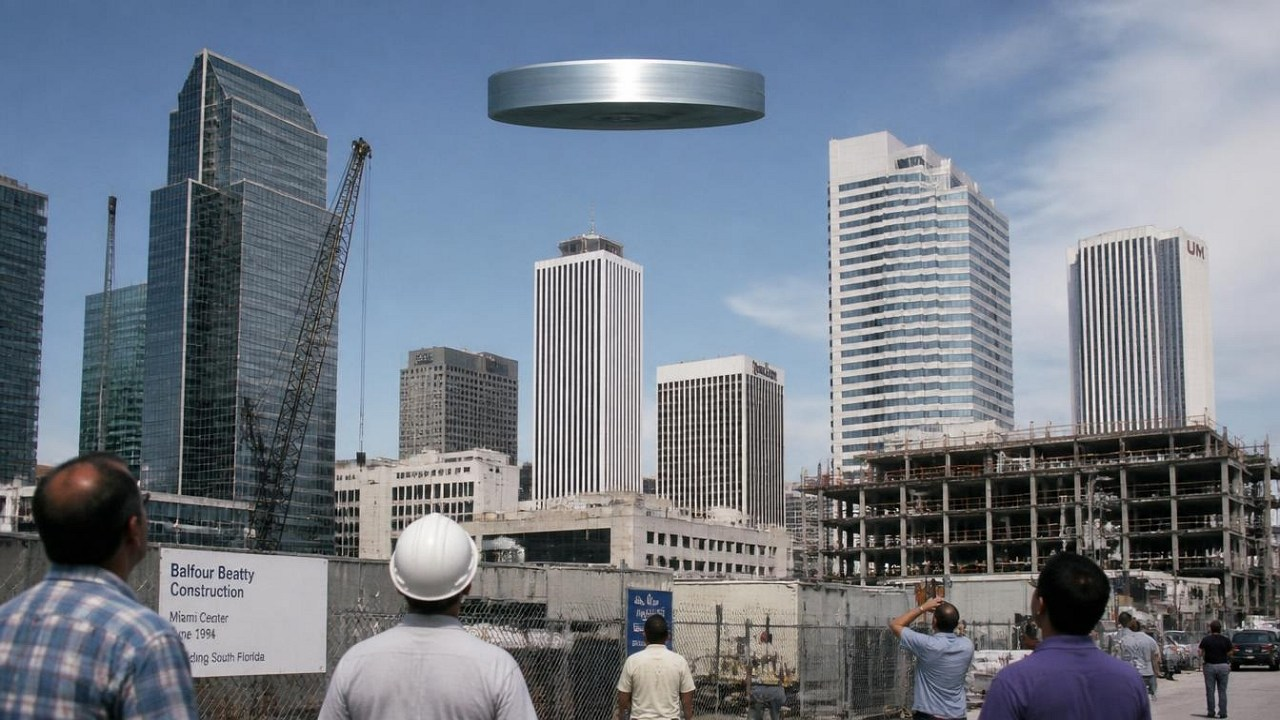
The summer of 1994 brought Miami a momentary pause in its constant motion, a brief but dramatic interruption of the city’s usual rhythm of traffic, construction, commerce, and noise. In June of that year, an unexplained cylindrical object hovered above downtown Miami, witnessed by construction workers stationed atop high-rises, office employees on lunch break, commuters stuck in traffic, and people along the sidewalks who watched with disbelief as a metallic, featureless object remained motionless against the sky. For more than one minute, the object reportedly held its place before ascending vertically at a speed that witnesses uniformly described as controlled, deliberate, and far beyond the performance of conventional aircraft.
The “Flying Cylinder” case quickly became one of South Florida’s most discussed UFO incidents of the decade. Local television stations received dozens of calls within minutes, and camcorder recordings—grainy, shaky, and imperfect—were submitted by Miami residents who had caught glimpses of the object. Though the evidence was inconclusive, the combination of multiple witnesses, direct overhead visibility, and the object’s apparent structured form made the case stand out from typical one-person sightings. Miami, known for its vibrant skyline and coastal atmosphere, became the center of UFO attention for the first time since earlier waves of sightings in the 1970s and 1980s.
This synopsis examines the event as a whole, the people involved, its cultural effect on Miami, the debates that followed, and its lingering place in Florida’s broader pattern of aerial anomalies.
The Event: A Cylinder Over the Skyline
On a clear June morning in 1994, workers on a downtown construction site were the first to report the unexplained object. High above the noise of machinery and the rising steel skeletons of new buildings, several workers noticed what they initially mistook for a helicopter or blimp. Upon closer observation, the object had no blades, no tail structure, no flashing lights, no textual markings, and no sound. Witnesses described it as a smooth, metallic cylinder, reflecting sunlight but without any visible seams or edges.
The object hovered silently above the business district for approximately one minute. A few witnesses estimated the length to be between 20 and 30 feet, though perspective and altitude made precise measurement difficult. Still, the general consensus among observers was that the object appeared far too rigid and controlled to be a drifting balloon. It did not roll, sway, or exhibit rotational motion. Instead, it maintained a stable orientation before abruptly ascending straight up, accelerating at a rate that caused several witnesses to gasp or shout.
By the time it disappeared into the upper atmosphere, dozens of people had seen it from different vantage points: elevated construction sites, office windows, parking structures, sidewalks, and stopped traffic on major routes. This multi-angle witness pool distinguished the Miami sighting from typical isolated reports and provided a broader base for later analysis.
Eyewitness Testimony and Public Response
Eyewitness testimonies came from a diverse range of individuals, lending credibility to the case. Construction crews described the object in straightforward terms—metallic, long, cylindrical, and unmoving. A few workers claimed the object made “no noise at all,” which struck them as unusual given Miami’s frequent helicopter traffic.
Office workers who observed the object from windows or rooftops added details about its reflective surface and its sharp, vertical ascent. Commuters stuck in downtown congestion called radio stations to report a hovering “silver tube” that seemed oddly precise and intentional in its movement.
Local television news stations began receiving calls within minutes. By midday, at least two major stations aired short segments acknowledging that an unknown object had been reported and that viewer videos had been submitted for review. Though no major newsroom declared the event to be extraterrestrial or unexplainable, they acknowledged the number of witnesses and the consistency of descriptions.
For a brief period, Miami was swept up in conversation. Radio talk shows featured callers sharing personal accounts. Newspapers carried articles titled with questions rather than conclusions. The sighting became a topic of conversation in restaurants and workplaces, dividing people into groups—those who believed something unusual had happened and those who dismissed the event as misinterpreted conventional activity.
Video Footage and Public Interpretation
Several residents submitted camcorder recordings showing a small, elongated object hovering against the pale blue sky. The footage, while imperfect and lacking zoom clarity, displayed a consistent shape across multiple recordings: a narrow cylinder with no visible appendages. Skeptics argued that poor image quality made the object difficult to identify, suggesting the possibility of a distant aircraft or a solar-lit balloon. Believers countered that the videos, combined with eyewitness testimony describing controlled movement, supported the idea of an aircraft with unconventional capabilities.
The footage did not provide enough detail to satisfy scientific scrutiny. However, it contributed to the cultural momentum surrounding the case. For many Miami residents, the videos served as validation that something truly had hovered above their city—something that did not match standard aircraft shapes or behavior.
Skeptical Interpretations and Official Silence
In the days following the event, skeptics proposed several potential explanations. The most common was a weather balloon, though this theory quickly lost support among witnesses who insisted the object’s stationary position and sudden vertical acceleration contradicted balloon behavior. Balloons drift, rotate, or rise slowly based on wind currents. They do not hover motionless in windy conditions, nor do they shoot upward at high speed.
Some suggested a misidentified promotional blimp or advertising drone, but no downtown advertising campaign involving airborne craft was reported by local businesses that week.
As for official agencies, the Federal Aviation Administration gave no formal explanation, stating simply that no unusual radar returns had been recorded that morning. Local law enforcement agencies treated the event as an unexplained but harmless aerial occurrence. No investigation was initiated by the city’s police department.
This silence from official institutions left the public to interpret the event on their own, which played a central role in the cultural resonance of the case.
Cultural Impact on Miami
Miami, unlike more rural regions of Florida, does not usually associate itself with UFO phenomena. The 1994 cylinder sighting brought the topic directly into the heart of the city, challenging assumptions that UFO reports were more common in isolated coastal, swamp, or agricultural regions. Here, within a dense urban landscape, an object hovered over one of the busiest metro areas in the southeastern United States.
The sighting triggered a temporary but genuine excitement among residents. It made its way into casual conversation, workplace discussions, and local media commentary. Miami’s identity—diverse, fast-moving, and culturally layered—absorbed the incident and interpreted it through various lenses. For some, it was entertainment. For others, an unsettling reminder of how little is known about the skies above us. And for a small but vocal group, it was a sign of an ongoing pattern of unexplained aerial activity.
The event also provided renewed interest in Florida’s long history of sightings. While the Gulf Breeze wave had dominated the late 1980s, the Miami case suggested that unconventional aerial events were not confined to a single region or decade.
Lasting Influence and Modern Interpretation
Today, the 1994 Flying Cylinder case remains an important example of a multi-witness urban UFO event. While it lacks the complexity of long-term waves or detailed radar data, its strength lies in the shared experience of dozens of people in a major American city. As cameras were rare and generally low-resolution at that time, the available footage represents early attempts to document UAPs with consumer technology.
Within modern UAP research, the Miami case is sometimes referenced as part of a broader trend of cylindrical or “tic-tac-shaped” objects reported worldwide, particularly in naval incidents. Although no connection can be proven, the similarity in shape has drawn renewed interest in earlier cases such as Miami’s.
The incident also demonstrates how quickly public attention can mobilize around a single sighting when multiple witnesses and video recordings converge. While the event faded from mainstream memory after a few months, it remains in regional records and continues to be cited by researchers compiling Florida’s historical sightings.
Notable Individuals
The identities of most witnesses were not widely publicized. However, a few contributors to local news segments—including construction workers and office employees—provided on-record accounts describing the metallic cylinder and its behavior. These witnesses later reiterated that what they saw did not resemble a balloon, blimp, or drone.
A handful of Florida UFO researchers met with some of the witnesses, collecting statements and analyzing the videos. Although none produced conclusive findings, their reports preserved the details of the sighting and ensured it remained part of Florida’s documented UAP history.
Why the Miami Cylinder Still Matters
The 1994 Miami Flying Cylinder case stands as a unique entry in Florida’s record of aerial anomalies. It merged multiple elements—urban witnesses, video evidence, consistency of description, and an object that behaved in ways not easily attributed to known technology. While no single detail proves the phenomenon to be extraordinary, the event as a whole remains difficult to classify under conventional aerial explanations.
Its importance lies not only in the event itself, but also in what it reveals about public reaction to unexplained aerial events. People across different professions, social groups, and vantage points saw the same object. Some accepted its mystery. Others dismissed it. Many remained undecided. But the sighting ignited a moment—brief but meaningful—when Miami collectively looked upward, searching for answers that still elude definitive explanation.
In the end, the Miami Flying Cylinder endures as a reminder that extraordinary events do not always occur in remote fields or quiet coastlines. Sometimes they appear above crowded streets, in broad daylight, visible to anyone willing to pause, look up, and witness something beyond the ordinary skies of a busy city.