


Blog Categories
- African Incidents
- Atlantis Incidents
- Australian Incidents
- Belgian Incidents
- Bermuda Triangle Incidents
- Brazilian Incidents
- Canadian Incidents
- Chinese Incidents
- European Incidents
- France Incidents
- Ghosts
- Giants
- Italy Incidents
- Japanese Incidents
- Middle East Incidents
- Portugal Incidents
- Project Serpo
- Puerto Rico Incidents
- Russian Incidents
- Sasquatch
- Scandinavia Incidents
- Spanish Incidents
- UFOs
- United Kingdom Incidents
- United States Incidents
70 AD: Josephus Aerial Chariots Over Sea and Land
The year 70 AD stands as one of the most turbulent periods in ancient history, marked by the fall of Jerusalem, the collapse of political structures, and a shattering cultural transformation for the people of Judea. Amid this upheaval, one of antiquity’s most respected historians— Flavius Josephus—recorded a series of extraordinary aerial events that continue to intrigue modern researchers.
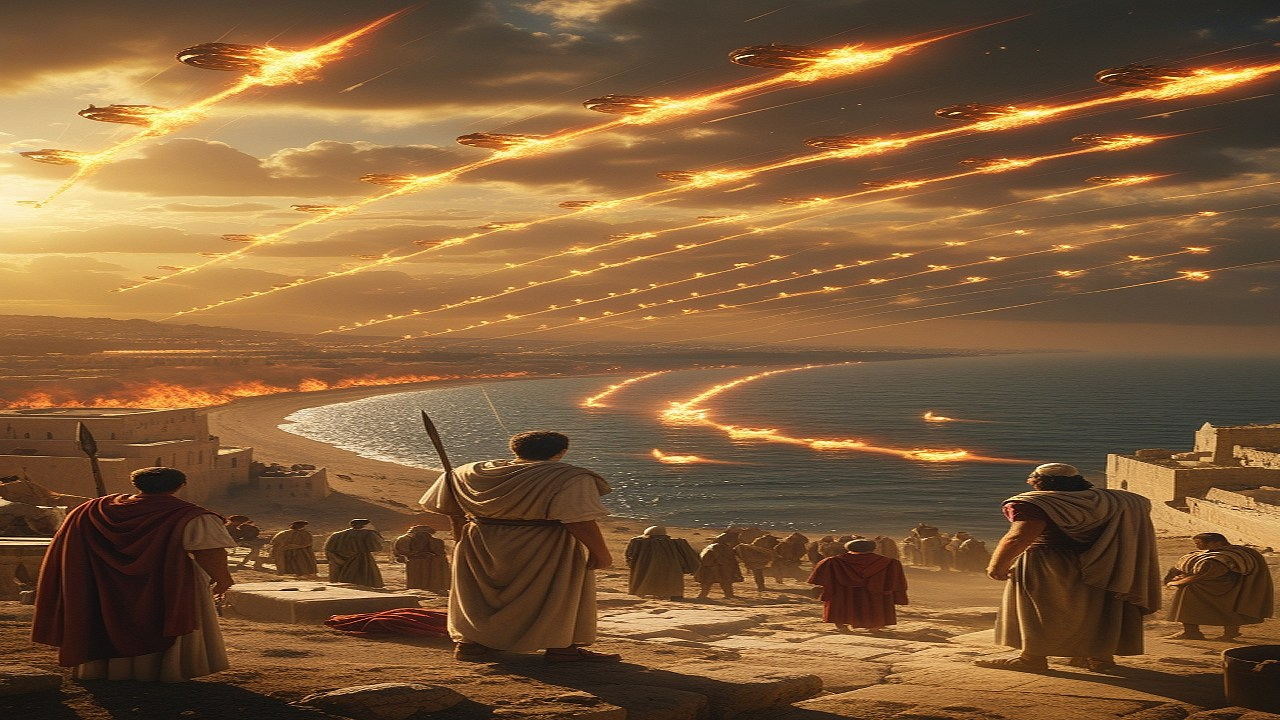
His descriptions of “phantom armies,” “chariots of fire,” and luminous formations traversing the sky have become familiar to students of ancient anomalies, but less frequently discussed is a subtle detail embedded within ancient testimonies: some of these objects, after crossing over land, appeared to descend toward the coastal waters and vanish “beyond the sea.” To contemporary UFO and USO investigators, the narrative reads eerily like early documentation of underwater unidentified objects, exhibiting the same luminous displays, sudden directional shifts, and atmospheric-to-aquatic transitions that define the modern USO profile.
While Josephus did not record ship-like structures splashing into the Mediterranean with the precision of a twenty-first century witness, the similarities are striking. He captured the astonishment of thousands who looked skyward and saw something that defied their worldview. These were not metaphorical visions or poetic symbols of divine wrath but events recorded by a careful historian known for grounding his writings in the politics, customs, and disasters of his time. As a result, the phenomena he described have an enduring credibility, making them invaluable in the broader timeline of UFO and USO reports.
To understand the significance of Josephus’s account, one must appreciate the environment in which these sightings occurred. Judea in the mid-first century was a region shaped by conflict, rebellion, and intense religious fervor.
The Roman military had encircled the land, rebellions rose and fell, and prophecies of destruction swirled among the populace. In such a climate, unusual celestial events—comets, eclipses, and meteors—were interpreted as omens. Yet Josephus distinguishes the 70 AD aerial chariots from ordinary celestial activity. He describes them as coordinated formations, with shapes resembling chariots and armed battalions stretching across the sky. These formations moved with intention and coherence, not with the predictable arc of a celestial body.
The most compelling element for USO researchers is the directional movement of these luminous formations. Several accounts in ancient texts, parallel to Josephus but drawing from regional oral traditions, mention the objects moving westward—toward the Mediterranean coast —before disappearing as if they simply entered the sea. This specific detail aligns with thousands of later USO reports in which objects are observed descending into oceans, lakes, or rivers and vanishing without splash or sound. The 70 AD events may therefore represent one of the earliest documented instances of unexplained technology interacting with Earth’s waters.
For the people of Judea, these events were interpreted through a spiritual lens. Josephus, writing for both Roman and Jewish audiences, framed the incidents as “signs” that foreshadowed the destruction of the Temple. To the devout, the sight of fiery chariots symbolized divine armies withdrawing their protection. Yet the descriptions themselves transcend purely religious interpretation. The objects exhibited structured shapes, luminous qualities, and orchestrated movement that today would be associated more readily with craft than with meteorological or celestial phenomena.
This duality—spiritual interpretation overlaying a physical event—remains crucial in understanding how ancient societies processed encounters that surpassed their technological comprehension. Just as modern witnesses may interpret unexplained aerial or underwater objects through the frameworks of extraterrestrials, advanced drones, or interdimensional travel, ancient observers interpreted the unknown in terms of gods, angels, or prophetic warnings.
What remains constant across eras is the sense of awe, unease, and transformation that follows such events.
In the centuries that followed, Josephus's account was preserved, reinterpreted, and debated by scholars. Medieval writers viewed the aerial chariots as literal angelic forces. Enlightenment thinkers questioned Josephus’s credibility or attempted to naturalize the events as atmospheric phenomena. Yet in the twentieth and twenty-first centuries, the rise of UFO and USO research reopened the conversation, revealing that Josephus’s narrative sits comfortably within a global pattern of anomalous sightings exhibiting similar behavior.
One of the most notable impacts of this ancient account is the way it bridges modern and ancient UFO studies. Many researchers argue that such reports—unfiltered by contemporary technology or aviation—carry a certain purity. They emerge from observers with no preconceived notions of spacecraft or advanced machinery.
The fact that these ancient witnesses used the language of their time, such as “chariots of fire,” underscores their effort to describe something beyond their understanding. In modern investigations, this type of testimony helps establish the long-term consistency of UFO and USO characteristics across millennia.
Moreover, Josephus’s account holds an important psychological and cultural impact. It highlights that humanity’s sense of being observed or visited from above—or in this case, above and below the waters—is not a modern phenomenon. The idea that unknown intelligences may traverse both sky and sea has influenced mythology, religion, and philosophical thought for thousands of years.
In Judea, the 70 AD sightings intensified a sense of cosmic drama unfolding alongside political turmoil. For communities already living on the brink, the celestial armies reinforced fears that forces beyond their control were shaping their destiny.
In the present day, the 70 AD sightings continue to generate interest among UFO scholars because of their potential alignment with modern USO behavior. The Mediterranean Sea has been the site of numerous contemporary reports involving luminous objects entering or exiting the water—some by commercial pilots, fishermen, and naval personnel. The idea that such activity could stretch back two thousand years suggests that these objects, whatever their origin, have interacted with Earth’s oceans for far longer than commonly imagined.
Several notable figures in the modern era have referenced Josephus when examining historical UFO sightings. Historians point to the consistency between Josephus’s visual description and modern reports of luminous aerial formations. Even naval analysts, examining ancient accounts for clues about long-term marine anomalies, have drawn parallels between Josephus’s “vanishing beyond the waters” and more recent USO disappearances observed off Puerto Rico, Catalina Island, and the Mediterranean Basin.
The long-term impact of Josephus’s narrative also extends to cultural memory. For centuries, the story of the fiery chariots shaped local beliefs about divine intervention and celestial warfare. Today, those same descriptions fuel discussions about ancient contact, interdimensional phenomena, or long-term extraterrestrial observation. While interpretations differ, the central mystery remains unchanged: objects not made by human hands appeared in the skies, moved intelligently, and interacted with the sea.
Even skeptics acknowledge that Josephus was a careful and respected historian known for his precision. His willingness to document these events—and the consistency of corroborating accounts—creates a foundation of credibility that sets the 70 AD sightings apart from mythologies or fictional narratives. As a result, the case stands as one of the earliest—and strongest—pieces of evidence supporting the idea that advanced non-human technology has been present on Earth across multiple eras.
In considering how these events affect people today, one sees a blend of curiosity, validation, and a sense of historical continuity. For those who study USOs, Josephus’s account supports the thesis that underwater activity is not a recent development but a recurring phenomenon woven into human history. For historians and theologians, the events challenge traditional interpretations of ancient texts. And for the general public, the story inspires wonder, raising the possibility that humanity has shared its world—both sky and seas—with others for far longer than we realize.
Ultimately, the account of aerial chariots vanishing toward the waters stands as an early marker in the global UFO narrative. It reminds us that the unknown is not confined to our technological age. Instead, it stretches across centuries, quietly shaping civilizations, influencing belief systems, and hinting at mysteries still unfolding beneath our oceans. The ancient world may have lacked satellites, radar, or deep-sea sonar, but it possessed the same sense of awe and the same willingness to report what was seen. In that sense, Josephus’s testimony becomes not only a historical record but a bridge connecting ancient observers to modern witnesses of the unexplained.
The year 70 AD stands as one of the most turbulent periods in ancient history, marked by the fall of Jerusalem, the collapse of political structures, and a shattering cultural transformation for the people of Judea. Amid this upheaval, one of antiquity’s most respected historians— Flavius Josephus—recorded a series of extraordinary aerial events that continue to intrigue modern researchers.
His descriptions of “phantom armies,” “chariots of fire,” and luminous formations traversing the sky have become familiar to students of ancient anomalies, but less frequently discussed is a subtle detail embedded within ancient testimonies: some of these objects, after crossing over land, appeared to descend toward the coastal waters and vanish “beyond the sea.” To contemporary UFO and USO investigators, the narrative reads eerily like early documentation of underwater unidentified objects, exhibiting the same luminous displays, sudden directional shifts, and atmospheric-to-aquatic transitions that define the modern USO profile.
While Josephus did not record ship-like structures splashing into the Mediterranean with the precision of a twenty-first century witness, the similarities are striking. He captured the astonishment of thousands who looked skyward and saw something that defied their worldview. These were not metaphorical visions or poetic symbols of divine wrath but events recorded by a careful historian known for grounding his writings in the politics, customs, and disasters of his time. As a result, the phenomena he described have an enduring credibility, making them invaluable in the broader timeline of UFO and USO reports.
To understand the significance of Josephus’s account, one must appreciate the environment in which these sightings occurred. Judea in the mid-first century was a region shaped by conflict, rebellion, and intense religious fervor.
The Roman military had encircled the land, rebellions rose and fell, and prophecies of destruction swirled among the populace. In such a climate, unusual celestial events—comets, eclipses, and meteors—were interpreted as omens. Yet Josephus distinguishes the 70 AD aerial chariots from ordinary celestial activity. He describes them as coordinated formations, with shapes resembling chariots and armed battalions stretching across the sky. These formations moved with intention and coherence, not with the predictable arc of a celestial body.
The most compelling element for USO researchers is the directional movement of these luminous formations. Several accounts in ancient texts, parallel to Josephus but drawing from regional oral traditions, mention the objects moving westward—toward the Mediterranean coast —before disappearing as if they simply entered the sea. This specific detail aligns with thousands of later USO reports in which objects are observed descending into oceans, lakes, or rivers and vanishing without splash or sound. The 70 AD events may therefore represent one of the earliest documented instances of unexplained technology interacting with Earth’s waters.
For the people of Judea, these events were interpreted through a spiritual lens. Josephus, writing for both Roman and Jewish audiences, framed the incidents as “signs” that foreshadowed the destruction of the Temple. To the devout, the sight of fiery chariots symbolized divine armies withdrawing their protection. Yet the descriptions themselves transcend purely religious interpretation. The objects exhibited structured shapes, luminous qualities, and orchestrated movement that today would be associated more readily with craft than with meteorological or celestial phenomena.
This duality—spiritual interpretation overlaying a physical event—remains crucial in understanding how ancient societies processed encounters that surpassed their technological comprehension. Just as modern witnesses may interpret unexplained aerial or underwater objects through the frameworks of extraterrestrials, advanced drones, or interdimensional travel, ancient observers interpreted the unknown in terms of gods, angels, or prophetic warnings.
What remains constant across eras is the sense of awe, unease, and transformation that follows such events.
In the centuries that followed, Josephus's account was preserved, reinterpreted, and debated by scholars. Medieval writers viewed the aerial chariots as literal angelic forces. Enlightenment thinkers questioned Josephus’s credibility or attempted to naturalize the events as atmospheric phenomena. Yet in the twentieth and twenty-first centuries, the rise of UFO and USO research reopened the conversation, revealing that Josephus’s narrative sits comfortably within a global pattern of anomalous sightings exhibiting similar behavior.
One of the most notable impacts of this ancient account is the way it bridges modern and ancient UFO studies. Many researchers argue that such reports—unfiltered by contemporary technology or aviation—carry a certain purity. They emerge from observers with no preconceived notions of spacecraft or advanced machinery.
The fact that these ancient witnesses used the language of their time, such as “chariots of fire,” underscores their effort to describe something beyond their understanding. In modern investigations, this type of testimony helps establish the long-term consistency of UFO and USO characteristics across millennia.
Moreover, Josephus’s account holds an important psychological and cultural impact. It highlights that humanity’s sense of being observed or visited from above—or in this case, above and below the waters—is not a modern phenomenon. The idea that unknown intelligences may traverse both sky and sea has influenced mythology, religion, and philosophical thought for thousands of years.
In Judea, the 70 AD sightings intensified a sense of cosmic drama unfolding alongside political turmoil. For communities already living on the brink, the celestial armies reinforced fears that forces beyond their control were shaping their destiny.
In the present day, the 70 AD sightings continue to generate interest among UFO scholars because of their potential alignment with modern USO behavior. The Mediterranean Sea has been the site of numerous contemporary reports involving luminous objects entering or exiting the water—some by commercial pilots, fishermen, and naval personnel. The idea that such activity could stretch back two thousand years suggests that these objects, whatever their origin, have interacted with Earth’s oceans for far longer than commonly imagined.
Several notable figures in the modern era have referenced Josephus when examining historical UFO sightings. Historians point to the consistency between Josephus’s visual description and modern reports of luminous aerial formations. Even naval analysts, examining ancient accounts for clues about long-term marine anomalies, have drawn parallels between Josephus’s “vanishing beyond the waters” and more recent USO disappearances observed off Puerto Rico, Catalina Island, and the Mediterranean Basin.
The long-term impact of Josephus’s narrative also extends to cultural memory. For centuries, the story of the fiery chariots shaped local beliefs about divine intervention and celestial warfare. Today, those same descriptions fuel discussions about ancient contact, interdimensional phenomena, or long-term extraterrestrial observation. While interpretations differ, the central mystery remains unchanged: objects not made by human hands appeared in the skies, moved intelligently, and interacted with the sea.
Even skeptics acknowledge that Josephus was a careful and respected historian known for his precision. His willingness to document these events—and the consistency of corroborating accounts—creates a foundation of credibility that sets the 70 AD sightings apart from mythologies or fictional narratives. As a result, the case stands as one of the earliest—and strongest—pieces of evidence supporting the idea that advanced non-human technology has been present on Earth across multiple eras.
In considering how these events affect people today, one sees a blend of curiosity, validation, and a sense of historical continuity. For those who study USOs, Josephus’s account supports the thesis that underwater activity is not a recent development but a recurring phenomenon woven into human history. For historians and theologians, the events challenge traditional interpretations of ancient texts. And for the general public, the story inspires wonder, raising the possibility that humanity has shared its world—both sky and seas—with others for far longer than we realize.
Ultimately, the account of aerial chariots vanishing toward the waters stands as an early marker in the global UFO narrative. It reminds us that the unknown is not confined to our technological age. Instead, it stretches across centuries, quietly shaping civilizations, influencing belief systems, and hinting at mysteries still unfolding beneath our oceans. The ancient world may have lacked satellites, radar, or deep-sea sonar, but it possessed the same sense of awe and the same willingness to report what was seen. In that sense, Josephus’s testimony becomes not only a historical record but a bridge connecting ancient observers to modern witnesses of the unexplained.