


Blog Categories
- African Incidents
- Atlantis Incidents
- Australian Incidents
- Belgian Incidents
- Bermuda Triangle Incidents
- Brazilian Incidents
- Canadian Incidents
- Chinese Incidents
- European Incidents
- France Incidents
- Ghosts
- Giants
- Italy Incidents
- Japanese Incidents
- Middle East Incidents
- Portugal Incidents
- Project Serpo
- Puerto Rico Incidents
- Russian Incidents
- Sasquatch
- Scandinavia Incidents
- Spanish Incidents
- UFOs
- United Kingdom Incidents
- United States Incidents
A Light Over the Thames: Summer of 1947
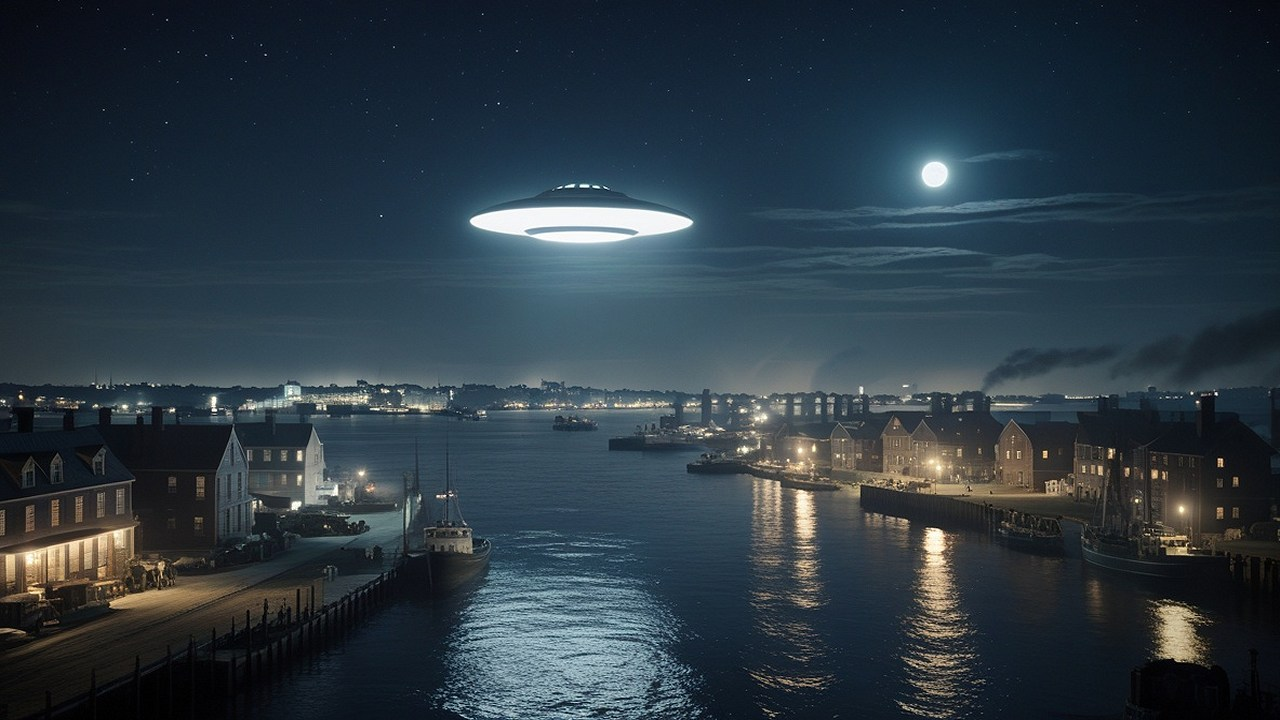
In the long postwar summer of 1947, a new kind of public story began to circulate across American newsrooms, kitchen tables, and police switchboards: sightings of “flying discs,” “strange objects,” or unidentified lights moving through the sky. The phenomenon that began with Kenneth Arnold’s June 24 sighting in the Pacific Northwest quickly rippled into a national conversation about the possibility of unknown aerial technology. Connecticut was not immune to the attention; towns and cities up and down the state registered reports, and one such notice—briefly recorded in The Day of New London in late August 1947—places the coastal city within the texture of that pivotal summer.
This is the story of the 1947 New London sighting — a modest but meaningful piece of Connecticut’s UFO history. Today we examine what was reported, what it meant to people at the time, how this brief newspaper notice fits into the larger arc of UFO history, and why it continues to matter today.
Welcome to the channel. We’re going back to the summer of 1947 to explore how one short item in a Connecticut newspaper became part of America’s first major UFO wave. Everything in this video is drawn directly from the historical record. No speculation. Just the documented context and significance.
Let’s set the scene in the summer of 1947.
After Kenneth Arnold’s famous June 24 sighting near Mount Rainier, Washington, American newspapers rushed to cover the phenomenon. The language — “flying saucer,” “disc,” “mystery object” — entered headlines and conversations almost overnight. For many readers, the term captured a mixture of anxiety and wonder: the Cold War had quietly begun and the public was acutely aware of new aircraft, secret projects, and the rapid pace of technological change. At the same time, wartime exposure to new aviation capabilities — jet engines, radar, experimental airplanes — meant that ordinary citizens had a new baseline for what the sky could contain.
Against this charged backdrop, a short report in The Day that a local observer had seen something unusual would have registered both as a local curiosity and as part of a national phenomenon now discussed in every newsroom.
The surviving public record for the specific New London item in The Day is limited — what we have is the fact of a late-August 1947 entry in the local paper reporting an unidentified aerial sighting, not a detailed police transcript or multi-page investigative dossier. That lack of granular documentation is itself telling; it reflects how many 1947 sightings were handled at the local level — short items in newspapers, letters to the editor, calls to local police or airport managers, and sometimes no official follow-up at all. Yet even a short newspaper item is historically valuable because it shows how national events were absorbed locally, and how everyday people in a coastal Connecticut city participated in the new national habit of looking up and asking, “What was that?”
For New London specifically, several local factors shaped how the report would have been received. New London is a coastal city with a maritime economy, naval connections, and a public used to watching the horizon for shipping traffic and weather. Its social fabric in 1947 included sailors, dockworkers, civilians engaged in wartime industry, and families still adjusting to postwar life. A nighttime light over the Long Island Sound or the Thames River would not have been dismissed out of hand; coastal communities were familiar with many sources of unusual illumination. Yet the language of the national flying-disc story gifted local observers a new set of categories to apply — so that a light that might once simply have been filed mentally as a shipping signal could instead be read as a possible “disc.”
At the institutional level, the New London report probably generated a short sequence of administrative reactions: a call to a local police dispatcher, perhaps an inquiry to the nearest civil airport or watchtower, and a passing note in the paper. In August 1947, formalized federal interest was only beginning to coalesce; most follow-up still landed at the local level. That local handling shaped the public’s perception: many sightings remained episodic, recorded in print and then folded into local lore.
How did these small reports affect people as a whole? The effects were multiple and layered. At an immediate level, a short item in The Day created conversation and curiosity. It could occasion polite skepticism in one neighbor and deep concern in another; it might inspire teenagers to organize nocturnal sky-watches; it might rekindle an older folk habit of watching for omens in the heavens. At a broader level, the accumulation of such local notices across the state and nation did something more consequential: it normalized reporting. People who might previously have kept quiet about a strange light now had precedent for telling the paper or phoning an authority. That normalization produced the modern UFO culture — an infrastructure of civilian reporting that would later be embodied by organizations like MUFON, NICAP, and NUFORC.
There is also an emotional and cultural effect that matters. The late 1940s were a period of transition: wartime unity gave way to Cold War anxieties; scientific triumph coexisted with unease about where technology might lead. Reports of unidentified aerial objects touched on both the hope for human mastery of the skies and fear of unknown capabilities — human or otherwise — that might challenge national security. For families in New London, the report would have intersected with everyday concerns about employment, housing for returning veterans, and the uncertain geopolitics of 1947. The phenomenon’s mixture of wonder and unease matched the tenor of the time.
What is the impact today? Two lines of significance stand out. First, historically, these local items — short though many were — constitute primary evidence for researchers tracing how the modern UFO phenomenon took shape. Scholars who compile 1947-era archives rely on newspaper notices like The Day’s entry to document how widely and quickly the story spread. Second, for local culture, the memory of a 1947 sighting participates in a longer Connecticut genealogy of sky-watching: it links nineteenth-century airship notices and early twentieth-century balloon exhibitions to late-twentieth and twenty-first-century UAP reports. Contemporary historians and journalists in Connecticut often cite 1947 as their community’s entry point into national UFO conversations — an origin story that continues to inform how townspeople respond to new sightings.
Notable people connected directly to the New London report are not recorded in the surviving cursory press notice. Unlike some high-profile cases elsewhere, New London’s 1947 item does not center on a single dramatic witness whose name became part of the record. Kenneth Arnold’s sighting, of course, remains relevant in framing the New London episode: Arnold’s sighting established the language and media dynamics that made a New London notice significant rather than incidental.
Finally, what this item invites is further archival work. That a New London sighting was recorded in The Day suggests more may exist in local police logs, airport records, or letters to the editor — documents often held in city archives or microfilm collections. Even absent those additional details, the The Day notice remains historically useful: it is a small but clear piece of evidence that in August 1947 New London citizens, like communities across America, saw something they could not readily explain — and chose to tell their local paper.
In sum, the New London entry of late August 1947 is a modest but meaningful marker in Connecticut’s aerial-phenomena history. It stands at the crossroads of personal observation, local journalism, and national fascination. It shows how a single, briefly reported sighting participated in the broader social process that transformed unidentified aerial reports into an enduring part of modern public life. For historians, it is a prompt — an archival breadcrumb that points toward the lived experience of an anxious, hopeful postwar America looking up at the sky and wondering what new realities might be descending from above.
The light reported over the Thames in New London in the summer of 1947 may have eventually faded from view, but its place in the historical record endures. It reminds us that the mystery of the skies is not new — and that ordinary people, in ordinary coastal towns, have long looked up and wondered at lights that refused to behave as expected.
The skies above Connecticut in August 1947 were not empty. Something moved there that left a lasting impression on local residents and a place in the early history of the modern UFO phenomenon. In the study of unidentified aerial phenomena, even brief, local cases like the New London sighting help build the larger picture of a mystery that has persisted for nearly eighty years.
In the long postwar summer of 1947, a new kind of public story began to circulate across American newsrooms, kitchen tables, and police switchboards: sightings of “flying discs,” “strange objects,” or unidentified lights moving through the sky. The phenomenon that began with Kenneth Arnold’s June 24 sighting in the Pacific Northwest quickly rippled into a national conversation about the possibility of unknown aerial technology. Connecticut was not immune to the attention; towns and cities up and down the state registered reports, and one such notice—briefly recorded in The Day of New London in late August 1947—places the coastal city within the texture of that pivotal summer.
This is the story of the 1947 New London sighting — a modest but meaningful piece of Connecticut’s UFO history. Today we examine what was reported, what it meant to people at the time, how this brief newspaper notice fits into the larger arc of UFO history, and why it continues to matter today.
Welcome to the channel. We’re going back to the summer of 1947 to explore how one short item in a Connecticut newspaper became part of America’s first major UFO wave. Everything in this video is drawn directly from the historical record. No speculation. Just the documented context and significance.
Let’s set the scene in the summer of 1947.
After Kenneth Arnold’s famous June 24 sighting near Mount Rainier, Washington, American newspapers rushed to cover the phenomenon. The language — “flying saucer,” “disc,” “mystery object” — entered headlines and conversations almost overnight. For many readers, the term captured a mixture of anxiety and wonder: the Cold War had quietly begun and the public was acutely aware of new aircraft, secret projects, and the rapid pace of technological change. At the same time, wartime exposure to new aviation capabilities — jet engines, radar, experimental airplanes — meant that ordinary citizens had a new baseline for what the sky could contain.
Against this charged backdrop, a short report in The Day that a local observer had seen something unusual would have registered both as a local curiosity and as part of a national phenomenon now discussed in every newsroom.
The surviving public record for the specific New London item in The Day is limited — what we have is the fact of a late-August 1947 entry in the local paper reporting an unidentified aerial sighting, not a detailed police transcript or multi-page investigative dossier. That lack of granular documentation is itself telling; it reflects how many 1947 sightings were handled at the local level — short items in newspapers, letters to the editor, calls to local police or airport managers, and sometimes no official follow-up at all. Yet even a short newspaper item is historically valuable because it shows how national events were absorbed locally, and how everyday people in a coastal Connecticut city participated in the new national habit of looking up and asking, “What was that?”
For New London specifically, several local factors shaped how the report would have been received. New London is a coastal city with a maritime economy, naval connections, and a public used to watching the horizon for shipping traffic and weather. Its social fabric in 1947 included sailors, dockworkers, civilians engaged in wartime industry, and families still adjusting to postwar life. A nighttime light over the Long Island Sound or the Thames River would not have been dismissed out of hand; coastal communities were familiar with many sources of unusual illumination. Yet the language of the national flying-disc story gifted local observers a new set of categories to apply — so that a light that might once simply have been filed mentally as a shipping signal could instead be read as a possible “disc.”
At the institutional level, the New London report probably generated a short sequence of administrative reactions: a call to a local police dispatcher, perhaps an inquiry to the nearest civil airport or watchtower, and a passing note in the paper. In August 1947, formalized federal interest was only beginning to coalesce; most follow-up still landed at the local level. That local handling shaped the public’s perception: many sightings remained episodic, recorded in print and then folded into local lore.
How did these small reports affect people as a whole? The effects were multiple and layered. At an immediate level, a short item in The Day created conversation and curiosity. It could occasion polite skepticism in one neighbor and deep concern in another; it might inspire teenagers to organize nocturnal sky-watches; it might rekindle an older folk habit of watching for omens in the heavens. At a broader level, the accumulation of such local notices across the state and nation did something more consequential: it normalized reporting. People who might previously have kept quiet about a strange light now had precedent for telling the paper or phoning an authority. That normalization produced the modern UFO culture — an infrastructure of civilian reporting that would later be embodied by organizations like MUFON, NICAP, and NUFORC.
There is also an emotional and cultural effect that matters. The late 1940s were a period of transition: wartime unity gave way to Cold War anxieties; scientific triumph coexisted with unease about where technology might lead. Reports of unidentified aerial objects touched on both the hope for human mastery of the skies and fear of unknown capabilities — human or otherwise — that might challenge national security. For families in New London, the report would have intersected with everyday concerns about employment, housing for returning veterans, and the uncertain geopolitics of 1947. The phenomenon’s mixture of wonder and unease matched the tenor of the time.
What is the impact today? Two lines of significance stand out. First, historically, these local items — short though many were — constitute primary evidence for researchers tracing how the modern UFO phenomenon took shape. Scholars who compile 1947-era archives rely on newspaper notices like The Day’s entry to document how widely and quickly the story spread. Second, for local culture, the memory of a 1947 sighting participates in a longer Connecticut genealogy of sky-watching: it links nineteenth-century airship notices and early twentieth-century balloon exhibitions to late-twentieth and twenty-first-century UAP reports. Contemporary historians and journalists in Connecticut often cite 1947 as their community’s entry point into national UFO conversations — an origin story that continues to inform how townspeople respond to new sightings.
Notable people connected directly to the New London report are not recorded in the surviving cursory press notice. Unlike some high-profile cases elsewhere, New London’s 1947 item does not center on a single dramatic witness whose name became part of the record. Kenneth Arnold’s sighting, of course, remains relevant in framing the New London episode: Arnold’s sighting established the language and media dynamics that made a New London notice significant rather than incidental.
Finally, what this item invites is further archival work. That a New London sighting was recorded in The Day suggests more may exist in local police logs, airport records, or letters to the editor — documents often held in city archives or microfilm collections. Even absent those additional details, the The Day notice remains historically useful: it is a small but clear piece of evidence that in August 1947 New London citizens, like communities across America, saw something they could not readily explain — and chose to tell their local paper.
In sum, the New London entry of late August 1947 is a modest but meaningful marker in Connecticut’s aerial-phenomena history. It stands at the crossroads of personal observation, local journalism, and national fascination. It shows how a single, briefly reported sighting participated in the broader social process that transformed unidentified aerial reports into an enduring part of modern public life. For historians, it is a prompt — an archival breadcrumb that points toward the lived experience of an anxious, hopeful postwar America looking up at the sky and wondering what new realities might be descending from above.
The light reported over the Thames in New London in the summer of 1947 may have eventually faded from view, but its place in the historical record endures. It reminds us that the mystery of the skies is not new — and that ordinary people, in ordinary coastal towns, have long looked up and wondered at lights that refused to behave as expected.
The skies above Connecticut in August 1947 were not empty. Something moved there that left a lasting impression on local residents and a place in the early history of the modern UFO phenomenon. In the study of unidentified aerial phenomena, even brief, local cases like the New London sighting help build the larger picture of a mystery that has persisted for nearly eighty years.