


Blog Categories
- African Incidents
- Atlantis Incidents
- Australian Incidents
- Belgian Incidents
- Bermuda Triangle Incidents
- Brazilian Incidents
- Canadian Incidents
- Chinese Incidents
- European Incidents
- France Incidents
- Ghosts
- Giants
- Italy Incidents
- Japanese Incidents
- Middle East Incidents
- Portugal Incidents
- Project Serpo
- Puerto Rico Incidents
- Russian Incidents
- Sasquatch
- Scandinavia Incidents
- Spanish Incidents
- UFOs
- United Kingdom Incidents
- United States Incidents
Alien Species - Men in Black
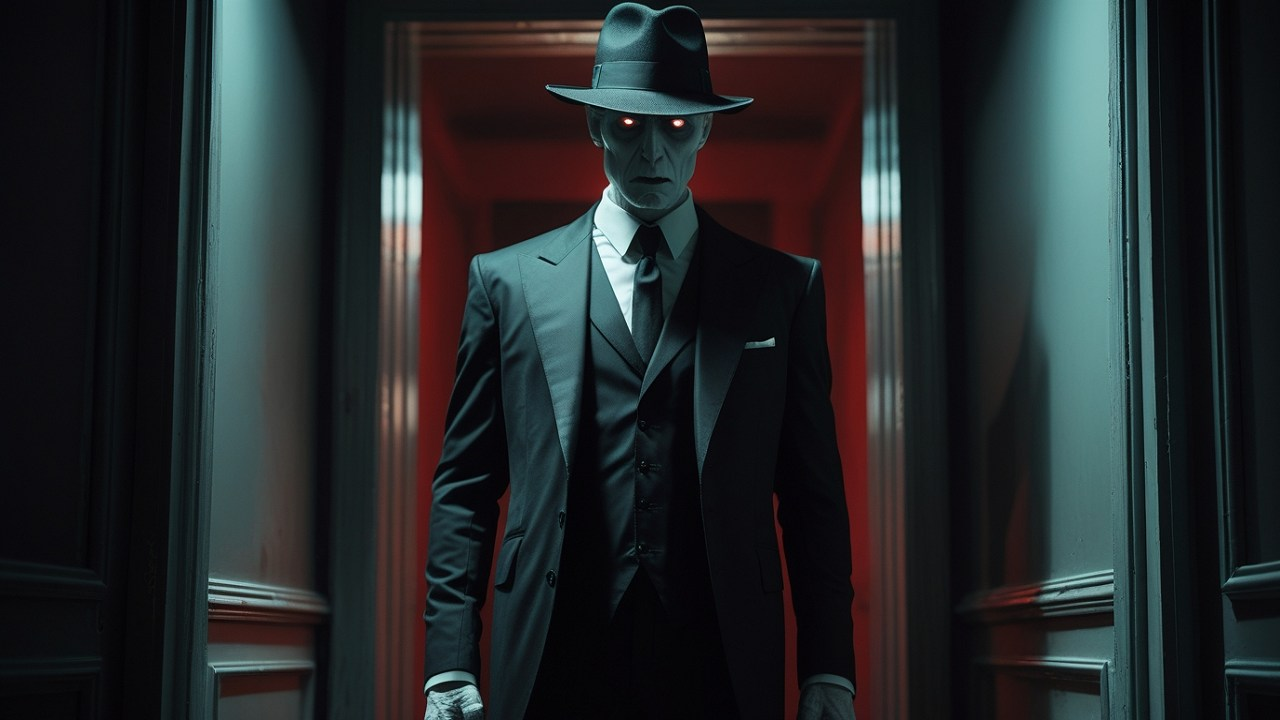
Physical Description and Behavior Reports of Men in Black share several consistent characteristics across decades of testimony: -Appearance: They are typically described as tall, thin men dressed in perfectly pressed black suits, white shirts, black ties, and black hats (often fedoras or similar styles). Their clothing appears brand new and unusually formal for the context. Skin is often pale or unnaturally smooth, sometimes with an artificial or waxy quality. Hair is usually dark and neatly styled, but in some cases described as unnatural or “too perfect.” -Eyes: Many witnesses report unusually large, dark, or piercing eyes that lack normal human expressiveness. Some accounts mention eyes that appear completely black or have an unsettling, hypnotic quality. -Speech and Demeanor: Their speech is often stilted, formal, or monotone, sometimes with an odd accent or awkward phrasing that sounds scripted. They frequently display limited knowledge of everyday human customs, such as how to eat or drink, or they exhibit unnatural stiffness in movement. Behavior is generally cold, threatening, or mechanically polite, with an underlying sense of menace. -Vehicles: They are often reported arriving in large, black, vintage or brand-new cars (commonly Cadillacs or Lincolns) that appear too clean or operate silently. In some cases, the vehicles have no visible license plates or have plates that cannot be traced.
Men in Black usually appear in groups of two or three, though single visitors are also reported. They typically arrive shortly after a UFO sighting or alien encounter, sometimes within hours or days. Their primary purpose seems to be intimidation or silencing: warning witnesses not to speak about what they saw, confiscating evidence (photos, film, or physical samples), or delivering cryptic messages.
Key Historical Cases and Patterns The modern Men in Black phenomenon gained prominence in the 1950s and 1960s, though earlier precedents exist in folklore and occult literature.
One of the earliest well-documented cases is the Albert K. Bender incident of 1953. Bender, founder of the International Flying Saucer Bureau, claimed three Men in Black visited him after he announced a major breakthrough in UFO research. They allegedly warned him to stop his investigations and confiscated his materials. Bender described the visitors as unnaturally pale, wearing black suits, and emitting a strong odor of sulfur or brimstone. His experience was detailed in Gray Barker’s book They Knew Too Much About Flying Saucers (1956) and helped popularize the MIB concept.
In the 1960s and 1970s, numerous UFO witnesses reported similar visits. A notable pattern emerged: witnesses who had clear sightings or physical evidence were visited by strange men in black who demanded silence. Some cases involved threats of harm to the witness or their family. The visitors often displayed knowledge of private details about the witness’s life, adding to the intimidation factor.
The Indrid Cold / Mothman connection in Point Pleasant, West Virginia (1966–1967) included reports of Men in Black-like figures. John Keel, in his book The Mothman Prophecies (1975), documented multiple encounters with odd, formally dressed men who appeared after Mothman sightings and UFO activity. These figures exhibited bizarre behavior, such as asking strange questions or displaying unnatural mannerisms.
Throughout the 1970s–1990s, MIB reports continued, often linked to high-profile UFO cases. Witnesses described visitors who arrived in unmarked black cars, spoke in monotone voices, and left an impression of being “not quite human.” Some reports included physical anomalies, such as the visitors appearing to malfunction like malfunctioning androids or dissolving into shadow when observed too closely.
Theories and Proposed Explanations Within UFO and paranormal research, several interpretations of the Men in Black exist: -Government Agents or Cover-Up Operatives: Some researchers believe the Men in Black are human agents from secretive government or military branches tasked with suppressing UFO evidence. Their odd behavior is sometimes attributed to special training or the use of disguises and psychological tactics. -Extraterrestrial or Interdimensional Entities: A significant portion of accounts suggest the Men in Black are not human at all, but alien beings or constructs designed to appear human. Their unnatural mannerisms, inability to blend perfectly, and knowledge of private information support this view. Some link them to Grey or Reptilian operations, suggesting they serve as enforcers or monitors for other races. -Robotic or Synthetic Constructs: Certain reports describe the visitors as mechanical or artificial in nature, leading to theories that they are androids or bio-engineered entities created to perform suppression tasks. -Psychological or Archetypal Phenomena: Skeptics and some paranormal researchers propose that Men in Black experiences may be manifestations of the collective unconscious, stress-induced hallucinations, or archetypal figures representing authority and fear of the unknown.
The phenomenon is often associated with the “high strangeness” category of UFO encounters, where the events defy conventional explanation and blend physical and psychological elements.
Credibility and Limitations The Men in Black phenomenon is almost entirely based on eyewitness testimony. There is no physical evidence — no photographs, video footage, or artifacts — that has been independently verified. Most accounts come from individuals who had prior UFO or paranormal experiences, raising questions about expectation, suggestion, or psychological factors.
Skeptics argue that many MIB reports can be explained as misidentification of ordinary government or law enforcement personnel, combined with the stress and paranoia that often follows unusual sightings. The consistency of the black suits, odd behavior, and intimidation tactics is sometimes attributed to cultural contamination from early books and media portrayals.
Supporters point to the volume of independent reports spanning decades, the unusual details that predate popular media depictions, and the emotional consistency of the fear and intimidation described by witnesses. The fact that some encounters occurred before the phenomenon was widely known in popular culture is often cited as significant.
Current Status Men in Black reports continue to surface, though they are less frequent than in the mid-to-late 20th century. They remain a staple of UFO and paranormal discussion forums, podcasts, and documentaries. The archetype has also influenced popular culture, but the actual reported experiences retain a distinct, unsettling quality that sets them apart from fictional portrayals.
In summary, the Men in Black are described as mysterious, formally dressed, human-like figures who appear after UFO or high-strangeness events to intimidate or silence witnesses. They are characterized by pale skin, unnatural behavior, and an aura of menace. Information about them comes almost entirely from eyewitness testimony, with no independent physical corroboration.
They represent one of the most persistent and psychologically unsettling aspects of the UFO phenomenon — entities that seem to exist in the liminal space between government secrecy and extraterrestrial activity. Whether viewed as human operatives, alien enforcers, synthetic constructs, or psychological projections, the Men in Black continue to intrigue and disturb those who encounter them or study their reports.
The Albert K. Bender Case (1953)
The Albert K. Bender case of 1953 is widely regarded as one of the earliest and most influential reports that helped establish the modern concept of the Men in Black. It marks a pivotal moment when the phenomenon transitioned from scattered folklore-like tales into a recognizable pattern associated with UFO research and witness intimidation.
Albert K. Bender was a bridgeport, Connecticut resident who founded the International Flying Saucer Bureau (IFSB) in 1952, one of the first civilian UFO research organizations in the United States. The group published a newsletter called Space Review and quickly attracted a dedicated following of enthusiasts interested in flying saucers. Bender positioned himself as a serious investigator and announced in early 1953 that he was on the verge of a major breakthrough regarding the origin and nature of UFOs.
Then, abruptly, in late 1953, Bender shut down the IFSB and ceased all public UFO-related activities. He stopped publishing Space Review and refused to explain his sudden withdrawal to his members. This unexpected silence caused confusion and speculation within the small but growing UFO community.
Later, Bender revealed what had happened. He claimed that three strange men dressed in black suits had visited him in his apartment. According to Bender, the men were pale, had an unnatural appearance, and behaved in a stiff, almost mechanical manner. They knew details about his private research that he had not shared publicly. The visitors warned him sternly to stop all investigations into flying saucers and to destroy or surrender all related materials. They allegedly delivered the warning with an implied threat, leaving Bender deeply frightened.
Bender described the men as wearing identical black suits, black hats, and exhibiting an eerie, otherworldly quality. He later told researcher Gray Barker that the visitors emitted a strong odor of sulfur or brimstone, and that their eyes had an unsettling, penetrating quality. Bender claimed the encounter left him physically ill and psychologically shaken for some time afterward.
Gray Barker, a well-known UFO writer at the time, interviewed Bender and published the story in his 1956 book They Knew Too Much About Flying Saucers. This book played a crucial role in popularizing the Men in Black concept. Barker presented Bender’s account as evidence that someone — or something — was actively suppressing UFO research. The story quickly spread through the emerging UFO community and became a foundational narrative for the entire MIB phenomenon.
The Bender case is significant for several reasons. First, it was one of the earliest well-publicized accounts in which ordinary UFO researchers were allegedly visited and threatened by mysterious men in black. Second, it introduced many of the classic MIB traits that would appear in later reports: the black suits, the formal and unnatural demeanor, the knowledge of private information, and the clear intent to silence witnesses. Third, it helped shift the narrative from simple UFO sightings to the idea of active suppression and cover-up.
Bender’s story also established a template that would be repeated in many subsequent MIB reports. The visitors arrived shortly after a significant announcement or breakthrough, delivered a direct warning, and left the witness frightened and compliant. This pattern — sudden silencing after a key development — became a recurring motif in Men in Black lore.
Over the years, Bender’s account has been analyzed, debated, and reinterpreted. Some researchers accept it as a genuine encounter with non-human or government-linked entities. Others suggest Bender may have experienced a psychological breakdown or fabricated the story for attention. Barker himself later expressed some doubts about certain details, but the core narrative remained influential.
The Albert K. Bender case is important because it helped codify the modern Men in Black archetype. Before 1953, stories of mysterious visitors existed in folklore and occult literature, but Bender’s experience provided a clear, contemporary UFO-related context. It suggested that investigating flying saucers could attract dangerous attention from unknown parties who dressed in black and operated with an aura of menace and authority.
In the broader history of the Men in Black phenomenon, the Bender incident serves as a foundational event. It demonstrated that the visitors were not random government agents but something stranger — beings who appeared human yet exhibited unnatural qualities. This case laid the groundwork for later interpretations that the Men in Black could be extraterrestrial enforcers, interdimensional entities, or synthetic constructs designed to maintain secrecy around the UFO phenomenon.
While the Bender case lacks independent corroboration and physical evidence, its influence cannot be overstated. It helped transform the Men in Black from vague rumors into a recognizable and feared element of UFO lore. The story continues to be referenced in books, documentaries, and online discussions more than seventy years later, serving as the prototype for countless subsequent Men in Black encounters.
In many ways, the Albert K. Bender case of 1953 represents the birth of the modern Men in Black phenomenon as we understand it today. It introduced the idea that those who get too close to the truth about UFOs may find themselves confronted by silent, menacing figures in black suits who demand silence — an idea that has haunted UFO research ever since.
Gray Barker’s Documentation (1956)
Gray Barker’s 1956 book They Knew Too Much About Flying Saucers stands as one of the most important early works that helped establish and popularize the modern Men in Black phenomenon within UFO research circles. The book centered on the Albert K. Bender case but went far beyond it, compiling additional reports of mysterious men in black suits who appeared to intimidate, silence, or threaten UFO witnesses and researchers. Barker’s documentation played a crucial role in transforming scattered individual stories into a recognizable pattern that would become a staple of UFO lore.
Gray Barker was a West Virginia-based writer and UFO enthusiast who had been active in the flying saucer community since the early 1950s. He was personally acquainted with Albert K. Bender and had followed the sudden shutdown of the International Flying Saucer Bureau with great interest. When Bender finally revealed his story of being visited by three strange men in black, Barker saw the potential significance and decided to investigate further.
In They Knew Too Much About Flying Saucers, Barker presented Bender’s account in detail while also collecting similar reports from other UFO researchers and witnesses. He described multiple cases in which individuals who had made significant UFO discoveries or public announcements were visited shortly afterward by odd, formally dressed men who demanded they cease their activities. These visitors were consistently described as wearing black suits, appearing unnaturally pale or stiff, and behaving in a cold, mechanical, or threatening manner. Some witnesses reported the men confiscating materials, issuing direct warnings, or leaving an unmistakable impression of menace.
Barker’s book was significant because it did not treat the Bender incident as an isolated curiosity. Instead, he framed it as part of a broader pattern of suppression. He suggested that someone — or something — was actively working to prevent the public from learning the full truth about flying saucers. By compiling multiple independent accounts, Barker helped establish the idea that the Men in Black were not random government agents but a coordinated effort with consistent characteristics and methods.
The book included reports from various parts of the United States and even some international cases. Witnesses described visitors arriving in large black cars (often Cadillacs or similar models) that appeared unusually clean or operated without noise. The men were said to possess detailed knowledge of the witness’s private research or personal life, adding to the intimidation factor. Barker noted recurring details such as the visitors’ monotone or stilted speech, their unnatural stiffness, and their tendency to disappear quickly after delivering their warning.
One of the strengths of Barker’s work was its accessible, narrative style. He presented the accounts as a detective story, building suspense and drawing connections between seemingly unrelated incidents. This approach made the Men in Black concept compelling and easy for readers to grasp, helping it spread beyond the small circle of hardcore UFO enthusiasts.
They Knew Too Much About Flying Saucers was published at a time when the UFO phenomenon was still relatively new to the public consciousness. The book arrived during a period of growing interest in flying saucers following the 1947 Kenneth Arnold sighting and the wave of reports in the early 1950s. By linking the suppression of UFO research to mysterious visitors in black suits, Barker helped create a narrative of official or non-human cover-up that resonated with many readers who felt the government was not being transparent.
Barker’s documentation also introduced the idea that the Men in Black might not be ordinary human agents. He highlighted the unnatural qualities reported by witnesses — the pale skin, the odd speech patterns, the mechanical behavior — suggesting the possibility that these visitors were not entirely human. This interpretation opened the door for later theories that the Men in Black could be extraterrestrial enforcers, synthetic constructs, or interdimensional entities tasked with maintaining secrecy around the UFO phenomenon.
The impact of Gray Barker’s 1956 book was substantial. It helped codify the Men in Black as a distinct phenomenon rather than isolated oddities. The book was widely read in the emerging UFO community and influenced many subsequent researchers and writers. The phrase “Men in Black” itself gained traction largely through Barker’s work and the publicity surrounding Bender’s story.
While Barker’s book was groundbreaking, it also faced criticism. Some reviewers and later researchers questioned the accuracy of certain details and suggested that Barker may have sensationalized elements of the story for dramatic effect. The lack of independent verification for many of the accounts Barker included remains a limitation. Nevertheless, the book’s influence endured, and it continues to be cited as a foundational text in Men in Black studies.
In the broader context of the Men in Black phenomenon, Gray Barker’s documentation in 1956 represents a key moment of crystallization. It took the personal experience of Albert K. Bender and expanded it into a wider pattern, giving the phenomenon a name, a narrative structure, and a sense of ongoing relevance. Barker’s work helped shift the focus from simple UFO sightings to the idea of active suppression and intimidation by mysterious forces.
By compiling and presenting multiple cases in an engaging format, Barker laid the groundwork for decades of subsequent Men in Black reports. His book helped establish the classic image of the Men in Black — tall, thin men in black suits and hats who appear suddenly after significant UFO-related developments — that would recur in countless witness accounts over the following decades.
The enduring legacy of They Knew Too Much About Flying Saucers is that it transformed the Men in Black from a single strange incident into a recognized and feared element of the UFO experience. It suggested that those who delved too deeply into the mystery might attract dangerous attention, a theme that continues to resonate in UFO research to this day.
The Maury Island Incident (1947)
The Maury Island Incident of June 1947 is frequently cited as one of the earliest retroactively identified encounters that fits the classic Men in Black pattern. Although the term “Men in Black” was not coined until years later, the case contains many of the hallmark elements that would later define the phenomenon: a UFO-related sighting followed by the appearance of a mysterious, formally dressed man who warned the witness to remain silent.
The central figure in the incident was Harold Dahl, a harbor patrolman and boat operator who claimed that on June 21, 1947, he and his crew were salvaging logs in Maury Island Bay, near Tacoma, Washington, when they observed six large, doughnut-shaped metallic objects hovering in the sky. Dahl described the objects as approximately 100 feet in diameter with a central hole and portholes around the outer edge. One of the objects appeared to be in distress and was being tended to by the others. According to Dahl, the damaged craft suddenly ejected a large quantity of lightweight, slag-like material that rained down on his boat, injuring his son and killing his dog.
Dahl reported the incident to his superior, Fred Crisman, who visited the site and collected some of the strange debris. Crisman then contacted writer and publisher Ray Palmer, who was editing Amazing Stories magazine at the time and had an interest in flying saucer reports. Palmer, in turn, reached out to Kenneth Arnold, who had famously reported seeing nine crescent-shaped objects near Mount Rainier just a few days earlier on June 24, 1947 — the sighting that popularized the term “flying saucers.”
Shortly after the initial sighting and while the story was still developing, Harold Dahl claimed he was approached by a mysterious man in a black suit. According to Dahl, the man met him at a local diner and, in a calm but firm manner, warned him not to speak about what he had seen over Maury Island. The visitor allegedly knew specific details about the incident that Dahl had not publicly shared, adding to the intimidation factor. Dahl described the man as unusually pale and formal, fitting the emerging profile of what would later be called a Man in Black.
The warning had a significant effect. Dahl became frightened and reluctant to discuss the event further. When investigators attempted to follow up, they encountered inconsistencies and difficulties obtaining clear testimony. Some of the physical evidence, including the metallic slag, was later analyzed and found to be ordinary industrial slag, leading many researchers to question the veracity of the entire incident. However, the appearance of the man in the black suit remained a compelling detail that aligned with later Men in Black reports.
The Maury Island Incident occurred just days before Kenneth Arnold’s famous sighting, placing it at the very beginning of the 1947 UFO wave that swept the United States. This timing has led some researchers to view it as an early example of the pattern that would become associated with Men in Black: a witness has a significant UFO-related experience, and shortly afterward is visited by a mysterious figure in dark clothing who demands silence.
Gray Barker and other early UFO writers later highlighted the Bender and Maury Island cases as foundational to the Men in Black narrative. The Maury Island story demonstrated that the silencing tactic was not limited to organized UFO researchers but could also target ordinary witnesses who stumbled upon anomalous events. The combination of a dramatic sighting, physical debris, and an immediate warning from a man in black helped establish the template for many future reports.
The case also introduced the element of official or quasi-official involvement. After the incident, the U.S. Army Air Force sent investigators, including Captain Edward Ruppelt (who would later head Project Blue Book), to look into the matter. Some researchers have speculated that the man in the black suit could have been a government agent using intimidation tactics, while others argue the visitor displayed characteristics that suggested he was not entirely human.
In the broader history of the Men in Black phenomenon, the Maury Island Incident of 1947 is significant because it occurred at the very dawn of the modern UFO era. It showed that the pattern of post-sighting intimidation by mysterious dark-suited figures was present from the beginning, even before the term “Men in Black” was coined. The case helped establish the idea that someone — whether human or otherwise — was actively working to suppress information about unusual aerial phenomena.
While the physical evidence from Maury Island was later discredited as ordinary slag, the reported visit by the man in the black suit remained a compelling and influential detail. It demonstrated that the silencing tactic could be effective even on ordinary working-class witnesses, not just dedicated researchers like Albert Bender.
The Maury Island Incident continues to be referenced in UFO literature as an early example of what would become a recurring motif: witnesses to extraordinary events being approached by enigmatic figures in black who demand silence. It helped lay the groundwork for the Men in Black archetype that would evolve and expand over the following decades, influencing everything from Gray Barker’s writings to modern conspiracy discussions.
Whether the man in the black suit was a government operative, an extraterrestrial enforcer, or something else entirely, the 1947 Maury Island case remains a foundational event in the development of the Men in Black phenomenon. It showed that the urge to control the narrative around UFOs was present from the very first major wave of sightings, and that mysterious visitors in dark suits would become a persistent feature of the UFO experience for decades to come.
Physical Description and Behavior Reports of Men in Black share several consistent characteristics across decades of testimony: -Appearance: They are typically described as tall, thin men dressed in perfectly pressed black suits, white shirts, black ties, and black hats (often fedoras or similar styles). Their clothing appears brand new and unusually formal for the context. Skin is often pale or unnaturally smooth, sometimes with an artificial or waxy quality. Hair is usually dark and neatly styled, but in some cases described as unnatural or “too perfect.” -Eyes: Many witnesses report unusually large, dark, or piercing eyes that lack normal human expressiveness. Some accounts mention eyes that appear completely black or have an unsettling, hypnotic quality. -Speech and Demeanor: Their speech is often stilted, formal, or monotone, sometimes with an odd accent or awkward phrasing that sounds scripted. They frequently display limited knowledge of everyday human customs, such as how to eat or drink, or they exhibit unnatural stiffness in movement. Behavior is generally cold, threatening, or mechanically polite, with an underlying sense of menace. -Vehicles: They are often reported arriving in large, black, vintage or brand-new cars (commonly Cadillacs or Lincolns) that appear too clean or operate silently. In some cases, the vehicles have no visible license plates or have plates that cannot be traced.
Men in Black usually appear in groups of two or three, though single visitors are also reported. They typically arrive shortly after a UFO sighting or alien encounter, sometimes within hours or days. Their primary purpose seems to be intimidation or silencing: warning witnesses not to speak about what they saw, confiscating evidence (photos, film, or physical samples), or delivering cryptic messages.
Key Historical Cases and Patterns The modern Men in Black phenomenon gained prominence in the 1950s and 1960s, though earlier precedents exist in folklore and occult literature.
One of the earliest well-documented cases is the Albert K. Bender incident of 1953. Bender, founder of the International Flying Saucer Bureau, claimed three Men in Black visited him after he announced a major breakthrough in UFO research. They allegedly warned him to stop his investigations and confiscated his materials. Bender described the visitors as unnaturally pale, wearing black suits, and emitting a strong odor of sulfur or brimstone. His experience was detailed in Gray Barker’s book They Knew Too Much About Flying Saucers (1956) and helped popularize the MIB concept.
In the 1960s and 1970s, numerous UFO witnesses reported similar visits. A notable pattern emerged: witnesses who had clear sightings or physical evidence were visited by strange men in black who demanded silence. Some cases involved threats of harm to the witness or their family. The visitors often displayed knowledge of private details about the witness’s life, adding to the intimidation factor.
The Indrid Cold / Mothman connection in Point Pleasant, West Virginia (1966–1967) included reports of Men in Black-like figures. John Keel, in his book The Mothman Prophecies (1975), documented multiple encounters with odd, formally dressed men who appeared after Mothman sightings and UFO activity. These figures exhibited bizarre behavior, such as asking strange questions or displaying unnatural mannerisms.
Throughout the 1970s–1990s, MIB reports continued, often linked to high-profile UFO cases. Witnesses described visitors who arrived in unmarked black cars, spoke in monotone voices, and left an impression of being “not quite human.” Some reports included physical anomalies, such as the visitors appearing to malfunction like malfunctioning androids or dissolving into shadow when observed too closely.
Theories and Proposed Explanations Within UFO and paranormal research, several interpretations of the Men in Black exist: -Government Agents or Cover-Up Operatives: Some researchers believe the Men in Black are human agents from secretive government or military branches tasked with suppressing UFO evidence. Their odd behavior is sometimes attributed to special training or the use of disguises and psychological tactics. -Extraterrestrial or Interdimensional Entities: A significant portion of accounts suggest the Men in Black are not human at all, but alien beings or constructs designed to appear human. Their unnatural mannerisms, inability to blend perfectly, and knowledge of private information support this view. Some link them to Grey or Reptilian operations, suggesting they serve as enforcers or monitors for other races. -Robotic or Synthetic Constructs: Certain reports describe the visitors as mechanical or artificial in nature, leading to theories that they are androids or bio-engineered entities created to perform suppression tasks. -Psychological or Archetypal Phenomena: Skeptics and some paranormal researchers propose that Men in Black experiences may be manifestations of the collective unconscious, stress-induced hallucinations, or archetypal figures representing authority and fear of the unknown.
The phenomenon is often associated with the “high strangeness” category of UFO encounters, where the events defy conventional explanation and blend physical and psychological elements.
Credibility and Limitations The Men in Black phenomenon is almost entirely based on eyewitness testimony. There is no physical evidence — no photographs, video footage, or artifacts — that has been independently verified. Most accounts come from individuals who had prior UFO or paranormal experiences, raising questions about expectation, suggestion, or psychological factors.
Skeptics argue that many MIB reports can be explained as misidentification of ordinary government or law enforcement personnel, combined with the stress and paranoia that often follows unusual sightings. The consistency of the black suits, odd behavior, and intimidation tactics is sometimes attributed to cultural contamination from early books and media portrayals.
Supporters point to the volume of independent reports spanning decades, the unusual details that predate popular media depictions, and the emotional consistency of the fear and intimidation described by witnesses. The fact that some encounters occurred before the phenomenon was widely known in popular culture is often cited as significant.
Current Status Men in Black reports continue to surface, though they are less frequent than in the mid-to-late 20th century. They remain a staple of UFO and paranormal discussion forums, podcasts, and documentaries. The archetype has also influenced popular culture, but the actual reported experiences retain a distinct, unsettling quality that sets them apart from fictional portrayals.
In summary, the Men in Black are described as mysterious, formally dressed, human-like figures who appear after UFO or high-strangeness events to intimidate or silence witnesses. They are characterized by pale skin, unnatural behavior, and an aura of menace. Information about them comes almost entirely from eyewitness testimony, with no independent physical corroboration.
They represent one of the most persistent and psychologically unsettling aspects of the UFO phenomenon — entities that seem to exist in the liminal space between government secrecy and extraterrestrial activity. Whether viewed as human operatives, alien enforcers, synthetic constructs, or psychological projections, the Men in Black continue to intrigue and disturb those who encounter them or study their reports.
The Albert K. Bender Case (1953)
The Albert K. Bender case of 1953 is widely regarded as one of the earliest and most influential reports that helped establish the modern concept of the Men in Black. It marks a pivotal moment when the phenomenon transitioned from scattered folklore-like tales into a recognizable pattern associated with UFO research and witness intimidation.
Albert K. Bender was a bridgeport, Connecticut resident who founded the International Flying Saucer Bureau (IFSB) in 1952, one of the first civilian UFO research organizations in the United States. The group published a newsletter called Space Review and quickly attracted a dedicated following of enthusiasts interested in flying saucers. Bender positioned himself as a serious investigator and announced in early 1953 that he was on the verge of a major breakthrough regarding the origin and nature of UFOs.
Then, abruptly, in late 1953, Bender shut down the IFSB and ceased all public UFO-related activities. He stopped publishing Space Review and refused to explain his sudden withdrawal to his members. This unexpected silence caused confusion and speculation within the small but growing UFO community.
Later, Bender revealed what had happened. He claimed that three strange men dressed in black suits had visited him in his apartment. According to Bender, the men were pale, had an unnatural appearance, and behaved in a stiff, almost mechanical manner. They knew details about his private research that he had not shared publicly. The visitors warned him sternly to stop all investigations into flying saucers and to destroy or surrender all related materials. They allegedly delivered the warning with an implied threat, leaving Bender deeply frightened.
Bender described the men as wearing identical black suits, black hats, and exhibiting an eerie, otherworldly quality. He later told researcher Gray Barker that the visitors emitted a strong odor of sulfur or brimstone, and that their eyes had an unsettling, penetrating quality. Bender claimed the encounter left him physically ill and psychologically shaken for some time afterward.
Gray Barker, a well-known UFO writer at the time, interviewed Bender and published the story in his 1956 book They Knew Too Much About Flying Saucers. This book played a crucial role in popularizing the Men in Black concept. Barker presented Bender’s account as evidence that someone — or something — was actively suppressing UFO research. The story quickly spread through the emerging UFO community and became a foundational narrative for the entire MIB phenomenon.
The Bender case is significant for several reasons. First, it was one of the earliest well-publicized accounts in which ordinary UFO researchers were allegedly visited and threatened by mysterious men in black. Second, it introduced many of the classic MIB traits that would appear in later reports: the black suits, the formal and unnatural demeanor, the knowledge of private information, and the clear intent to silence witnesses. Third, it helped shift the narrative from simple UFO sightings to the idea of active suppression and cover-up.
Bender’s story also established a template that would be repeated in many subsequent MIB reports. The visitors arrived shortly after a significant announcement or breakthrough, delivered a direct warning, and left the witness frightened and compliant. This pattern — sudden silencing after a key development — became a recurring motif in Men in Black lore.
Over the years, Bender’s account has been analyzed, debated, and reinterpreted. Some researchers accept it as a genuine encounter with non-human or government-linked entities. Others suggest Bender may have experienced a psychological breakdown or fabricated the story for attention. Barker himself later expressed some doubts about certain details, but the core narrative remained influential.
The Albert K. Bender case is important because it helped codify the modern Men in Black archetype. Before 1953, stories of mysterious visitors existed in folklore and occult literature, but Bender’s experience provided a clear, contemporary UFO-related context. It suggested that investigating flying saucers could attract dangerous attention from unknown parties who dressed in black and operated with an aura of menace and authority.
In the broader history of the Men in Black phenomenon, the Bender incident serves as a foundational event. It demonstrated that the visitors were not random government agents but something stranger — beings who appeared human yet exhibited unnatural qualities. This case laid the groundwork for later interpretations that the Men in Black could be extraterrestrial enforcers, interdimensional entities, or synthetic constructs designed to maintain secrecy around the UFO phenomenon.
While the Bender case lacks independent corroboration and physical evidence, its influence cannot be overstated. It helped transform the Men in Black from vague rumors into a recognizable and feared element of UFO lore. The story continues to be referenced in books, documentaries, and online discussions more than seventy years later, serving as the prototype for countless subsequent Men in Black encounters.
In many ways, the Albert K. Bender case of 1953 represents the birth of the modern Men in Black phenomenon as we understand it today. It introduced the idea that those who get too close to the truth about UFOs may find themselves confronted by silent, menacing figures in black suits who demand silence — an idea that has haunted UFO research ever since.
Gray Barker’s Documentation (1956)
Gray Barker’s 1956 book They Knew Too Much About Flying Saucers stands as one of the most important early works that helped establish and popularize the modern Men in Black phenomenon within UFO research circles. The book centered on the Albert K. Bender case but went far beyond it, compiling additional reports of mysterious men in black suits who appeared to intimidate, silence, or threaten UFO witnesses and researchers. Barker’s documentation played a crucial role in transforming scattered individual stories into a recognizable pattern that would become a staple of UFO lore.
Gray Barker was a West Virginia-based writer and UFO enthusiast who had been active in the flying saucer community since the early 1950s. He was personally acquainted with Albert K. Bender and had followed the sudden shutdown of the International Flying Saucer Bureau with great interest. When Bender finally revealed his story of being visited by three strange men in black, Barker saw the potential significance and decided to investigate further.
In They Knew Too Much About Flying Saucers, Barker presented Bender’s account in detail while also collecting similar reports from other UFO researchers and witnesses. He described multiple cases in which individuals who had made significant UFO discoveries or public announcements were visited shortly afterward by odd, formally dressed men who demanded they cease their activities. These visitors were consistently described as wearing black suits, appearing unnaturally pale or stiff, and behaving in a cold, mechanical, or threatening manner. Some witnesses reported the men confiscating materials, issuing direct warnings, or leaving an unmistakable impression of menace.
Barker’s book was significant because it did not treat the Bender incident as an isolated curiosity. Instead, he framed it as part of a broader pattern of suppression. He suggested that someone — or something — was actively working to prevent the public from learning the full truth about flying saucers. By compiling multiple independent accounts, Barker helped establish the idea that the Men in Black were not random government agents but a coordinated effort with consistent characteristics and methods.
The book included reports from various parts of the United States and even some international cases. Witnesses described visitors arriving in large black cars (often Cadillacs or similar models) that appeared unusually clean or operated without noise. The men were said to possess detailed knowledge of the witness’s private research or personal life, adding to the intimidation factor. Barker noted recurring details such as the visitors’ monotone or stilted speech, their unnatural stiffness, and their tendency to disappear quickly after delivering their warning.
One of the strengths of Barker’s work was its accessible, narrative style. He presented the accounts as a detective story, building suspense and drawing connections between seemingly unrelated incidents. This approach made the Men in Black concept compelling and easy for readers to grasp, helping it spread beyond the small circle of hardcore UFO enthusiasts.
They Knew Too Much About Flying Saucers was published at a time when the UFO phenomenon was still relatively new to the public consciousness. The book arrived during a period of growing interest in flying saucers following the 1947 Kenneth Arnold sighting and the wave of reports in the early 1950s. By linking the suppression of UFO research to mysterious visitors in black suits, Barker helped create a narrative of official or non-human cover-up that resonated with many readers who felt the government was not being transparent.
Barker’s documentation also introduced the idea that the Men in Black might not be ordinary human agents. He highlighted the unnatural qualities reported by witnesses — the pale skin, the odd speech patterns, the mechanical behavior — suggesting the possibility that these visitors were not entirely human. This interpretation opened the door for later theories that the Men in Black could be extraterrestrial enforcers, synthetic constructs, or interdimensional entities tasked with maintaining secrecy around the UFO phenomenon.
The impact of Gray Barker’s 1956 book was substantial. It helped codify the Men in Black as a distinct phenomenon rather than isolated oddities. The book was widely read in the emerging UFO community and influenced many subsequent researchers and writers. The phrase “Men in Black” itself gained traction largely through Barker’s work and the publicity surrounding Bender’s story.
While Barker’s book was groundbreaking, it also faced criticism. Some reviewers and later researchers questioned the accuracy of certain details and suggested that Barker may have sensationalized elements of the story for dramatic effect. The lack of independent verification for many of the accounts Barker included remains a limitation. Nevertheless, the book’s influence endured, and it continues to be cited as a foundational text in Men in Black studies.
In the broader context of the Men in Black phenomenon, Gray Barker’s documentation in 1956 represents a key moment of crystallization. It took the personal experience of Albert K. Bender and expanded it into a wider pattern, giving the phenomenon a name, a narrative structure, and a sense of ongoing relevance. Barker’s work helped shift the focus from simple UFO sightings to the idea of active suppression and intimidation by mysterious forces.
By compiling and presenting multiple cases in an engaging format, Barker laid the groundwork for decades of subsequent Men in Black reports. His book helped establish the classic image of the Men in Black — tall, thin men in black suits and hats who appear suddenly after significant UFO-related developments — that would recur in countless witness accounts over the following decades.
The enduring legacy of They Knew Too Much About Flying Saucers is that it transformed the Men in Black from a single strange incident into a recognized and feared element of the UFO experience. It suggested that those who delved too deeply into the mystery might attract dangerous attention, a theme that continues to resonate in UFO research to this day.
The Maury Island Incident (1947)
The Maury Island Incident of June 1947 is frequently cited as one of the earliest retroactively identified encounters that fits the classic Men in Black pattern. Although the term “Men in Black” was not coined until years later, the case contains many of the hallmark elements that would later define the phenomenon: a UFO-related sighting followed by the appearance of a mysterious, formally dressed man who warned the witness to remain silent.
The central figure in the incident was Harold Dahl, a harbor patrolman and boat operator who claimed that on June 21, 1947, he and his crew were salvaging logs in Maury Island Bay, near Tacoma, Washington, when they observed six large, doughnut-shaped metallic objects hovering in the sky. Dahl described the objects as approximately 100 feet in diameter with a central hole and portholes around the outer edge. One of the objects appeared to be in distress and was being tended to by the others. According to Dahl, the damaged craft suddenly ejected a large quantity of lightweight, slag-like material that rained down on his boat, injuring his son and killing his dog.
Dahl reported the incident to his superior, Fred Crisman, who visited the site and collected some of the strange debris. Crisman then contacted writer and publisher Ray Palmer, who was editing Amazing Stories magazine at the time and had an interest in flying saucer reports. Palmer, in turn, reached out to Kenneth Arnold, who had famously reported seeing nine crescent-shaped objects near Mount Rainier just a few days earlier on June 24, 1947 — the sighting that popularized the term “flying saucers.”
Shortly after the initial sighting and while the story was still developing, Harold Dahl claimed he was approached by a mysterious man in a black suit. According to Dahl, the man met him at a local diner and, in a calm but firm manner, warned him not to speak about what he had seen over Maury Island. The visitor allegedly knew specific details about the incident that Dahl had not publicly shared, adding to the intimidation factor. Dahl described the man as unusually pale and formal, fitting the emerging profile of what would later be called a Man in Black.
The warning had a significant effect. Dahl became frightened and reluctant to discuss the event further. When investigators attempted to follow up, they encountered inconsistencies and difficulties obtaining clear testimony. Some of the physical evidence, including the metallic slag, was later analyzed and found to be ordinary industrial slag, leading many researchers to question the veracity of the entire incident. However, the appearance of the man in the black suit remained a compelling detail that aligned with later Men in Black reports.
The Maury Island Incident occurred just days before Kenneth Arnold’s famous sighting, placing it at the very beginning of the 1947 UFO wave that swept the United States. This timing has led some researchers to view it as an early example of the pattern that would become associated with Men in Black: a witness has a significant UFO-related experience, and shortly afterward is visited by a mysterious figure in dark clothing who demands silence.
Gray Barker and other early UFO writers later highlighted the Bender and Maury Island cases as foundational to the Men in Black narrative. The Maury Island story demonstrated that the silencing tactic was not limited to organized UFO researchers but could also target ordinary witnesses who stumbled upon anomalous events. The combination of a dramatic sighting, physical debris, and an immediate warning from a man in black helped establish the template for many future reports.
The case also introduced the element of official or quasi-official involvement. After the incident, the U.S. Army Air Force sent investigators, including Captain Edward Ruppelt (who would later head Project Blue Book), to look into the matter. Some researchers have speculated that the man in the black suit could have been a government agent using intimidation tactics, while others argue the visitor displayed characteristics that suggested he was not entirely human.
In the broader history of the Men in Black phenomenon, the Maury Island Incident of 1947 is significant because it occurred at the very dawn of the modern UFO era. It showed that the pattern of post-sighting intimidation by mysterious dark-suited figures was present from the beginning, even before the term “Men in Black” was coined. The case helped establish the idea that someone — whether human or otherwise — was actively working to suppress information about unusual aerial phenomena.
While the physical evidence from Maury Island was later discredited as ordinary slag, the reported visit by the man in the black suit remained a compelling and influential detail. It demonstrated that the silencing tactic could be effective even on ordinary working-class witnesses, not just dedicated researchers like Albert Bender.
The Maury Island Incident continues to be referenced in UFO literature as an early example of what would become a recurring motif: witnesses to extraordinary events being approached by enigmatic figures in black who demand silence. It helped lay the groundwork for the Men in Black archetype that would evolve and expand over the following decades, influencing everything from Gray Barker’s writings to modern conspiracy discussions.
Whether the man in the black suit was a government operative, an extraterrestrial enforcer, or something else entirely, the 1947 Maury Island case remains a foundational event in the development of the Men in Black phenomenon. It showed that the urge to control the narrative around UFOs was present from the very first major wave of sightings, and that mysterious visitors in dark suits would become a persistent feature of the UFO experience for decades to come.