

Blog Categories
- African Incidents
- Atlantis Incidents
- Australian Incidents
- Belgian Incidents
- Bermuda Triangle Incidents
- Brazilian Incidents
- Canadian Incidents
- Chinese Incidents
- European Incidents
- France Incidents
- Ghosts
- Giants
- Italy Incidents
- Japanese Incidents
- Middle East Incidents
- Portugal Incidents
- Project Serpo
- Puerto Rico Incidents
- Russian Incidents
- Sasquatch
- Scandinavia Incidents
- Spanish Incidents
- UFOs
- United Kingdom Incidents
- United States Incidents
April 1874: A White Streak Across the Moon
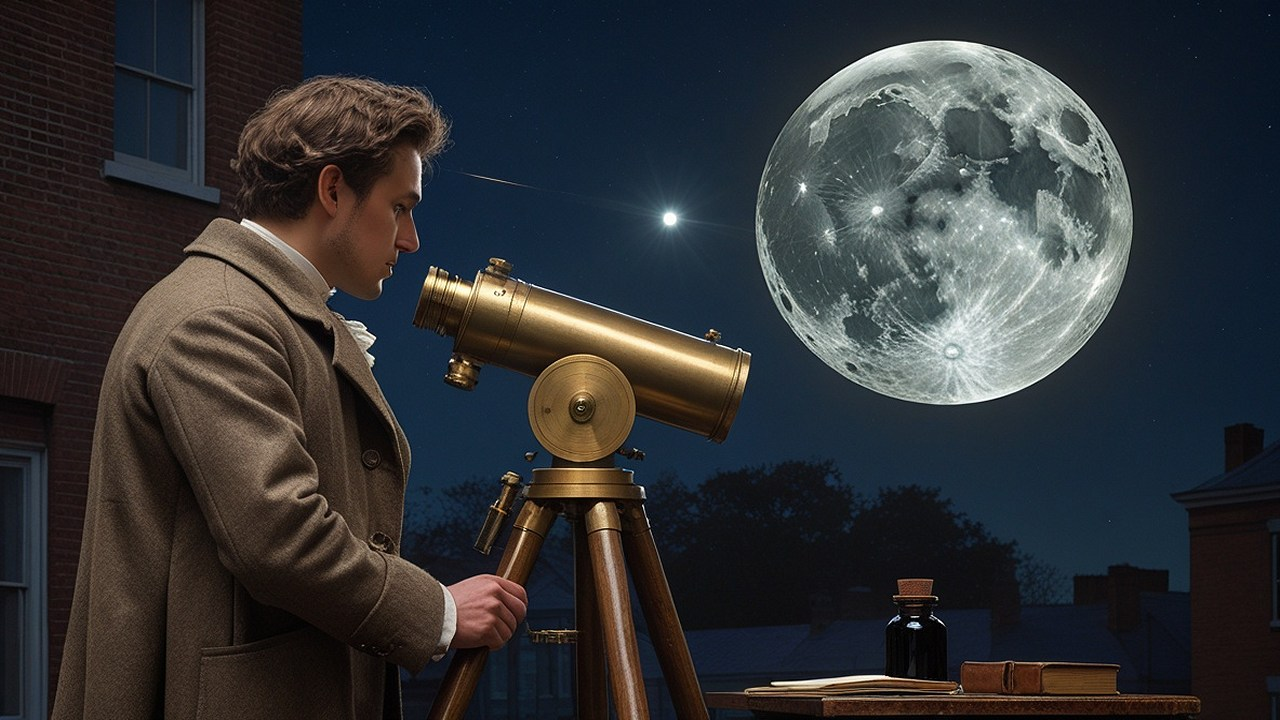
April 12, 1874, a man in London has his eye on the Moon through a six-inch refractor. He is not hunting shooting stars. He is doing what Victorian amateurs did on clear nights. He is looking at a world he thinks he already knows.
Then a point of light appears on the disk.
Intensely white. Almost dazzling.
It runs west to east in a straight line.
It leaves a faint trail.
It dies at the limb.
One and a half to two seconds.
Gone.
The same night, a smaller telescope in Edinburgh sees the same streak.
The same night, a rural observer in northern England calls it a shooting star — then corrects himself. It was against the Moon. It was slower than any meteor he had watched in the open sky. And it did not keep going into the dark.
Three stations. Hundreds of miles apart. Men who did not know each other. Different glass.
One Moon.
April 1874. A White Streak Across the Moon.
If you think unidentified objects begin with radar and fighter jets, this night is a problem. There is no airplane that can do this. There is no satellite. The Space Age is almost a century away. Balloons do not cross the lunar disk as a dazzling white point and vanish at the edge. Birds do not look like stellar sparks against the bright face of the Moon for two seconds and leave a trail three separate observers all notice.
This is a lunar transit case. Not a light over a barn. Not a story told decades later to a magazine. It is a published astronomical record from the decade when amateur lunar study was becoming a serious craft.
By the 1870s, looking at the Moon was no longer a private hobby for a few gentlemen. Telescopes were cheaper. Local observatories had multiplied. Journals reached readers who would never hold a university chair. Men with six-inch refractors in garden sheds and smaller instruments in city windows kept logs, made sketches, timed shadows on crater walls, and compared notes through the post.
The Selenographical Society — founded in 1865 in England, according to the source material for this chapter — published the Selenographical Journal. It was a dedicated periodical for lunar studies. Sketches. Measurements. Reports of anything unusual on the Moon’s surface. This was not a fringe pamphlet. It was edited and contributed to by respected astronomers, many of them fellows of the Royal Astronomical Society. Crater catalogs sat beside eclipse timings. Drawings of Mare Crisium sat beside notes on lights that did not belong.
It was in those pages that this transit was written down.
The reports did not come from one rooftop.
In London, an amateur using a 6-inch refractor recorded a rapid transit from west to east across the visible face. He was looking at the Moon. The white point appeared, crossed, and was gone. The path was linear. The color was not the dirty yellow or green of a common meteor. It was white enough to startle.
In Edinburgh, another observer with a smaller instrument saw a brilliant white streak appear suddenly, travel the disk in a straight line, and vanish at the limb. He was not copying a London letter. Same night. Same geometry. Same bright screen.
From northern England, a rural observer reached for the nearest word he had — shooting star — and then refused to let the word stand alone. Against the Moon. Slower than meteors he had seen in the open sky. Confined to the disk.
All three locked on the same details: intense whiteness, linear path, about 1.5 to 2 seconds, a faint trailing glow that faded fast.
They did not agree because they had compared notes first. They agreed because they had seen the same class of event.
The Selenographical Journal printed the accounts in the next issue, under a section reserved for “unusual phenomena.”
The editor did the honest thing. He noted that the observers were unknown to each other, used different instruments, and were separated by hundreds of miles. Local illusion is a weak story when London, Edinburgh, and a northern field all write down the same brief white crossing. Shared misperception needs a shared scene. There was no shared scene. There was a shared Moon.
No bright meteor shower was active that night. No artificial satellite existed. Nothing in the Victorian inventory of flying machines matches a dazzling white point that crosses the lunar disk and stops at the limb.
A grazing meteor should look slower and leave a longer trail. High-altitude ice crystals do not produce a uniform white point with a short fading trail confined to the disk.
Skeptics spoke then, as they do now. That is not a scandal. Victorian astronomers were not waiting for flying saucers. They were waiting for error. A fireball entering at such an angle that it briefly silhouetted against the Moon was suggested. Eye fatigue. Lens flare.
Those alternatives do not carry the file.
A fireball bright enough to be called intensely white against the Moon should have been seen across a wide sky and reported as a meteor. None were. The motion stayed on the disk. It did not continue into the surrounding darkness the way a bolide should. Three independent descriptions of the same duration, the same direction, the same color, the same trail, and the same vanishing point is not a coincidence. Coincidence is a word. It is not a machine that writes three notebooks at once.
Lens flare does not travel west to east across the Moon for observers hundreds of miles apart. Eye fatigue does not draw the same trail in London and Edinburgh on the same night.
This case is one of the strongest naked-eye and small-telescope lunar transits of the Victorian era precisely because it is short.
Most earlier disk crossings last seconds to minutes. This one is a fraction of two seconds. That brevity is the opposite of comfort. Taken seriously, it implies extreme velocity — or an object much closer than a typical meteor if the crossing time is real.
The color works against the easy meteor file too. Typical meteors burn with color changes and linger. This was intensely white. The trail was faint and died quickly.
The journal’s decision to publish without dismissal is part of the evidence. This was not a spiritualist circular. April 12 sat beside crater measurements and eclipse timings. That is how 19th-century lunar observers understood their job. When the witnesses were credible and the sighting was multi-station, they recorded it. They had no radar. They had no digital cameras. They had disciplined looking, letters in the post, and a habit of writing down what the maps did not predict.
Amateur astronomy in Britain in the 1870s was respectable. A man with a six-inch refractor was often a teacher, a clerk, a physician, a retired officer, or a society fellow whose sketches could be compared. The Moon was the perfect amateur target: bright, large, familiar. A new light on that familiar disk is more shocking, not less, because the background is known.
Scotland and England shared journals and the same civil night. London and Edinburgh on the same date is not a rumor on a coach road. It is two optical records on one celestial screen. The rural northern observer adds a third angle. Later researchers would call that a multi-station case, even if the stations were a townhouse, a city window, and a field.
Listen to the language again.
Intensely white.
Almost dazzling.
A shooting star, but against the Moon.
Those are not the phrases of men inventing a spaceship. They are the phrases of men grabbing the nearest comparison and then correcting it. The correction is the case. Ordinary meteors do not stay politely on the lunar disk. Ordinary reflections do not leave a faint trail that three men watch die.
[SECTION: WHAT YOU CANNOT RETROFIT]
From this century it is tempting to say satellite. Debris. Aircraft.
The calendar forbids it.
There were no satellites. There was no orbital junk. There was no aircraft that could present as a dazzling white point crossing the Moon in under two seconds and leaving a short trail visible from London, Edinburgh, and northern England at the same time.
It is also tempting to say they saw a meteor and sit down.
That flattening ignores the editor’s note: no shower, no matching wide-sky fireball reports, motion that did not continue off the disk. A meteor that is invisible everywhere except exactly on the Moon, for two seconds, to three separated observers, is not the simple answer. It is the strained one.
This night does not stand alone in the longer record of objects crossing the lunar disk, lights that do not act like stars, motions that do not match known mechanics. It does not prove an occupied Moon. It does not need to. Its value is narrower and harder.
It shows that trained and semi-trained observers, with real instruments, in a journal that cared about crater diameters, wrote down a white object that crossed the Moon too fast for the available names.
Victorian science loved classification. What survived classification was not celebrated. It was filed. The Selenographical Journal filed this under unusual phenomena and went back to maps. That calm is easy to call indifference. It is better read as confidence that the record would outlast the night.
A great deal of later anomaly literature — sketches, radar, pilot reports — begins with the same refusal: do not throw away two seconds of white light because the textbook has no drawer for it.
Here is what can be said without leaving the evidence.
On April 12, 1874, at least three observers in England and Scotland, unknown to one another, using different telescopes, watched an intensely white luminous object cross the Moon from west to east in roughly 1.5 to 2 seconds, leave a faint trail that faded quickly, and vanish at the limb. A serious lunar journal published the reports and underlined the independence of the witnesses. No meteor shower, satellite, or matching fireball report accounts for a motion confined to the disk. The explanations offered at the time remain incomplete.
The Moon that night was not a blank. It was a screen.
Something bright moved across it and was gone.
The men who saw it did the scientific thing.
They wrote it down.
The file is still open because the observations were short, consistent, and inconvenient. Inconvenience is not a visitor’s passport. It is proof that a six-inch refractor in Victorian Britain could catch what a journal could not name.
Multiple stations. Independent instruments. A published record. A duration too brief for comfort. A color too clean for a common meteor. A path that ended where the Moon ended.
That is the case.
If you only want craters, take the craters.
If you want the whole Victorian Moon, you also take the two seconds that would not sit still.
If this investigation was useful, subscribe. The historical sky is not empty. It is under-read.
April 12, 1874, a man in London has his eye on the Moon through a six-inch refractor. He is not hunting shooting stars. He is doing what Victorian amateurs did on clear nights. He is looking at a world he thinks he already knows.
Then a point of light appears on the disk.
Intensely white. Almost dazzling.
It runs west to east in a straight line.
It leaves a faint trail.
It dies at the limb.
One and a half to two seconds.
Gone.
The same night, a smaller telescope in Edinburgh sees the same streak.
The same night, a rural observer in northern England calls it a shooting star — then corrects himself. It was against the Moon. It was slower than any meteor he had watched in the open sky. And it did not keep going into the dark.
Three stations. Hundreds of miles apart. Men who did not know each other. Different glass.
One Moon.
April 1874. A White Streak Across the Moon.
If you think unidentified objects begin with radar and fighter jets, this night is a problem. There is no airplane that can do this. There is no satellite. The Space Age is almost a century away. Balloons do not cross the lunar disk as a dazzling white point and vanish at the edge. Birds do not look like stellar sparks against the bright face of the Moon for two seconds and leave a trail three separate observers all notice.
This is a lunar transit case. Not a light over a barn. Not a story told decades later to a magazine. It is a published astronomical record from the decade when amateur lunar study was becoming a serious craft.
By the 1870s, looking at the Moon was no longer a private hobby for a few gentlemen. Telescopes were cheaper. Local observatories had multiplied. Journals reached readers who would never hold a university chair. Men with six-inch refractors in garden sheds and smaller instruments in city windows kept logs, made sketches, timed shadows on crater walls, and compared notes through the post.
The Selenographical Society — founded in 1865 in England, according to the source material for this chapter — published the Selenographical Journal. It was a dedicated periodical for lunar studies. Sketches. Measurements. Reports of anything unusual on the Moon’s surface. This was not a fringe pamphlet. It was edited and contributed to by respected astronomers, many of them fellows of the Royal Astronomical Society. Crater catalogs sat beside eclipse timings. Drawings of Mare Crisium sat beside notes on lights that did not belong.
It was in those pages that this transit was written down.
The reports did not come from one rooftop.
In London, an amateur using a 6-inch refractor recorded a rapid transit from west to east across the visible face. He was looking at the Moon. The white point appeared, crossed, and was gone. The path was linear. The color was not the dirty yellow or green of a common meteor. It was white enough to startle.
In Edinburgh, another observer with a smaller instrument saw a brilliant white streak appear suddenly, travel the disk in a straight line, and vanish at the limb. He was not copying a London letter. Same night. Same geometry. Same bright screen.
From northern England, a rural observer reached for the nearest word he had — shooting star — and then refused to let the word stand alone. Against the Moon. Slower than meteors he had seen in the open sky. Confined to the disk.
All three locked on the same details: intense whiteness, linear path, about 1.5 to 2 seconds, a faint trailing glow that faded fast.
They did not agree because they had compared notes first. They agreed because they had seen the same class of event.
The Selenographical Journal printed the accounts in the next issue, under a section reserved for “unusual phenomena.”
The editor did the honest thing. He noted that the observers were unknown to each other, used different instruments, and were separated by hundreds of miles. Local illusion is a weak story when London, Edinburgh, and a northern field all write down the same brief white crossing. Shared misperception needs a shared scene. There was no shared scene. There was a shared Moon.
No bright meteor shower was active that night. No artificial satellite existed. Nothing in the Victorian inventory of flying machines matches a dazzling white point that crosses the lunar disk and stops at the limb.
A grazing meteor should look slower and leave a longer trail. High-altitude ice crystals do not produce a uniform white point with a short fading trail confined to the disk.
Skeptics spoke then, as they do now. That is not a scandal. Victorian astronomers were not waiting for flying saucers. They were waiting for error. A fireball entering at such an angle that it briefly silhouetted against the Moon was suggested. Eye fatigue. Lens flare.
Those alternatives do not carry the file.
A fireball bright enough to be called intensely white against the Moon should have been seen across a wide sky and reported as a meteor. None were. The motion stayed on the disk. It did not continue into the surrounding darkness the way a bolide should. Three independent descriptions of the same duration, the same direction, the same color, the same trail, and the same vanishing point is not a coincidence. Coincidence is a word. It is not a machine that writes three notebooks at once.
Lens flare does not travel west to east across the Moon for observers hundreds of miles apart. Eye fatigue does not draw the same trail in London and Edinburgh on the same night.
This case is one of the strongest naked-eye and small-telescope lunar transits of the Victorian era precisely because it is short.
Most earlier disk crossings last seconds to minutes. This one is a fraction of two seconds. That brevity is the opposite of comfort. Taken seriously, it implies extreme velocity — or an object much closer than a typical meteor if the crossing time is real.
The color works against the easy meteor file too. Typical meteors burn with color changes and linger. This was intensely white. The trail was faint and died quickly.
The journal’s decision to publish without dismissal is part of the evidence. This was not a spiritualist circular. April 12 sat beside crater measurements and eclipse timings. That is how 19th-century lunar observers understood their job. When the witnesses were credible and the sighting was multi-station, they recorded it. They had no radar. They had no digital cameras. They had disciplined looking, letters in the post, and a habit of writing down what the maps did not predict.
Amateur astronomy in Britain in the 1870s was respectable. A man with a six-inch refractor was often a teacher, a clerk, a physician, a retired officer, or a society fellow whose sketches could be compared. The Moon was the perfect amateur target: bright, large, familiar. A new light on that familiar disk is more shocking, not less, because the background is known.
Scotland and England shared journals and the same civil night. London and Edinburgh on the same date is not a rumor on a coach road. It is two optical records on one celestial screen. The rural northern observer adds a third angle. Later researchers would call that a multi-station case, even if the stations were a townhouse, a city window, and a field.
Listen to the language again.
Intensely white.
Almost dazzling.
A shooting star, but against the Moon.
Those are not the phrases of men inventing a spaceship. They are the phrases of men grabbing the nearest comparison and then correcting it. The correction is the case. Ordinary meteors do not stay politely on the lunar disk. Ordinary reflections do not leave a faint trail that three men watch die.
[SECTION: WHAT YOU CANNOT RETROFIT]
From this century it is tempting to say satellite. Debris. Aircraft.
The calendar forbids it.
There were no satellites. There was no orbital junk. There was no aircraft that could present as a dazzling white point crossing the Moon in under two seconds and leaving a short trail visible from London, Edinburgh, and northern England at the same time.
It is also tempting to say they saw a meteor and sit down.
That flattening ignores the editor’s note: no shower, no matching wide-sky fireball reports, motion that did not continue off the disk. A meteor that is invisible everywhere except exactly on the Moon, for two seconds, to three separated observers, is not the simple answer. It is the strained one.
This night does not stand alone in the longer record of objects crossing the lunar disk, lights that do not act like stars, motions that do not match known mechanics. It does not prove an occupied Moon. It does not need to. Its value is narrower and harder.
It shows that trained and semi-trained observers, with real instruments, in a journal that cared about crater diameters, wrote down a white object that crossed the Moon too fast for the available names.
Victorian science loved classification. What survived classification was not celebrated. It was filed. The Selenographical Journal filed this under unusual phenomena and went back to maps. That calm is easy to call indifference. It is better read as confidence that the record would outlast the night.
A great deal of later anomaly literature — sketches, radar, pilot reports — begins with the same refusal: do not throw away two seconds of white light because the textbook has no drawer for it.
Here is what can be said without leaving the evidence.
On April 12, 1874, at least three observers in England and Scotland, unknown to one another, using different telescopes, watched an intensely white luminous object cross the Moon from west to east in roughly 1.5 to 2 seconds, leave a faint trail that faded quickly, and vanish at the limb. A serious lunar journal published the reports and underlined the independence of the witnesses. No meteor shower, satellite, or matching fireball report accounts for a motion confined to the disk. The explanations offered at the time remain incomplete.
The Moon that night was not a blank. It was a screen.
Something bright moved across it and was gone.
The men who saw it did the scientific thing.
They wrote it down.
The file is still open because the observations were short, consistent, and inconvenient. Inconvenience is not a visitor’s passport. It is proof that a six-inch refractor in Victorian Britain could catch what a journal could not name.
Multiple stations. Independent instruments. A published record. A duration too brief for comfort. A color too clean for a common meteor. A path that ended where the Moon ended.
That is the case.
If you only want craters, take the craters.
If you want the whole Victorian Moon, you also take the two seconds that would not sit still.
If this investigation was useful, subscribe. The historical sky is not empty. It is under-read.