


Blog Categories
- African Incidents
- Atlantis Incidents
- Australian Incidents
- Belgian Incidents
- Bermuda Triangle Incidents
- Brazilian Incidents
- Canadian Incidents
- Chinese Incidents
- European Incidents
- France Incidents
- Ghosts
- Giants
- Italy Incidents
- Japanese Incidents
- Middle East Incidents
- Portugal Incidents
- Project Serpo
- Puerto Rico Incidents
- Russian Incidents
- Sasquatch
- Scandinavia Incidents
- Spanish Incidents
- UFOs
- United Kingdom Incidents
- United States Incidents
April 1897: Kendall Mountain Lights
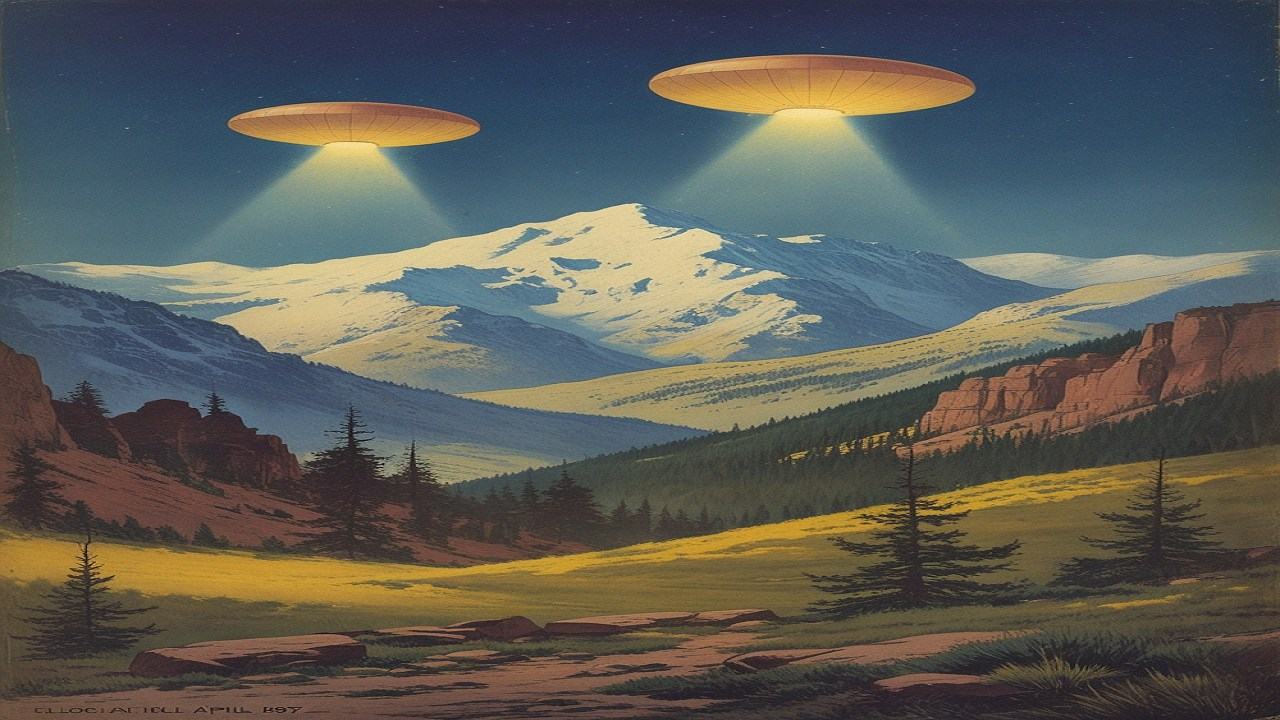
In the spring of 1897, a wave of “mystery airships” or supernatural / unknown aerial lights swept across many parts of the United States. In Colorado, among the more notable reports was one from Silverton, in the San Juan Mountains, at the Silver Lake Mine, east of Kendall Mountain. On or about April 24, 1897, the Silverton Standard newspaper printed an account by a night watchman, Mr. T. K. Holden, who claimed to have seen two yellow lights approximately eight feet apart, hovering about 1,000 feet above the ground.
From that vantage he said he could discern—under moonlight—the outline of what appeared to be a vessel or “air-ship,” which he judged to be about 24 feet long and 8 feet wide. The object was said to move at considerable speed—Holden reported that the “airship” sailed toward Mount Solomon at what he estimated to be at least 60 miles per hour, then upon reaching the mountain, rose and cleared the peak.
The report included a note on Holden’s reputation: the Silverton Standard emphasized that “Mr. Holden is a man of good standing … noted for his truth and veracity, and being at all times strictly temperate…” thereby trying to lend credibility to his account.
Interestingly, the report did not stand alone. The day before, April 23, 1897, the Aspen Daily News published a similar account: miners from the Aspen and Durant mines coming off their shift claimed to have witnessed a mysterious airship early in the morning (after 1:00 a.m.), appearing as a bright light resembling a locomotive headlight (but larger), crossing the sky during snow and darkness.
These linked reports contribute to the sense that Holden’s sighting was part of a broader “airship craze” or flap across Colorado and other Western states in that period.
Impact on People at the Time
The immediate impact in 1897 of these Silverton / Silver Lake Mine sightings was mainly in the same vein as many frontier newspaper tales: curiosity, sensational interest, and a fair amount of debate. Some of the ways it affected people then:
Public Sensation and Debate: The report of Holden was printed, discussed, and connected with other similar sightings across Colorado and the US. The presence of multiple reports in different towns (e.g. Aspen, Cripple Creek, Denver, etc.) made this more than a local oddity. Newspapers collected these reports and published them, sometimes giving weight to the notions of unknown air-vessels or experiments, weather balloons, or inventors at work.
Credibility & Social Standing: The emphasis on Holden’s character suggests that readers were concerned about credibility. In a small, mining community like Silverton, reputation mattered, and the paper’s insistence that Holden was “noted for truth and veracity” was almost necessary to assure readers that this wasn’t just drunken exaggeration or hallucination.
Fear, Wonder, and Imagination: For many people, especially in remote mountain mining towns, communication was slower, scientific instrumentation rarer, and isolation greater. Reports such as these likely stirred both fear and fascination: fear of the unknown, perhaps of other worldly powers; fascination with technology, innovation (people wondered, could this be some new kind of craft), or natural phenomena.
Media Culture and the Airship Wave: The report became part of what historians now call the “mystery airship” wave of 1896–97, when many folks in the U.S. reported seeing strange flying machines, often described as cigar-shaped, with lights, and sometimes moving erratically. The Silverton case added a high altitude, mountainous example. These stories contributed to popular culture, local storytelling, and perhaps even investor or inventor speculation (“which genius is building these mysterious vessels”).
Effects & Legacy Over Time
Though there is no evidence the Silver Lake case resulted in any long term official investigation (by government or the military) that has survived in clear archival record, it has had lasting influence and is often referenced in later UFO / airship histories. Some of the continuing effects:
Historical UFO / Airship Studies: Modern writers and researchers of UFO history often cite the Silver Lake Mine case among early western U.S. reports. It is used to illustrate how sightings were not restricted to plains or urban areas but reached into remote, mountainous mining regions.
Local Lore and Regional Identity: Silverton, San Juan County, and the mining districts around Silver Lake are known among UFO enthusiasts for this case. The story contributes to the folklore of the area. Even if many locals regard it as anecdote or legend, it is part of the region’s mystique.
Comparative Research: When scholars look at patterns of airship sightings (dates, descriptions, geography), this case helps form part of a dataset. For example, comparing how different locale’s geology, altitude, weather (snow, moonlight), and population density influence reports. The Silver Lake case, being at altitude in the Rockies, adds useful contrast with flatland cases.
Influence on Popular Media / Speculation: While I found no specific documentary or film that has made Silver Lake the central setting, its inclusion in blogs, books, and websites focused on early UFO history ensures it remains part of the cultural imagination.
Skeptical and Alternative Explanations: The case, like many early sightings, has been the subject of speculation: could the watchman have mistaken natural phenomena (reflections, moonlight, lights from mines), optical illusions, meteors, or even hoaxes? The lack of follow-up physical evidence keeps the case mysterious and thus a point for both proponents and skeptics.
Notable Persons and Veracity
T. K. Holden: The night watchman at the Silver Lake Mine is the key person in this account. The Standard made specific reference to his character—his reputation for truth and temperance—as important. Beyond that, I found no strong archival source confirming much more about his life, subsequent statements, or other corroborations beyond the newspaper article itself.
Newspapers / Press: The Silverton Standard is the local source that printed the report on April 24, 1897. The Aspen Daily News published corroborating / similar reports the previous day. These newspapers served important roles—frontier media, transmitting local sensation to regional readership, helping to spread information (and rumors).
Historians / Modern Writers: Carol Turner, for example, in her blog “Intriguing Faces and Places from Colorado’s Past,” has written about this case in modern times, collecting these reports, comparing them, and bringing them to public attention. Her retellings are based on newspaper archives (e.g. the Silverton Standard, the Aspen Daily News) and local historical materials.
What We Don’t Know / Gaps
Because this event happened over 125 years ago, many details are lacking, which limits firm conclusions:
There is no known photograph, physical artifact, or official government investigation (at least none that is commonly cited or that I found) that verifies the object or lights beyond the newspaper description.
The exact conditions (weather, moon phase, distance, angle) are somewhat vague: “moonlight” is mentioned, but things like wind, temperature, landscape details (trees, mine structures) are not fully given.
There are no known follow-ups involving air-ship inventors identification, or claims from aerial experimenters, or official statements beyond local press.
It is hard to separate sensationalism (newspapers seeking readership) from fact; frontier newspapers often reported strange lights or tales without strong verification.
How It Affects People & Community Today
While the event happened in 1897, its reverberations persist in several ways:
Cultural / Tourist Interest: Silverton, as a historical mining town in the San Juan Mountains, is a place of interest for many kinds of history enthusiasts (mining history, ghost towns, frontier stories). The airship / lights story adds an element of mystery that tourists, UFO buffs, and locals often find intriguing.
UFO / Airship Historical Scholarship: Researchers studying early UFO sightings use cases like Silver Lake to understand how the phenomenon evolved, what kinds of witnesses were making claims, how media reported them, and how people interpreted strange lights before the age of modern aircraft and satellites.
Local Identity & Storytelling: Communities like Silverton often embrace their mining heritage, ghost stories, tales of “something extra” in the sky. The Silver Lake Mine case becomes part of local lore, something that connects the present generation to the frontier past.
Skepticism and Critical Inquiry: This case is also used as an example in skeptical literature: how claims must be evaluated, how witness reputation and newspaper framing affect belief, and how absence of physical evidence limits conclusions. It’s a reference point in balancing belief and doubt.
Conclusion
The April 1897 Silver Lake Mine sighting is a fascinating fragment of early American “mystery airship” lore—one of those frontier tales that combine mining, moonlight, strange lights, and the unknown.
Though lacking in physical proof, its detailed witness description (of two yellow lights, the outline of a vessel, rapid movement) and the emphasis in the original report on the credibility of the witness give it more heft than many other reports of its kind.
While it clearly made a stir in its day—part of a broader wave of aerial mysteries—the case’s impact today is more historical and cultural than scientific. It helps modern students of UFO/airship history understand how people in remote, pre-aviation-era America perceived anomalous phenomena, how media treated such reports, and how legend can grow out of limited data.
Ultimately, like many early reports, the Silver Lake Mine case remains unresolved and mysterious. It stands as a reminder both of human wonder toward the unknown, and of the challenges in evaluating claim vs. evidence. For those interested in UFO history, it remains one of the more compelling early-frontier sightings, especially because of its specific details and credible witness characterizations.
In the spring of 1897, a wave of “mystery airships” or supernatural / unknown aerial lights swept across many parts of the United States. In Colorado, among the more notable reports was one from Silverton, in the San Juan Mountains, at the Silver Lake Mine, east of Kendall Mountain. On or about April 24, 1897, the Silverton Standard newspaper printed an account by a night watchman, Mr. T. K. Holden, who claimed to have seen two yellow lights approximately eight feet apart, hovering about 1,000 feet above the ground.
From that vantage he said he could discern—under moonlight—the outline of what appeared to be a vessel or “air-ship,” which he judged to be about 24 feet long and 8 feet wide. The object was said to move at considerable speed—Holden reported that the “airship” sailed toward Mount Solomon at what he estimated to be at least 60 miles per hour, then upon reaching the mountain, rose and cleared the peak.
The report included a note on Holden’s reputation: the Silverton Standard emphasized that “Mr. Holden is a man of good standing … noted for his truth and veracity, and being at all times strictly temperate…” thereby trying to lend credibility to his account.
Interestingly, the report did not stand alone. The day before, April 23, 1897, the Aspen Daily News published a similar account: miners from the Aspen and Durant mines coming off their shift claimed to have witnessed a mysterious airship early in the morning (after 1:00 a.m.), appearing as a bright light resembling a locomotive headlight (but larger), crossing the sky during snow and darkness.
These linked reports contribute to the sense that Holden’s sighting was part of a broader “airship craze” or flap across Colorado and other Western states in that period.
Impact on People at the Time
The immediate impact in 1897 of these Silverton / Silver Lake Mine sightings was mainly in the same vein as many frontier newspaper tales: curiosity, sensational interest, and a fair amount of debate. Some of the ways it affected people then:
Public Sensation and Debate: The report of Holden was printed, discussed, and connected with other similar sightings across Colorado and the US. The presence of multiple reports in different towns (e.g. Aspen, Cripple Creek, Denver, etc.) made this more than a local oddity. Newspapers collected these reports and published them, sometimes giving weight to the notions of unknown air-vessels or experiments, weather balloons, or inventors at work.
Credibility & Social Standing: The emphasis on Holden’s character suggests that readers were concerned about credibility. In a small, mining community like Silverton, reputation mattered, and the paper’s insistence that Holden was “noted for truth and veracity” was almost necessary to assure readers that this wasn’t just drunken exaggeration or hallucination.
Fear, Wonder, and Imagination: For many people, especially in remote mountain mining towns, communication was slower, scientific instrumentation rarer, and isolation greater. Reports such as these likely stirred both fear and fascination: fear of the unknown, perhaps of other worldly powers; fascination with technology, innovation (people wondered, could this be some new kind of craft), or natural phenomena.
Media Culture and the Airship Wave: The report became part of what historians now call the “mystery airship” wave of 1896–97, when many folks in the U.S. reported seeing strange flying machines, often described as cigar-shaped, with lights, and sometimes moving erratically. The Silverton case added a high altitude, mountainous example. These stories contributed to popular culture, local storytelling, and perhaps even investor or inventor speculation (“which genius is building these mysterious vessels”).
Effects & Legacy Over Time
Though there is no evidence the Silver Lake case resulted in any long term official investigation (by government or the military) that has survived in clear archival record, it has had lasting influence and is often referenced in later UFO / airship histories. Some of the continuing effects:
Historical UFO / Airship Studies: Modern writers and researchers of UFO history often cite the Silver Lake Mine case among early western U.S. reports. It is used to illustrate how sightings were not restricted to plains or urban areas but reached into remote, mountainous mining regions.
Local Lore and Regional Identity: Silverton, San Juan County, and the mining districts around Silver Lake are known among UFO enthusiasts for this case. The story contributes to the folklore of the area. Even if many locals regard it as anecdote or legend, it is part of the region’s mystique.
Comparative Research: When scholars look at patterns of airship sightings (dates, descriptions, geography), this case helps form part of a dataset. For example, comparing how different locale’s geology, altitude, weather (snow, moonlight), and population density influence reports. The Silver Lake case, being at altitude in the Rockies, adds useful contrast with flatland cases.
Influence on Popular Media / Speculation: While I found no specific documentary or film that has made Silver Lake the central setting, its inclusion in blogs, books, and websites focused on early UFO history ensures it remains part of the cultural imagination.
Skeptical and Alternative Explanations: The case, like many early sightings, has been the subject of speculation: could the watchman have mistaken natural phenomena (reflections, moonlight, lights from mines), optical illusions, meteors, or even hoaxes? The lack of follow-up physical evidence keeps the case mysterious and thus a point for both proponents and skeptics.
Notable Persons and Veracity
T. K. Holden: The night watchman at the Silver Lake Mine is the key person in this account. The Standard made specific reference to his character—his reputation for truth and temperance—as important. Beyond that, I found no strong archival source confirming much more about his life, subsequent statements, or other corroborations beyond the newspaper article itself.
Newspapers / Press: The Silverton Standard is the local source that printed the report on April 24, 1897. The Aspen Daily News published corroborating / similar reports the previous day. These newspapers served important roles—frontier media, transmitting local sensation to regional readership, helping to spread information (and rumors).
Historians / Modern Writers: Carol Turner, for example, in her blog “Intriguing Faces and Places from Colorado’s Past,” has written about this case in modern times, collecting these reports, comparing them, and bringing them to public attention. Her retellings are based on newspaper archives (e.g. the Silverton Standard, the Aspen Daily News) and local historical materials.
What We Don’t Know / Gaps
Because this event happened over 125 years ago, many details are lacking, which limits firm conclusions:
There is no known photograph, physical artifact, or official government investigation (at least none that is commonly cited or that I found) that verifies the object or lights beyond the newspaper description.
The exact conditions (weather, moon phase, distance, angle) are somewhat vague: “moonlight” is mentioned, but things like wind, temperature, landscape details (trees, mine structures) are not fully given.
There are no known follow-ups involving air-ship inventors identification, or claims from aerial experimenters, or official statements beyond local press.
It is hard to separate sensationalism (newspapers seeking readership) from fact; frontier newspapers often reported strange lights or tales without strong verification.
How It Affects People & Community Today
While the event happened in 1897, its reverberations persist in several ways:
Cultural / Tourist Interest: Silverton, as a historical mining town in the San Juan Mountains, is a place of interest for many kinds of history enthusiasts (mining history, ghost towns, frontier stories). The airship / lights story adds an element of mystery that tourists, UFO buffs, and locals often find intriguing.
UFO / Airship Historical Scholarship: Researchers studying early UFO sightings use cases like Silver Lake to understand how the phenomenon evolved, what kinds of witnesses were making claims, how media reported them, and how people interpreted strange lights before the age of modern aircraft and satellites.
Local Identity & Storytelling: Communities like Silverton often embrace their mining heritage, ghost stories, tales of “something extra” in the sky. The Silver Lake Mine case becomes part of local lore, something that connects the present generation to the frontier past.
Skepticism and Critical Inquiry: This case is also used as an example in skeptical literature: how claims must be evaluated, how witness reputation and newspaper framing affect belief, and how absence of physical evidence limits conclusions. It’s a reference point in balancing belief and doubt.
Conclusion
The April 1897 Silver Lake Mine sighting is a fascinating fragment of early American “mystery airship” lore—one of those frontier tales that combine mining, moonlight, strange lights, and the unknown.
Though lacking in physical proof, its detailed witness description (of two yellow lights, the outline of a vessel, rapid movement) and the emphasis in the original report on the credibility of the witness give it more heft than many other reports of its kind.
While it clearly made a stir in its day—part of a broader wave of aerial mysteries—the case’s impact today is more historical and cultural than scientific. It helps modern students of UFO/airship history understand how people in remote, pre-aviation-era America perceived anomalous phenomena, how media treated such reports, and how legend can grow out of limited data.
Ultimately, like many early reports, the Silver Lake Mine case remains unresolved and mysterious. It stands as a reminder both of human wonder toward the unknown, and of the challenges in evaluating claim vs. evidence. For those interested in UFO history, it remains one of the more compelling early-frontier sightings, especially because of its specific details and credible witness characterizations.