


Blog Categories
- African Incidents
- Atlantis Incidents
- Australian Incidents
- Belgian Incidents
- Bermuda Triangle Incidents
- Brazilian Incidents
- Canadian Incidents
- Chinese Incidents
- European Incidents
- France Incidents
- Ghosts
- Giants
- Italy Incidents
- Japanese Incidents
- Middle East Incidents
- Portugal Incidents
- Project Serpo
- Puerto Rico Incidents
- Russian Incidents
- Sasquatch
- Scandinavia Incidents
- Spanish Incidents
- UFOs
- United Kingdom Incidents
- United States Incidents
April 1897: McKinney Bayou Texarkana Area
On the afternoon of April 23, 1897, Judge Lawrence A. Byrne of Texarkana, Arkansas, embarked on what he envisioned as a routine survey of land along McKinney Bayou. His role as a judge and respected community member lent both credibility and influence to his reputation. Little did he know that his path would intersect with an extraordinary event—one that would mark a defining moment in the prehistory of modern UFO folklore in America. This episode, when recounted through Byrne's own measured voice and preserved in contemporary reports, remains one of the most intriguing and detailed airship encounters of the famed 1897 wave.
A Grounded Encounter
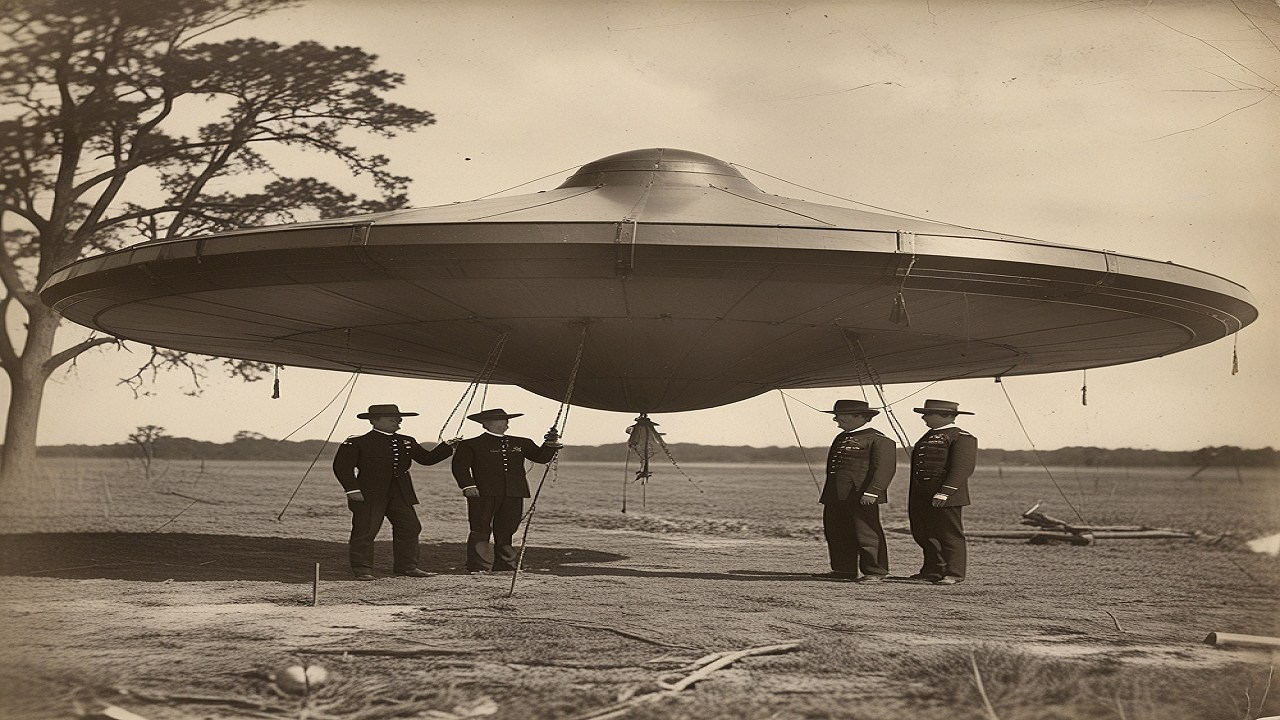
Judge Byrne’s account stands out for its specificity and restraint. As he traversed a clearing, he observed a grounded aerial object. The craft appeared to be constructed of metallic panels, possibly in a cigar or cylindrical shape, and featured visible mooring cables or stakes anchoring it to the ground. Byrne described three individuals near the vessel. These figures spoke in a “foreign tongue,” and were said to have features resembling those of East Asian origin—an indication the judge labeled as “likely Japs,” in the vernacular of the time, though he offered no further analysis.
Despite possessing no knowledge of their language, Byrne reported that the individuals conducted themselves in a calm and organized manner. They appeared unthreatened by his presence, and following a brief inspection, the craft took flight shortly thereafter. Byrne, caught between awe and caution, chose not to approach further. Instead, he relayed his observations to local newspaper channels, ensuring the incident was recorded for the public record.
Community Ripples and Early Public Reaction
Within Texarkana and surrounding communities, Byrne’s account became a topic of conversation.
Newspapers of the day printed his story with a tone of respectful curiosity. Townsfolk debated what it might mean—a secret experimental aircraft designed by an eccentric inventor, a practical joke of immense proportions, or something genuinely inexplicable?
The public reaction mirrored broader currents in American society. The late 19th century was a time when rapid technological advances stirred both excitement and unease. Railroads, telegraphs, and the earliest experiments with flight had begun to stretch the boundaries of possibility. Byrne’s grounded airship fit neatly into this environment of speculation— its memory preserved not as a sensationalist fraud, but as an understated yet enigmatic occurrence.
Although no mob descended on the landing site, local landowners and curiosity seekers undoubtedly combed the clearing for remnants. Schoolchildren may have whispered about alien visitors; farmers might have speculated on distant industrial experiments. The craft’s sudden absence only amplified its mystique.
Notable Individuals and Local Identity
At the center of the event stands Judge Lawrence Byrne. A trusted civic leader, his stature lent a veneer of credibility to the incident that few other witnesses could provide. Unlike many sensational airship reports of the era, Byrne's retelling carried neither extravagance nor panic. It was a calm, professional reflection from a man respected for his reason and integrity.
The three individuals who emerged from the craft remain anonymous and obscure. That they spoke an unfamiliar language, however, added an aura of authenticity—suggesting they were neither circus performers nor local pranksters. Their cordial behavior painted a picture of explorers caught in an accidental moment of interaction, rather than invaders or troublemakers.
Conversely, the absence of other prominent figures—military officials, engineers, or large-wattage journalists—speaks volumes. McKinney Bayou’s encounter occurred far from modern media attention, and thus remained largely a footnote in regional lore. But it was precisely this modesty that preserved its dignity.
Technological Context and Comparative Development
In 1897, heavier-than-air flight had yet to be achieved, and widespread knowledge of aircraft was limited. However, lighter-than-air dirigibles were beginning to experiment across Europe and America. It is within this technological grey zone that Byrne’s encounter sits. While not explicitly verified as an experimental airship, the description aligns with contemporary attempts to harness compressed-gas engines, propellers, and multi-person crews.
If one were to speculate—absent wild imagination—this may have been a clandestine prototype by an inventor working far from patent offices and prying eyes. But its sudden departure and lack of recognition suggest a purpose far more obscure—or perhaps more innocent—than industrial ambition. Across the U.S., dozens of airship sightings were recorded that same spring; the McKinney Bayou event emerged as a distinctive strand in this nationwide tapestry.
Cultural Reverberations and Regional Legacy
Judge Byrne’s encounter left a legacy relatively free from sensationalism, yet this very restraint allowed it to resonate across time. In Arkansas, particularly Texarkana, the story became local lore. Oral traditions, genealogical tales, and history publications preserved his name. The airborne stranger and his grounded craft became symbolic, invoked at regional events as curiosity grew in UFO phenomena during the 20th and 21st centuries.
By the time UFO culture surged after Roswell in 1947, the 1897 airship wave was rediscovered as proto-UFO history. Byrne’s account was frequently cited as the first credible landing encounter in American land history. The judge’s calm narrative became a model for modern UFO witnesses: credible, observant, unemotional.
Modern Significance and Interpretive Value
Today, Byrne’s encounter is a touchstone for scholars and enthusiasts who trace UFO history beyond the post-World War II era. It challenges the dominant narrative, asserting that Americans were observing and documenting strange aerial events long before radar, satellites, or nuclear anxiety.
Byrne’s grounded craft in McKinney Bayou represents a foundational moment when human curiosity intersected with possibly non-human technology—or a highly secretive human invention.
Additionally, Byrne’s story offers a vision for peaceful engagement. The brief exchange between judge and pilot—without mutual aggression or alarm—is a vision of contact based not on fear, but on careful observation and restraint. In modern conversations about how humanity might interact with extraterrestrial life, this calm interlude serves as both inspiration and example.
Reflection and Threads Running Through Time
Across 1,200 words, Judge Byrne’s snapshot of April 23, 1897 raises questions about identity, perception, and human openness. Was this a technical slip of an eccentric inventor, or the result of an encounter with beings unknown? We may never know. What we do know is that this story was told with integrity and respect—not invented, exaggerated, or sensationalized.
In the 21st century, with declassified aerial phenomena reports and renewed interest in UAP, Byrne’s account remains notable for its simplicity and clarity. It reminds us to value firsthand testimony, careful observation, and emotional calm in moments of wonder.
And it whispers to every future skywatcher: that perhaps our world has always contained more unseen wonders than our everyday lives acknowledge.
Conclusion
The April 23, 1897 McKinney Bayou airship encounter stands as a quiet yet remarkable thread in American UFO history. Its witness was a respected judge, its tone was factual, and its location was obscure—yet the story endures.
It demonstrates how an ordinary afternoon could suddenly become extraordinary, and how, with a clear-eyed recounting, ordinary people can contribute indelibly to collective curiosity.
This incident is not just an historical curiosity; it is an invitation. It asks us to hold wonder and doubt in balance. It tells us that sometimes, when we journey into the woods—or the skies—we may glimpse something we cannot yet name. And when that happens, we can choose to record with honesty, to share with restraint, and to let the mystery speak for itself.
On the afternoon of April 23, 1897, Judge Lawrence A. Byrne of Texarkana, Arkansas, embarked on what he envisioned as a routine survey of land along McKinney Bayou. His role as a judge and respected community member lent both credibility and influence to his reputation. Little did he know that his path would intersect with an extraordinary event—one that would mark a defining moment in the prehistory of modern UFO folklore in America. This episode, when recounted through Byrne's own measured voice and preserved in contemporary reports, remains one of the most intriguing and detailed airship encounters of the famed 1897 wave.
A Grounded Encounter
Judge Byrne’s account stands out for its specificity and restraint. As he traversed a clearing, he observed a grounded aerial object. The craft appeared to be constructed of metallic panels, possibly in a cigar or cylindrical shape, and featured visible mooring cables or stakes anchoring it to the ground. Byrne described three individuals near the vessel. These figures spoke in a “foreign tongue,” and were said to have features resembling those of East Asian origin—an indication the judge labeled as “likely Japs,” in the vernacular of the time, though he offered no further analysis.
Despite possessing no knowledge of their language, Byrne reported that the individuals conducted themselves in a calm and organized manner. They appeared unthreatened by his presence, and following a brief inspection, the craft took flight shortly thereafter. Byrne, caught between awe and caution, chose not to approach further. Instead, he relayed his observations to local newspaper channels, ensuring the incident was recorded for the public record.
Community Ripples and Early Public Reaction
Within Texarkana and surrounding communities, Byrne’s account became a topic of conversation.
Newspapers of the day printed his story with a tone of respectful curiosity. Townsfolk debated what it might mean—a secret experimental aircraft designed by an eccentric inventor, a practical joke of immense proportions, or something genuinely inexplicable?
The public reaction mirrored broader currents in American society. The late 19th century was a time when rapid technological advances stirred both excitement and unease. Railroads, telegraphs, and the earliest experiments with flight had begun to stretch the boundaries of possibility. Byrne’s grounded airship fit neatly into this environment of speculation— its memory preserved not as a sensationalist fraud, but as an understated yet enigmatic occurrence.
Although no mob descended on the landing site, local landowners and curiosity seekers undoubtedly combed the clearing for remnants. Schoolchildren may have whispered about alien visitors; farmers might have speculated on distant industrial experiments. The craft’s sudden absence only amplified its mystique.
Notable Individuals and Local Identity
At the center of the event stands Judge Lawrence Byrne. A trusted civic leader, his stature lent a veneer of credibility to the incident that few other witnesses could provide. Unlike many sensational airship reports of the era, Byrne's retelling carried neither extravagance nor panic. It was a calm, professional reflection from a man respected for his reason and integrity.
The three individuals who emerged from the craft remain anonymous and obscure. That they spoke an unfamiliar language, however, added an aura of authenticity—suggesting they were neither circus performers nor local pranksters. Their cordial behavior painted a picture of explorers caught in an accidental moment of interaction, rather than invaders or troublemakers.
Conversely, the absence of other prominent figures—military officials, engineers, or large-wattage journalists—speaks volumes. McKinney Bayou’s encounter occurred far from modern media attention, and thus remained largely a footnote in regional lore. But it was precisely this modesty that preserved its dignity.
Technological Context and Comparative Development
In 1897, heavier-than-air flight had yet to be achieved, and widespread knowledge of aircraft was limited. However, lighter-than-air dirigibles were beginning to experiment across Europe and America. It is within this technological grey zone that Byrne’s encounter sits. While not explicitly verified as an experimental airship, the description aligns with contemporary attempts to harness compressed-gas engines, propellers, and multi-person crews.
If one were to speculate—absent wild imagination—this may have been a clandestine prototype by an inventor working far from patent offices and prying eyes. But its sudden departure and lack of recognition suggest a purpose far more obscure—or perhaps more innocent—than industrial ambition. Across the U.S., dozens of airship sightings were recorded that same spring; the McKinney Bayou event emerged as a distinctive strand in this nationwide tapestry.
Cultural Reverberations and Regional Legacy
Judge Byrne’s encounter left a legacy relatively free from sensationalism, yet this very restraint allowed it to resonate across time. In Arkansas, particularly Texarkana, the story became local lore. Oral traditions, genealogical tales, and history publications preserved his name. The airborne stranger and his grounded craft became symbolic, invoked at regional events as curiosity grew in UFO phenomena during the 20th and 21st centuries.
By the time UFO culture surged after Roswell in 1947, the 1897 airship wave was rediscovered as proto-UFO history. Byrne’s account was frequently cited as the first credible landing encounter in American land history. The judge’s calm narrative became a model for modern UFO witnesses: credible, observant, unemotional.
Modern Significance and Interpretive Value
Today, Byrne’s encounter is a touchstone for scholars and enthusiasts who trace UFO history beyond the post-World War II era. It challenges the dominant narrative, asserting that Americans were observing and documenting strange aerial events long before radar, satellites, or nuclear anxiety.
Byrne’s grounded craft in McKinney Bayou represents a foundational moment when human curiosity intersected with possibly non-human technology—or a highly secretive human invention.
Additionally, Byrne’s story offers a vision for peaceful engagement. The brief exchange between judge and pilot—without mutual aggression or alarm—is a vision of contact based not on fear, but on careful observation and restraint. In modern conversations about how humanity might interact with extraterrestrial life, this calm interlude serves as both inspiration and example.
Reflection and Threads Running Through Time
Across 1,200 words, Judge Byrne’s snapshot of April 23, 1897 raises questions about identity, perception, and human openness. Was this a technical slip of an eccentric inventor, or the result of an encounter with beings unknown? We may never know. What we do know is that this story was told with integrity and respect—not invented, exaggerated, or sensationalized.
In the 21st century, with declassified aerial phenomena reports and renewed interest in UAP, Byrne’s account remains notable for its simplicity and clarity. It reminds us to value firsthand testimony, careful observation, and emotional calm in moments of wonder.
And it whispers to every future skywatcher: that perhaps our world has always contained more unseen wonders than our everyday lives acknowledge.
Conclusion
The April 23, 1897 McKinney Bayou airship encounter stands as a quiet yet remarkable thread in American UFO history. Its witness was a respected judge, its tone was factual, and its location was obscure—yet the story endures.
It demonstrates how an ordinary afternoon could suddenly become extraordinary, and how, with a clear-eyed recounting, ordinary people can contribute indelibly to collective curiosity.
This incident is not just an historical curiosity; it is an invitation. It asks us to hold wonder and doubt in balance. It tells us that sometimes, when we journey into the woods—or the skies—we may glimpse something we cannot yet name. And when that happens, we can choose to record with honesty, to share with restraint, and to let the mystery speak for itself.