


Blog Categories
- African Incidents
- Atlantis Incidents
- Australian Incidents
- Belgian Incidents
- Bermuda Triangle Incidents
- Brazilian Incidents
- Canadian Incidents
- Chinese Incidents
- European Incidents
- France Incidents
- Ghosts
- Giants
- Italy Incidents
- Japanese Incidents
- Middle East Incidents
- Portugal Incidents
- Project Serpo
- Puerto Rico Incidents
- Russian Incidents
- Sasquatch
- Scandinavia Incidents
- Spanish Incidents
- UFOs
- United Kingdom Incidents
- United States Incidents
April 1897: Texarkana Arkansas UFO
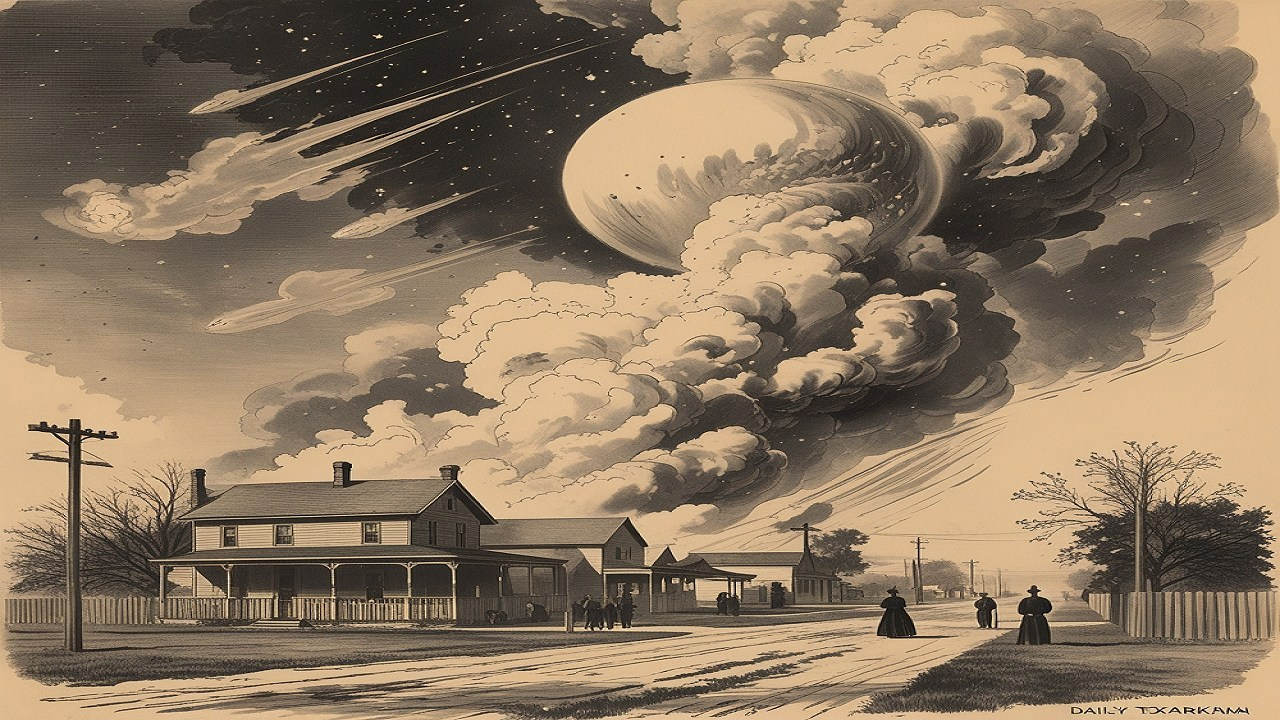
In the spring of 1897, the skies above Arkansas were alive with stories that would later become a defining part of America’s early UFO lore. One of the most intriguing and least embellished of these reports occurred on April 17, 1897, in the city of Texarkana, Miller County. On that day, a group of children witnessed what they described as a "huge ball of fire traveling with fearful velocity."
This seemingly simple account would go on to be recorded in the Daily Texarkanian and later cited by numerous researchers as a key entry in the mysterious wave of 1897 airship sightings across the United States.
The children’s observation of the fiery object is notable not only for its visual drama but also for how it fit into the broader pattern of reports happening around the country at that time. Unlike more sensational airship stories that involved human-like pilots, messages from other planets, or technological marvels far beyond the 19th-century norm, the Texarkana sighting was succinct and raw—a pure expression of awe and fear. The image of a glowing orb or fireball racing across the sky, described with urgency by children and later relayed to adults, carries with it a haunting authenticity. These were not seasoned newspaper men crafting an attention-grabbing tale, nor were they airship enthusiasts speculating on science fiction; they were children reacting to something they couldn’t explain.
J. F. Floyd, the father the children ran to, acted as an early conduit for the story, ensuring that it was shared with the local press. His inclusion in the account serves to ground the event in a real domestic setting, highlighting the way such phenomena often ripple outward from the private to the public sphere. The report, published in the Daily Texarkanian, became one of many similar stories printed across American newspapers in April of that year, yet it maintains its own identity through its straightforwardness.
What makes this case compelling even today is its contribution to the broader pattern of sightings during the 1896–1897 “airship wave,” a historic moment that some consider the beginning of modern UFOlogy in the United States. These airships were frequently described as cigar shaped with lights, sometimes piloted by strange humanoids, and often spotted hovering or landing in rural areas.
But unlike most of those encounters, the Texarkana sighting didn’t involve close contact or anthropomorphic interpretations—it was visual, immediate, and brief. It was also one of the few cases that emerged from a child’s perspective, which, for many researchers, added an additional layer of credibility. Children, especially in the 19th century, were not considered likely to fabricate such unusual stories, especially not with such specific descriptions as "traveling with fearful velocity."
The impact on the local population at the time was subtle but significant. Unlike some larger cities where airship reports prompted gatherings or even full-blown panics, Texarkana's reaction was quieter. However, the mere act of the event being printed in the local newspaper ensured that the community took it seriously, at least to the degree that it warranted preservation in public record.
Conversations would have occurred around dinner tables and in churches, speculations passing between neighbors and officials alike. Some may have believed it to be a meteor, while others may have considered it part of a larger divine or extraterrestrial phenomenon—ideas that were not uncommon during this period.
In a religiously and culturally conservative region like Arkansas at the turn of the century, such an event might have been interpreted through a theological lens. Was it a sign from God? A warning? Or something more scientific, perhaps evidence of a celestial event or manmade contraption? The answers depended on who was asked, but the event undoubtedly encouraged people to question their understanding of the skies and what might lie beyond them.
Today, the April 17, 1897 sighting holds a valuable place in the timeline of American UFO history. It is often cited by historians and UFO researchers as part of the foundational cluster of pre-Roswell sightings that demonstrated public interest and the psychological groundwork necessary for later 20th-century UFO culture to flourish. What makes this sighting particularly impactful in modern times is how it challenges the notion that UFO fascination began only after World War II. In reality, Americans were looking up with wonder and fear long before radar, satellites, or high-altitude aircraft ever existed.
There’s also a subtle sociological legacy to this sighting. Stories like the one from Texarkana helped shape regional folklore and collective memory. In places like Arkansas, where rural communities often depend on oral history and generational storytelling, such an event becomes part of the local identity, even if it’s not always cited with exact dates and newspaper references. The image of a fiery ball hurtling through the night sky on an otherwise quiet April evening is a story that grandparents might tell to their grandchildren—not to frighten, but to provoke thought and spark curiosity.
As for notable individuals connected with the case, aside from the children themselves and their father J. F. Floyd, no further names were officially tied to the report. But this anonymity also works in the story’s favor. Unlike many modern sightings where personalities become the focus and credibility is endlessly debated, the Texarkana event is humble, clean, and concise. It’s a genuine mystery—no embellishments, no after the-fact elaborations, just a singular visual report with immediate emotional impact.
There has been no recorded recurrence of a similar phenomenon in Texarkana with the same visual profile. However, the state of Arkansas has continued to be a quiet but consistent location for UFO reports through the decades, ranging from triangular crafts to abduction claims. Some researchers believe that the early airship sightings in Arkansas may reflect the beginnings of a longer-term pattern—an area with low population density, open skies, and culturally introspective communities that make it ideal for sightings to occur but difficult for mass hysteria or media exploitation to take root.
In terms of broader cultural resonance, the Texarkana event reminds us that not all UFO sightings need to involve alien beings or government cover-ups to be significant. Sometimes, it’s the simplest accounts—the flash of light, the panicked children, the father listening carefully—that tell us the most about how people respond to the unknown. It’s a human story, one that connects us not only to potential visitors from elsewhere but to each other, across generations.
In conclusion, the April 17, 1897 Texarkana UFO sighting stands as a quiet but meaningful entry in the annals of American unexplained phenomena. Its authenticity lies in its simplicity. The witnesses were ordinary, the report minimal, and the implications vast. Whether viewed as a historical curiosity, a cultural flashpoint, or a genuine unexplained aerial event, this incident invites reflection. It challenges us to remember that long before modern science fiction, government disclosures, or advanced imaging, people were already watching the skies—and sometimes, what they saw made them run for help.
In the spring of 1897, the skies above Arkansas were alive with stories that would later become a defining part of America’s early UFO lore. One of the most intriguing and least embellished of these reports occurred on April 17, 1897, in the city of Texarkana, Miller County. On that day, a group of children witnessed what they described as a "huge ball of fire traveling with fearful velocity."
This seemingly simple account would go on to be recorded in the Daily Texarkanian and later cited by numerous researchers as a key entry in the mysterious wave of 1897 airship sightings across the United States.
The children’s observation of the fiery object is notable not only for its visual drama but also for how it fit into the broader pattern of reports happening around the country at that time. Unlike more sensational airship stories that involved human-like pilots, messages from other planets, or technological marvels far beyond the 19th-century norm, the Texarkana sighting was succinct and raw—a pure expression of awe and fear. The image of a glowing orb or fireball racing across the sky, described with urgency by children and later relayed to adults, carries with it a haunting authenticity. These were not seasoned newspaper men crafting an attention-grabbing tale, nor were they airship enthusiasts speculating on science fiction; they were children reacting to something they couldn’t explain.
J. F. Floyd, the father the children ran to, acted as an early conduit for the story, ensuring that it was shared with the local press. His inclusion in the account serves to ground the event in a real domestic setting, highlighting the way such phenomena often ripple outward from the private to the public sphere. The report, published in the Daily Texarkanian, became one of many similar stories printed across American newspapers in April of that year, yet it maintains its own identity through its straightforwardness.
What makes this case compelling even today is its contribution to the broader pattern of sightings during the 1896–1897 “airship wave,” a historic moment that some consider the beginning of modern UFOlogy in the United States. These airships were frequently described as cigar shaped with lights, sometimes piloted by strange humanoids, and often spotted hovering or landing in rural areas.
But unlike most of those encounters, the Texarkana sighting didn’t involve close contact or anthropomorphic interpretations—it was visual, immediate, and brief. It was also one of the few cases that emerged from a child’s perspective, which, for many researchers, added an additional layer of credibility. Children, especially in the 19th century, were not considered likely to fabricate such unusual stories, especially not with such specific descriptions as "traveling with fearful velocity."
The impact on the local population at the time was subtle but significant. Unlike some larger cities where airship reports prompted gatherings or even full-blown panics, Texarkana's reaction was quieter. However, the mere act of the event being printed in the local newspaper ensured that the community took it seriously, at least to the degree that it warranted preservation in public record.
Conversations would have occurred around dinner tables and in churches, speculations passing between neighbors and officials alike. Some may have believed it to be a meteor, while others may have considered it part of a larger divine or extraterrestrial phenomenon—ideas that were not uncommon during this period.
In a religiously and culturally conservative region like Arkansas at the turn of the century, such an event might have been interpreted through a theological lens. Was it a sign from God? A warning? Or something more scientific, perhaps evidence of a celestial event or manmade contraption? The answers depended on who was asked, but the event undoubtedly encouraged people to question their understanding of the skies and what might lie beyond them.
Today, the April 17, 1897 sighting holds a valuable place in the timeline of American UFO history. It is often cited by historians and UFO researchers as part of the foundational cluster of pre-Roswell sightings that demonstrated public interest and the psychological groundwork necessary for later 20th-century UFO culture to flourish. What makes this sighting particularly impactful in modern times is how it challenges the notion that UFO fascination began only after World War II. In reality, Americans were looking up with wonder and fear long before radar, satellites, or high-altitude aircraft ever existed.
There’s also a subtle sociological legacy to this sighting. Stories like the one from Texarkana helped shape regional folklore and collective memory. In places like Arkansas, where rural communities often depend on oral history and generational storytelling, such an event becomes part of the local identity, even if it’s not always cited with exact dates and newspaper references. The image of a fiery ball hurtling through the night sky on an otherwise quiet April evening is a story that grandparents might tell to their grandchildren—not to frighten, but to provoke thought and spark curiosity.
As for notable individuals connected with the case, aside from the children themselves and their father J. F. Floyd, no further names were officially tied to the report. But this anonymity also works in the story’s favor. Unlike many modern sightings where personalities become the focus and credibility is endlessly debated, the Texarkana event is humble, clean, and concise. It’s a genuine mystery—no embellishments, no after the-fact elaborations, just a singular visual report with immediate emotional impact.
There has been no recorded recurrence of a similar phenomenon in Texarkana with the same visual profile. However, the state of Arkansas has continued to be a quiet but consistent location for UFO reports through the decades, ranging from triangular crafts to abduction claims. Some researchers believe that the early airship sightings in Arkansas may reflect the beginnings of a longer-term pattern—an area with low population density, open skies, and culturally introspective communities that make it ideal for sightings to occur but difficult for mass hysteria or media exploitation to take root.
In terms of broader cultural resonance, the Texarkana event reminds us that not all UFO sightings need to involve alien beings or government cover-ups to be significant. Sometimes, it’s the simplest accounts—the flash of light, the panicked children, the father listening carefully—that tell us the most about how people respond to the unknown. It’s a human story, one that connects us not only to potential visitors from elsewhere but to each other, across generations.
In conclusion, the April 17, 1897 Texarkana UFO sighting stands as a quiet but meaningful entry in the annals of American unexplained phenomena. Its authenticity lies in its simplicity. The witnesses were ordinary, the report minimal, and the implications vast. Whether viewed as a historical curiosity, a cultural flashpoint, or a genuine unexplained aerial event, this incident invites reflection. It challenges us to remember that long before modern science fiction, government disclosures, or advanced imaging, people were already watching the skies—and sometimes, what they saw made them run for help.