


Blog Categories
- African Incidents
- Atlantis Incidents
- Australian Incidents
- Belgian Incidents
- Bermuda Triangle Incidents
- Brazilian Incidents
- Canadian Incidents
- Chinese Incidents
- European Incidents
- France Incidents
- Ghosts
- Giants
- Italy Incidents
- Japanese Incidents
- Middle East Incidents
- Portugal Incidents
- Project Serpo
- Puerto Rico Incidents
- Russian Incidents
- Sasquatch
- Scandinavia Incidents
- Spanish Incidents
- UFOs
- United Kingdom Incidents
- United States Incidents
April 1897: The Chicago - Evanston Airship
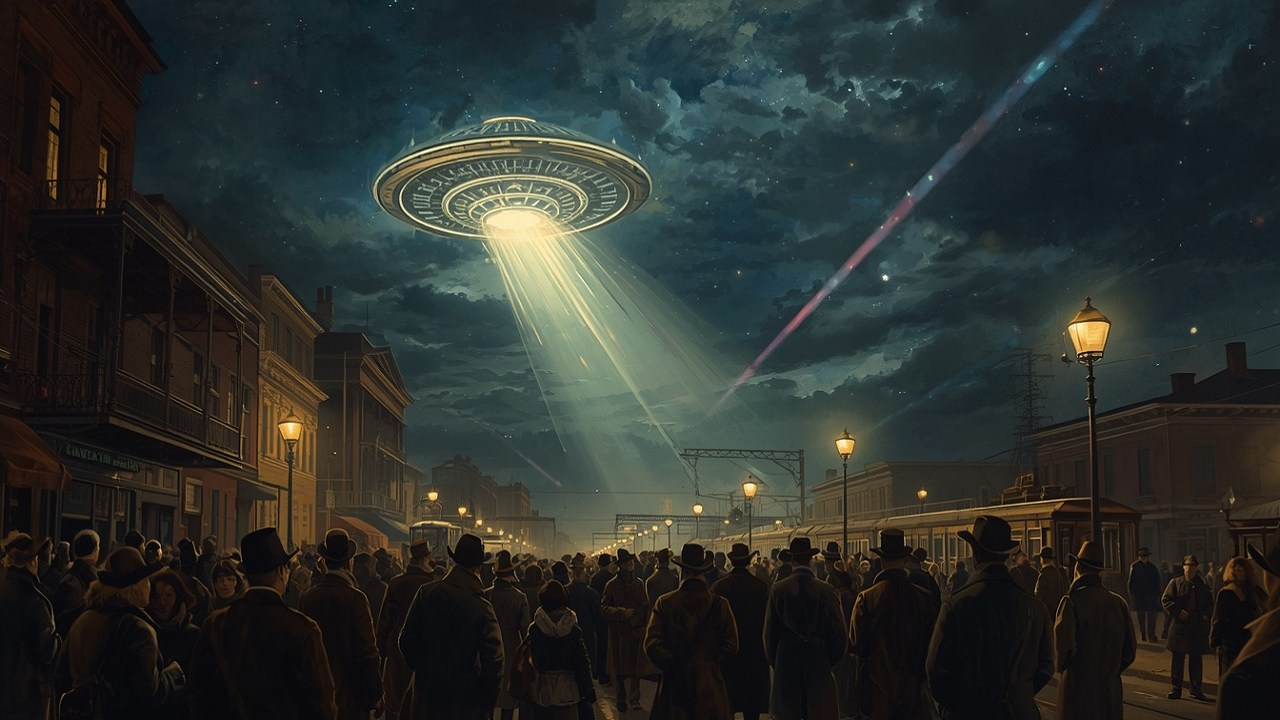
In the first week of April 1897, the night skies above Chicago and its northern suburbs became the focus of one of the earliest large-scale public observations of an anomalous aerial object in Illinois history. On the evening of April 9, hundreds of residents across Chicago, Evanston, Niles Center, and Schermerville reported seeing a bright, structured light or craft moving through the heavens. Contemporary newspaper accounts described a powerful headlight that swung from side to side, multicolored lights, and, in some cases, the faint outline of a large aerial structure. The event formed a prominent local chapter within the broader national mystery airship wave of 1896–1897 and stands as one of the best documented mass sightings of that era in the Illinois portion of the phenomenon.
Chicago in 1897 was a rapidly expanding industrial metropolis of more than 1.5 million people. Electric streetlights, elevated trains, and a growing network of newspapers defined daily life, yet the practical reality of controlled, powered flight remained years in the future. The Wright brothers’ first successful airplane flight would not occur until December 1903. Experimental balloons and rudimentary dirigibles existed, but none possessed the sustained, directional performance or the scale implied by the reports that flooded local papers that spring. Against this technological backdrop, the appearance of a bright, maneuvering object over the densely populated lakefront and northern suburbs carried unusual weight.
The primary wave of observations began around 8:15 to 8:30 p.m. on April 9. In Evanston, nearly eight hundred people gathered along Davis Street and other vantage points to watch a brilliant light low on the western horizon. Witnesses described it as possessing the brightness of dozens of ordinary electric street lamps. Many used opera glasses or binoculars. Through these instruments some observers reported discerning the outline of a structure behind the powerful white light. The object carried additional smaller lights—accounts frequently mentioned green and white points—and the main beam appeared to swing slowly from side to side, illuminating the sky in a manner unlike any fixed star or conventional balloon of the period. Estimates of size varied, but some witnesses placed the overall length in the range of several hundred feet.
From Evanston the object was tracked southward and westward. Residents in Niles Center (the community later renamed Skokie) and Schermerville reported the same luminous craft moving across their skies. In Chicago proper, crowds formed on street corners in the northwestern sections of the city where smoke from factories did not fully obscure the view. Reports described the object approaching from the direction of Lake Michigan in some accounts, then proceeding on a generally westward or northwestward course. By approximately 9:30 p.m. it was last noted over the South Chicago area. The duration of visibility—more than an hour in some locations—allowed large numbers of independent observers to compare notes in real time.
Newspaper coverage the following day was extensive. The Chicago Tribune devoted front-page space to the story under headlines that reflected both excitement and cautious inquiry. The Evanston Index reported that five hundred reputable citizens had watched the spectacle with astonishment. Other papers, including the Inter Ocean and the Times-Herald, collected additional statements from across Cook County. Witnesses repeatedly emphasized that the object moved independently of the wind and changed position in ways inconsistent with a fixed celestial body. The light did not twinkle like a star; it maintained a steady or slowly oscillating brilliance and appeared to travel at a measurable speed across the sky.
Astronomical explanations were offered almost immediately. Professor George W. Hough, director of the Dearborn Observatory at Northwestern University in Evanston, publicly stated that the object was almost certainly the star Alpha Orionis, better known as Betelgeuse. Hough argued that atmospheric conditions and the low elevation of the star near the horizon could produce an unusually bright appearance. Many citizens rejected the suggestion. They pointed out that the object had been seen to move laterally, to change direction, and to display a sweeping searchlight beam—behaviors incompatible with a distant star. Crowds that had stood for extended periods under clear viewing conditions insisted they had observed something far closer and more dynamic.
The Chicago-area sightings did not occur in isolation. They formed part of a much larger wave of airship reports that had begun in California in November 1896 and progressed steadily eastward through the winter and spring of 1897. By early April the phenomenon had reached Nebraska, Kansas, Iowa, and Missouri before appearing in force over Illinois and neighboring states. Descriptions across this geographic range shared common elements: elongated or cigar-shaped forms, powerful forward lights often compared to locomotive headlights, secondary colored lights, and controlled, purposeful movement. In some Midwestern accounts witnesses claimed to see wings, propellers, or gondolas, though the Chicago reports focused more heavily on the luminous and structural features visible at night.
What distinguished the April 9 events around Chicago was the sheer number of simultaneous observers in a major urban center and its immediate suburbs. Hundreds of people in multiple independent locations described essentially the same object within the same narrow time window. The use of optical aids by some witnesses added a layer of detail—the reported outline of a structure behind the primary light—that pure point-source explanations struggled to accommodate. The swinging searchlight further complicated attempts to dismiss the reports as misidentifications of planets or stars.
Public reaction mixed wonder, skepticism, and lively debate. Street-corner discussions continued for days. Some residents speculated about secret inventors testing advanced aerial machines; others treated the reports with humor or outright disbelief. A few individuals claimed prior knowledge of experimental craft under construction somewhere in the Midwest, though no verifiable inventor or working prototype capable of the observed performance ever surfaced. Newspapers themselves alternated between straightforward reporting of witness statements and editorial caution, reflecting the tension between the volume of testimony and the technological impossibility of such a craft under known conditions of 1897.
From the standpoint of later aerial-phenomena research, the Chicago-Evanston cluster occupies an important place. It demonstrates that large numbers of ordinary citizens, including many described by the press as reputable and sober, could converge on a consistent description of an anomalous object long before the modern UFO era or the cultural templates that followed World War II. The absence of powered, controllable aircraft of comparable capability in 1897 removes the most common conventional explanation available for later sightings. At the same time, the reports remain purely observational; no physical traces, photographs of undisputed authenticity, or recovered materials were associated with the April 9 events.
Subsequent nights brought additional sightings across Illinois and the surrounding region, keeping the airship story in the headlines for weeks. Yet the mass observation of April 9 over Chicago and its northern suburbs remains one of the clearest single-evening concentrations of the entire wave. The combination of urban density, multiple independent vantage points, optical confirmation of structure by some witnesses, and the explicit rejection of the leading astronomical explanation by large numbers of observers gives the case lasting documentary value.
In the broader continuum of Illinois anomalous aerial history, the 1897 airship reports serve as an early benchmark. They establish that unexplained lights and structured objects were already being recorded by the public and the press more than half a century before the 1947 flying-disc wave. The descriptions—powerful searchlight, multicolored secondary lights, apparent size, and controlled motion—prefigure motifs that would reappear in later decades under different cultural labels. Whether interpreted as unknown human technology, natural phenomena imperfectly understood at the time, or something genuinely anomalous, the events of that April evening left a clear imprint on the historical record.
The night of April 9, 1897, therefore stands as more than a curious footnote in local journalism. It represents one of the first occasions on which hundreds of Illinois residents, spread across a major city and its suburbs, simultaneously observed and described an aerial object that defied the explanatory tools of their era. The powerful headlight sweeping the sky, the faint structural outline glimpsed through opera glasses, and the collective insistence that the object was neither star nor ordinary balloon continue to invite careful reconsideration. In the quiet streets of Evanston, Niles Center, Schermerville, and Chicago that spring night, the modern conversation about unidentified aerial phenomena found one of its earliest and most populous chapters.