


Blog Categories
- African Incidents
- Atlantis Incidents
- Australian Incidents
- Belgian Incidents
- Bermuda Triangle Incidents
- Brazilian Incidents
- Canadian Incidents
- Chinese Incidents
- European Incidents
- France Incidents
- Ghosts
- Giants
- Italy Incidents
- Japanese Incidents
- Middle East Incidents
- Portugal Incidents
- Project Serpo
- Puerto Rico Incidents
- Russian Incidents
- Sasquatch
- Scandinavia Incidents
- Spanish Incidents
- UFOs
- United Kingdom Incidents
- United States Incidents
August 1950: Pine Bluff Flying Saucer
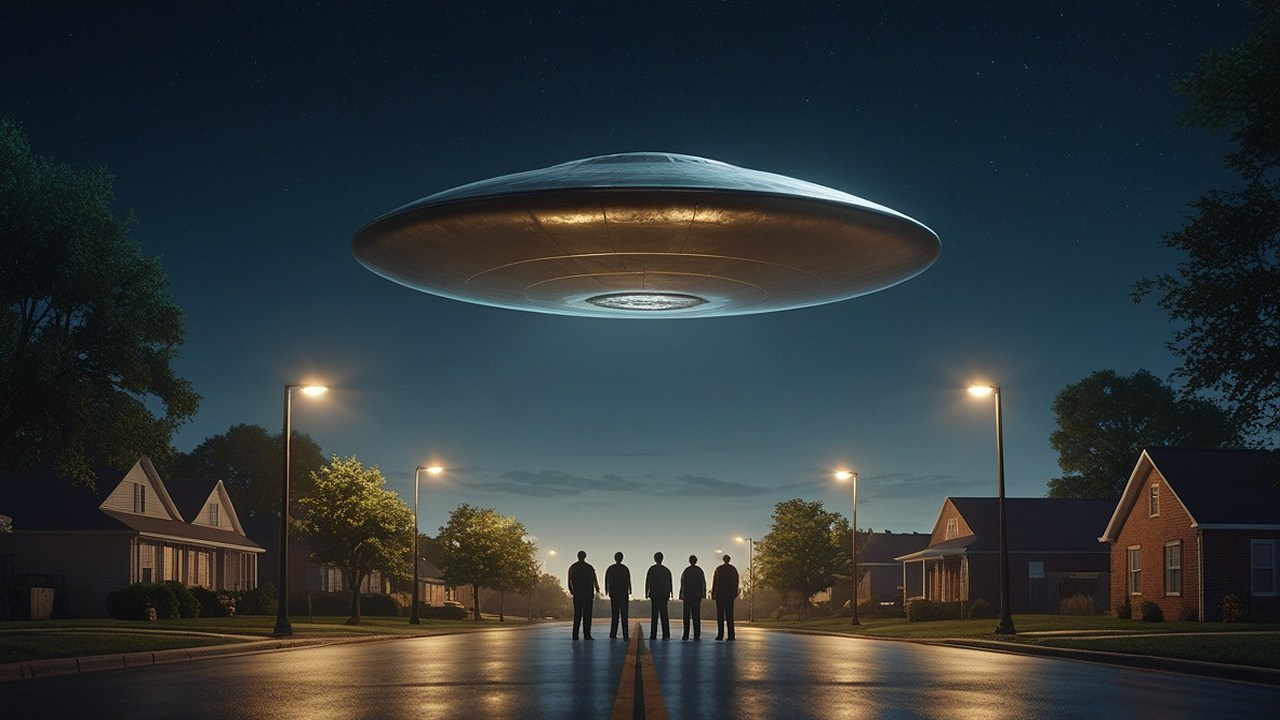
On a warm summer night in August 1950, seven people in Pine Bluff, Arkansas, looked up and saw something that would stay with them for the rest of their lives.
It was a disc-shaped metallic craft. Silent. Hovering. Completely unlike anything that belonged in the ordinary night sky over their town.
This was not a distant light or a fleeting streak. This was a structured object that held their attention for several minutes before it moved slowly, then accelerated and vanished into the darkness without a sound, without a flash, without a sonic boom.
Among those seven witnesses was a man named Charles White. And this was not his first time.
Five years earlier, in 1948, White had already reported seeing something unidentified in the skies over Pine Bluff. That earlier experience had already marked him as a careful, thoughtful observer. So when he stood with six other people on the night of August 5, 1950, and watched a metallic saucer shimmer against the night, his presence carried weight.
This is the story of that night – a quiet, multi-witness encounter that never made national headlines, never produced physical wreckage, and never received an official investigation… yet still managed to shift the way an entire community thought about the sky above them.
[Section break – soft transition music]
Let’s set the scene.
Pine Bluff in 1950 was a postwar Southern town finding its footing. Veterans had returned. Manufacturing was expanding. The early tensions of the Cold War were beginning to settle into daily conversation. People understood airplanes. They understood the growing power of military aviation. What they did not understand was a silent, metallic disc hovering over their suburban skyline.
Charles White and six other residents – people of different ages, backgrounds, and professions – were together that evening when the object appeared. Descriptions varied slightly in the finer details, as honest human observations often do. But on the core points they agreed completely.
It was disc-shaped.
It had a metallic sheen.
It made no noise.
It did not move the way any conventional aircraft of 1950 moved.
Some witnesses said it seemed to glow. Others noticed reflective patches catching the light from streetlamps or nearby buildings. It hung in the air for several minutes, drifting slowly, before it accelerated and disappeared into the night.
No sudden flash.
No sonic boom.
Just… gone.
Because seven people saw it together, and because one of them had already reported a similar experience five years earlier, this sighting avoided the usual weaknesses of single-witness accounts. It was not rumor. It was a shared, lived experience that the witnesses later discussed calmly among themselves and with others in the community.
News of the sighting did not explode across the country. It spread the way real local stories often do – quietly, thoroughly, through conversation.
In stores.
In churches.
Around family tables.
In civic clubrooms.
People asked the same questions we still ask today.
Was it secret military hardware?
Some new prototype being tested far from public view?
Or was it something else entirely?
What stands out is what did not happen. There was no panic. No mass fear. Instead, the people of Pine Bluff met the event with sober curiosity – a mixture of optimism and caution that feels almost refreshing when we look back at it.
Local businesses noticed a modest increase in people stopping by just to talk about it. “I think I saw the same thing,” some would say. A few even suggested organizing evening sky watches in the nights that followed, though those never grew into large public gatherings. City officials acknowledged the incident informally but declined to file any formal report, citing the lack of physical evidence.
That official silence created a vacuum. And public curiosity filled it.
Charles White found himself in an unexpected position. Having now reported two separate sightings in Pine Bluff, he became a quiet point of reference whenever the subject of unusual aerial objects came up. He never sought the attention. Accounts from the time describe him as balanced and free of theatrics. When pressed for dramatic details he often demurred. Yet he consistently provided the essential facts – the time, the general flight path, the appearance of the object – enough for others to cross-reference what they themselves had seen or heard.
The other six witnesses included, among them, a teacher returning from summer classes and a factory worker on a break. None of them went on to become professional UFO researchers. None formed clubs or sought the spotlight. They remained ordinary citizens who had shared an extraordinary moment. Their testimony stayed grounded, collective, and free of exaggeration.
That grounded quality is one of the reasons this case continues to matter.
In the years that followed, the 1950 sighting settled into Pine Bluff’s quieter local memory. It became acceptable – even respectable – to mention having seen something unusual in the sky. Families would bring it up over dinner. Workers would recall it while dusting off at the end of a shift. Elderly couples strolling after supper might glance upward and remember that August night.
The event did not spark organized investigations or large public campaigns. But it did inspire small, personal responses. Some local journalists quietly checked earlier records to see whether similar objects had been noted before. Amateur pilots paid closer attention to flight paths. Teachers occasionally used the story as a starting point for conversations about science, observation, and the unknown, even encouraging young people to watch the sky with more deliberate attention.
By the 1970s and 1980s, regional UFO researchers began including the Pine Bluff incident in their catalogs of Arkansas sightings, often highlighting Charles White’s credibility as a repeat observer. The case never became a headline-grabbing classic like some of the more famous events of the era. Instead it remained what it had always been: a solid, multi-witness observation of a metallic disc that refused easy explanation.
From the perspective of more than seven decades later, several things about this sighting still stand out with unusual clarity.
First, the value of a repeat witness. Charles White had already reported an unidentified aerial object in 1948. When the same careful observer reported a second, similar experience in 1950 – this time alongside six other people – the probability of simple misperception dropped significantly. A person who has already trained their attention on the sky once is less likely to mistake ordinary aircraft or atmospheric effects the second time.
Second, the power of group observation. Seven people saw the same object at the same time and later described the same core characteristics: metallic, disc-shaped, silent, slow then accelerating. Group validation does not prove extraterrestrial origin, but it dramatically reduces the chance that the event was pure imagination or individual error.
Third, the meaning of official silence. In 1950, many unusual aerial reports received little or no public response from authorities. The lack of a press release or formal investigation was common. That silence should not be mistaken for evidence that nothing happened. It simply reflects the cultural and institutional posture of the time.
And fourth, the way the community responded. Pine Bluff did not descend into fear. Residents treated the sighting with curiosity and composure. That posture – open without being hysterical, interested without demanding immediate answers – remains a model for how people can encounter the unexplained.
The object itself left no wreckage, no photographs, no radar tracks that we know of. It simply appeared, hovered, moved, and left. Yet its brief presence was enough to shift local attitudes. Looking at the night sky became a slightly different experience for those who had been there, and for those who heard the story afterward. Wonder entered ordinary conversation. The possibility that the skies held more than routine aircraft became something people could discuss without embarrassment.
Today the August 5, 1950 Pine Bluff sighting sits quietly in the broader record of Arkansas and American UFO history. Documentaries that explore lesser-known cases sometimes mention it – not to sensationalize, but to illustrate how widespread these observations actually were. They happened not only near military bases or in remote deserts, but over ordinary neighborhoods in places like Pine Bluff.
The witnesses never claimed to know what the object was. They simply reported what they saw: a metallic, disc-shaped craft that did not behave like any aircraft they knew. Charles White, the man who had already seen something similar five years earlier, helped anchor the account in credibility. The six others who stood with him that night turned a single observation into a shared event.
In the end, this is a small story with a sturdy foundation. No dramatic confrontation. No recovered hardware. No official confirmation or denial that changed anything. Just seven people on a warm Arkansas night watching a silent metallic disc hover, drift, and then accelerate out of sight.
That simplicity is precisely why the case endures. It reminds us that unexplained aerial phenomena have been part of ordinary American life for a very long time. They appear, they are seen by credible people, they leave no easy answers, and they settle into local memory – quiet, persistent, and still unresolved.
The sky over Pine Bluff on August 5, 1950, held something that seven witnesses could not identify. More than seventy years later, neither can we.
And that, more than any speculation, is why the sighting still matters.
If you enjoy these deeper looks at the cases that rarely make the big documentaries, consider subscribing. There are far more of these quiet, well-witnessed events in the historical record than most people realize.
The next one might be closer to home than you think.
Thanks for watching. Keep looking up.
On a warm summer night in August 1950, seven people in Pine Bluff, Arkansas, looked up and saw something that would stay with them for the rest of their lives.
It was a disc-shaped metallic craft. Silent. Hovering. Completely unlike anything that belonged in the ordinary night sky over their town.
This was not a distant light or a fleeting streak. This was a structured object that held their attention for several minutes before it moved slowly, then accelerated and vanished into the darkness without a sound, without a flash, without a sonic boom.
Among those seven witnesses was a man named Charles White. And this was not his first time.
Five years earlier, in 1948, White had already reported seeing something unidentified in the skies over Pine Bluff. That earlier experience had already marked him as a careful, thoughtful observer. So when he stood with six other people on the night of August 5, 1950, and watched a metallic saucer shimmer against the night, his presence carried weight.
This is the story of that night – a quiet, multi-witness encounter that never made national headlines, never produced physical wreckage, and never received an official investigation… yet still managed to shift the way an entire community thought about the sky above them.
[Section break – soft transition music]
Let’s set the scene.
Pine Bluff in 1950 was a postwar Southern town finding its footing. Veterans had returned. Manufacturing was expanding. The early tensions of the Cold War were beginning to settle into daily conversation. People understood airplanes. They understood the growing power of military aviation. What they did not understand was a silent, metallic disc hovering over their suburban skyline.
Charles White and six other residents – people of different ages, backgrounds, and professions – were together that evening when the object appeared. Descriptions varied slightly in the finer details, as honest human observations often do. But on the core points they agreed completely.
It was disc-shaped.
It had a metallic sheen.
It made no noise.
It did not move the way any conventional aircraft of 1950 moved.
Some witnesses said it seemed to glow. Others noticed reflective patches catching the light from streetlamps or nearby buildings. It hung in the air for several minutes, drifting slowly, before it accelerated and disappeared into the night.
No sudden flash.
No sonic boom.
Just… gone.
Because seven people saw it together, and because one of them had already reported a similar experience five years earlier, this sighting avoided the usual weaknesses of single-witness accounts. It was not rumor. It was a shared, lived experience that the witnesses later discussed calmly among themselves and with others in the community.
News of the sighting did not explode across the country. It spread the way real local stories often do – quietly, thoroughly, through conversation.
In stores.
In churches.
Around family tables.
In civic clubrooms.
People asked the same questions we still ask today.
Was it secret military hardware?
Some new prototype being tested far from public view?
Or was it something else entirely?
What stands out is what did not happen. There was no panic. No mass fear. Instead, the people of Pine Bluff met the event with sober curiosity – a mixture of optimism and caution that feels almost refreshing when we look back at it.
Local businesses noticed a modest increase in people stopping by just to talk about it. “I think I saw the same thing,” some would say. A few even suggested organizing evening sky watches in the nights that followed, though those never grew into large public gatherings. City officials acknowledged the incident informally but declined to file any formal report, citing the lack of physical evidence.
That official silence created a vacuum. And public curiosity filled it.
Charles White found himself in an unexpected position. Having now reported two separate sightings in Pine Bluff, he became a quiet point of reference whenever the subject of unusual aerial objects came up. He never sought the attention. Accounts from the time describe him as balanced and free of theatrics. When pressed for dramatic details he often demurred. Yet he consistently provided the essential facts – the time, the general flight path, the appearance of the object – enough for others to cross-reference what they themselves had seen or heard.
The other six witnesses included, among them, a teacher returning from summer classes and a factory worker on a break. None of them went on to become professional UFO researchers. None formed clubs or sought the spotlight. They remained ordinary citizens who had shared an extraordinary moment. Their testimony stayed grounded, collective, and free of exaggeration.
That grounded quality is one of the reasons this case continues to matter.
In the years that followed, the 1950 sighting settled into Pine Bluff’s quieter local memory. It became acceptable – even respectable – to mention having seen something unusual in the sky. Families would bring it up over dinner. Workers would recall it while dusting off at the end of a shift. Elderly couples strolling after supper might glance upward and remember that August night.
The event did not spark organized investigations or large public campaigns. But it did inspire small, personal responses. Some local journalists quietly checked earlier records to see whether similar objects had been noted before. Amateur pilots paid closer attention to flight paths. Teachers occasionally used the story as a starting point for conversations about science, observation, and the unknown, even encouraging young people to watch the sky with more deliberate attention.
By the 1970s and 1980s, regional UFO researchers began including the Pine Bluff incident in their catalogs of Arkansas sightings, often highlighting Charles White’s credibility as a repeat observer. The case never became a headline-grabbing classic like some of the more famous events of the era. Instead it remained what it had always been: a solid, multi-witness observation of a metallic disc that refused easy explanation.
From the perspective of more than seven decades later, several things about this sighting still stand out with unusual clarity.
First, the value of a repeat witness. Charles White had already reported an unidentified aerial object in 1948. When the same careful observer reported a second, similar experience in 1950 – this time alongside six other people – the probability of simple misperception dropped significantly. A person who has already trained their attention on the sky once is less likely to mistake ordinary aircraft or atmospheric effects the second time.
Second, the power of group observation. Seven people saw the same object at the same time and later described the same core characteristics: metallic, disc-shaped, silent, slow then accelerating. Group validation does not prove extraterrestrial origin, but it dramatically reduces the chance that the event was pure imagination or individual error.
Third, the meaning of official silence. In 1950, many unusual aerial reports received little or no public response from authorities. The lack of a press release or formal investigation was common. That silence should not be mistaken for evidence that nothing happened. It simply reflects the cultural and institutional posture of the time.
And fourth, the way the community responded. Pine Bluff did not descend into fear. Residents treated the sighting with curiosity and composure. That posture – open without being hysterical, interested without demanding immediate answers – remains a model for how people can encounter the unexplained.
The object itself left no wreckage, no photographs, no radar tracks that we know of. It simply appeared, hovered, moved, and left. Yet its brief presence was enough to shift local attitudes. Looking at the night sky became a slightly different experience for those who had been there, and for those who heard the story afterward. Wonder entered ordinary conversation. The possibility that the skies held more than routine aircraft became something people could discuss without embarrassment.
Today the August 5, 1950 Pine Bluff sighting sits quietly in the broader record of Arkansas and American UFO history. Documentaries that explore lesser-known cases sometimes mention it – not to sensationalize, but to illustrate how widespread these observations actually were. They happened not only near military bases or in remote deserts, but over ordinary neighborhoods in places like Pine Bluff.
The witnesses never claimed to know what the object was. They simply reported what they saw: a metallic, disc-shaped craft that did not behave like any aircraft they knew. Charles White, the man who had already seen something similar five years earlier, helped anchor the account in credibility. The six others who stood with him that night turned a single observation into a shared event.
In the end, this is a small story with a sturdy foundation. No dramatic confrontation. No recovered hardware. No official confirmation or denial that changed anything. Just seven people on a warm Arkansas night watching a silent metallic disc hover, drift, and then accelerate out of sight.
That simplicity is precisely why the case endures. It reminds us that unexplained aerial phenomena have been part of ordinary American life for a very long time. They appear, they are seen by credible people, they leave no easy answers, and they settle into local memory – quiet, persistent, and still unresolved.
The sky over Pine Bluff on August 5, 1950, held something that seven witnesses could not identify. More than seventy years later, neither can we.
And that, more than any speculation, is why the sighting still matters.
If you enjoy these deeper looks at the cases that rarely make the big documentaries, consider subscribing. There are far more of these quiet, well-witnessed events in the historical record than most people realize.
The next one might be closer to home than you think.
Thanks for watching. Keep looking up.