


Blog Categories
- African Incidents
- Atlantis Incidents
- Australian Incidents
- Belgian Incidents
- Bermuda Triangle Incidents
- Brazilian Incidents
- Canadian Incidents
- Chinese Incidents
- European Incidents
- France Incidents
- Ghosts
- Giants
- Italy Incidents
- Japanese Incidents
- Middle East Incidents
- Portugal Incidents
- Project Serpo
- Puerto Rico Incidents
- Russian Incidents
- Sasquatch
- Scandinavia Incidents
- Spanish Incidents
- UFOs
- United Kingdom Incidents
- United States Incidents
Behind the Flying Saucers 1950: Frank Scully
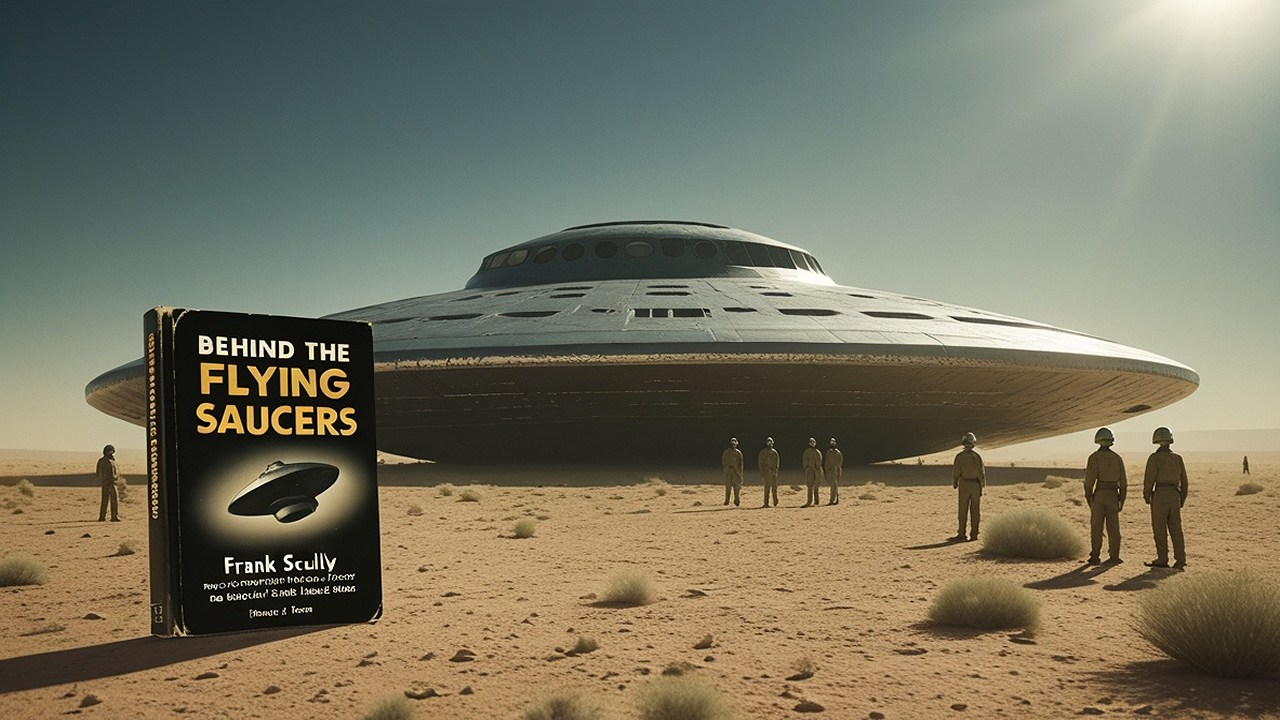
In the wake of World War II, as humanity grappled with the dawn of the atomic age and the vast unknowns of a rapidly expanding technological frontier, the skies became a canvas for profound mysteries that captured the collective imagination. Reports of strange aerial objects, defying the laws of known physics and human engineering, began to emerge from pilots, scientists, and everyday observers, hinting at intelligences far beyond our earthly confines. It was amid this surge of intrigue that journalist Frank Scully, a seasoned voice in the world of entertainment and inquiry, published his seminal work, Behind the Flying Saucers, in 1950.
Drawing from insider accounts that spoke of recovered craft and enigmatic beings, Scully’s book pierced the veil of official silence, presenting evidence of visitors from other worlds whose presence had been systematically concealed by authorities. Though rooted in narratives that would later face scrutiny, the book’s revelations ignited a firestorm of public fascination, urging society to confront the possibility that we are not alone and that advanced civilizations have long been observing our planet’s tumultuous progress. Scully’s narrative, rich with details of technological wonders and humanoid forms, challenged the boundaries of what was deemed possible, fostering a dialogue that resonated deeply in an era hungry for answers about the cosmos.
This is the story of Behind the Flying Saucers. Welcome to the channel. Today we examine Frank Scully’s groundbreaking 1950 book and the claims that helped define modern UFO crash-retrieval lore, staying strictly faithful to the historical record.
Frank Scully’s path to becoming a pivotal figure in this unfolding drama was marked by a blend of journalistic acumen and a flair for storytelling that had already established him as a respected name in media circles. Born in 1892, Scully began his career as a reporter for The New York Sun, where his sharp wit and keen eye for human interest stories quickly set him apart. He transitioned into the entertainment industry, penning a regular column for Variety magazine, the bible of Hollywood insiders, where he chronicled the glitz and glamour of show business with humor and insight. His books, including humorous works like the Fun in Bed series for convalescents and Rogue’s Gallery, showcased his ability to weave engaging tales from real-life inspirations.
By the late 1940s, as sightings of unidentified aerial phenomena escalated following Kenneth Arnold’s 1947 report of “flying saucers” near Mount Rainier, Scully’s curiosity was piqued. His network of contacts, spanning from oil tycoons to scientists, positioned him uniquely to delve into whispers of extraordinary events. In October and November 1949, he published two columns in Variety that teased revelations from anonymous sources about crashed vessels and their occupants, setting the stage for the full exposition in Behind the Flying Saucers. Priced affordably and spanning 230 pages, the book was not merely a recounting of events but a bold assertion that governments possessed tangible proof of extraterrestrial visitation, suppressed to prevent widespread alarm and to harness the advanced knowledge for earthly gains.
The core of Scully’s revelations stemmed from accounts provided by two key informants: Silas Newton, a wealthy Denver oilman with a reputation for bold ventures, and a scientist Scully cryptically referred to as “Dr. Gee” to protect his identity. Newton, whom Scully met through mutual acquaintances in the oil industry, claimed firsthand knowledge from scientific circles about multiple incidents where disk-shaped craft had come down in the American Southwest. Dr. Gee, described as a magnetic expert with more degrees than a thermometer and affiliations with top research institutions, provided technical details that lent an air of authority to the claims.
According to their testimonies, as relayed by Scully, the most significant event occurred in March 1948 near Aztec, New Mexico, in Hart Canyon, approximately 12 miles northeast of the town. A massive saucer, measuring nearly 100 feet in diameter, executed a controlled landing after encountering some form of interference, possibly related to Earth’s magnetic fields or radar emissions. The craft, constructed from an unknown lightweight metal impervious to human tools, featured a seamless design with portholes and intricate mechanisms inside. Upon entry by military teams, 16 humanoid bodies were discovered, each about three feet tall, dressed in form-fitting suits, and perfectly proportioned like miniature adults. These beings, with fair skin and no signs of violence, appeared to have perished from decompression or exposure during the landing.
Scully detailed how the craft operated on magnetic principles, harnessing cosmic energies without combustion engines, allowing silent, high-speed travel that explained the maneuvers reported in sightings worldwide. Expanding beyond the Aztec incident, Scully’s book chronicled additional recoveries, including crashes near Paradise Valley, Arizona, and other sites in New Mexico, suggesting a pattern of exploration by these visitors. He described the interiors of the vessels as equipped with advanced instruments, including devices resembling television screens and controls operated by thought or gesture, far surpassing contemporary human technology. Water found aboard was twice as heavy as Earth’s, hinting at origins from a world with different gravitational or atmospheric conditions, possibly Venus or another nearby planet.
Scully argued that these craft navigated using magnetic fault zones, areas of Earth’s surface with anomalous magnetic properties, which explained why crashes occurred in remote desert regions. His sources claimed the military had whisked away the wreckage and bodies to secret facilities, such as Wright-Patterson Air Force Base, for analysis and reverse engineering. Efforts to disassemble the saucers required innovative techniques, as conventional tools failed against the alien alloys. Scully posited that the government’s suppression stemmed from fears of public panic and the strategic advantage of monopolizing such breakthroughs, potentially revolutionizing energy, propulsion, and materials science. He wove in historical precedents, noting ancient accounts of aerial phenomena that mirrored modern sightings, implying these intelligences had monitored humanity for centuries, with increased activity following nuclear detonations in 1945, as if drawn by our entry into the atomic era.
The book’s publication in September 1950 sent ripples through society, selling over 60,000 copies in its first print run and becoming a bestseller that transcended niche audiences. In an era defined by Cold War tensions and rapid scientific advancement, Behind the Flying Saucers resonated as a beacon of possibility, offering explanations for the unexplained lights and disks reported across the globe. Readers from all walks of life—scientists, military veterans, and ordinary citizens—found themselves captivated by the notion that tangible evidence of otherworldly visitors existed, hidden behind layers of official denial. The book’s accessible prose, blending journalistic rigor with narrative flair, made complex ideas digestible, sparking discussions in homes, workplaces, and media outlets.
Newspapers and radio programs debated its claims, with some hailing it as a groundbreaking exposé while others dismissed it as sensationalism. Scully’s work democratized the conversation around aerial mysteries, encouraging witnesses to share their experiences without fear of ridicule, as it provided a framework that validated their observations. Public interest surged, leading to the formation of early UFO study groups and increased reporting of sightings, particularly in the magnetic fault zones Scully highlighted. Culturally, it fueled a wave of science fiction literature and films that explored themes of visitation and concealment, embedding the idea of government-held secrets into the collective psyche.
Notable individuals played crucial roles in shaping and propagating Scully’s narrative. Silas Newton, the charismatic oil entrepreneur, served as the primary conduit for the stories, leveraging his connections in Denver’s business circles to gather intel from alleged insiders. His partner in revelation, Leo GeBauer—whom Scully masked as part of the composite “Dr. Gee”—brought technical expertise, claiming involvement in magnetic research that aligned with the craft’s propulsion systems. Their accounts formed the backbone of the book, portraying them as whistleblowers risking exposure to reveal humanity’s cosmic neighbors.
On the opposing side, journalist J.P. Cahn of the San Francisco Chronicle emerged as a key debunker, investigating Newton and GeBauer’s backgrounds and exposing their involvement in fraudulent schemes. Cahn’s 1952 article in True magazine, “The Flying Saucers and the Mysterious Little Men,” dismantled their credibility, revealing how they peddled fake oil-detection devices touted as derived from alien tech. This led to their 1953 conviction for fraud, tarnishing Scully’s reputation and labeling the book a hoax. Despite this, figures like Donald Keyhoe engaged with similar ideas in his own works, echoing themes of suppression. Later researchers, including William Steinman in his 1986 book UFO Crash at Aztec, revisited the claims, interviewing alleged witnesses and suggesting the debunking was itself a cover-up.
The societal impact of Behind the Flying Saucers extended far beyond its initial sales, embedding crash retrieval concepts into the fabric of mid-20th-century culture and fostering a lasting quest for truth amid institutional opacity. Even after the fraud convictions, the book’s core ideas refused to fade. Scully defended his work, arguing in his 1963 autobiography that the debunking overlooked genuine elements, and he maintained belief in the crashes until his death in 1964. Similar stories continued to surface, including the 1947 Roswell incident, which bore echoes of Scully’s humanoid recoveries and military cover-ups.
In the 1970s and 1980s, researchers like Stanton Friedman referenced crash retrieval motifs, and William Steinman’s work directly revived Scully’s account. In more recent years, Scott and Suzanne Ramsey’s investigations into the Aztec incident, along with the declassified FBI Hottel memo mentioning recovered saucers in New Mexico, kept the conversation alive. Modern whistleblowers have echoed themes of retrieved craft and biologics, showing how Scully’s 1950 revelations helped lay the groundwork for decades of inquiry into government secrecy and non-human technology.
Frank Scully’s Behind the Flying Saucers remains a testament to the power of inquiry in the face of the extraordinary. By compiling accounts of crashed vessels and their enigmatic crews, Scully invited a reevaluation of reality, urging transparency where shadows lingered. His collaboration with Newton and GeBauer, though undermined, sparked a movement that transcended debunking, inspiring generations to seek evidence of intelligent visitors whose technology could redefine our world. In an age where aerial enigmas persist, Scully’s vision endures, calling us to embrace the unknown with curiosity and resolve, ensuring the quest for cosmic truths unites us in wonder.
A 100-foot saucer in the New Mexico desert. Sixteen small humanoid bodies. Magnetic propulsion beyond human understanding. Military recovery and total secrecy. That was the story Frank Scully brought to the world in 1950. Controversies followed. Debunkings followed. Yet the questions he raised about recovered craft, non-human beings, and institutional concealment have never fully gone away. They remain part of the foundation of modern UFO research.
In the wake of World War II, as humanity grappled with the dawn of the atomic age and the vast unknowns of a rapidly expanding technological frontier, the skies became a canvas for profound mysteries that captured the collective imagination. Reports of strange aerial objects, defying the laws of known physics and human engineering, began to emerge from pilots, scientists, and everyday observers, hinting at intelligences far beyond our earthly confines. It was amid this surge of intrigue that journalist Frank Scully, a seasoned voice in the world of entertainment and inquiry, published his seminal work, Behind the Flying Saucers, in 1950.
Drawing from insider accounts that spoke of recovered craft and enigmatic beings, Scully’s book pierced the veil of official silence, presenting evidence of visitors from other worlds whose presence had been systematically concealed by authorities. Though rooted in narratives that would later face scrutiny, the book’s revelations ignited a firestorm of public fascination, urging society to confront the possibility that we are not alone and that advanced civilizations have long been observing our planet’s tumultuous progress. Scully’s narrative, rich with details of technological wonders and humanoid forms, challenged the boundaries of what was deemed possible, fostering a dialogue that resonated deeply in an era hungry for answers about the cosmos.
This is the story of Behind the Flying Saucers. Welcome to the channel. Today we examine Frank Scully’s groundbreaking 1950 book and the claims that helped define modern UFO crash-retrieval lore, staying strictly faithful to the historical record.
Frank Scully’s path to becoming a pivotal figure in this unfolding drama was marked by a blend of journalistic acumen and a flair for storytelling that had already established him as a respected name in media circles. Born in 1892, Scully began his career as a reporter for The New York Sun, where his sharp wit and keen eye for human interest stories quickly set him apart. He transitioned into the entertainment industry, penning a regular column for Variety magazine, the bible of Hollywood insiders, where he chronicled the glitz and glamour of show business with humor and insight. His books, including humorous works like the Fun in Bed series for convalescents and Rogue’s Gallery, showcased his ability to weave engaging tales from real-life inspirations.
By the late 1940s, as sightings of unidentified aerial phenomena escalated following Kenneth Arnold’s 1947 report of “flying saucers” near Mount Rainier, Scully’s curiosity was piqued. His network of contacts, spanning from oil tycoons to scientists, positioned him uniquely to delve into whispers of extraordinary events. In October and November 1949, he published two columns in Variety that teased revelations from anonymous sources about crashed vessels and their occupants, setting the stage for the full exposition in Behind the Flying Saucers. Priced affordably and spanning 230 pages, the book was not merely a recounting of events but a bold assertion that governments possessed tangible proof of extraterrestrial visitation, suppressed to prevent widespread alarm and to harness the advanced knowledge for earthly gains.
The core of Scully’s revelations stemmed from accounts provided by two key informants: Silas Newton, a wealthy Denver oilman with a reputation for bold ventures, and a scientist Scully cryptically referred to as “Dr. Gee” to protect his identity. Newton, whom Scully met through mutual acquaintances in the oil industry, claimed firsthand knowledge from scientific circles about multiple incidents where disk-shaped craft had come down in the American Southwest. Dr. Gee, described as a magnetic expert with more degrees than a thermometer and affiliations with top research institutions, provided technical details that lent an air of authority to the claims.
According to their testimonies, as relayed by Scully, the most significant event occurred in March 1948 near Aztec, New Mexico, in Hart Canyon, approximately 12 miles northeast of the town. A massive saucer, measuring nearly 100 feet in diameter, executed a controlled landing after encountering some form of interference, possibly related to Earth’s magnetic fields or radar emissions. The craft, constructed from an unknown lightweight metal impervious to human tools, featured a seamless design with portholes and intricate mechanisms inside. Upon entry by military teams, 16 humanoid bodies were discovered, each about three feet tall, dressed in form-fitting suits, and perfectly proportioned like miniature adults. These beings, with fair skin and no signs of violence, appeared to have perished from decompression or exposure during the landing.
Scully detailed how the craft operated on magnetic principles, harnessing cosmic energies without combustion engines, allowing silent, high-speed travel that explained the maneuvers reported in sightings worldwide. Expanding beyond the Aztec incident, Scully’s book chronicled additional recoveries, including crashes near Paradise Valley, Arizona, and other sites in New Mexico, suggesting a pattern of exploration by these visitors. He described the interiors of the vessels as equipped with advanced instruments, including devices resembling television screens and controls operated by thought or gesture, far surpassing contemporary human technology. Water found aboard was twice as heavy as Earth’s, hinting at origins from a world with different gravitational or atmospheric conditions, possibly Venus or another nearby planet.
Scully argued that these craft navigated using magnetic fault zones, areas of Earth’s surface with anomalous magnetic properties, which explained why crashes occurred in remote desert regions. His sources claimed the military had whisked away the wreckage and bodies to secret facilities, such as Wright-Patterson Air Force Base, for analysis and reverse engineering. Efforts to disassemble the saucers required innovative techniques, as conventional tools failed against the alien alloys. Scully posited that the government’s suppression stemmed from fears of public panic and the strategic advantage of monopolizing such breakthroughs, potentially revolutionizing energy, propulsion, and materials science. He wove in historical precedents, noting ancient accounts of aerial phenomena that mirrored modern sightings, implying these intelligences had monitored humanity for centuries, with increased activity following nuclear detonations in 1945, as if drawn by our entry into the atomic era.
The book’s publication in September 1950 sent ripples through society, selling over 60,000 copies in its first print run and becoming a bestseller that transcended niche audiences. In an era defined by Cold War tensions and rapid scientific advancement, Behind the Flying Saucers resonated as a beacon of possibility, offering explanations for the unexplained lights and disks reported across the globe. Readers from all walks of life—scientists, military veterans, and ordinary citizens—found themselves captivated by the notion that tangible evidence of otherworldly visitors existed, hidden behind layers of official denial. The book’s accessible prose, blending journalistic rigor with narrative flair, made complex ideas digestible, sparking discussions in homes, workplaces, and media outlets.
Newspapers and radio programs debated its claims, with some hailing it as a groundbreaking exposé while others dismissed it as sensationalism. Scully’s work democratized the conversation around aerial mysteries, encouraging witnesses to share their experiences without fear of ridicule, as it provided a framework that validated their observations. Public interest surged, leading to the formation of early UFO study groups and increased reporting of sightings, particularly in the magnetic fault zones Scully highlighted. Culturally, it fueled a wave of science fiction literature and films that explored themes of visitation and concealment, embedding the idea of government-held secrets into the collective psyche.
Notable individuals played crucial roles in shaping and propagating Scully’s narrative. Silas Newton, the charismatic oil entrepreneur, served as the primary conduit for the stories, leveraging his connections in Denver’s business circles to gather intel from alleged insiders. His partner in revelation, Leo GeBauer—whom Scully masked as part of the composite “Dr. Gee”—brought technical expertise, claiming involvement in magnetic research that aligned with the craft’s propulsion systems. Their accounts formed the backbone of the book, portraying them as whistleblowers risking exposure to reveal humanity’s cosmic neighbors.
On the opposing side, journalist J.P. Cahn of the San Francisco Chronicle emerged as a key debunker, investigating Newton and GeBauer’s backgrounds and exposing their involvement in fraudulent schemes. Cahn’s 1952 article in True magazine, “The Flying Saucers and the Mysterious Little Men,” dismantled their credibility, revealing how they peddled fake oil-detection devices touted as derived from alien tech. This led to their 1953 conviction for fraud, tarnishing Scully’s reputation and labeling the book a hoax. Despite this, figures like Donald Keyhoe engaged with similar ideas in his own works, echoing themes of suppression. Later researchers, including William Steinman in his 1986 book UFO Crash at Aztec, revisited the claims, interviewing alleged witnesses and suggesting the debunking was itself a cover-up.
The societal impact of Behind the Flying Saucers extended far beyond its initial sales, embedding crash retrieval concepts into the fabric of mid-20th-century culture and fostering a lasting quest for truth amid institutional opacity. Even after the fraud convictions, the book’s core ideas refused to fade. Scully defended his work, arguing in his 1963 autobiography that the debunking overlooked genuine elements, and he maintained belief in the crashes until his death in 1964. Similar stories continued to surface, including the 1947 Roswell incident, which bore echoes of Scully’s humanoid recoveries and military cover-ups.
In the 1970s and 1980s, researchers like Stanton Friedman referenced crash retrieval motifs, and William Steinman’s work directly revived Scully’s account. In more recent years, Scott and Suzanne Ramsey’s investigations into the Aztec incident, along with the declassified FBI Hottel memo mentioning recovered saucers in New Mexico, kept the conversation alive. Modern whistleblowers have echoed themes of retrieved craft and biologics, showing how Scully’s 1950 revelations helped lay the groundwork for decades of inquiry into government secrecy and non-human technology.
Frank Scully’s Behind the Flying Saucers remains a testament to the power of inquiry in the face of the extraordinary. By compiling accounts of crashed vessels and their enigmatic crews, Scully invited a reevaluation of reality, urging transparency where shadows lingered. His collaboration with Newton and GeBauer, though undermined, sparked a movement that transcended debunking, inspiring generations to seek evidence of intelligent visitors whose technology could redefine our world. In an age where aerial enigmas persist, Scully’s vision endures, calling us to embrace the unknown with curiosity and resolve, ensuring the quest for cosmic truths unites us in wonder.
A 100-foot saucer in the New Mexico desert. Sixteen small humanoid bodies. Magnetic propulsion beyond human understanding. Military recovery and total secrecy. That was the story Frank Scully brought to the world in 1950. Controversies followed. Debunkings followed. Yet the questions he raised about recovered craft, non-human beings, and institutional concealment have never fully gone away. They remain part of the foundation of modern UFO research.