


Blog Categories
- African Incidents
- Atlantis Incidents
- Australian Incidents
- Belgian Incidents
- Bermuda Triangle Incidents
- Brazilian Incidents
- Canadian Incidents
- Chinese Incidents
- European Incidents
- France Incidents
- Ghosts
- Giants
- Italy Incidents
- Japanese Incidents
- Middle East Incidents
- Portugal Incidents
- Project Serpo
- Puerto Rico Incidents
- Russian Incidents
- Sasquatch
- Scandinavia Incidents
- Spanish Incidents
- UFOs
- United Kingdom Incidents
- United States Incidents
From Skepticism to Revelation 1960s: J Allen Hynek
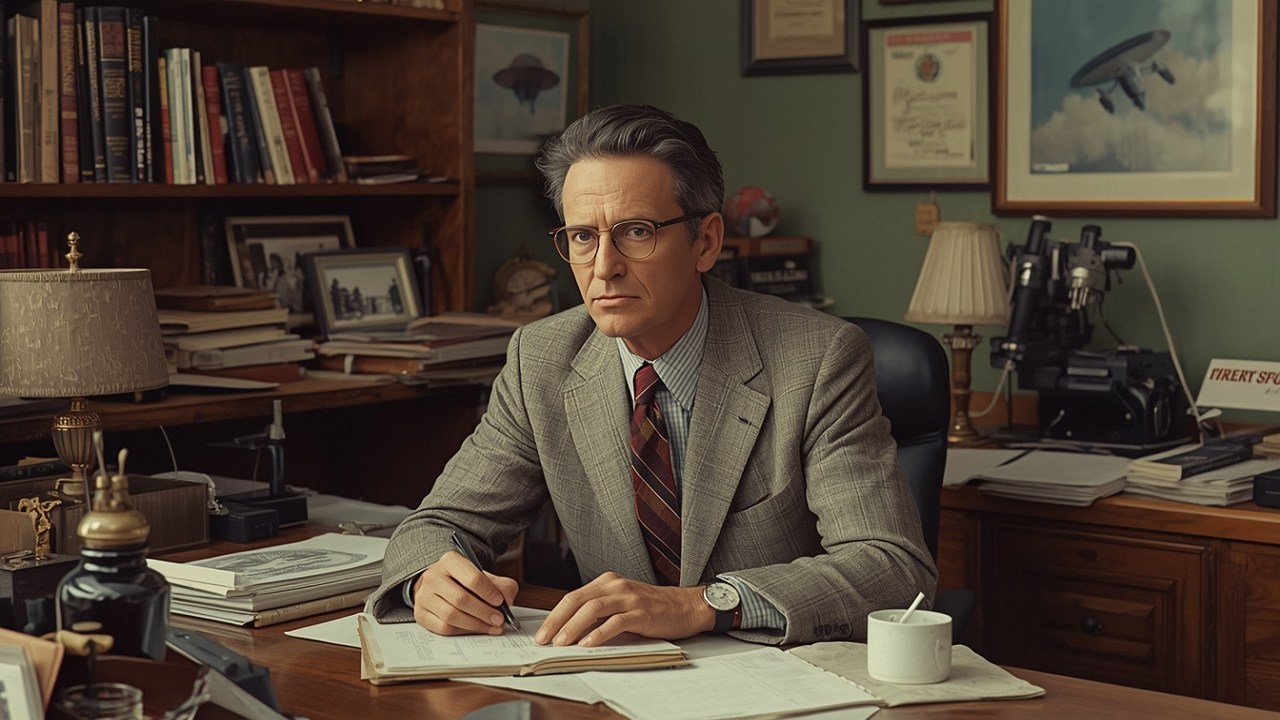
In the mid-20th century, as humanity ventured into the atomic age and the vastness of space beckoned with both promise and peril, the skies above became a theater for enigmas that defied conventional explanation. Reports of luminous objects darting across the heavens, exhibiting maneuvers far beyond the capabilities of earthly aircraft, poured in from pilots, scientists, and civilians worldwide, sparking a blend of awe, fear, and intellectual curiosity. At the forefront of the United States Air Force's efforts to grapple with these mysteries stood Dr. Josef Allen Hynek, an esteemed astronomer whose journey from staunch skeptic to passionate advocate marked a turning point in the serious consideration of phenomena that hinted at intelligences operating on levels we could scarcely comprehend.
Born on May 1, 1910, in Chicago, Illinois, Hynek earned his bachelor's degree in physics from the University of Chicago in 1931 and his doctorate in astrophysics there in 1935, specializing in stellar spectroscopy. By the late 1940s, as director of Ohio State University's McMillin Observatory, he was a respected figure in astronomy. Yet it was his unexpected recruitment by the Air Force in 1948 that thrust him into a realm where empirical rigor met the inexplicable.
Hynek's involvement began with his expertise in astronomy and atmospheric optics. In the wake of Kenneth Arnold's 1947 sighting, the military launched Project Sign in late 1947. Hynek was enlisted as a consultant to evaluate whether sightings could be attributed to natural celestial events. Initially approaching the task with scientific detachment, he dismissed many reports as misidentifications. Project Sign's internal Estimate of the Situation in 1948 tentatively concluded that some phenomena might be extraterrestrial, a view Hynek did not share at the time. The project evolved into Project Grudge, which adopted a more skeptical stance. Hynek's analyses during this phase reinforced conventional explanations, such as attributing the 1948 Chiles-Whitted encounter to a meteor despite the witnesses' insistence on structured form and evasive maneuvers.
By 1952, with sightings escalating, the Air Force reorganized under Project Blue Book, retaining Hynek as chief scientific consultant. This phase marked the beginning of deeper immersion as he traveled to investigate cases firsthand. One early standout was the 1952 Tremonton, Utah, film, showing multiple luminous objects maneuvering in formation. Hynek and experts ruled out birds, balloons, or aircraft due to consistent brightness and coordinated movements, yet the Air Force publicly attributed it to seagulls. Such discrepancies began to affect him as he encountered patterns of right-angle turns, silent hovering, and electromagnetic interference. As Blue Book processed thousands of cases, with 20-25 percent remaining unexplained, Hynek's skepticism eroded.
The turning point came during the turbulent 1960s. In 1966, a wave of sightings in Michigan drew national attention. Hynek was dispatched to investigate. Under pressure from the Air Force, he attributed the events to "swamp gas," despite dry conditions and lack of supporting evidence. The pronouncement backfired, inciting ridicule. This episode crystallized his disillusionment with institutional biases that suppressed data. Concurrently, the University of Colorado's Condon Committee aimed to deliver a final verdict. Hynek critiqued its methodology, noting that Edward U. Condon dismissed the subject prematurely. The committee's 1969 report concluded that further study held no scientific value, leading to Blue Book's closure, despite internal acknowledgment of unexplained cases. Hynek viewed this as a travesty that ignored high-quality evidence.
Freed from Air Force constraints, Hynek emerged as a vocal critic. In 1972, he published "The UFO Experience: A Scientific Inquiry," introducing his Close Encounter classification system. This scale categorized interactions based on proximity and effects: Close Encounters of the First Kind involved sightings within 500 feet; the Second Kind featured physical interactions; and the Third Kind encompassed observations of animate beings. Drawing from cases like the 1964 Socorro incident, Hynek argued these encounters exhibited patterns of intelligent behavior. In 1973, he founded the Center for UFO Studies (CUFOS) to collect and analyze reports systematically. Collaborating with researchers like Jacques Vallée, he emphasized trace evidence as keys to unlocking the mystery.
Hynek's subsequent works delved deeper into Blue Book archives. His advocacy extended to public forums, testifying before the United Nations in 1978. His transformation influenced Steven Spielberg's 1977 film "Close Encounters of the Third Kind," for which Hynek served as technical advisor and made a cameo. The movie popularized his classification system. Through CUFOS, Hynek mentored researchers and fostered a network bridging astronomy, physics, and psychology.
The societal impact of Hynek's shift was profound. Initially, his "swamp gas" explanation fueled distrust in government narratives. As he spoke out, he validated the experiences of thousands who had witnessed inexplicable lights and craft. His books became bestsellers, reaching audiences beyond academia. The Close Encounter framework provided a common language, enabling global comparisons of reports. Hynek's insistence on evidence over speculation distinguished serious research from sensationalism.
Notable individuals intersected with his journey. Edward J. Ruppelt collaborated closely. Donald Keyhoe engaged him in debates. Jacques Vallée co-authored "The Edge of Reality" with him in 1975. Steven Spielberg consulted him extensively. These alliances underscored Hynek's role as a bridge between establishment science and emerging paradigms.
In today's landscape of unidentified aerial phenomena, Hynek's influence permeates policy and public fascination. Contemporary figures echo his evolution from insider to advocate. Declassified Navy videos validate the maneuvers he analyzed. Organizations build on his methodologies. Congressional hearings cite his critiques of past biases. Hynek's journey reminds us that true science thrives on curiosity, not closure, inviting humanity to look upward with open minds and united purpose.