


Blog Categories
- African Incidents
- Atlantis Incidents
- Australian Incidents
- Belgian Incidents
- Bermuda Triangle Incidents
- Brazilian Incidents
- Canadian Incidents
- Chinese Incidents
- European Incidents
- France Incidents
- Ghosts
- Giants
- Italy Incidents
- Japanese Incidents
- Middle East Incidents
- Portugal Incidents
- Project Serpo
- Puerto Rico Incidents
- Russian Incidents
- Sasquatch
- Scandinavia Incidents
- Spanish Incidents
- UFOs
- United Kingdom Incidents
- United States Incidents
Idaho Mystery Airship Wave 1896 to 1897
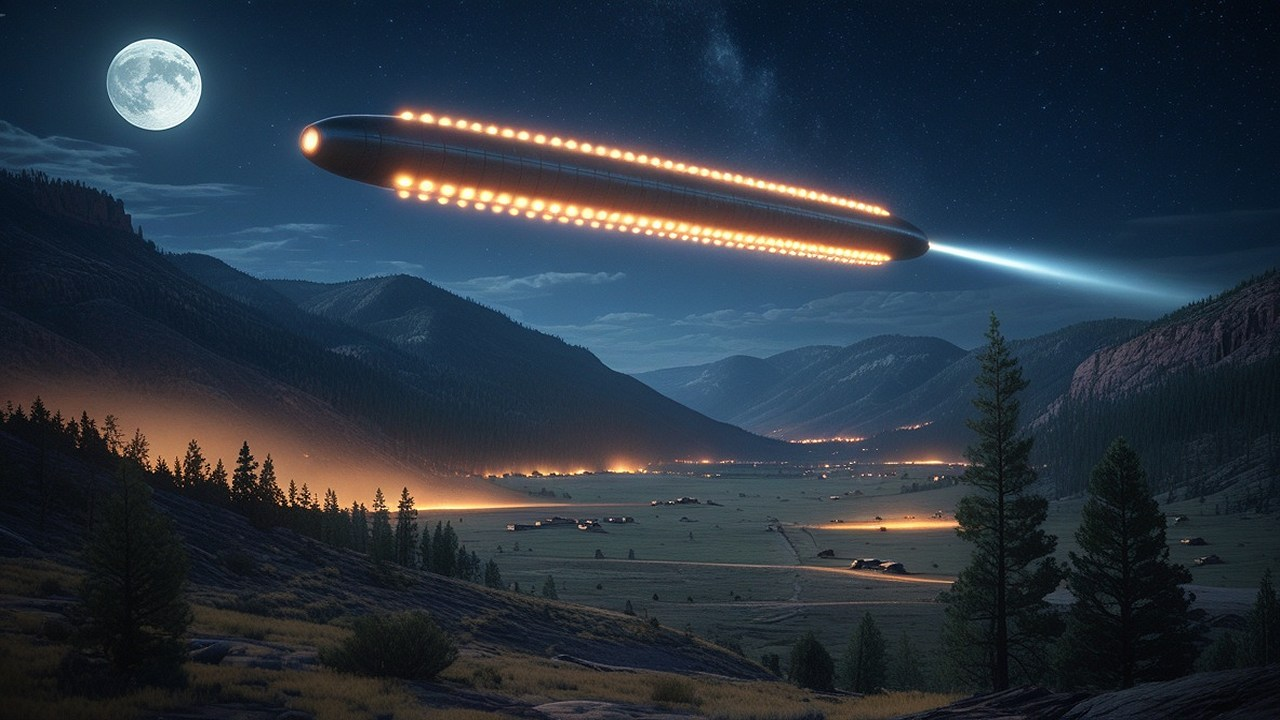
In the final years of the nineteenth century, long before the term “flying saucer” entered the language and decades before the modern UFO era began, the skies over the United States were already filled with reports of something extraordinary. Between late 1896 and the spring of 1897, thousands of people across the country described strange, lighted craft moving through the night. These were not meteors. They were not ordinary balloons. Witnesses repeatedly spoke of large, often cigar-shaped objects equipped with powerful lights, capable of hovering motionless, changing direction at will, and—most remarkably—moving against the wind in complete silence.
This was the great mystery airship wave, sometimes called the phantom airship wave. And while it touched nearly every region of the nation, it held particular relevance for the American West, including areas near Idaho.
Tonight we examine that wave through the lens of Idaho and the broader Western United States. The pre-1900 record does not give us one single, iconic Idaho crash or close encounter that dominates the history books. What it does give us is something equally important: clear evidence that Idaho newspapers and regional accounts participated in the same continental phenomenon. Silent, lighted craft were being reported across the Western states, and those reports matched the descriptions coming from California, the Midwest, and beyond. The consistency is striking. The technological implications are profound. And the historical significance for Idaho’s later UFO history is undeniable.
Let us set the scene. The late 1890s were a time of rapid change and lingering uncertainty in America. The nation was still recovering from the severe economic depression of the mid-1890s. Westward expansion continued. Electricity was spreading through cities. The first practical automobiles were beginning to appear. Yet the skies remained almost entirely the domain of birds, weather, and the occasional balloon or experimental kite. Controlled, powered human flight was still years away. The Wright brothers would not achieve their first successful airplane flight until December 1903. In that environment, reports of large structured craft that could hover, accelerate, and travel against the wind stood out as profoundly anomalous.
The wave itself began in California in the final months of 1896. From there it spread eastward, reaching a dramatic peak across the Midwest and South in the spring of 1897. Newspapers from coast to coast carried stories of strange lights and elongated objects passing overhead at night. Witnesses in both cities and remote rural areas described craft that were frequently cigar-shaped or spindle-shaped. Many carried a powerful searchlight at the front or rows of smaller lights along their sides. Time and again observers noted the complete absence of engine noise or propeller sound, even when the objects appeared large and relatively close. Some accounts described the craft hovering for long periods before suddenly accelerating away. Others spoke of searchlights sweeping the ground below, as if examining the terrain.
In the American West, including the region around Idaho, the same pattern appeared. Idaho had only been admitted to the Union in 1890. It was still a young state of open landscapes, dark skies, and growing towns connected by railroads and telegraph lines. Local newspapers and regional correspondence from the period referenced luminous objects and mysterious airships consistent with the national reports. Witnesses across Western states described silent, lighted craft that moved against the wind or hovered in place—behaviors that matched descriptions from hundreds of miles away. These Western accounts helped demonstrate that the phenomenon was not confined to the more densely populated East or Midwest. It was truly continental.
The core characteristics repeated with remarkable consistency. The objects were most often elongated. Bright lights—sometimes a single powerful beam, sometimes multiple colored or white lights—were almost always present. Silence was repeatedly emphasized. Controlled flight, including the ability to stop and hover, was reported again and again. In a smaller number of cases witnesses claimed to hear voices or glimpse figures aboard the craft, though these more detailed claims were less common and often met with greater skepticism even in 1897. The dominant impression left by the majority of reports was of structured, intelligently controlled machines operating with capabilities far beyond anything publicly known at the time.
Newspapers played a decisive role in spreading the stories. Sensational headlines generated excitement and debate. Some reports were undoubtedly exaggerated or fabricated for circulation. Yet many others came from ordinary citizens, farmers, townspeople, and occasionally law-enforcement officers who had no obvious reason to invent what they saw. The wave occurred during a period of technological optimism mixed with anxiety about the future. The most common contemporary interpretation was that a secret inventor or group of inventors had perfected an advanced airship and was testing it across the country. A minority of observers leaned toward more exotic explanations, but the prevailing view in 1897 still favored human ingenuity—however unexplained that ingenuity remained.
For the American West the sightings carried special resonance. The vast open spaces and exceptionally dark night skies provided ideal conditions for observing unusual lights or craft. Regional newspapers linked local observations to the national conversation, creating a sense that the frontier itself was part of a larger mystery. Although no single Idaho case achieved the lasting fame of certain California or Midwest reports, the state’s participation through newspaper references and regional accounts places it firmly inside the historical record of the wave. The phenomenon was not limited to places with large populations. It appeared over sparsely settled territories as well.
By mid-1897 the intensity of the reports declined. The mystery airship wave faded from the front pages. Yet it left a durable imprint on American culture. It stands as one of the first large-scale, mass-media-driven episodes of public engagement with unidentified aerial objects. The descriptive patterns established in 1896 and 1897—elongated shapes, bright lights, silent operation, hovering, and controlled movement against the wind—would reappear in later waves of sightings throughout the twentieth century and into the present day.
Skeptical explanations have long been offered. Misidentification of bright planets or stars, atmospheric phenomena, mass suggestion amplified by newspaper coverage, and deliberate hoaxes all played some role. A few researchers have suggested that a small number of genuine experimental airships built by private inventors could account for certain reports. No conclusive evidence of such craft has ever surfaced. Serious historical examination of the wave generally acknowledges that while hoaxes and misidentifications occurred, the sheer volume of reports, their geographic spread across thousands of miles, and the repeated core details are difficult to dismiss entirely. Something was being observed in the skies of 1896 and 1897 that did not fit the known technology of the era.
That “something” is what continues to draw the attention of researchers today. The mystery airship wave is now widely regarded as a precursor to the modern era of unidentified aerial phenomena. The same themes of advanced, silent, lighted craft displaying apparent intelligent control surface again in the 1947 flying-disc wave and in countless reports since. For Idaho, the late-1890s accounts form an early foundation. They show that the region was never isolated from national patterns of anomalous aerial activity. Local newspapers helped preserve the observations even when individual sightings lacked the extensive detail of some Eastern or Midwestern cases. The continuity is clear: the same sky that produced silent, wind-defying craft in the 1890s would later produce the lights, discs, and triangles reported across Idaho in the decades that followed.
Consider the implications of the reported performance. In an age before practical airplanes, witnesses described objects that could remain stationary in the air, then move deliberately, sometimes against prevailing winds, without any audible means of propulsion. Searchlights powerful enough to illuminate the ground from altitude were mentioned repeatedly. The combination of structure, lighting, silence, and controlled flight exceeded every publicly demonstrated aeronautical capability of the 1890s. Whether the true explanation involves unknown human technology, natural phenomena still not fully understood, or something else entirely, the observations themselves were recorded by people living at the time. Those records survive in newspaper archives and regional accounts.
The Western dimension of the wave, including the references connected to Idaho, underscores an important point. Anomalous aerial phenomena have never been limited to a few famous locations. They have appeared over remote territories and young states as well as over major cities. The dark skies of the American West simply made the lights and shapes more visible. The newspapers of the region ensured that the reports entered the historical record alongside those from California, Kansas, Texas, and the Midwest.
More than one hundred and twenty-five years later, the 1896–1897 mystery airship wave still rewards careful study. It bridges earlier isolated sightings and the modern UFO era. It demonstrates consistency of description across enormous distances and different communities. And for Idaho it establishes an early chapter in a much longer story of unexplained aerial activity. The silent, lighted craft that moved against the wind or hovered in the night skies of the late nineteenth century remain a compelling reminder that humanity’s encounter with the unknown in the air did not begin in 1947. It was already underway when the American West was still being settled and when powered flight itself was only a distant dream.
The wave of 1896 and 1897 stands as one of the earliest large-scale examples of widespread public engagement with unidentified aerial phenomena in the United States. For the American West, including areas near Idaho, it was a period when local observations fed into a national conversation. Witnesses described craft whose capabilities challenged every technological assumption of their time. Regional accounts documented the phenomenon even when no single Idaho case rose to dominant fame. That documentation is enough. It places Idaho inside the foundational history of American anomalous aerial reports and links the state’s skies to a mystery that has never fully gone away.
As we continue to investigate unidentified aerial phenomena in the twenty-first century with better sensors, greater official attention, and renewed scientific interest, the events of the late 1890s offer a valuable perspective. They show us that people have been looking up and seeing structured, intelligent-appearing objects in the sky for a very long time. The descriptions from the mystery airship wave—cigar shapes, bright lights, total silence, hovering, movement against the wind—still sound familiar to anyone who follows contemporary UAP reports. The technology of the witnesses has changed. The fundamental puzzle has not.
Idaho’s connection to that puzzle begins early. In the newspapers and regional accounts of 1896 and 1897 we find the first clear traces of the state’s long relationship with the unexplained in the sky. Those traces deserve to be remembered. They form the opening pages of a story that is still being written every time a pilot, a rancher, or an ordinary citizen in Idaho looks up and sees something that should not be there—something silent, lighted, and apparently under intelligent control.
The mystery airships of the 1890s may have faded from the headlines by the summer of 1897, but they never really left. Their legacy lives on in the continuing reports of unidentified craft and in the recognition that the skies over Idaho, like the skies over the rest of the American West, have been a stage for the anomalous for far longer than most people realize.
In the final years of the nineteenth century, long before the term “flying saucer” entered the language and decades before the modern UFO era began, the skies over the United States were already filled with reports of something extraordinary. Between late 1896 and the spring of 1897, thousands of people across the country described strange, lighted craft moving through the night. These were not meteors. They were not ordinary balloons. Witnesses repeatedly spoke of large, often cigar-shaped objects equipped with powerful lights, capable of hovering motionless, changing direction at will, and—most remarkably—moving against the wind in complete silence.
This was the great mystery airship wave, sometimes called the phantom airship wave. And while it touched nearly every region of the nation, it held particular relevance for the American West, including areas near Idaho.
Tonight we examine that wave through the lens of Idaho and the broader Western United States. The pre-1900 record does not give us one single, iconic Idaho crash or close encounter that dominates the history books. What it does give us is something equally important: clear evidence that Idaho newspapers and regional accounts participated in the same continental phenomenon. Silent, lighted craft were being reported across the Western states, and those reports matched the descriptions coming from California, the Midwest, and beyond. The consistency is striking. The technological implications are profound. And the historical significance for Idaho’s later UFO history is undeniable.
Let us set the scene. The late 1890s were a time of rapid change and lingering uncertainty in America. The nation was still recovering from the severe economic depression of the mid-1890s. Westward expansion continued. Electricity was spreading through cities. The first practical automobiles were beginning to appear. Yet the skies remained almost entirely the domain of birds, weather, and the occasional balloon or experimental kite. Controlled, powered human flight was still years away. The Wright brothers would not achieve their first successful airplane flight until December 1903. In that environment, reports of large structured craft that could hover, accelerate, and travel against the wind stood out as profoundly anomalous.
The wave itself began in California in the final months of 1896. From there it spread eastward, reaching a dramatic peak across the Midwest and South in the spring of 1897. Newspapers from coast to coast carried stories of strange lights and elongated objects passing overhead at night. Witnesses in both cities and remote rural areas described craft that were frequently cigar-shaped or spindle-shaped. Many carried a powerful searchlight at the front or rows of smaller lights along their sides. Time and again observers noted the complete absence of engine noise or propeller sound, even when the objects appeared large and relatively close. Some accounts described the craft hovering for long periods before suddenly accelerating away. Others spoke of searchlights sweeping the ground below, as if examining the terrain.
In the American West, including the region around Idaho, the same pattern appeared. Idaho had only been admitted to the Union in 1890. It was still a young state of open landscapes, dark skies, and growing towns connected by railroads and telegraph lines. Local newspapers and regional correspondence from the period referenced luminous objects and mysterious airships consistent with the national reports. Witnesses across Western states described silent, lighted craft that moved against the wind or hovered in place—behaviors that matched descriptions from hundreds of miles away. These Western accounts helped demonstrate that the phenomenon was not confined to the more densely populated East or Midwest. It was truly continental.
The core characteristics repeated with remarkable consistency. The objects were most often elongated. Bright lights—sometimes a single powerful beam, sometimes multiple colored or white lights—were almost always present. Silence was repeatedly emphasized. Controlled flight, including the ability to stop and hover, was reported again and again. In a smaller number of cases witnesses claimed to hear voices or glimpse figures aboard the craft, though these more detailed claims were less common and often met with greater skepticism even in 1897. The dominant impression left by the majority of reports was of structured, intelligently controlled machines operating with capabilities far beyond anything publicly known at the time.
Newspapers played a decisive role in spreading the stories. Sensational headlines generated excitement and debate. Some reports were undoubtedly exaggerated or fabricated for circulation. Yet many others came from ordinary citizens, farmers, townspeople, and occasionally law-enforcement officers who had no obvious reason to invent what they saw. The wave occurred during a period of technological optimism mixed with anxiety about the future. The most common contemporary interpretation was that a secret inventor or group of inventors had perfected an advanced airship and was testing it across the country. A minority of observers leaned toward more exotic explanations, but the prevailing view in 1897 still favored human ingenuity—however unexplained that ingenuity remained.
For the American West the sightings carried special resonance. The vast open spaces and exceptionally dark night skies provided ideal conditions for observing unusual lights or craft. Regional newspapers linked local observations to the national conversation, creating a sense that the frontier itself was part of a larger mystery. Although no single Idaho case achieved the lasting fame of certain California or Midwest reports, the state’s participation through newspaper references and regional accounts places it firmly inside the historical record of the wave. The phenomenon was not limited to places with large populations. It appeared over sparsely settled territories as well.
By mid-1897 the intensity of the reports declined. The mystery airship wave faded from the front pages. Yet it left a durable imprint on American culture. It stands as one of the first large-scale, mass-media-driven episodes of public engagement with unidentified aerial objects. The descriptive patterns established in 1896 and 1897—elongated shapes, bright lights, silent operation, hovering, and controlled movement against the wind—would reappear in later waves of sightings throughout the twentieth century and into the present day.
Skeptical explanations have long been offered. Misidentification of bright planets or stars, atmospheric phenomena, mass suggestion amplified by newspaper coverage, and deliberate hoaxes all played some role. A few researchers have suggested that a small number of genuine experimental airships built by private inventors could account for certain reports. No conclusive evidence of such craft has ever surfaced. Serious historical examination of the wave generally acknowledges that while hoaxes and misidentifications occurred, the sheer volume of reports, their geographic spread across thousands of miles, and the repeated core details are difficult to dismiss entirely. Something was being observed in the skies of 1896 and 1897 that did not fit the known technology of the era.
That “something” is what continues to draw the attention of researchers today. The mystery airship wave is now widely regarded as a precursor to the modern era of unidentified aerial phenomena. The same themes of advanced, silent, lighted craft displaying apparent intelligent control surface again in the 1947 flying-disc wave and in countless reports since. For Idaho, the late-1890s accounts form an early foundation. They show that the region was never isolated from national patterns of anomalous aerial activity. Local newspapers helped preserve the observations even when individual sightings lacked the extensive detail of some Eastern or Midwestern cases. The continuity is clear: the same sky that produced silent, wind-defying craft in the 1890s would later produce the lights, discs, and triangles reported across Idaho in the decades that followed.
Consider the implications of the reported performance. In an age before practical airplanes, witnesses described objects that could remain stationary in the air, then move deliberately, sometimes against prevailing winds, without any audible means of propulsion. Searchlights powerful enough to illuminate the ground from altitude were mentioned repeatedly. The combination of structure, lighting, silence, and controlled flight exceeded every publicly demonstrated aeronautical capability of the 1890s. Whether the true explanation involves unknown human technology, natural phenomena still not fully understood, or something else entirely, the observations themselves were recorded by people living at the time. Those records survive in newspaper archives and regional accounts.
The Western dimension of the wave, including the references connected to Idaho, underscores an important point. Anomalous aerial phenomena have never been limited to a few famous locations. They have appeared over remote territories and young states as well as over major cities. The dark skies of the American West simply made the lights and shapes more visible. The newspapers of the region ensured that the reports entered the historical record alongside those from California, Kansas, Texas, and the Midwest.
More than one hundred and twenty-five years later, the 1896–1897 mystery airship wave still rewards careful study. It bridges earlier isolated sightings and the modern UFO era. It demonstrates consistency of description across enormous distances and different communities. And for Idaho it establishes an early chapter in a much longer story of unexplained aerial activity. The silent, lighted craft that moved against the wind or hovered in the night skies of the late nineteenth century remain a compelling reminder that humanity’s encounter with the unknown in the air did not begin in 1947. It was already underway when the American West was still being settled and when powered flight itself was only a distant dream.
The wave of 1896 and 1897 stands as one of the earliest large-scale examples of widespread public engagement with unidentified aerial phenomena in the United States. For the American West, including areas near Idaho, it was a period when local observations fed into a national conversation. Witnesses described craft whose capabilities challenged every technological assumption of their time. Regional accounts documented the phenomenon even when no single Idaho case rose to dominant fame. That documentation is enough. It places Idaho inside the foundational history of American anomalous aerial reports and links the state’s skies to a mystery that has never fully gone away.
As we continue to investigate unidentified aerial phenomena in the twenty-first century with better sensors, greater official attention, and renewed scientific interest, the events of the late 1890s offer a valuable perspective. They show us that people have been looking up and seeing structured, intelligent-appearing objects in the sky for a very long time. The descriptions from the mystery airship wave—cigar shapes, bright lights, total silence, hovering, movement against the wind—still sound familiar to anyone who follows contemporary UAP reports. The technology of the witnesses has changed. The fundamental puzzle has not.
Idaho’s connection to that puzzle begins early. In the newspapers and regional accounts of 1896 and 1897 we find the first clear traces of the state’s long relationship with the unexplained in the sky. Those traces deserve to be remembered. They form the opening pages of a story that is still being written every time a pilot, a rancher, or an ordinary citizen in Idaho looks up and sees something that should not be there—something silent, lighted, and apparently under intelligent control.
The mystery airships of the 1890s may have faded from the headlines by the summer of 1897, but they never really left. Their legacy lives on in the continuing reports of unidentified craft and in the recognition that the skies over Idaho, like the skies over the rest of the American West, have been a stage for the anomalous for far longer than most people realize.