

Blog Categories
- African Incidents
- Atlantis Incidents
- Australian Incidents
- Belgian Incidents
- Bermuda Triangle Incidents
- Brazilian Incidents
- Canadian Incidents
- Chinese Incidents
- European Incidents
- France Incidents
- Ghosts
- Giants
- Italy Incidents
- Japanese Incidents
- Middle East Incidents
- Portugal Incidents
- Project Serpo
- Puerto Rico Incidents
- Russian Incidents
- Sasquatch
- Scandinavia Incidents
- Spanish Incidents
- UFOs
- United Kingdom Incidents
- United States Incidents
July 1947: The Flying Disc Wave Reaches Delaware
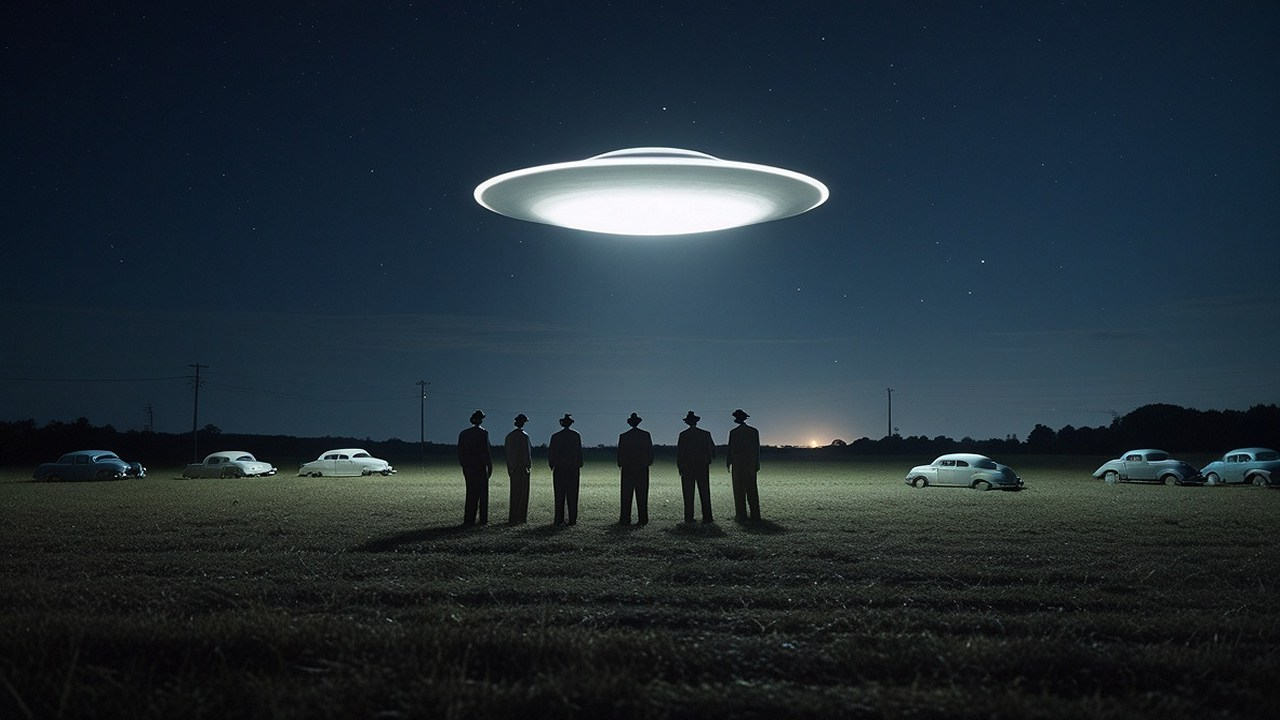
If you think the UFO story starts in the desert, or only in the big western states, you are missing a piece of the map. In July 1947, the flying-disc wave reached Delaware. It did not arrive as a crash file or a famous named witness. It arrived the way the phenomenon actually spread across America: through newspapers, wire stories, breakfast-table talk, and a few local people who looked up and saw something they could not place.
That summer is now treated as the dawn of the modern UFO era. It began with one report and became a national story in days. Delaware was small. It was not New Mexico. It was not Washington State. It still got pulled into the same sky.
On June 24, 1947, private pilot and businessman Kenneth Arnold reported nine fast-moving, crescent-shaped objects near Mount Rainier in Washington. He estimated their speed at more than 1,000 miles per hour, faster than any known aircraft of the time. When reporters pressed him, he described their motion as like a saucer skipping across water. That phrase was widely taken as a description of shape. The term “flying saucer” was born.
Within forty-eight hours the story was national. The Associated Press and United Press International put it on the wire. By the beginning of July, major cities were printing articles on flying discs. Local papers started running their own reports as residents came forward. By early July the Flying Disc Wave had arrived.
Delaware’s papers joined quickly. The Wilmington Morning News and smaller publications in Newark and Dover printed the national story. Syndicated articles mentioned flying discs seen in several states, including Delaware, in the first week of July. Historian Curtis Peebles later called that moment a perfect storm of public imagination, media repetition, and Cold War unease. Delaware was inside that storm.
Delaware did not get a flood of sightings like some western or midwestern states. The few reports it did get still tell you how the phenomenon moved. The Wilmington Morning News ran short pieces that mixed national developments with local comments. One mention said residents across several states, including Delaware, reported bright discs flashing through the sky at great speed.
A more specific brief pointed to Newark. A group of residents reported a bright round light crossing the sky west to east in a smooth arc. It was not described like a meteor. It had no tail. It made no sound. It moved steadily, then disappeared suddenly, as if it blinked out. Authorities did not investigate. The paper gave it only a small paragraph. National headlines were louder. That is how a lot of early cases survive: a few lines, then silence.
Geography matters here. In 1947 large parts of Delaware were still rural. Night skies were dark outside Wilmington. Air traffic was minimal. Light pollution was almost nonexistent in much of the state. A strange light or a reflection in the evening sky would have been easy to see and easy to talk about. That does not automatically make every light a craft. It does mean witnesses were not staring through the glare of a modern metro sky.
The timing made the reports harder to shrug off. In early July 1947, while Delaware papers were covering the discs, the Roswell story broke in New Mexico. For a few days national headlines said the U.S. Army had recovered a flying disc. Then the statement was pulled back and the object was identified as a weather balloon. Revelation, then retraction. That sequence fed the mystery. Delaware readers were looking at the same headlines as everyone else. The subject became impossible to ignore.
Most Delawareans treated the craze as curiosity, not crisis. Letters and comments mixed skepticism and fascination. Some readers joked that the discs were advertising gimmicks or tricks of light. Others wondered about secret government projects. Others wondered about visitors from another world. That range is important. The public was not a single panicked mass. It was a small state trying to decide what the sky had become.
A Wilmington editorial from July 1947 captured the split. It said Americans appeared to be seeing more in the skies than stars lately, and that the human eye could easily mistake reflections or astronomical phenomena for mysterious craft. The same editorial admitted that some accounts were too consistent to dismiss entirely and left room for speculation. That is not a tabloid scream. That is a local paper saying: some of this may be ordinary, and some of it is not easy to throw away.
The social backdrop was heavy. The summer of 1947 was only two years after the end of World War II. The Cold War was beginning. The Soviet Union had long-range aircraft. Rumors of secret weapons were common. Radar, jet propulsion, and guided missiles were changing aviation. Ordinary people knew that new and secret things might be flying overhead. Against that uncertainty, an unexplained light could grow into something larger. Delawareans projected both fear and wonder onto the sky, the same way the rest of the country did.
Delaware also had older sky stories. There were reports of mystery lights over Delaware Bay in the late 1930s. There were wartime Foo Fighter-type sightings. The 1947 disc wave tied those earlier curiosities to a national phenomenon and gave them a new frame. Once people accepted that something strange could appear in the sky, later events were easier to read through that lens.
The 1947 reports, thin as they are in the surviving print record, put Delaware into UFO catalogues. Researchers in the 1950s and 1960s, including people affiliated with the National Investigations Committee on Aerial Phenomena, NICAP, listed Delaware among the states where the 1947 disc wave produced accounts they treated as credible. That listing matters. It means the state’s small reports were not later inventions. They were already part of the first-generation research map.
No Delaware individual became famous for a July 1947 sighting. The institutions that mattered were the newspapers. Editors at the Wilmington Morning News and the Evening Journal were the main path the story took into the state. They reprinted national wire reports and added local mentions. That is how thousands of readers encountered the discs. Amateur astronomers and science teachers offered comments. Some argued for misidentified meteors or weather balloons. Others admitted uncertainty. UFO research was not yet an organized field. In Delaware the conversation stayed open speculation rather than a formal inquiry.
The wave changed how people used the sky. It created a new vocabulary. An ordinary atmospheric observation could now be a mystery. It also started a long cycle of public fascination and official scrutiny. For Delaware residents the immediate effect was simple and psychological: people looked up more often. Children scanned the night for discs. Families talked about the newspaper at breakfast. Local pilots got questions from friends. Even in small towns like Smyrna or Milford, where the skies were dark and quiet, the national conversation showed up as local gossip.
That atmosphere did not vanish in August. When later waves arrived in the 1950s, the 1960s, and after, Delaware newspapers treated 1947 as the starting point. By the time the Air Force was running Project Blue Book, Delaware’s place in the first wave was already local legend.
Modern researchers who study the social side of UFO sightings often use 1947 as an example of how media narratives shape what people notice and how they describe it. Delaware is a clean example of that process. A few short news items, reprinted from national wires, were enough to produce local sightings, letters, and rumors. The story was never only about what was in the air. It was also about how a small state interpreted lights through a sudden national language of flying discs.
That is why you should not dismiss Delaware’s 1947 file because it is short. The national wave itself was built from short reports. Arnold’s sighting became a template. Wire services multiplied it. Local papers added their own paragraphs. Newark’s bright round light, moving west to east with no sound and no tail, then blinking out, sits inside that pattern. So does the broader claim that residents in several states, including Delaware, saw bright discs at great speed.
A pro-UFO reading does not require you to pretend Delaware had a Roswell. It requires you to notice that the first modern wave was national, not regional, and that even a small Atlantic state produced the same ingredients: press coverage, local witnesses, editorial uncertainty, and a public that would not fully accept the “just the stars” answer. Some accounts were consistent enough that a Wilmington editorial left the door open. NICAP later kept Delaware on the 1947 list. That is not nothing.
More than seventy years later the July 1947 Delaware reports look modest: newspaper paragraphs, a Newark group sighting, no official investigation, no recovered hardware. Their weight is symbolic and historical. They mark the moment Delaware joined the rest of the country in looking up with a new question. The flying discs that filled American headlines that summer did more than start a fad. They redefined an age. For Delaware, those fleeting lights were the beginning of a long relationship with unexplained things in the sky.
If you are mapping UFO history state by state, do not skip the small ones. The phenomenon did not wait for a famous crash to cross a border. In July 1947 it crossed into Delaware through the morning paper, through a bright round light over Newark, and through people who decided the sky was no longer only weather and stars.
Like and subscribe if you want more documented cases told from the record, not from rumor. The first wave was bigger than the famous names. Delaware was in it.
If you think the UFO story starts in the desert, or only in the big western states, you are missing a piece of the map. In July 1947, the flying-disc wave reached Delaware. It did not arrive as a crash file or a famous named witness. It arrived the way the phenomenon actually spread across America: through newspapers, wire stories, breakfast-table talk, and a few local people who looked up and saw something they could not place.
That summer is now treated as the dawn of the modern UFO era. It began with one report and became a national story in days. Delaware was small. It was not New Mexico. It was not Washington State. It still got pulled into the same sky.
On June 24, 1947, private pilot and businessman Kenneth Arnold reported nine fast-moving, crescent-shaped objects near Mount Rainier in Washington. He estimated their speed at more than 1,000 miles per hour, faster than any known aircraft of the time. When reporters pressed him, he described their motion as like a saucer skipping across water. That phrase was widely taken as a description of shape. The term “flying saucer” was born.
Within forty-eight hours the story was national. The Associated Press and United Press International put it on the wire. By the beginning of July, major cities were printing articles on flying discs. Local papers started running their own reports as residents came forward. By early July the Flying Disc Wave had arrived.
Delaware’s papers joined quickly. The Wilmington Morning News and smaller publications in Newark and Dover printed the national story. Syndicated articles mentioned flying discs seen in several states, including Delaware, in the first week of July. Historian Curtis Peebles later called that moment a perfect storm of public imagination, media repetition, and Cold War unease. Delaware was inside that storm.
Delaware did not get a flood of sightings like some western or midwestern states. The few reports it did get still tell you how the phenomenon moved. The Wilmington Morning News ran short pieces that mixed national developments with local comments. One mention said residents across several states, including Delaware, reported bright discs flashing through the sky at great speed.
A more specific brief pointed to Newark. A group of residents reported a bright round light crossing the sky west to east in a smooth arc. It was not described like a meteor. It had no tail. It made no sound. It moved steadily, then disappeared suddenly, as if it blinked out. Authorities did not investigate. The paper gave it only a small paragraph. National headlines were louder. That is how a lot of early cases survive: a few lines, then silence.
Geography matters here. In 1947 large parts of Delaware were still rural. Night skies were dark outside Wilmington. Air traffic was minimal. Light pollution was almost nonexistent in much of the state. A strange light or a reflection in the evening sky would have been easy to see and easy to talk about. That does not automatically make every light a craft. It does mean witnesses were not staring through the glare of a modern metro sky.
The timing made the reports harder to shrug off. In early July 1947, while Delaware papers were covering the discs, the Roswell story broke in New Mexico. For a few days national headlines said the U.S. Army had recovered a flying disc. Then the statement was pulled back and the object was identified as a weather balloon. Revelation, then retraction. That sequence fed the mystery. Delaware readers were looking at the same headlines as everyone else. The subject became impossible to ignore.
Most Delawareans treated the craze as curiosity, not crisis. Letters and comments mixed skepticism and fascination. Some readers joked that the discs were advertising gimmicks or tricks of light. Others wondered about secret government projects. Others wondered about visitors from another world. That range is important. The public was not a single panicked mass. It was a small state trying to decide what the sky had become.
A Wilmington editorial from July 1947 captured the split. It said Americans appeared to be seeing more in the skies than stars lately, and that the human eye could easily mistake reflections or astronomical phenomena for mysterious craft. The same editorial admitted that some accounts were too consistent to dismiss entirely and left room for speculation. That is not a tabloid scream. That is a local paper saying: some of this may be ordinary, and some of it is not easy to throw away.
The social backdrop was heavy. The summer of 1947 was only two years after the end of World War II. The Cold War was beginning. The Soviet Union had long-range aircraft. Rumors of secret weapons were common. Radar, jet propulsion, and guided missiles were changing aviation. Ordinary people knew that new and secret things might be flying overhead. Against that uncertainty, an unexplained light could grow into something larger. Delawareans projected both fear and wonder onto the sky, the same way the rest of the country did.
Delaware also had older sky stories. There were reports of mystery lights over Delaware Bay in the late 1930s. There were wartime Foo Fighter-type sightings. The 1947 disc wave tied those earlier curiosities to a national phenomenon and gave them a new frame. Once people accepted that something strange could appear in the sky, later events were easier to read through that lens.
The 1947 reports, thin as they are in the surviving print record, put Delaware into UFO catalogues. Researchers in the 1950s and 1960s, including people affiliated with the National Investigations Committee on Aerial Phenomena, NICAP, listed Delaware among the states where the 1947 disc wave produced accounts they treated as credible. That listing matters. It means the state’s small reports were not later inventions. They were already part of the first-generation research map.
No Delaware individual became famous for a July 1947 sighting. The institutions that mattered were the newspapers. Editors at the Wilmington Morning News and the Evening Journal were the main path the story took into the state. They reprinted national wire reports and added local mentions. That is how thousands of readers encountered the discs. Amateur astronomers and science teachers offered comments. Some argued for misidentified meteors or weather balloons. Others admitted uncertainty. UFO research was not yet an organized field. In Delaware the conversation stayed open speculation rather than a formal inquiry.
The wave changed how people used the sky. It created a new vocabulary. An ordinary atmospheric observation could now be a mystery. It also started a long cycle of public fascination and official scrutiny. For Delaware residents the immediate effect was simple and psychological: people looked up more often. Children scanned the night for discs. Families talked about the newspaper at breakfast. Local pilots got questions from friends. Even in small towns like Smyrna or Milford, where the skies were dark and quiet, the national conversation showed up as local gossip.
That atmosphere did not vanish in August. When later waves arrived in the 1950s, the 1960s, and after, Delaware newspapers treated 1947 as the starting point. By the time the Air Force was running Project Blue Book, Delaware’s place in the first wave was already local legend.
Modern researchers who study the social side of UFO sightings often use 1947 as an example of how media narratives shape what people notice and how they describe it. Delaware is a clean example of that process. A few short news items, reprinted from national wires, were enough to produce local sightings, letters, and rumors. The story was never only about what was in the air. It was also about how a small state interpreted lights through a sudden national language of flying discs.
That is why you should not dismiss Delaware’s 1947 file because it is short. The national wave itself was built from short reports. Arnold’s sighting became a template. Wire services multiplied it. Local papers added their own paragraphs. Newark’s bright round light, moving west to east with no sound and no tail, then blinking out, sits inside that pattern. So does the broader claim that residents in several states, including Delaware, saw bright discs at great speed.
A pro-UFO reading does not require you to pretend Delaware had a Roswell. It requires you to notice that the first modern wave was national, not regional, and that even a small Atlantic state produced the same ingredients: press coverage, local witnesses, editorial uncertainty, and a public that would not fully accept the “just the stars” answer. Some accounts were consistent enough that a Wilmington editorial left the door open. NICAP later kept Delaware on the 1947 list. That is not nothing.
More than seventy years later the July 1947 Delaware reports look modest: newspaper paragraphs, a Newark group sighting, no official investigation, no recovered hardware. Their weight is symbolic and historical. They mark the moment Delaware joined the rest of the country in looking up with a new question. The flying discs that filled American headlines that summer did more than start a fad. They redefined an age. For Delaware, those fleeting lights were the beginning of a long relationship with unexplained things in the sky.
If you are mapping UFO history state by state, do not skip the small ones. The phenomenon did not wait for a famous crash to cross a border. In July 1947 it crossed into Delaware through the morning paper, through a bright round light over Newark, and through people who decided the sky was no longer only weather and stars.
Like and subscribe if you want more documented cases told from the record, not from rumor. The first wave was bigger than the famous names. Delaware was in it.