


Blog Categories
- African Incidents
- Atlantis Incidents
- Australian Incidents
- Belgian Incidents
- Bermuda Triangle Incidents
- Brazilian Incidents
- Canadian Incidents
- Chinese Incidents
- European Incidents
- France Incidents
- Ghosts
- Giants
- Italy Incidents
- Japanese Incidents
- Middle East Incidents
- Portugal Incidents
- Project Serpo
- Puerto Rico Incidents
- Russian Incidents
- Sasquatch
- Scandinavia Incidents
- Spanish Incidents
- UFOs
- United Kingdom Incidents
- United States Incidents
June 1974: Mount Shasta and the Triangle in the Sky
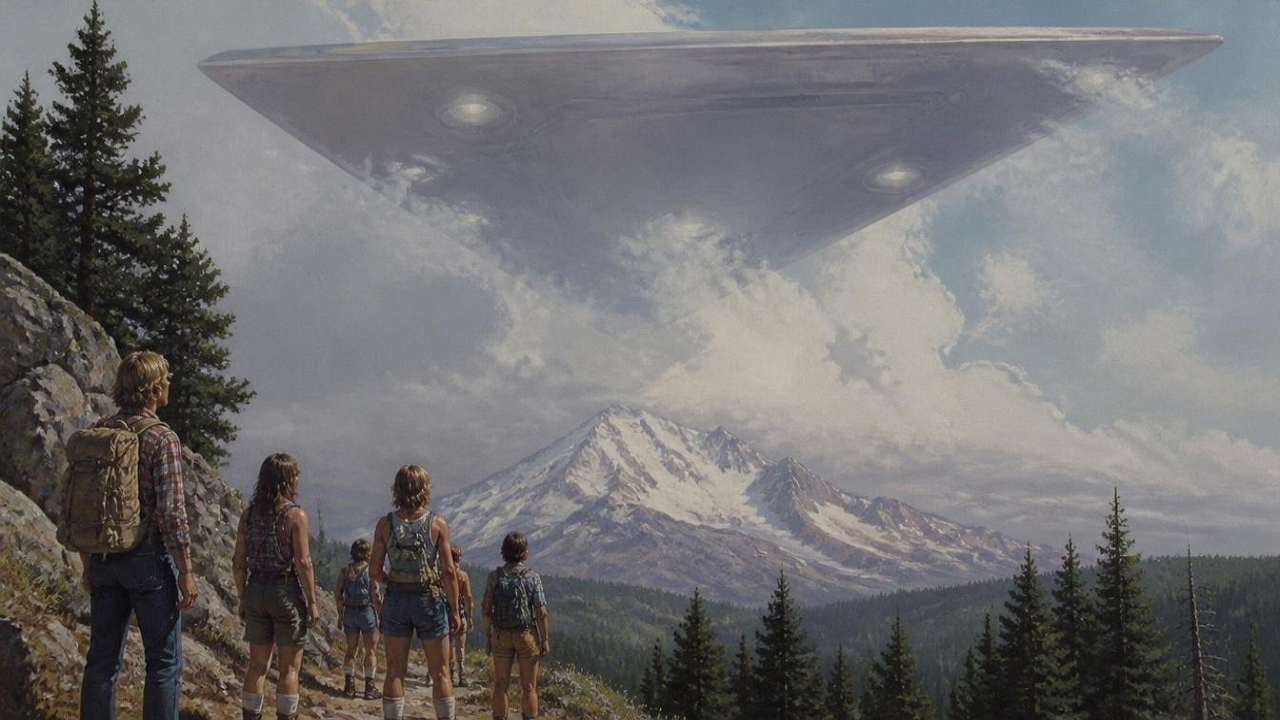
There is a long, layered history of unusual aerial reports around Mount Shasta — folklore, spiritual lore, early mystery airship sightings, and a steady stream of modern UFO accounts that range from distant lights to close encounters. Into that regional background comes the June 1974 episode: a group of hikers on a summer trek who, as they later reported, watched a very large, triangle-shaped craft emerge from low cloud and hover over the mountain for nearly a minute before drifting upward and vanishing. The narrative is compact, vivid, and characteristic of the kind of high-strangeness sighting that sews itself into a place’s lore. Examined carefully, it reveals more than a single night’s adrenaline; it reflects how people, communities, and researchers make sense of anomalous experience—and how those experiences, in turn, reshape a region’s identity.
The first thing to note about the June 1974 sighting is its basic structure: multiple observers in a natural, relatively isolated setting; a clearly perceived geometric object at low altitude; a period of sustained observation of almost a minute by the usual accounts; silent hovering; and a slow, deliberate upward departure into cloud or sky. That bundle of elements — multi-witness, close range, duration, lack of sound — is precisely the combination that makes a case memorable and relatively resistant to simple misidentification. Hikers are outdoors observers, attentive to terrain, weather, and wildlife; they are also, in many cases, practiced at reading atmospheric cues. When several such people separately report consistent visual details, the incident moves beyond the realm of an odd anecdote toward the territory of a credible, if unexplained, event.
Descriptions emphasize the craft’s triangular geometry and its scale. Witnesses typically report a broad triangular planform — flat or slightly convex — with a sense of mass that dwarfed the trees and rock forms below. The craft’s edges were sometimes described as hard and defined rather than diffuse, reinforcing the impression of a constructed object. Its movement was not the erratic flutter of a meteor nor the steady transit of a distant aircraft; rather, it hovered in near silence, a behavior inconsistent with conventional powered craft of the era. After nearly a minute, the triangle parted the low cloud and, with a slow graceful ascent, vanished into the sky. The silence and the absence of visible propulsion — no plumes, no rotor blur, nothing to imply jets or propellers — are details most witnesses stress. Those details are what make the report align with numerous other triangular-type sightings that would later populate UFO catalogs and spark intense interest among researchers and skeptics alike.
The social and psychological impact on the witnesses is worth underscoring. For hikers unprepared for aerial anomalies, close encounters often produce a mix of awe, fear, and confusion. A minute at close range—long enough to notice shape, texture, and motion—gives rise to strong memories that can endure for decades. Those recollections are typically vivid: witnesses remember the way the craft blocked a section of sky, how its light or surface looked in the overcast light, and the peculiar quiet. For many participants in such episodes, the experience prompts immediate questions—Was it a secret military craft? A natural phenomenon misread under stress and low light? Something else entirely? The hikers’ responses in the days and years afterward—whether to report the sighting to authorities, tell friends, or keep it private—shape how the event becomes a part of community narrative. In the Mount Shasta region, where spiritual and anomalous narratives already circulate freely, the sighting added another chapter to a preexisting archive of extraordinary claims.
The event’s impact on the wider community was subtle but cumulative. Mount Shasta already had a reputation among certain subcultures for being a locus of strange experiences; stories of lights, strange sounds, and otherworldly presences circulated in local taverns, guidebooks, and spiritual gatherings. A well-documented, multiple-witness sighting augments that local mythology. It does not necessarily produce sensational headlines that last long in mainstream media, but it does deepen the mountain’s identity as a place where the ordinary rules of nature sometimes seem suspended. For regional guides, new-age practitioners, and UFO enthusiasts, such reports become currency—attracting pilgrims, researchers, and occasional journalists. Economically and culturally, the accumulation of such stories can transform a place into a destination for seekers of anomalous experience; the mountain’s tourism ecology then begins to incorporate, deliberately or incidentally, the aura of mystery.
From a research perspective, the case is useful in several ways. First, multi-witness reports allow for cross-checking internal consistency: independent recollections of the same geometric shape, timing, and sequence reduce the chance that a single misperception became a contagion. Second, the setting—outdoors, in steady but variable mountain weather—invites careful consideration of atmospheric optics, lenticular cloud formations, and other meteorological phenomena that can create unusual visual effects. Researchers will typically examine wind, cloud layers, local aviation activity, and any military flight operations in the area at the time. The absence of corroborating radar records, photographs, or physical traces limits definitive conclusions, but the presence of multiple competent observers elevates the event beyond anecdote.
Skeptical explanations have often focused on misperception and context. Mountain regions produce dramatic sky effects: lenticular clouds over peaks can assume hard-edged triangular profiles at certain angles; cloud banks lit from below can appear as illuminated objects; and distant aircraft reflected in low cloud can seem to hover. In some cases, secret or experimental aircraft operating at high altitude, viewed obliquely through cloud, may be misinterpreted as low, hovering craft. The Mount Shasta sighting must be weighed against these possibilities: could a lenticular cloud or a combination of cloud, moonlight, and perspective explain a triangular silhouette? Could light from a distant airport or naval facility have been refracted or reflected to produce the observed colors and apparent hovering? Those are the questions a careful investigator asks. In many notable cases, investigators conclude that no conventional explanation fully accounts for the totality of witness reports; in others, an atmospheric or aircraft explanation proves sufficient. The Mount Shasta June 1974 episode, lacking definitive instrumental corroboration, remains in the ambiguous middle ground.
Institutionally, the event had a limited official footprint. In most cases of this sort, local law enforcement may receive calls and make notes but cannot pursue airborne investigations. Air traffic control logs and regional military flight manifests are a common next step for researchers seeking corroboration; in their absence, the incident rests chiefly on witness statements. Civilian UFO organizations and local chroniclers often preserve reports like this in files and compilations, ensuring the sighting remains available to future researchers and curious members of the public. Because Mount Shasta already had an archive of anomalous experiences, the 1974 sighting became another node in a continuing chain—something researchers point to when mapping long-term regional patterns.
What does the episode mean today? Practically, it is a reminder that credible, multi-witness encounters continue to occur in geographically diverse settings. Culturally, it feeds the living lore of Mount Shasta: those who visit the mountain today may do so with the awareness—faint or keen—that it is a place where unusual skies have been seen. For scientific inquiry, the sighting stands as an example of the challenge of investigating one-off sightings that lack physical evidence. The methodological lessons are familiar: insist on immediate documentation when possible, cross-corroborate witness statements, search for independent instrument records, and consider atmospheric and human perceptual factors with rigor. The case also underscores the social dynamic: witnesses’ choices about reporting, the role of local culture in shaping narratives, and the way regional identities absorb and repurpose anomalous events.
Finally, the Mount Shasta June 1974 report raises broader questions about how societies engage with unexplained phenomena. Even when conventional explanations are plausible, they rarely erase the subjective sense of wonder and dislocation such an encounter produces. Whether the event ultimately turns out to be a rare atmospheric illusion, an experimental platform, or something else entirely, it has already done its work: it has opened a window into human experience, testifying that even in an age of mapped skies and sophisticated instruments, people still encounter moments that exceed ready explanation. That gap—between what we can easily model and what people report seeing—remains the fertile territory that keeps regional lore alive and motivates continued inquiry.
If one were to sum up the June 1974 Mount Shasta sighting in a single thought, it would be this: a brief, silent triangular presence over a sacred mountain became a communal story, not merely because of the object itself, but because of what it revealed about perception, place, and the human need to understand anomalies that touch the everyday world.