


Blog Categories
- African Incidents
- Atlantis Incidents
- Australian Incidents
- Belgian Incidents
- Bermuda Triangle Incidents
- Brazilian Incidents
- Canadian Incidents
- Chinese Incidents
- European Incidents
- France Incidents
- Ghosts
- Giants
- Italy Incidents
- Japanese Incidents
- Middle East Incidents
- Portugal Incidents
- Project Serpo
- Puerto Rico Incidents
- Russian Incidents
- Sasquatch
- Scandinavia Incidents
- Spanish Incidents
- UFOs
- United Kingdom Incidents
- United States Incidents
Late 1930s: Mysterious Lights Over the Delaware Bay
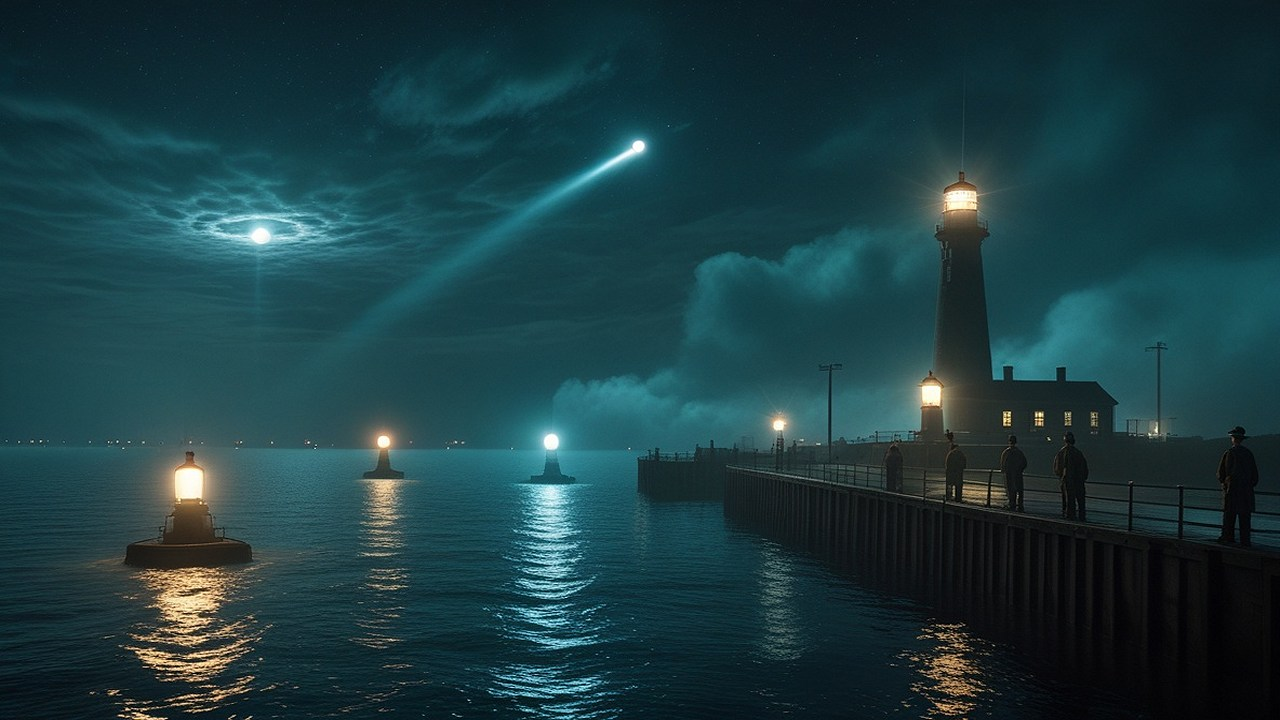
Long before Roswell, before Kenneth Arnold coined the term “flying saucers,” and decades before the modern UAP era, something unusual was already appearing in American skies. In the late 1930s, along the quiet waters of the Delaware Bay, fishermen, light-keepers, and coastal residents repeatedly saw strange lights hovering, darting, and moving in ways that defied easy explanation.
These were not fleeting meteors or distant ships. They were lights that rose from the water, hovered motionless, and then accelerated away at high speed — silent, deliberate, and impossible for the technology of the time. This is the story of the Mysterious Lights Over the Delaware Bay — one of America’s earliest and most persistent clusters of unidentified aerial phenomena, hidden in plain sight within maritime lore and local memory.
Welcome to the channel. Today we’re going back more than 85 years to examine a fascinating pre-World War II UAP wave that has been largely overlooked by mainstream history but deserves serious attention in the study of unidentified aerial phenomena.
Let’s set the scene.
The Delaware Bay region in the late 1930s was a place of contrasts. Busy maritime traffic moved through its waters. Lighthouses kept watch over shifting shoals and dangerous currents. Fishermen cast their nets under moonlit skies, and light-keepers scanned the horizon for signs of distress. With the Atlantic at their doorstep and open skies above, observers had an unobstructed view of both sea and sky.
This was also a time of growing global tension. War was brewing in Europe, and the United States, though still neutral, was quietly preparing. Coastal communities were on watch, alert for anything out of the ordinary. In this environment of vigilance and isolation, the strange lights began to appear.
According to scattered contemporary accounts, local newspapers, and later oral histories, residents and seafarers reported lights that rose from the water or hovered low over the bay before moving away at high speed. Fishermen described them as too bright, too fast, and too silent to be ordinary navigation lights or aircraft. Light-keepers, accustomed to tracking ships and buoys at night, noted lights that behaved in ways they had never seen before — hovering motionless against the wind, then darting away without sound or visible propulsion.
The reports shared several consistent elements. The lights often appeared low over the water, sometimes seeming to emerge from the bay itself. They would hover for minutes at a time, defying the drift expected of balloons or lanterns. Then, without warning, they would accelerate rapidly and disappear into the darkness. There were no engine sounds, no visible exhaust, and no conventional aircraft signatures. For people living and working on the water, these characteristics made the lights stand out as genuinely anomalous.
The maritime environment played a crucial role in how these sightings were perceived. Fishermen and light-keepers were practical, experienced observers who knew the difference between ships’ lights, stars, planets, and weather phenomena. When something appeared that didn’t fit any known category, they took notice. The bay’s open horizon and dark waters provided an ideal backdrop for such observations, making even modest lights highly visible against the night sky.
While no single dramatic mass sighting dominated the headlines, the cumulative pattern of reports over several years created a quiet but persistent local lore. Stories of the “bay lights” passed between fishing crews, lighthouse families, and coastal communities. They became part of the region’s oral tradition — tales told during long nights at sea or around winter fires. The absence of official explanation only added to their intrigue.
This late-1930s Delaware Bay activity fits into a broader pattern of pre-World War II anomalous aerial phenomena reported across the United States and Europe. The famous 1896–1897 airship wave had already shown that structured craft could be seen in American skies. By the 1930s, with aviation technology advancing rapidly, people were even more attuned to anything unusual overhead. The Delaware Bay lights represent an important regional chapter in this longer history, showing that the phenomenon was active along the East Coast well before the modern UFO era.
The credibility of the witnesses strengthens the case. Fishermen and light-keepers were not prone to wild exaggeration. Their livelihoods depended on accurate observation and practical knowledge of the sea and sky. When multiple independent observers from different vantage points reported the same unusual lights over an extended period, it becomes difficult to dismiss the entire wave as mass hallucination or misidentification.
The lights’ behavior — hovering against the wind, rapid acceleration, and silent operation — challenged the technological understanding of the time. In the late 1930s, the only flying machines were basic airplanes and experimental airships, none of which could hover motionless or accelerate silently in the manner described. The reports predate widespread radar use and advanced aviation, making conventional explanations even harder to sustain.
When we compare these 1930s sightings to modern UAP reports, the parallels are striking. Luminous objects rising from water, hovering silently, and departing at high speed continue to be documented today by military personnel and civilian mariners. The Delaware Bay cases demonstrate continuity — the same phenomenon appearing in the same maritime environment across generations. This long-term pattern suggests something persistent rather than fleeting or localized.
The cultural impact on coastal Delaware communities was subtle but enduring. Stories of the bay lights became part of local folklore, passed down through families and shared among fishermen. They contributed to a sense of connection with the mysterious — the idea that the waters and skies around them held secrets beyond everyday understanding. In a region already rich with maritime ghost stories and shipwreck legends, the lights added another layer of nocturnal wonder.
The absence of official investigation or public acknowledgment at the time is typical of pre-1947 UAP reports. Without a formal framework like Project Blue Book, most sightings remained local matters, recorded in newspapers, letters, or oral memory. The Delaware Bay lights were no exception. Their preservation through later historical compilations and regional lore ensures they remain part of America’s early UAP record.
Today, as governments worldwide gradually acknowledge the reality of UAP, cases like the late-1930s Delaware Bay lights take on new relevance. They show that the phenomenon did not begin with the post-war era or the atomic age. It was already active along America’s coasts in the years leading up to World War II, observed by practical people with no cultural bias toward extraterrestrial explanations. They simply saw lights that behaved in ways that defied natural and technological understanding of their time.
The fishermen and light-keepers who watched those strange lights rise from the Delaware Bay in the late 1930s may not have realized the historical significance of their observations. But their accounts help us understand that the mystery has deep roots — stretching back decades before Roswell, before Kenneth Arnold, and before the modern UAP disclosure efforts. They remind us that ordinary people, in ordinary places, have been encountering the unexplained for a very long time.
As we continue our modern search for answers, the Delaware Bay lights of the 1930s serve as an important early chapter. They challenge us to look beyond the familiar narratives and recognize that this phenomenon has been with us far longer than most people realize. The lights that hovered and darted over the bay in the years before World War II may have eventually faded from view, but their place in the history of unidentified aerial phenomena remains secure.
They stand as quiet testimony that the skies above our coasts have never been entirely empty — and that something unknown has been moving through them, observed and remembered, for generations.
Long before Roswell, before Kenneth Arnold coined the term “flying saucers,” and decades before the modern UAP era, something unusual was already appearing in American skies. In the late 1930s, along the quiet waters of the Delaware Bay, fishermen, light-keepers, and coastal residents repeatedly saw strange lights hovering, darting, and moving in ways that defied easy explanation.
These were not fleeting meteors or distant ships. They were lights that rose from the water, hovered motionless, and then accelerated away at high speed — silent, deliberate, and impossible for the technology of the time. This is the story of the Mysterious Lights Over the Delaware Bay — one of America’s earliest and most persistent clusters of unidentified aerial phenomena, hidden in plain sight within maritime lore and local memory.
Welcome to the channel. Today we’re going back more than 85 years to examine a fascinating pre-World War II UAP wave that has been largely overlooked by mainstream history but deserves serious attention in the study of unidentified aerial phenomena.
Let’s set the scene.
The Delaware Bay region in the late 1930s was a place of contrasts. Busy maritime traffic moved through its waters. Lighthouses kept watch over shifting shoals and dangerous currents. Fishermen cast their nets under moonlit skies, and light-keepers scanned the horizon for signs of distress. With the Atlantic at their doorstep and open skies above, observers had an unobstructed view of both sea and sky.
This was also a time of growing global tension. War was brewing in Europe, and the United States, though still neutral, was quietly preparing. Coastal communities were on watch, alert for anything out of the ordinary. In this environment of vigilance and isolation, the strange lights began to appear.
According to scattered contemporary accounts, local newspapers, and later oral histories, residents and seafarers reported lights that rose from the water or hovered low over the bay before moving away at high speed. Fishermen described them as too bright, too fast, and too silent to be ordinary navigation lights or aircraft. Light-keepers, accustomed to tracking ships and buoys at night, noted lights that behaved in ways they had never seen before — hovering motionless against the wind, then darting away without sound or visible propulsion.
The reports shared several consistent elements. The lights often appeared low over the water, sometimes seeming to emerge from the bay itself. They would hover for minutes at a time, defying the drift expected of balloons or lanterns. Then, without warning, they would accelerate rapidly and disappear into the darkness. There were no engine sounds, no visible exhaust, and no conventional aircraft signatures. For people living and working on the water, these characteristics made the lights stand out as genuinely anomalous.
The maritime environment played a crucial role in how these sightings were perceived. Fishermen and light-keepers were practical, experienced observers who knew the difference between ships’ lights, stars, planets, and weather phenomena. When something appeared that didn’t fit any known category, they took notice. The bay’s open horizon and dark waters provided an ideal backdrop for such observations, making even modest lights highly visible against the night sky.
While no single dramatic mass sighting dominated the headlines, the cumulative pattern of reports over several years created a quiet but persistent local lore. Stories of the “bay lights” passed between fishing crews, lighthouse families, and coastal communities. They became part of the region’s oral tradition — tales told during long nights at sea or around winter fires. The absence of official explanation only added to their intrigue.
This late-1930s Delaware Bay activity fits into a broader pattern of pre-World War II anomalous aerial phenomena reported across the United States and Europe. The famous 1896–1897 airship wave had already shown that structured craft could be seen in American skies. By the 1930s, with aviation technology advancing rapidly, people were even more attuned to anything unusual overhead. The Delaware Bay lights represent an important regional chapter in this longer history, showing that the phenomenon was active along the East Coast well before the modern UFO era.
The credibility of the witnesses strengthens the case. Fishermen and light-keepers were not prone to wild exaggeration. Their livelihoods depended on accurate observation and practical knowledge of the sea and sky. When multiple independent observers from different vantage points reported the same unusual lights over an extended period, it becomes difficult to dismiss the entire wave as mass hallucination or misidentification.
The lights’ behavior — hovering against the wind, rapid acceleration, and silent operation — challenged the technological understanding of the time. In the late 1930s, the only flying machines were basic airplanes and experimental airships, none of which could hover motionless or accelerate silently in the manner described. The reports predate widespread radar use and advanced aviation, making conventional explanations even harder to sustain.
When we compare these 1930s sightings to modern UAP reports, the parallels are striking. Luminous objects rising from water, hovering silently, and departing at high speed continue to be documented today by military personnel and civilian mariners. The Delaware Bay cases demonstrate continuity — the same phenomenon appearing in the same maritime environment across generations. This long-term pattern suggests something persistent rather than fleeting or localized.
The cultural impact on coastal Delaware communities was subtle but enduring. Stories of the bay lights became part of local folklore, passed down through families and shared among fishermen. They contributed to a sense of connection with the mysterious — the idea that the waters and skies around them held secrets beyond everyday understanding. In a region already rich with maritime ghost stories and shipwreck legends, the lights added another layer of nocturnal wonder.
The absence of official investigation or public acknowledgment at the time is typical of pre-1947 UAP reports. Without a formal framework like Project Blue Book, most sightings remained local matters, recorded in newspapers, letters, or oral memory. The Delaware Bay lights were no exception. Their preservation through later historical compilations and regional lore ensures they remain part of America’s early UAP record.
Today, as governments worldwide gradually acknowledge the reality of UAP, cases like the late-1930s Delaware Bay lights take on new relevance. They show that the phenomenon did not begin with the post-war era or the atomic age. It was already active along America’s coasts in the years leading up to World War II, observed by practical people with no cultural bias toward extraterrestrial explanations. They simply saw lights that behaved in ways that defied natural and technological understanding of their time.
The fishermen and light-keepers who watched those strange lights rise from the Delaware Bay in the late 1930s may not have realized the historical significance of their observations. But their accounts help us understand that the mystery has deep roots — stretching back decades before Roswell, before Kenneth Arnold, and before the modern UAP disclosure efforts. They remind us that ordinary people, in ordinary places, have been encountering the unexplained for a very long time.
As we continue our modern search for answers, the Delaware Bay lights of the 1930s serve as an important early chapter. They challenge us to look beyond the familiar narratives and recognize that this phenomenon has been with us far longer than most people realize. The lights that hovered and darted over the bay in the years before World War II may have eventually faded from view, but their place in the history of unidentified aerial phenomena remains secure.
They stand as quiet testimony that the skies above our coasts have never been entirely empty — and that something unknown has been moving through them, observed and remembered, for generations.