

Blog Categories
- African Incidents
- Atlantis Incidents
- Australian Incidents
- Belgian Incidents
- Bermuda Triangle Incidents
- Brazilian Incidents
- Canadian Incidents
- Chinese Incidents
- European Incidents
- France Incidents
- Ghosts
- Giants
- Italy Incidents
- Japanese Incidents
- Middle East Incidents
- Portugal Incidents
- Project Serpo
- Puerto Rico Incidents
- Russian Incidents
- Sasquatch
- Scandinavia Incidents
- Spanish Incidents
- UFOs
- United Kingdom Incidents
- United States Incidents
Native American Oral Traditions: Star-People
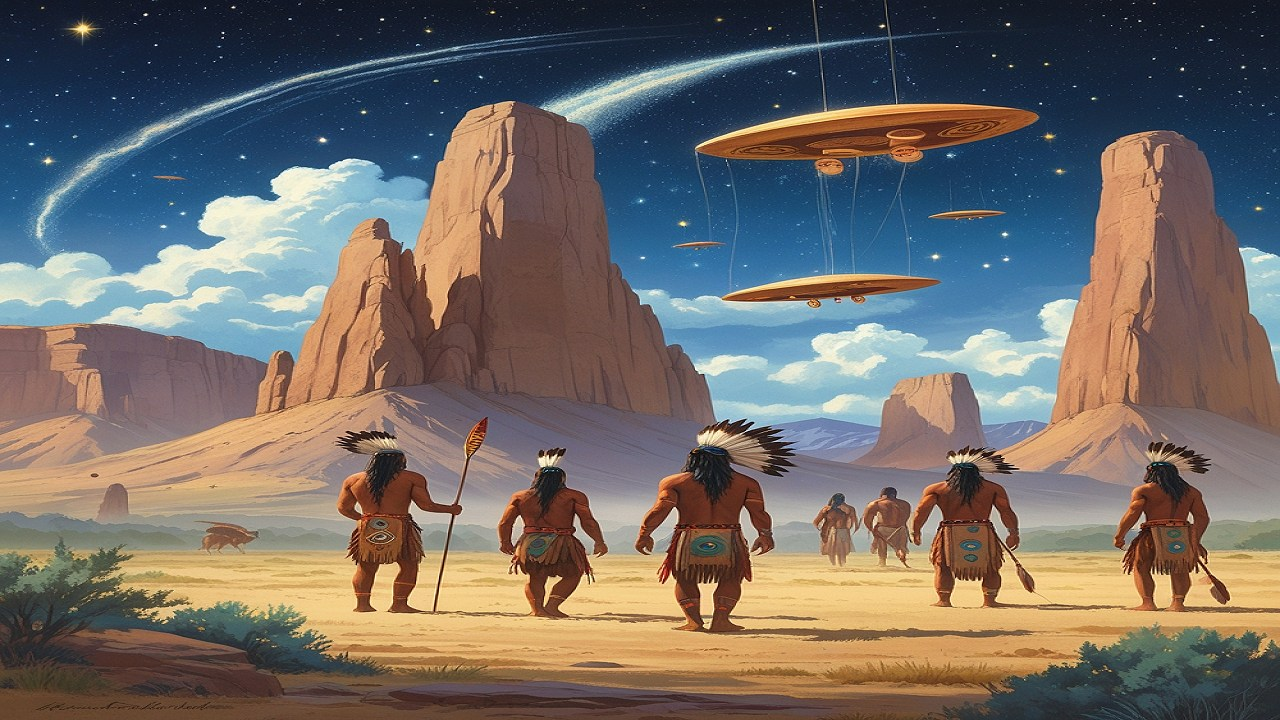
Long before European contact, many Native tribes in California— including the Chumash, Yokuts, and Miwok peoples—told stories of beings who came from the sky, taught knowledge, or watched from above.
These oral traditions describe luminous beings, ancestors in the stars, and multi-layered cosmologies—cultural patterns that resonate with modern UFO themes, though they hold deep spiritual and worldview significance.
Chumash Cosmology & Star People
The Chumash of coastal Southern California and the Channel Islands believed the universe comprised three realms: the Middle World (humans), the World Above (sky beings), and the World Below (monsters or underworld beings). The World Above is populated by supernatural figures such as Sky Snake (Alchupo’osh), the Great Eagle (Slo’w / ?elye? wun), and the Sun—who is portrayed as an old widower living in a crystalline house with daughters and wielding cosmic power.
In Chumash mythology, celestial objects—like the Sun, Moon, Morning Star, and Pleiades—are animated ancestor-or spirit-beings. For example, star clusters such as the Pleiades are explained through a narrative called “The Boys Who Turned into Geese,” where neglected boys ascend in a sweat lodge to become the seven stars of the Pleiades constellation.
This tradition places agency and personhood in the sky—not simply as abstract stars, but as beings that interact with humankind. People in trance states (through vision quests or intake of toloache, a hallucinogenic plant) would reportedly receive messages from the sky world, after which they created rock pictographs or paintings meant to communicate with the spirit realm.
Yokuts & Miwok Star-People Elements
The Yokuts, who lived in the San Joaquin Valley and Sierra foothills, share creation narratives involving animals and birds cooperating to rescue land from floodwaters—eagle, crow, and duck cooperating to scoop mud from the watery abyss. Though largely animal-centered, such myths emphasize sky creatures (eagle, crow) as agents shaping the world.
The Miwok, comprised of various Central and Coast Miwok groups, describe a class of primordial beings known as star-people spirits. In one Coast Miwok catalog of first spirits, names such as Os-so-so’li (Pleiades) and Hul’-luk mi-yum’-ko (two star women chiefs) appear alongside Coyote and Falcon spirits.
These early spirits predate ordinary humans and are revered as ancestral or mythical beings with powers beyond the physical world.
Themes & Symbolism: Light, Flight, and Guidance
Across these traditions, a few clear motifs emerge: Luminous Sky Ancestors: The stars, sun, and moon are personified or deified— sometimes even ancestors—indicating a cultural belief in beings who traverse the sky and influence human affairs.
Inter-World Travel: Vision journeys and mythic narratives describe Coyote or others moving between worlds, and humans receiving messages via spiritual intermediaries or plant-induced trance states.
Teaching and Warnings from Above: Star-people or sky beings were associated with imparting knowledge—about seasons, cosmology, or moral conduct—to human beings.
Cosmological Maps & Star Knowledge: The Chumash produced arborglyphs and pictographs aligned to solar and stellar cycles; elders like Alan Salazar and Joe Talaugon emphasize how these aided navigation, calendars, and ritual timing.
Cultural Effects and Social Role
Community Cohesion and Identity
These stories served multiple social functions. They unify ancestral origin, cosmology, art, and ritual into coherent identity. The Chumash Syuxtun Story Circle mosaic, for instance, visually encodes the three-world cosmology, sky-people, channel islands, serpents, floods, and even resistance to colonial disruption—all reinforcing a shared cultural memory and spiritual framework.
Spiritual Leadership and Healing
Chumash shamans—using toloache to enter trance—played roles in health, weather control, and interpreting celestial omens. They painted cave pictographs that linked directly to their visions of spirit realms. These practices sustained social order, foretold events, and maintained balance with nature.
Astronomy and Environmental Knowledge
Tribes like the Kumeyaay in Southern California developed astronomical observation systems (e.g. equinox alignment sites, solar calendars). While not directly mythological star-people encounters, this points to a broader cultural priority on sky knowledge interwoven with spirituality.
Impact on Contemporary Awareness
Cultural Revitalization
In recent decades, many California tribes have revived storytelling, language, and ceremonial practice. Elders such as Joe Talaugon and storytellers like Julie Tumamait-Stenslie share star-people and creation myths at events (e.g. the Ojai Foundation, Joseph Campbell RoundTable) to educate both tribal and non-tribal audiences today.
Indigenous Astronomy Initiatives
Projects such as Native Skywatchers (though focused on Ojibwe and Dakota groups) demonstrate a broader movement to integrate indigenous star knowledge with modern astronomy education. California tribal educators are part of this broader indigenous astronomy revival, linking oral traditions to science classrooms.
Public Understanding of “UFO-like” Elements
While these native star stories are spiritual and symbolic, they have occasionally influenced modern interpretations of UFO folklore. Some UFO enthusiasts reference star-people traditions as ancient parallels to contact experiences—though tribal scholars emphasize that such interpretations risk misappropriating sacred beliefs.
Notable Individuals
Joe Talaugon, a Chumash elder and cultural leader, has frequently spoken on Chumash sky-knowledge and traditional astronomy, emphasizing how the North Star (Sky Coyote) served as moral guide and cosmic reference for planting and ceremony.
Julie Tumamait-Stenslie, a Ventureno Chumash elder and storyteller, presents creation stories, sky-people myths, and lessons about death and rebirth in public forums, maintaining oral tradition into the present generation.
Alan Salazar, a contemporary Chumash science-keeper, collaborates in interpreting arborglyphs (tree carvings recording solar motion) and bridging native astronomy with public science education at Mt. Pinos and ceremonies.
Significance in a Broader Context
Though not UFOs in the modern sense—i.e. advanced craft piloted by extraterrestrial beings—these oral traditions share striking parallels with recurring themes in modern sightings: luminous beings, flight, other realms, and teaching from above.
But crucially, they reside within spiritual cosmologies rather than mechanical or technological frameworks. Their resurrection in educational and ceremonial settings today underscores their resilience and their relevance to cultural identity and ecological stewardship.
Conclusion
In summary, California Native American oral traditions—especially among the Chumash, Yokuts, and Miwok.
Present a rich tapestry of star-people, sky beings, and inter-world travel that shaped moral systems, seasonal patterns, mythic identity, and spiritual practice. These stories continue to influence tribal identity, environmental knowledge, and indigenous astronomy movements today. As elders and scientists collaborate to preserve and reinterpret them, they offer an enduring window into humanity’s long-standing skyward gaze.
Long before European contact, many Native tribes in California— including the Chumash, Yokuts, and Miwok peoples—told stories of beings who came from the sky, taught knowledge, or watched from above.
These oral traditions describe luminous beings, ancestors in the stars, and multi-layered cosmologies—cultural patterns that resonate with modern UFO themes, though they hold deep spiritual and worldview significance.
Chumash Cosmology & Star People
The Chumash of coastal Southern California and the Channel Islands believed the universe comprised three realms: the Middle World (humans), the World Above (sky beings), and the World Below (monsters or underworld beings). The World Above is populated by supernatural figures such as Sky Snake (Alchupo’osh), the Great Eagle (Slo’w / ?elye? wun), and the Sun—who is portrayed as an old widower living in a crystalline house with daughters and wielding cosmic power.
In Chumash mythology, celestial objects—like the Sun, Moon, Morning Star, and Pleiades—are animated ancestor-or spirit-beings. For example, star clusters such as the Pleiades are explained through a narrative called “The Boys Who Turned into Geese,” where neglected boys ascend in a sweat lodge to become the seven stars of the Pleiades constellation.
This tradition places agency and personhood in the sky—not simply as abstract stars, but as beings that interact with humankind. People in trance states (through vision quests or intake of toloache, a hallucinogenic plant) would reportedly receive messages from the sky world, after which they created rock pictographs or paintings meant to communicate with the spirit realm.
Yokuts & Miwok Star-People Elements
The Yokuts, who lived in the San Joaquin Valley and Sierra foothills, share creation narratives involving animals and birds cooperating to rescue land from floodwaters—eagle, crow, and duck cooperating to scoop mud from the watery abyss. Though largely animal-centered, such myths emphasize sky creatures (eagle, crow) as agents shaping the world.
The Miwok, comprised of various Central and Coast Miwok groups, describe a class of primordial beings known as star-people spirits. In one Coast Miwok catalog of first spirits, names such as Os-so-so’li (Pleiades) and Hul’-luk mi-yum’-ko (two star women chiefs) appear alongside Coyote and Falcon spirits.
These early spirits predate ordinary humans and are revered as ancestral or mythical beings with powers beyond the physical world.
Themes & Symbolism: Light, Flight, and Guidance
Across these traditions, a few clear motifs emerge: Luminous Sky Ancestors: The stars, sun, and moon are personified or deified— sometimes even ancestors—indicating a cultural belief in beings who traverse the sky and influence human affairs.
Inter-World Travel: Vision journeys and mythic narratives describe Coyote or others moving between worlds, and humans receiving messages via spiritual intermediaries or plant-induced trance states.
Teaching and Warnings from Above: Star-people or sky beings were associated with imparting knowledge—about seasons, cosmology, or moral conduct—to human beings.
Cosmological Maps & Star Knowledge: The Chumash produced arborglyphs and pictographs aligned to solar and stellar cycles; elders like Alan Salazar and Joe Talaugon emphasize how these aided navigation, calendars, and ritual timing.
Cultural Effects and Social Role
Community Cohesion and Identity
These stories served multiple social functions. They unify ancestral origin, cosmology, art, and ritual into coherent identity. The Chumash Syuxtun Story Circle mosaic, for instance, visually encodes the three-world cosmology, sky-people, channel islands, serpents, floods, and even resistance to colonial disruption—all reinforcing a shared cultural memory and spiritual framework.
Spiritual Leadership and Healing
Chumash shamans—using toloache to enter trance—played roles in health, weather control, and interpreting celestial omens. They painted cave pictographs that linked directly to their visions of spirit realms. These practices sustained social order, foretold events, and maintained balance with nature.
Astronomy and Environmental Knowledge
Tribes like the Kumeyaay in Southern California developed astronomical observation systems (e.g. equinox alignment sites, solar calendars). While not directly mythological star-people encounters, this points to a broader cultural priority on sky knowledge interwoven with spirituality.
Impact on Contemporary Awareness
Cultural Revitalization
In recent decades, many California tribes have revived storytelling, language, and ceremonial practice. Elders such as Joe Talaugon and storytellers like Julie Tumamait-Stenslie share star-people and creation myths at events (e.g. the Ojai Foundation, Joseph Campbell RoundTable) to educate both tribal and non-tribal audiences today.
Indigenous Astronomy Initiatives
Projects such as Native Skywatchers (though focused on Ojibwe and Dakota groups) demonstrate a broader movement to integrate indigenous star knowledge with modern astronomy education. California tribal educators are part of this broader indigenous astronomy revival, linking oral traditions to science classrooms.
Public Understanding of “UFO-like” Elements
While these native star stories are spiritual and symbolic, they have occasionally influenced modern interpretations of UFO folklore. Some UFO enthusiasts reference star-people traditions as ancient parallels to contact experiences—though tribal scholars emphasize that such interpretations risk misappropriating sacred beliefs.
Notable Individuals
Joe Talaugon, a Chumash elder and cultural leader, has frequently spoken on Chumash sky-knowledge and traditional astronomy, emphasizing how the North Star (Sky Coyote) served as moral guide and cosmic reference for planting and ceremony.
Julie Tumamait-Stenslie, a Ventureno Chumash elder and storyteller, presents creation stories, sky-people myths, and lessons about death and rebirth in public forums, maintaining oral tradition into the present generation.
Alan Salazar, a contemporary Chumash science-keeper, collaborates in interpreting arborglyphs (tree carvings recording solar motion) and bridging native astronomy with public science education at Mt. Pinos and ceremonies.
Significance in a Broader Context
Though not UFOs in the modern sense—i.e. advanced craft piloted by extraterrestrial beings—these oral traditions share striking parallels with recurring themes in modern sightings: luminous beings, flight, other realms, and teaching from above.
But crucially, they reside within spiritual cosmologies rather than mechanical or technological frameworks. Their resurrection in educational and ceremonial settings today underscores their resilience and their relevance to cultural identity and ecological stewardship.
Conclusion
In summary, California Native American oral traditions—especially among the Chumash, Yokuts, and Miwok.
Present a rich tapestry of star-people, sky beings, and inter-world travel that shaped moral systems, seasonal patterns, mythic identity, and spiritual practice. These stories continue to influence tribal identity, environmental knowledge, and indigenous astronomy movements today. As elders and scientists collaborate to preserve and reinterpret them, they offer an enduring window into humanity’s long-standing skyward gaze.