


Blog Categories
- African Incidents
- Atlantis Incidents
- Australian Incidents
- Belgian Incidents
- Bermuda Triangle Incidents
- Brazilian Incidents
- Canadian Incidents
- Chinese Incidents
- European Incidents
- France Incidents
- Ghosts
- Giants
- Italy Incidents
- Japanese Incidents
- Middle East Incidents
- Portugal Incidents
- Project Serpo
- Puerto Rico Incidents
- Russian Incidents
- Sasquatch
- Scandinavia Incidents
- Spanish Incidents
- UFOs
- United Kingdom Incidents
- United States Incidents
November 1966: Palos Verdes UFO Encounter
The coastal cliffs and rolling hills of California’s Palos Verdes Peninsula are known for their scenic beauty, quiet neighborhoods, and sweeping views of the Pacific Ocean. In the mid-1960s, this affluent region was far removed from the turbulence of the era’s major cities. But in November 1966, the peaceful landscape became the backdrop for a UFO sighting that would be preserved for decades in the files of local and regional UFO research groups, including MUFON (Mutual UFO Network).
This case is notable for several reasons: it involved two witnesses in close proximity to the object, the craft was described as triangular—a shape that would not become widely reported in UFO cases until years later—and the sighting lasted an unusually long time for a close encounter. The witnesses’ reputations for honesty and reliability further distinguished the report, ensuring it would not be dismissed as a fleeting or unreliable observation.
The Witnesses and the Setting
The two witnesses were a man and his teenage son, whose names were preserved in the original MUFON files but have rarely been publicized in later summaries. Both were described as credible, articulate, and without any apparent motive to fabricate such a story. The father was a local resident with a professional background, while the son was a high school student active in community sports and academics.
The Palos Verdes Peninsula in 1966 was largely a residential area interspersed with undeveloped land. At night, certain stretches of road were almost completely dark, illuminated only by the occasional streetlamp or passing vehicle. The pair were driving late in the evening, returning from an errand or visit, when the incident began.
The Encounter
According to the witnesses, the first sign of something unusual was a series of pulsating blue lights in the night sky.
At first, they assumed it might be an aircraft approaching the nearby Los Angeles International Airport (LAX) or possibly a helicopter patrolling the coastline. But as the lights grew brighter and the shape of the object became discernible, they realized they were looking at something very different.
The craft was described as triangular in outline, with distinct points at each corner. The blue lights appeared to pulse rhythmically, not in the steady patterns associated with navigation lights on conventional aircraft. More unsettling was the complete absence of sound—no engine noise, no rotor chop, no hum beyond what the witnesses later described as “a feeling of pressure in the air.”
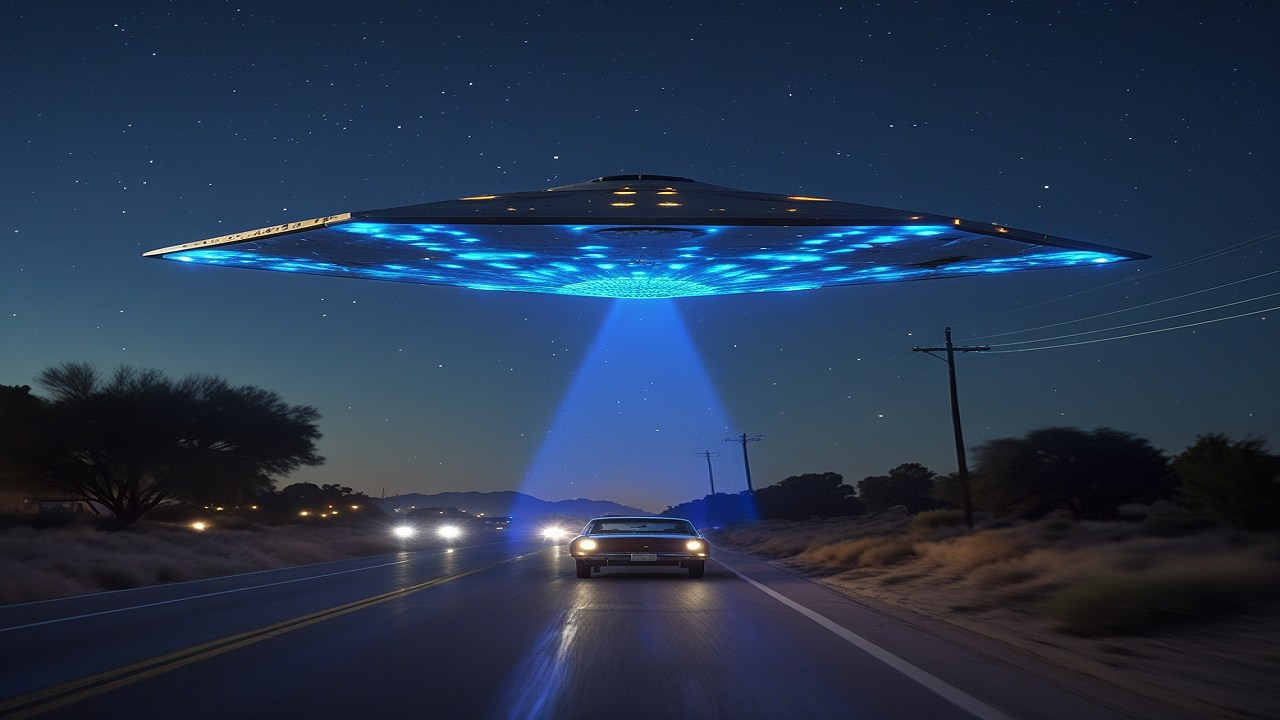
The object descended to a point where it hovered approximately 100 feet above their car. It remained there for an estimated five minutes, matching their speed as they continued driving. The father, increasingly concerned for their safety, chose not to stop the car. The son, however, craned his neck to keep the object in view and later recalled seeing details along the underside—dark panels and possible indentations, though the lighting made it difficult to be certain.
The Departure
Without warning, the craft ceased pacing the car and rose vertically into the sky at extraordinary speed. The ascent was so rapid that within seconds it had vanished from sight, leaving behind only the normal starfield of the night sky. There were no sonic booms, exhaust trails, or other physical traces left behind.
The witnesses pulled over shortly afterward to collect themselves and discuss what they had seen. Both agreed on the basic details: triangular shape, pulsating blue lights, silent hover, close proximity, and the sudden vertical departure.
The Report and Preservation
The father, uncertain of how to proceed, did not contact law enforcement directly but instead shared the experience with a friend who had connections to local UFO investigators.
This led to the case being documented and filed by MUFON researchers in California. The witnesses were interviewed separately to compare accounts, and both narratives were found to be consistent in core details and timing.
At the time, MUFON was still a relatively young organization, but its California chapters were actively collecting sighting reports. The Palos Verdes incident became part of a growing body of West Coast sightings from the mid-1960s, many of which featured unusual craft shapes and silent flight characteristics.
Public Awareness and Cultural Context
Unlike some other sightings from the period, the Palos Verdes case did not receive significant coverage in local newspapers. In part, this was due to the personal choice of the witnesses to keep their names and faces out of the media. They feared ridicule, a common concern during an era when UFO witnesses were often portrayed as eccentric or unreliable.
Nevertheless, within Southern California’s UFO research community, the case became well known. The description of a triangular craft was particularly striking, as such shapes were not yet a dominant feature in the UFO reporting landscape. In the 1940s and 1950s, most reports described discs or saucers; in the early 1960s, there was a mix of ovals, cigar-shaped objects, and classic “flying saucers.” The Palos Verdes sighting, therefore, was an outlier that would gain more relevance decades later when triangular craft became a recurring theme in reports from the Hudson Valley, Belgium, and military pilots.
Credibility and Key Factors
Several elements lent credibility to the case:
Multiple Witnesses: Both father and son independently confirmed the details.
Close Proximity: The craft was within 100 feet, allowing for detailed observation.
Duration: The five-minute pacing of their car was far longer than the fleeting glimpses common in many sightings.
Consistent Accounts: Separate interviews showed no significant discrepancies.
Physical Behavior: The silent hover and vertical departure are characteristics repeated in numerous credible UFO reports over the decades.
Possible Explanations and Official Silence
No official investigation by the Air Force or local authorities was documented, and the sighting does not appear in publicly available Project Blue Book records. The lack of sound and the hovering capability make conventional aircraft an unlikely explanation.
Helicopters could have matched the speed of the car, but their rotor noise would have been unmistakable at such close range. Balloons or lighter than-air craft were also ruled out due to the controlled hovering and rapid vertical acceleration.
Some skeptics have speculated about the possibility of experimental military aircraft, given Southern California’s proximity to aerospace contractors and test ranges. However, the silent flight and blue pulsating lights do not match known experimental platforms from the mid-1960s.
Impact on the Witnesses
While the witnesses did not seek publicity, the incident reportedly left a lasting impression on both.
The father became more open to discussing the possibility of advanced, unknown aerial technology, while the son developed a lifelong interest in astronomy and aerospace developments.
Neither expressed fear so much as a sense of awe and curiosity about what they had encountered.
Modern Relevance
Today, the Palos Verdes Peninsula sighting is seen as a precursor to the triangular UFO wave that emerged in later decades. In the 1980s and 1990s, numerous reports from around the world described silent, low flying triangular craft with unusual lighting patterns—sometimes red, sometimes white, sometimes blue. The Palos Verdes case stands out as an early, well-documented example of this type, suggesting that such objects may have been operating, or at least observed, long before they entered mainstream UFO awareness.
Conclusion
The November 1966 Palos Verdes Peninsula UFO encounter remains a compelling example of a credible, close-range sighting with lasting research value. While it never reached national headlines, it has endured in UFO archives because of its distinctive details and the reliability of its witnesses. Whether the triangular craft represented advanced human technology or something beyond our current understanding, its behavior that night—silent pursuit, hovering precision, and impossible vertical departure—still challenges conventional explanations.
This case is a reminder that some of the most important UFO sightings are those that never make the front page, yet remain preserved in careful documentation for future generations to study.
The coastal cliffs and rolling hills of California’s Palos Verdes Peninsula are known for their scenic beauty, quiet neighborhoods, and sweeping views of the Pacific Ocean. In the mid-1960s, this affluent region was far removed from the turbulence of the era’s major cities. But in November 1966, the peaceful landscape became the backdrop for a UFO sighting that would be preserved for decades in the files of local and regional UFO research groups, including MUFON (Mutual UFO Network).
This case is notable for several reasons: it involved two witnesses in close proximity to the object, the craft was described as triangular—a shape that would not become widely reported in UFO cases until years later—and the sighting lasted an unusually long time for a close encounter. The witnesses’ reputations for honesty and reliability further distinguished the report, ensuring it would not be dismissed as a fleeting or unreliable observation.
The Witnesses and the Setting
The two witnesses were a man and his teenage son, whose names were preserved in the original MUFON files but have rarely been publicized in later summaries. Both were described as credible, articulate, and without any apparent motive to fabricate such a story. The father was a local resident with a professional background, while the son was a high school student active in community sports and academics.
The Palos Verdes Peninsula in 1966 was largely a residential area interspersed with undeveloped land. At night, certain stretches of road were almost completely dark, illuminated only by the occasional streetlamp or passing vehicle. The pair were driving late in the evening, returning from an errand or visit, when the incident began.
The Encounter
According to the witnesses, the first sign of something unusual was a series of pulsating blue lights in the night sky.
At first, they assumed it might be an aircraft approaching the nearby Los Angeles International Airport (LAX) or possibly a helicopter patrolling the coastline. But as the lights grew brighter and the shape of the object became discernible, they realized they were looking at something very different.
The craft was described as triangular in outline, with distinct points at each corner. The blue lights appeared to pulse rhythmically, not in the steady patterns associated with navigation lights on conventional aircraft. More unsettling was the complete absence of sound—no engine noise, no rotor chop, no hum beyond what the witnesses later described as “a feeling of pressure in the air.”
The object descended to a point where it hovered approximately 100 feet above their car. It remained there for an estimated five minutes, matching their speed as they continued driving. The father, increasingly concerned for their safety, chose not to stop the car. The son, however, craned his neck to keep the object in view and later recalled seeing details along the underside—dark panels and possible indentations, though the lighting made it difficult to be certain.
The Departure
Without warning, the craft ceased pacing the car and rose vertically into the sky at extraordinary speed. The ascent was so rapid that within seconds it had vanished from sight, leaving behind only the normal starfield of the night sky. There were no sonic booms, exhaust trails, or other physical traces left behind.
The witnesses pulled over shortly afterward to collect themselves and discuss what they had seen. Both agreed on the basic details: triangular shape, pulsating blue lights, silent hover, close proximity, and the sudden vertical departure.
The Report and Preservation
The father, uncertain of how to proceed, did not contact law enforcement directly but instead shared the experience with a friend who had connections to local UFO investigators.
This led to the case being documented and filed by MUFON researchers in California. The witnesses were interviewed separately to compare accounts, and both narratives were found to be consistent in core details and timing.
At the time, MUFON was still a relatively young organization, but its California chapters were actively collecting sighting reports. The Palos Verdes incident became part of a growing body of West Coast sightings from the mid-1960s, many of which featured unusual craft shapes and silent flight characteristics.
Public Awareness and Cultural Context
Unlike some other sightings from the period, the Palos Verdes case did not receive significant coverage in local newspapers. In part, this was due to the personal choice of the witnesses to keep their names and faces out of the media. They feared ridicule, a common concern during an era when UFO witnesses were often portrayed as eccentric or unreliable.
Nevertheless, within Southern California’s UFO research community, the case became well known. The description of a triangular craft was particularly striking, as such shapes were not yet a dominant feature in the UFO reporting landscape. In the 1940s and 1950s, most reports described discs or saucers; in the early 1960s, there was a mix of ovals, cigar-shaped objects, and classic “flying saucers.” The Palos Verdes sighting, therefore, was an outlier that would gain more relevance decades later when triangular craft became a recurring theme in reports from the Hudson Valley, Belgium, and military pilots.
Credibility and Key Factors
Several elements lent credibility to the case:
Multiple Witnesses: Both father and son independently confirmed the details.
Close Proximity: The craft was within 100 feet, allowing for detailed observation.
Duration: The five-minute pacing of their car was far longer than the fleeting glimpses common in many sightings.
Consistent Accounts: Separate interviews showed no significant discrepancies.
Physical Behavior: The silent hover and vertical departure are characteristics repeated in numerous credible UFO reports over the decades.
Possible Explanations and Official Silence
No official investigation by the Air Force or local authorities was documented, and the sighting does not appear in publicly available Project Blue Book records. The lack of sound and the hovering capability make conventional aircraft an unlikely explanation.
Helicopters could have matched the speed of the car, but their rotor noise would have been unmistakable at such close range. Balloons or lighter than-air craft were also ruled out due to the controlled hovering and rapid vertical acceleration.
Some skeptics have speculated about the possibility of experimental military aircraft, given Southern California’s proximity to aerospace contractors and test ranges. However, the silent flight and blue pulsating lights do not match known experimental platforms from the mid-1960s.
Impact on the Witnesses
While the witnesses did not seek publicity, the incident reportedly left a lasting impression on both.
The father became more open to discussing the possibility of advanced, unknown aerial technology, while the son developed a lifelong interest in astronomy and aerospace developments.
Neither expressed fear so much as a sense of awe and curiosity about what they had encountered.
Modern Relevance
Today, the Palos Verdes Peninsula sighting is seen as a precursor to the triangular UFO wave that emerged in later decades. In the 1980s and 1990s, numerous reports from around the world described silent, low flying triangular craft with unusual lighting patterns—sometimes red, sometimes white, sometimes blue. The Palos Verdes case stands out as an early, well-documented example of this type, suggesting that such objects may have been operating, or at least observed, long before they entered mainstream UFO awareness.
Conclusion
The November 1966 Palos Verdes Peninsula UFO encounter remains a compelling example of a credible, close-range sighting with lasting research value. While it never reached national headlines, it has endured in UFO archives because of its distinctive details and the reliability of its witnesses. Whether the triangular craft represented advanced human technology or something beyond our current understanding, its behavior that night—silent pursuit, hovering precision, and impossible vertical departure—still challenges conventional explanations.
This case is a reminder that some of the most important UFO sightings are those that never make the front page, yet remain preserved in careful documentation for future generations to study.