


Blog Categories
- African Incidents
- Atlantis Incidents
- Australian Incidents
- Belgian Incidents
- Bermuda Triangle Incidents
- Brazilian Incidents
- Canadian Incidents
- Chinese Incidents
- European Incidents
- France Incidents
- Ghosts
- Giants
- Italy Incidents
- Japanese Incidents
- Middle East Incidents
- Portugal Incidents
- Project Serpo
- Puerto Rico Incidents
- Russian Incidents
- Sasquatch
- Scandinavia Incidents
- Spanish Incidents
- UFOs
- United Kingdom Incidents
- United States Incidents
November 1973: Chico UFO Hovering in the Pines
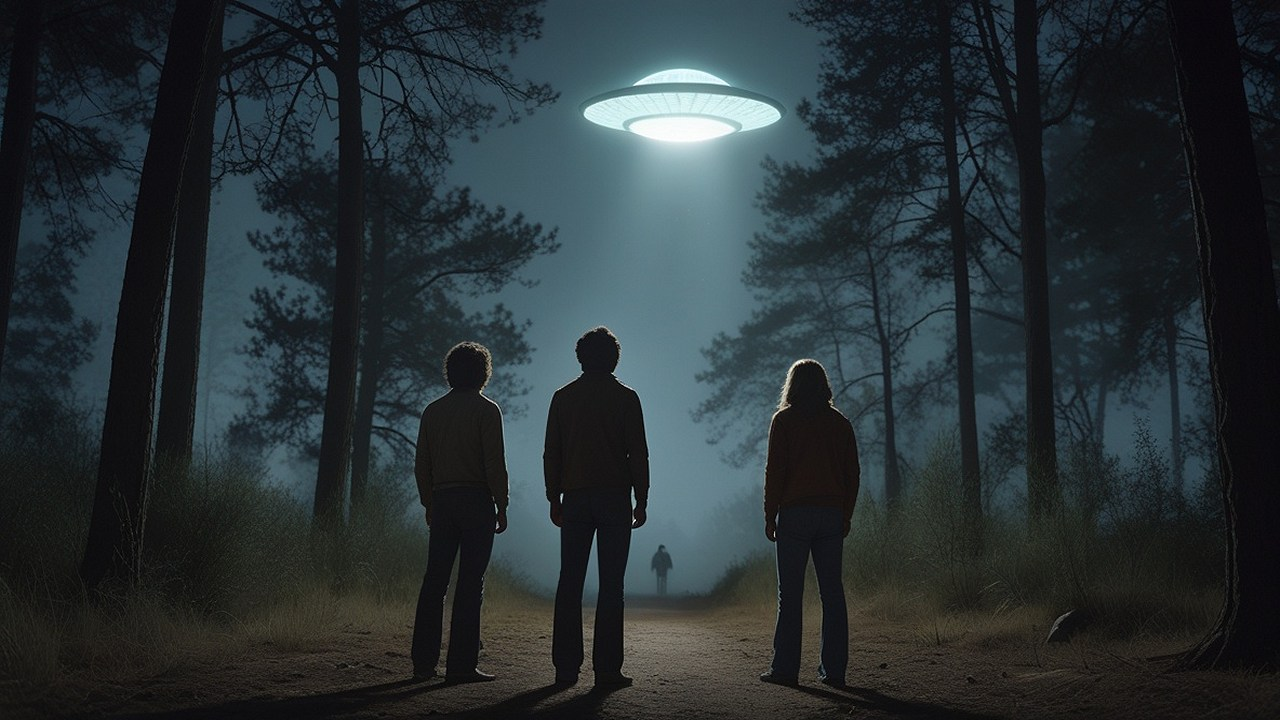
On a cool November night in 1973, three college students walking through a wooded area near Chico, California, came face to face with an experience that would alter the texture of their lives. According to the report eventually submitted for review to a civilian research organization, the students encountered a low-flying, saucer-shaped craft hovering roughly 30 feet above the treetops. It was described as silent save for a low, vibrating hum, and it bore a glowing dome that cast an otherworldly light into the surrounding pines. One of the students later reported missing time, a feature that would link this case to a second tier of encounters—those in which subjective intervals of consciousness and memory become problematic. The incident was preserved in investigator files and forwarded to CUFOS for formal review.
This is not a story of a single startled witness or a distant light seen by chance. It is a close-range sighting involving multiple observers, a sustained observation, and an element of post-event cognitive disturbance. Those qualities push the Chico case into an important category in UFO research: the multi-witness, short-duration close encounter that leaves palpable psychological traces even when physical evidence is absent.
The three students were walking together at night through a wooded tract—likely a route familiar to them given their collegiate connections—when one noticed a glow above the canopy. Within moments the group realized that the light belonged to a structured object, not a distant aircraft or a streetlamp. They described the vehicle as saucer-shaped, with a luminous dome and a quiet, mechanical-feeling vibration that seemed to emanate from the object itself rather than from the environment. The craft’s hovering behavior at approximately thirty feet was particularly striking: close enough that the students could discern shape and light, yet high enough to remain out of physical reach.
Sustained observation—longer than a fleeting glimpse—allowed the witnesses to exchange assessments as they watched. The core observations emphasized form, a classic saucer shape; light, a glowing dome; sound, a low hum; and position, very low over the trees. After a brief period the object departed, but by then one student perceived a gap in his subjective experience—a span he could not account for in ordinary memory. He described feeling as though he had lost a segment of time, a phenomenon commonly referred to in UFO literature as “missing time.”
Instead of suppressing the event, the students took the responsible step of documenting and reporting their experience. The dossier was later forwarded to a civilian UFO research organization—CUFOS—where it was entered for review. Submission to a formal investigative body indicates that the witnesses sought an objective evaluation and were interested in preserving a record beyond casual storytelling. That institutional step also increased the case’s availability for later comparative study.
Because the witnesses were college students—young, but also literate and reasonably credible—their account carried a certain social weight. Student witnesses who come forward are often motivated by a desire for accuracy rather than notoriety, and their willingness to be interviewed and to file a report suggests sincerity. In many regional cases from the 1970s, investigator teams placed a premium on the credibility of multiple-witness reports from ordinary citizens because they provide internally corroborating testimony that is harder to dismiss as a single misperception.
The immediate psychological responses to such an encounter are often mixed: awe, fear, confusion, and a drive to make sense of what happened. In the Chico case, one student’s missing time introduced an additional, disquieting dimension. Missing time experiences tend to stimulate deeper rumination. Witnesses re-examine their memories, sometimes seek hypnotic regression or psychotherapeutic help, and sometimes report subsequent changes in sleep, dreams, or emotional state. Even if no physical marks or injuries are present, psychological disturbance can be lasting. For the students involved, the incident likely prompted questions about sanity, social judgment, and the boundaries of ordinary experience—issues that carry consequences in small communities and on campuses.
Socially, these encounters can ripple outward. Friends and classmates learn the story. Rumors form and are retold, sometimes morphing into legend. The students’ willingness to involve investigators may have reduced the risk of sensationalization, but it also guaranteed that their experience would be entered into a public archival stream where future researchers could locate it. In small university towns the mere presence of such a reported incident can provoke a modest, localized culture of speculation: late-night conversations, interest in related literature, and even a transient increase in sky-watching.
The decision to submit the case to CUFOS signified a desire for systematic inquiry. Civilian organizations like CUFOS employ interview protocols, cross-checking methods, and archival comparison to determine how a case fits broader patterns. In this instance, investigators would likely have taken the standard steps: structured interviews with each witness, a search for corroborating witness statements from nearby residents or law enforcement, and background checks for any conventional explanations such as police or utility helicopter traffic, atmospheric anomalies, or experimental aircraft from nearby facilities.
No physical trace is recorded in the account. No marks on trees, no ground scorch, and no radar returns are described. That absence does not render the case trivial. Rather, it situates it within a substantial class of encounters where the primary data are human perceptions and recollections. For investigators, credibility and consistency among multiple statements carry special evidentiary weight in such contexts.
The early 1970s was an active period for UFO reports and for evolving research methodologies. Civilian groups were growing more professional in their archival practices, and researchers were increasingly aware of psychological dimensions—missing time, hypnotic regression, post-event stress—that often accompany close encounters. A 1973 Chico case with missing time aligns it not only with local California lore but also with the developing corpus of abduction-style reports and high-strangeness encounters of the era.
Regionally, northern California has a rich record of anomalous aerial phenomena. The Chico case fits into that tapestry as a credible, multi-witness, close-range event. Because the witnesses engaged investigators and because the case was preserved in CUFOS files, it is available—at least to the degree of the original interviews—for comparative study with other encounters that feature hovering craft, low altitudes, and subjective memory anomalies.
Any discussion of an encounter of this kind must be candid about limits. Without physical evidence—photographs, radar data, or recovered materials—analysis rests on testimony. Human perception is fallible, and memory can be reconstructed, especially over decades. Missing time reports invite particular caution: they can indicate trauma, dissociation, or other psychological phenomena unrelated to external agency. Investigators are thus careful to separate subjective psychological effects from claims about external causation.
At the same time, patterns among multiple independent cases can be revealing. The combination of hovering vehicle, glowing dome, low hum, and missing time recurs in several case clusters across time and space. While no definitive causal account emerges, the recurrence suggests either a persistent, unexplained phenomenon or repeated misperceptions under similar conditions. Repetition across cultural and technical boundaries is the kind of pattern that merits further scientific attention.
The Chico encounter’s preservation in CUFOS records is significant. It means the case has been archived for generations of researchers. Today, as interest in unidentified aerial phenomena has moved into mainstream scientific and governmental discourse, cases like Chico’s are being revisited—not to confirm speculative narratives, but to build a robust dataset for pattern analysis. Multi-witness, close-range events with psychological aftereffects are particularly valuable for study precisely because they combine human reporting with opportunities for methodological cross-checks.
For the witnesses themselves, the event likely remained a defining life episode: a mystery that shaped their personal narratives and perhaps informed their attitudes about the nature of reality. For Chico and for regional researchers, the case stands as an example of responsible reporting and documentation—witnesses who came forward, told their story, and submitted their experience to investigators who preserved it for future scrutiny.
The November 1973 Chico encounter is a compact but potent case: a close, quiet hovering craft observed by multiple college students; a glowing dome and a low vibrating hum; and the unsettling introduction of missing time. Its submission to CUFOS situates it within the professional record of civilian UFO investigation and ensures it remains accessible for comparative study. Though lacking physical corroboration, the case’s multi-witness character and psychological footprints make it an important node in the wider network of anomalous aerial reports—a reminder that some of the most compelling encounters are those that happen quietly in the dark, among ordinary people who then choose to be heard.
Three students walked through the pines on a cool November night. They looked up and saw a saucer-shaped object with a glowing dome hovering only thirty feet above the treetops, filling the woods with an otherworldly light and a low vibrating hum. One of them later discovered a gap in his memory. They reported what they had experienced. Investigators archived it. And more than fifty years later the case still stands as a clear, restrained example of a close-range, multi-witness encounter that left more than just a visual impression—it left a lasting question about time, perception, and what may occasionally move silently through the night skies over northern California.
On a cool November night in 1973, three college students walking through a wooded area near Chico, California, came face to face with an experience that would alter the texture of their lives. According to the report eventually submitted for review to a civilian research organization, the students encountered a low-flying, saucer-shaped craft hovering roughly 30 feet above the treetops. It was described as silent save for a low, vibrating hum, and it bore a glowing dome that cast an otherworldly light into the surrounding pines. One of the students later reported missing time, a feature that would link this case to a second tier of encounters—those in which subjective intervals of consciousness and memory become problematic. The incident was preserved in investigator files and forwarded to CUFOS for formal review.
This is not a story of a single startled witness or a distant light seen by chance. It is a close-range sighting involving multiple observers, a sustained observation, and an element of post-event cognitive disturbance. Those qualities push the Chico case into an important category in UFO research: the multi-witness, short-duration close encounter that leaves palpable psychological traces even when physical evidence is absent.
The three students were walking together at night through a wooded tract—likely a route familiar to them given their collegiate connections—when one noticed a glow above the canopy. Within moments the group realized that the light belonged to a structured object, not a distant aircraft or a streetlamp. They described the vehicle as saucer-shaped, with a luminous dome and a quiet, mechanical-feeling vibration that seemed to emanate from the object itself rather than from the environment. The craft’s hovering behavior at approximately thirty feet was particularly striking: close enough that the students could discern shape and light, yet high enough to remain out of physical reach.
Sustained observation—longer than a fleeting glimpse—allowed the witnesses to exchange assessments as they watched. The core observations emphasized form, a classic saucer shape; light, a glowing dome; sound, a low hum; and position, very low over the trees. After a brief period the object departed, but by then one student perceived a gap in his subjective experience—a span he could not account for in ordinary memory. He described feeling as though he had lost a segment of time, a phenomenon commonly referred to in UFO literature as “missing time.”
Instead of suppressing the event, the students took the responsible step of documenting and reporting their experience. The dossier was later forwarded to a civilian UFO research organization—CUFOS—where it was entered for review. Submission to a formal investigative body indicates that the witnesses sought an objective evaluation and were interested in preserving a record beyond casual storytelling. That institutional step also increased the case’s availability for later comparative study.
Because the witnesses were college students—young, but also literate and reasonably credible—their account carried a certain social weight. Student witnesses who come forward are often motivated by a desire for accuracy rather than notoriety, and their willingness to be interviewed and to file a report suggests sincerity. In many regional cases from the 1970s, investigator teams placed a premium on the credibility of multiple-witness reports from ordinary citizens because they provide internally corroborating testimony that is harder to dismiss as a single misperception.
The immediate psychological responses to such an encounter are often mixed: awe, fear, confusion, and a drive to make sense of what happened. In the Chico case, one student’s missing time introduced an additional, disquieting dimension. Missing time experiences tend to stimulate deeper rumination. Witnesses re-examine their memories, sometimes seek hypnotic regression or psychotherapeutic help, and sometimes report subsequent changes in sleep, dreams, or emotional state. Even if no physical marks or injuries are present, psychological disturbance can be lasting. For the students involved, the incident likely prompted questions about sanity, social judgment, and the boundaries of ordinary experience—issues that carry consequences in small communities and on campuses.
Socially, these encounters can ripple outward. Friends and classmates learn the story. Rumors form and are retold, sometimes morphing into legend. The students’ willingness to involve investigators may have reduced the risk of sensationalization, but it also guaranteed that their experience would be entered into a public archival stream where future researchers could locate it. In small university towns the mere presence of such a reported incident can provoke a modest, localized culture of speculation: late-night conversations, interest in related literature, and even a transient increase in sky-watching.
The decision to submit the case to CUFOS signified a desire for systematic inquiry. Civilian organizations like CUFOS employ interview protocols, cross-checking methods, and archival comparison to determine how a case fits broader patterns. In this instance, investigators would likely have taken the standard steps: structured interviews with each witness, a search for corroborating witness statements from nearby residents or law enforcement, and background checks for any conventional explanations such as police or utility helicopter traffic, atmospheric anomalies, or experimental aircraft from nearby facilities.
No physical trace is recorded in the account. No marks on trees, no ground scorch, and no radar returns are described. That absence does not render the case trivial. Rather, it situates it within a substantial class of encounters where the primary data are human perceptions and recollections. For investigators, credibility and consistency among multiple statements carry special evidentiary weight in such contexts.
The early 1970s was an active period for UFO reports and for evolving research methodologies. Civilian groups were growing more professional in their archival practices, and researchers were increasingly aware of psychological dimensions—missing time, hypnotic regression, post-event stress—that often accompany close encounters. A 1973 Chico case with missing time aligns it not only with local California lore but also with the developing corpus of abduction-style reports and high-strangeness encounters of the era.
Regionally, northern California has a rich record of anomalous aerial phenomena. The Chico case fits into that tapestry as a credible, multi-witness, close-range event. Because the witnesses engaged investigators and because the case was preserved in CUFOS files, it is available—at least to the degree of the original interviews—for comparative study with other encounters that feature hovering craft, low altitudes, and subjective memory anomalies.
Any discussion of an encounter of this kind must be candid about limits. Without physical evidence—photographs, radar data, or recovered materials—analysis rests on testimony. Human perception is fallible, and memory can be reconstructed, especially over decades. Missing time reports invite particular caution: they can indicate trauma, dissociation, or other psychological phenomena unrelated to external agency. Investigators are thus careful to separate subjective psychological effects from claims about external causation.
At the same time, patterns among multiple independent cases can be revealing. The combination of hovering vehicle, glowing dome, low hum, and missing time recurs in several case clusters across time and space. While no definitive causal account emerges, the recurrence suggests either a persistent, unexplained phenomenon or repeated misperceptions under similar conditions. Repetition across cultural and technical boundaries is the kind of pattern that merits further scientific attention.
The Chico encounter’s preservation in CUFOS records is significant. It means the case has been archived for generations of researchers. Today, as interest in unidentified aerial phenomena has moved into mainstream scientific and governmental discourse, cases like Chico’s are being revisited—not to confirm speculative narratives, but to build a robust dataset for pattern analysis. Multi-witness, close-range events with psychological aftereffects are particularly valuable for study precisely because they combine human reporting with opportunities for methodological cross-checks.
For the witnesses themselves, the event likely remained a defining life episode: a mystery that shaped their personal narratives and perhaps informed their attitudes about the nature of reality. For Chico and for regional researchers, the case stands as an example of responsible reporting and documentation—witnesses who came forward, told their story, and submitted their experience to investigators who preserved it for future scrutiny.
The November 1973 Chico encounter is a compact but potent case: a close, quiet hovering craft observed by multiple college students; a glowing dome and a low vibrating hum; and the unsettling introduction of missing time. Its submission to CUFOS situates it within the professional record of civilian UFO investigation and ensures it remains accessible for comparative study. Though lacking physical corroboration, the case’s multi-witness character and psychological footprints make it an important node in the wider network of anomalous aerial reports—a reminder that some of the most compelling encounters are those that happen quietly in the dark, among ordinary people who then choose to be heard.
Three students walked through the pines on a cool November night. They looked up and saw a saucer-shaped object with a glowing dome hovering only thirty feet above the treetops, filling the woods with an otherworldly light and a low vibrating hum. One of them later discovered a gap in his memory. They reported what they had experienced. Investigators archived it. And more than fifty years later the case still stands as a clear, restrained example of a close-range, multi-witness encounter that left more than just a visual impression—it left a lasting question about time, perception, and what may occasionally move silently through the night skies over northern California.