


Blog Categories
- African Incidents
- Atlantis Incidents
- Australian Incidents
- Belgian Incidents
- Bermuda Triangle Incidents
- Brazilian Incidents
- Canadian Incidents
- Chinese Incidents
- European Incidents
- France Incidents
- Ghosts
- Giants
- Italy Incidents
- Japanese Incidents
- Middle East Incidents
- Portugal Incidents
- Project Serpo
- Puerto Rico Incidents
- Russian Incidents
- Sasquatch
- Scandinavia Incidents
- Spanish Incidents
- UFOs
- United Kingdom Incidents
- United States Incidents
October 1947: Paradise Valley Dreamy Draw Arizona
Roswell is the crash everybody argues about.
Six months later, another alleged recovery almost nobody outside UFO research has ever heard of.
October 1947.
Paradise Valley. Just north of Phoenix, Arizona.
A licensed private pilot on a hunting trip looks across the desert and sees a large aluminum dome the size of a house.
Tents. Temporary buildings. Military personnel.
The hunting ground he was supposed to use that morning? The Air Force had just restricted it. No gunfire. Stay out.
Decades later he reads Frank Scully and realizes the “observatory” he thought he was looking at may have been a recovered disc — with two non-human bodies inside.
This is the Paradise Valley / Dreamy Draw story.
We are not adding a single detail that is not already in the record this chapter is built on.
We are putting the testimony on the table.
The roots of this case come from journalist Frank Scully. In the late 1940s and 1950s he became one of the first public figures to claim the U.S. military had retrieved extraterrestrial craft and occupants. His 1950 book Behind the Flying Saucers described several alleged crash recoveries. One of them, he wrote, occurred in the Paradise Valley area near Phoenix: a disc-shaped craft recovered with two non-human bodies inside.
That book is famous, contested, and still sitting in the foundation of crash-retrieval research. What brought Paradise Valley back into focus was not only Scully. It was a second witness who, in the 1980s, believed he may have seen the same operation Scully described.
His name was Selman E. Graves. Businessman. Licensed private pilot. In 1987 he sat down with researcher Timothy Good and told him what he saw in early October 1947.
Graves and four other men met at the home of his friend Walt Sayler. The plan was to hunt a particular stretch of Paradise Valley. Sayler came home later than expected and told them the destination was off-limits. The U.S. Air Force had restricted the area. Gunfire was prohibited.
Graves still wanted to look at terrain near several mine shafts and a small hill in the same general direction. They agreed not to use their weapons. Graves and two companions split from the rest of the group.
When the three men reached higher ground, they had a panoramic view of the desert. Graves could see Sayler’s house in the distance. He could also see something else.
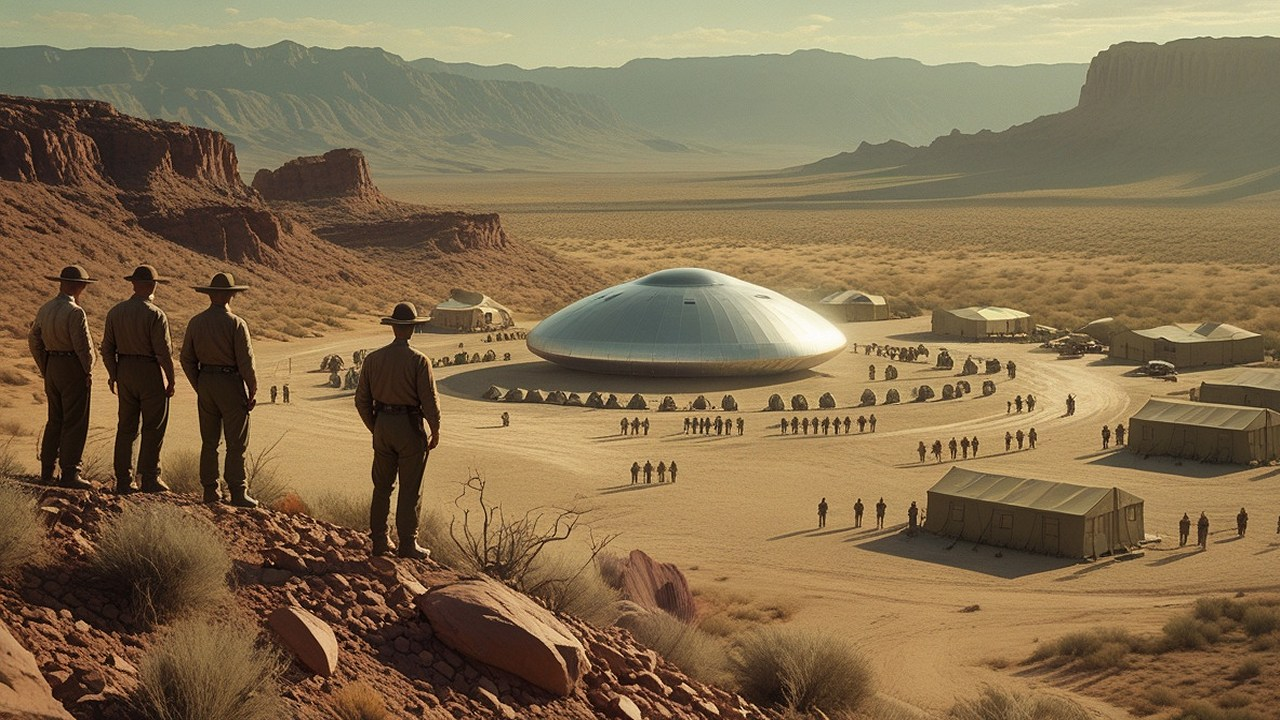
In the direction they had originally planned to hunt: a large, aluminum, dome-shaped object. He estimated it about the size of a house. Below it: pitched tents, several buildings, numerous personnel moving around the site.
At the time the men assumed they were looking at an observatory dome or some kind of scientific installation. They did not walk into the restricted zone. They kept exploring the mine area and left it alone.
That is the sighting. Not a light in the sky. A dome the size of a house, aluminum, on the ground, with a camp around it, on land the Air Force had closed that morning.
Years later Graves reads Scully. He hits the Paradise Valley section. He connects the “observatory” to the recovered disc. In his view they were the same object.
During his own investigation he managed to speak with at least one of Scully’s original sources. By the time he recorded the account with Timothy Good, he offered a broader reconstruction — partly what he saw, partly what he believed had happened before he arrived on that ridge.
From Graves’s perspective, Sayler may have been the one who first found the downed craft while checking the hunting grounds that morning. Sayler had a military background. Graves thought it plausible that Sayler notified the Air Force and then kept his guests away from the restricted ground. Graves also remembered military flatbed trucks leaving the region — something he had not thought twice about at the time. Later he interpreted those trucks as possibly tied to the removal of the beings allegedly found inside the object.
There is a local legend attached to this story: a local man briefly storing the bodies in a freezer until the military could retrieve them. If Graves’s assumptions about Sayler are correct, he speculated Sayler may have been that man as well.
He went further. Topographical maps of the region, he claimed, appeared to change after the incident. Updated versions shifted the original placement of Cave Creek Road — the area linked to the reported crash. When he tried to obtain an earlier map to compare, he was told no copies of the original version were available. He also told Good of an alleged project he believed was designed to obscure or remove physical traces of the craft.
That is where Dreamy Draw Dam enters the story.
One long-standing local legend says the dam was built specifically to cover the crash site and bury what could not be moved. Today the area is a public recreation site. The story maintains the object recovered at Paradise Valley was too large to extract covertly. The solution, according to the legend, was to hide it in place under earth and infrastructure.
Graves said that several years after the original event, a government project began renovating the area. Crews went directly to the site and excavated it with a bulldozer. He said he witnessed this. He noted the work lacked the methodical precision of typical professional excavation. In his view the intent looked like destruction, not recovery. He suggested such projects were a common method used to obscure the remains of large unidentified craft — including the one he believed still lay beneath present-day Dreamy Draw Dam.
Despite recreational use, numerous signs reportedly mark certain areas off-limits. No Trespassing. Fines. Imprisonment. One local resident who got as close as he could to a restricted zone reported a persistent, unexplained humming sound coming from beneath the ground.
Let that sit for a second.
A pilot sees a house-sized aluminum dome and a military camp on newly restricted land.
Scully had already published a Paradise Valley disc with two bodies.
Maps shift. A dam goes in. A hum under the dirt.
You do not have to accept every layer as proven. You do have to admit this is not a one-line “lights over Phoenix” story. It is a recovery narrative with a named civilian observer, a restricted hunting ground, and a piece of public works that locals still side-eye.
Why would the military handle a second 1947 crash differently from Roswell? Some researchers have suggested that the experience of the Roswell press release earlier that summer — announce, retract, lose control of the story — produced a quieter method the next time something came down. Whether that interpretation is correct or not, Paradise Valley was never given a public information officer and a weather-balloon punchline in the same way. It stayed inside Scully’s pages and Graves’s memory until Good put the hunting-trip testimony on paper.
Arizona is not a random backdrop. The chapter places Paradise Valley inside a Southwest that researchers have treated for decades as a concentration point: deserts, restricted airspace, reports of unusual craft, rumors of covert installations, and accounts of strange beings. Neighboring New Mexico, California, and Colorado feed the same corridor. The 1997 Phoenix Lights — thousands of witnesses, video around the world — sit in that same regional file as the most observed event in modern Arizona UFO history. The proposed reasons for the concentration are the ones this record already lists: later craft searching for lost vehicles or occupants from 1940s recoveries; advanced military aircraft built from reverse-engineered technology and tested in empty restricted sky; longstanding claims of deep underground facilities where human personnel and non-human entities supposedly coexist for research or containment. Unverified. Persistent. Consistent with decades of Southwest testimony.
Now the part every honest video has to say out loud.
Frank Scully’s credibility — and the reliability of his sources — has been debated for decades. Many investigators, including people open to the UFO subject, have argued that some of his informants were questionable. Portions of his material have been dismissed even inside UFO research. Others maintain Scully himself was sincere, honest in his reporting, and working in good faith. If individuals deliberately fed him misleading information, the question becomes why a civilian writer would be worth the disinformation in the first place. The possibility that official or intelligence circles muddied the water is itself part of the case. Mixed truth and fabrication is a known way to bury a program, discourage investigation, or discredit early reporting. The effect has lasted. Separating Scully’s pages into “this happened” and “this was planted” is still the work.
One of his key informants was “Dr. Gee.” Dr. Gee was not one man. It was a composite identity created to protect the anonymity of several scientists who, Scully said, provided information. That pseudonym has made later verification harder. It also fits the secrecy of the era. Anonymity among technical personnel — real or alleged — is part of the narrative, not a footnote.
The strongest personal endorsement of Scully in this chapter does not come from a blog. It comes from a remark his wife recalled in a late-1970s interview, attributed to Captain Edward J. Ruppelt after Ruppelt had retired as head of Project Blue Book. According to her account, Ruppelt said: “Of all the books published about flying saucers, your husband’s book was the one that gave us the most headaches, because it was the closest to the truth.”
Take it cautiously. Then take it seriously. The man who ran the Air Force’s official UFO desk is remembered, in that household, as saying Scully was the book that hurt — because it was closest.
So where does Paradise Valley stand if we refuse to invent?
We have Scully, 1950: Paradise Valley, disc, two non-human bodies.
We have Graves, 1987, to Timothy Good: October 1947 hunting trip, Air Force restriction, house-sized aluminum dome, tents, personnel, later identification with Scully’s craft, flatbed trucks, map changes, bulldozer work, Dreamy Draw as cover.
We have the dam legend, the no-trespassing perimeter, the underground hum.
We have Dr. Gee as a composite.
We have the Ruppelt line through Scully’s wife.
We have a region that never stopped producing sightings.
What we do not have in this chapter is a public military press release confirming the bodies, a published photograph of the disc on that hillside, or a named official file stamped “Paradise Valley recovery.” Absence of a press release is not proof the tents were an observatory. Presence of a disputed book is not proof of two beings in a freezer. The case lives in the overlap: a pilot who saw a dome and a camp on closed land, and a writer who said a disc and two bodies came out of that same valley in the same season.
If Roswell taught the government anything in July 1947, it may have been this: do not explain it to the papers. Restrict the ground. Move the trucks at night. Change the map. If the thing is too big, bury the draw and put a dam on top.
Selman Graves thought he was looking at science.
He may have been looking at the second crash of 1947.
Paradise Valley is still there.
Dreamy Draw is a place you can drive to.
The signs still say stay out.
Watch the sky over Arizona if you want the lights.
Read Scully and Graves if you want to know why some people think part of that sky never left the ground.
Roswell is the crash everybody argues about.
Six months later, another alleged recovery almost nobody outside UFO research has ever heard of.
October 1947.
Paradise Valley. Just north of Phoenix, Arizona.
A licensed private pilot on a hunting trip looks across the desert and sees a large aluminum dome the size of a house.
Tents. Temporary buildings. Military personnel.
The hunting ground he was supposed to use that morning? The Air Force had just restricted it. No gunfire. Stay out.
Decades later he reads Frank Scully and realizes the “observatory” he thought he was looking at may have been a recovered disc — with two non-human bodies inside.
This is the Paradise Valley / Dreamy Draw story.
We are not adding a single detail that is not already in the record this chapter is built on.
We are putting the testimony on the table.
The roots of this case come from journalist Frank Scully. In the late 1940s and 1950s he became one of the first public figures to claim the U.S. military had retrieved extraterrestrial craft and occupants. His 1950 book Behind the Flying Saucers described several alleged crash recoveries. One of them, he wrote, occurred in the Paradise Valley area near Phoenix: a disc-shaped craft recovered with two non-human bodies inside.
That book is famous, contested, and still sitting in the foundation of crash-retrieval research. What brought Paradise Valley back into focus was not only Scully. It was a second witness who, in the 1980s, believed he may have seen the same operation Scully described.
His name was Selman E. Graves. Businessman. Licensed private pilot. In 1987 he sat down with researcher Timothy Good and told him what he saw in early October 1947.
Graves and four other men met at the home of his friend Walt Sayler. The plan was to hunt a particular stretch of Paradise Valley. Sayler came home later than expected and told them the destination was off-limits. The U.S. Air Force had restricted the area. Gunfire was prohibited.
Graves still wanted to look at terrain near several mine shafts and a small hill in the same general direction. They agreed not to use their weapons. Graves and two companions split from the rest of the group.
When the three men reached higher ground, they had a panoramic view of the desert. Graves could see Sayler’s house in the distance. He could also see something else.
In the direction they had originally planned to hunt: a large, aluminum, dome-shaped object. He estimated it about the size of a house. Below it: pitched tents, several buildings, numerous personnel moving around the site.
At the time the men assumed they were looking at an observatory dome or some kind of scientific installation. They did not walk into the restricted zone. They kept exploring the mine area and left it alone.
That is the sighting. Not a light in the sky. A dome the size of a house, aluminum, on the ground, with a camp around it, on land the Air Force had closed that morning.
Years later Graves reads Scully. He hits the Paradise Valley section. He connects the “observatory” to the recovered disc. In his view they were the same object.
During his own investigation he managed to speak with at least one of Scully’s original sources. By the time he recorded the account with Timothy Good, he offered a broader reconstruction — partly what he saw, partly what he believed had happened before he arrived on that ridge.
From Graves’s perspective, Sayler may have been the one who first found the downed craft while checking the hunting grounds that morning. Sayler had a military background. Graves thought it plausible that Sayler notified the Air Force and then kept his guests away from the restricted ground. Graves also remembered military flatbed trucks leaving the region — something he had not thought twice about at the time. Later he interpreted those trucks as possibly tied to the removal of the beings allegedly found inside the object.
There is a local legend attached to this story: a local man briefly storing the bodies in a freezer until the military could retrieve them. If Graves’s assumptions about Sayler are correct, he speculated Sayler may have been that man as well.
He went further. Topographical maps of the region, he claimed, appeared to change after the incident. Updated versions shifted the original placement of Cave Creek Road — the area linked to the reported crash. When he tried to obtain an earlier map to compare, he was told no copies of the original version were available. He also told Good of an alleged project he believed was designed to obscure or remove physical traces of the craft.
That is where Dreamy Draw Dam enters the story.
One long-standing local legend says the dam was built specifically to cover the crash site and bury what could not be moved. Today the area is a public recreation site. The story maintains the object recovered at Paradise Valley was too large to extract covertly. The solution, according to the legend, was to hide it in place under earth and infrastructure.
Graves said that several years after the original event, a government project began renovating the area. Crews went directly to the site and excavated it with a bulldozer. He said he witnessed this. He noted the work lacked the methodical precision of typical professional excavation. In his view the intent looked like destruction, not recovery. He suggested such projects were a common method used to obscure the remains of large unidentified craft — including the one he believed still lay beneath present-day Dreamy Draw Dam.
Despite recreational use, numerous signs reportedly mark certain areas off-limits. No Trespassing. Fines. Imprisonment. One local resident who got as close as he could to a restricted zone reported a persistent, unexplained humming sound coming from beneath the ground.
Let that sit for a second.
A pilot sees a house-sized aluminum dome and a military camp on newly restricted land.
Scully had already published a Paradise Valley disc with two bodies.
Maps shift. A dam goes in. A hum under the dirt.
You do not have to accept every layer as proven. You do have to admit this is not a one-line “lights over Phoenix” story. It is a recovery narrative with a named civilian observer, a restricted hunting ground, and a piece of public works that locals still side-eye.
Why would the military handle a second 1947 crash differently from Roswell? Some researchers have suggested that the experience of the Roswell press release earlier that summer — announce, retract, lose control of the story — produced a quieter method the next time something came down. Whether that interpretation is correct or not, Paradise Valley was never given a public information officer and a weather-balloon punchline in the same way. It stayed inside Scully’s pages and Graves’s memory until Good put the hunting-trip testimony on paper.
Arizona is not a random backdrop. The chapter places Paradise Valley inside a Southwest that researchers have treated for decades as a concentration point: deserts, restricted airspace, reports of unusual craft, rumors of covert installations, and accounts of strange beings. Neighboring New Mexico, California, and Colorado feed the same corridor. The 1997 Phoenix Lights — thousands of witnesses, video around the world — sit in that same regional file as the most observed event in modern Arizona UFO history. The proposed reasons for the concentration are the ones this record already lists: later craft searching for lost vehicles or occupants from 1940s recoveries; advanced military aircraft built from reverse-engineered technology and tested in empty restricted sky; longstanding claims of deep underground facilities where human personnel and non-human entities supposedly coexist for research or containment. Unverified. Persistent. Consistent with decades of Southwest testimony.
Now the part every honest video has to say out loud.
Frank Scully’s credibility — and the reliability of his sources — has been debated for decades. Many investigators, including people open to the UFO subject, have argued that some of his informants were questionable. Portions of his material have been dismissed even inside UFO research. Others maintain Scully himself was sincere, honest in his reporting, and working in good faith. If individuals deliberately fed him misleading information, the question becomes why a civilian writer would be worth the disinformation in the first place. The possibility that official or intelligence circles muddied the water is itself part of the case. Mixed truth and fabrication is a known way to bury a program, discourage investigation, or discredit early reporting. The effect has lasted. Separating Scully’s pages into “this happened” and “this was planted” is still the work.
One of his key informants was “Dr. Gee.” Dr. Gee was not one man. It was a composite identity created to protect the anonymity of several scientists who, Scully said, provided information. That pseudonym has made later verification harder. It also fits the secrecy of the era. Anonymity among technical personnel — real or alleged — is part of the narrative, not a footnote.
The strongest personal endorsement of Scully in this chapter does not come from a blog. It comes from a remark his wife recalled in a late-1970s interview, attributed to Captain Edward J. Ruppelt after Ruppelt had retired as head of Project Blue Book. According to her account, Ruppelt said: “Of all the books published about flying saucers, your husband’s book was the one that gave us the most headaches, because it was the closest to the truth.”
Take it cautiously. Then take it seriously. The man who ran the Air Force’s official UFO desk is remembered, in that household, as saying Scully was the book that hurt — because it was closest.
So where does Paradise Valley stand if we refuse to invent?
We have Scully, 1950: Paradise Valley, disc, two non-human bodies.
We have Graves, 1987, to Timothy Good: October 1947 hunting trip, Air Force restriction, house-sized aluminum dome, tents, personnel, later identification with Scully’s craft, flatbed trucks, map changes, bulldozer work, Dreamy Draw as cover.
We have the dam legend, the no-trespassing perimeter, the underground hum.
We have Dr. Gee as a composite.
We have the Ruppelt line through Scully’s wife.
We have a region that never stopped producing sightings.
What we do not have in this chapter is a public military press release confirming the bodies, a published photograph of the disc on that hillside, or a named official file stamped “Paradise Valley recovery.” Absence of a press release is not proof the tents were an observatory. Presence of a disputed book is not proof of two beings in a freezer. The case lives in the overlap: a pilot who saw a dome and a camp on closed land, and a writer who said a disc and two bodies came out of that same valley in the same season.
If Roswell taught the government anything in July 1947, it may have been this: do not explain it to the papers. Restrict the ground. Move the trucks at night. Change the map. If the thing is too big, bury the draw and put a dam on top.
Selman Graves thought he was looking at science.
He may have been looking at the second crash of 1947.
Paradise Valley is still there.
Dreamy Draw is a place you can drive to.
The signs still say stay out.
Watch the sky over Arizona if you want the lights.
Read Scully and Graves if you want to know why some people think part of that sky never left the ground.